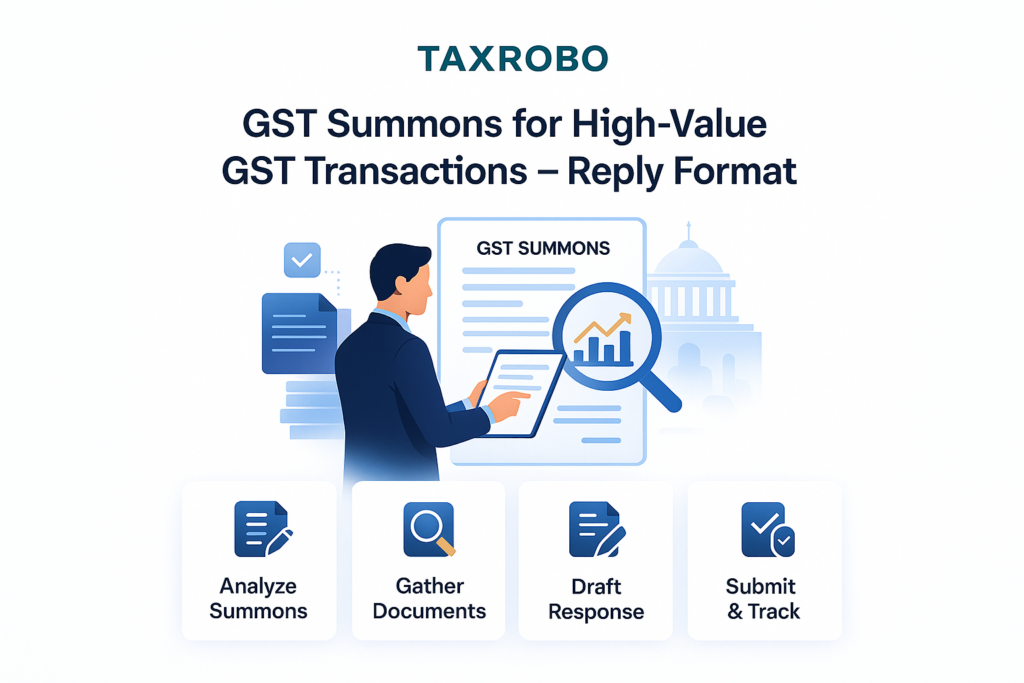

GST Summons for High-Value GST Transactions – Reply Format
That official-looking envelope from the GST department has arrived, and your heart skips a beat. Inside, it’s a summons. Panic might be your first reaction, but it doesn’t have to be. Understanding what a GST summons is and how to respond correctly is your best defence. This guide provides a detailed, step-by-step approach on how to respond to GST summons, complete with a ready-to-use GST summons reply format. A summons is typically a formal request for information or your presence related to an inquiry, often triggered when the tax authorities flag high-value transactions under your GSTIN for scrutiny. A timely and accurately drafted response is not just a formality; it’s a critical step in ensuring compliance and protecting your business from unnecessary penalties and legal troubles. The GST summons impact on businesses can be significant, but with the right knowledge, you can navigate the process confidently.
What is a GST Summons and Why Did You Receive One?
A GST summons can feel intimidating, but at its core, it’s a legal tool used by tax authorities to gather information. It’s not an accusation of wrongdoing but a call for cooperation in an ongoing inquiry. Understanding the legal foundation and the common reasons for receiving one can help demystify the process and prepare you for a proper response.
Understanding the Legal Basis: Section 70 of the CGST Act
The power of a GST officer to issue a summons comes directly from the law. Section 70 of the Central Goods and Services Tax (CGST) Act, 2017, grants authorized GST officers the authority to summon any person whose attendance they deem necessary for an inquiry. This summons can be for two main purposes:
- To give evidence: This means you may be required to appear in person and provide a statement under oath.
- To produce a document or any other thing: This involves submitting specific records, invoices, bank statements, or other documents relevant to the inquiry.
Think of it as a formal request for information backed by legal authority. The proceedings under a summons are considered “judicial proceedings,” meaning any statement you give can be used as evidence. It’s vital to understand the Statement Under GST (Section 70) – Legal Impact & Precautions. For a deeper understanding of the law, you can refer to the official CGST Act on the CBIC website.
Common Triggers for a GST Summons on High-Value Transactions
The GST department uses sophisticated data analytics to monitor transactions across the country. A summons related to high-value transactions is usually triggered by red flags identified by their system. Proper GST compliance for high-value transactions is essential to avoid such scrutiny. Here are some common reasons you might receive one:
- Significant Mismatches: A major difference between the sales you declared in your GSTR-1, the tax you paid in your GSTR-3B, and the purchases reflected in your GSTR-2A/2B is a primary trigger. These differences often lead to inquiries about the Impact of GSTR-2A and GSTR-3B Mismatches on ITC Claims.
- Unusually High Input Tax Credit (ITC) Claims: If your ITC claims are disproportionately high compared to your output tax liability, it can signal potential issues to the department.
- GSTN Data Analysis Discrepancies: The GST Network (GSTN) constantly analyzes taxpayer data. Any anomalies or patterns that deviate from your normal business activity can lead to an inquiry.
- Information from Other Government Bodies: The Income Tax Department, the Directorate General of GST Intelligence (DGGI), and other agencies share data. If you’ve reported high-value transactions in your income tax return that don’t align with your GST filings, it can trigger a summons.
- Suspected Fake Invoices: The department is cracking down on businesses that issue invoices without the actual supply of goods or services to fraudulently pass on ITC. If your business is linked in any way to such a chain, you may be summoned for clarification. The authorities are particularly focused on Fake ITC Cases in GST – Latest Rules, Penalties & Defence Strategy.
First Steps: What to Do Immediately After Receiving a GST Summons
Receiving a summons requires a calm and methodical approach. Acting hastily or ignoring it can lead to serious consequences. Follow these immediate steps to ensure you are on the right track.
Step 1: Verify the Authenticity of the Summons
Before you do anything else, verify that the summons is genuine. All communications from the Central Board of Indirect Taxes and Customs (CBIC), including summons, must have a computer-generated Document Identification Number (DIN).
- Check for a DIN: Look for the DIN on the document. If it’s missing, the summons may not be valid.
- Verify Online: You can verify the authenticity of the DIN on the CBIC’s online portal. This simple check ensures you are responding to a legitimate request from the tax department.
Step 2: Read Carefully and Gather All Relevant Documents
Once verified, read the summons thoroughly. It will specify exactly what information is needed or which transactions are under scrutiny. Misunderstanding the request is a common mistake that leads to an incomplete or incorrect reply. Start gathering all documents related to the period and transactions mentioned in the summons. A well-organized set of documents is the foundation of a strong reply.
Your document checklist should include:
- Sales Invoices and Purchase Invoices
- Copies of all GST Filings (GSTR-1, GSTR-3B, GSTR-9, etc.)
- Bank Statements for the relevant period
- Relevant E-way Bills
- Agreements and Contracts related to the transactions in question
- Stock Registers, Ledgers, and other accounting records
Step 3: Seek Professional Guidance
While you might be tempted to handle it yourself, the stakes are high. The statements you make and the documents you submit have legal weight. Engaging a tax professional, such as a Chartered Accountant or a tax lawyer, is highly recommended. An expert can help you understand the nuances of the notice, prepare an accurate and strategic reply, and represent you if needed. Getting professional GST legal advice India is a crucial investment to avoid potential pitfalls and navigate the complex legal landscape.
The Ultimate Guide: Crafting the Perfect GST Summons Reply Format
Your written reply is your first and most important communication with the GST officer. It should be clear, factual, and comprehensive, addressing all the points raised in the summons. A well-structured reply not only demonstrates your cooperation but also helps in resolving the inquiry quickly.
Key Components of an Effective Reply
An effective GST summons reply format is organized and professional. It leaves no room for ambiguity and makes it easy for the officer to understand your position. Here are the essential components to include:
- Header: Your official letterhead should contain your business name, GSTIN, and registered address. Below this, mention the details of the issuing authority (Designation and Address).
- Subject Line: The subject should be direct and immediately inform the officer about the purpose of the letter. For example: “Reply to Summons issued under F. No. [File Number] dated [Date]”.
- Reference: Always refer to the specific summons you are responding to. Clearly state the summons reference number and its date. This helps in correctly mapping your reply to their records.
- Submission Opening: Begin with a formal salutation and a sentence acknowledging the receipt of the summons.
- Point-by-Point Response: This is the heart of your reply. Do not write a long, narrative paragraph. Instead, address each query from the summons individually. Restate the officer’s query and then provide your response below it. This structured approach ensures you don’t miss any points and makes your reply easy to review.
- Annexures: Refer to your supporting documents within your point-wise response (e.g., “See Annexure-1”). At the end of the reply, create a numbered list of all the documents you are attaching. Each document should be clearly labelled with the corresponding annexure number.
- Declaration and Signature: Conclude with a formal statement affirming that the information provided is true and correct to the best of your knowledge. Sign the document, and mention your name and designation.
[Template] Sample GST Summons Reply Format
To make it easier, here is a fill-in-the-blanks template you can adapt. This sample GST summons reply format covers all the essential components discussed above.
[Your Company Letterhead]
Date: [Date of Reply]
To,
The [Designation of the Officer],
[Address of the GST Office]
Subject: Reply to Summons dated [Date of Summons] issued under F. No. [Summons File Number]
Reference: Your Summons Reference No. [Reference Number] dated [Date]
Respected Sir/Madam,
1. This is with reference to the summons issued to [Your Name/Company Name], holding GSTIN [Your GSTIN], directing us to appear on [Date] / submit the required documents. We acknowledge the receipt of the said summons and are grateful for the opportunity to present our case.
2. In full compliance with the directions in the summons, we are hereby submitting a detailed point-wise reply to the queries raised:
(Query 1 from Summons): [Restate the exact query from the summons for clarity]
Our Response: [Provide a clear, factual, and concise response to Query 1. Stick to the facts and avoid speculation. If the query is about a specific transaction, provide details like invoice number, date, value, and nature of the transaction.] The supporting documents for this response are attached as Annexure-1.
(Query 2 from Summons): [Restate the exact query from the summons]
Our Response: [Provide a clear, factual, and concise response to Query 2. Explain the business rationale if necessary.] The relevant contracts and bank statements are attached as Annexure-2.
(Continue this format for all queries raised in the summons)
3. We have attached the following documents, duly self-attested, for your kind perusal and record:
- Annexure-1: [Description of Document, e.g., Copy of Sales Invoices for FY 2022-23]
- Annexure-2: [Description of Document, e.g., Copy of Bank Statement from Jan 2023 to Mar 2023]
- (List all other annexures clearly)
We believe that the information provided above and the documents enclosed herewith will clarify the matter entirely. We assure you of our full cooperation in this inquiry and are available for any further clarification you may require.
Thank you for your time and consideration.
Yours faithfully,
For [Your Company Name] / [Your Name]
(Signature)
[Name of Authorized Person/Individual]
[Designation]
Navigating the GST Summons Procedure in India
Understanding the procedural aspects of a summons is as important as drafting the reply. Knowing your rights and responsibilities can help you handle the process with confidence and avoid legal missteps. The GST summons procedure in India is governed by law and requires careful navigation.
Your Rights and Responsibilities During the Inquiry
When you are summoned, you are part of a legal proceeding. It’s important to know what is expected of you and what rights you have.
- Right to Dignity: You have the right to be treated respectfully and professionally by the officers.
- Right to Counsel (with limitations): While you cannot have a lawyer present during the recording of your statement, you can consult with one before and after the session.
- Responsibility to Tell the Truth: Your statement is recorded under oath. Providing false information can lead to prosecution for perjury.
- Responsibility to Cooperate: You must cooperate with the inquiry and provide the information requested to the best of your ability. Concealing facts or providing misleading information can result in penalties.
Legal Implications of GST Summons: What if You Don’t Comply?
Ignoring a GST summons is a serious mistake with severe consequences. The law has strict provisions to ensure compliance. The legal implications of GST summons non-compliance include:
- Penalties: Under Section 122 of the CGST Act, failure to appear or produce documents when summoned can attract a penalty of up to ₹25,000.
- Prosecution under Indian Penal Code (IPC): Non-compliance with a summons is treated as an offense under Sections 174 (Non-attendance in obedience to an order from public servant) and 175 (Omission to produce document to public servant) of the IPC. This can lead to legal proceedings in a court of law.
- Adverse Inferences: The officer may draw adverse conclusions against you, which can negatively impact the outcome of the inquiry.
Best Practices for GST Response and Appearance
Adopting a professional and organized approach can make a significant difference. Here are some of the best practices for GST response and personal appearance:
- Be Prompt: Always respond within the time limit specified in the summons. If you need more time, formally request an extension with valid reasons.
- Be Truthful and Factual: Present information accurately. Avoid making vague statements or guessing. If you don’t know an answer, it is better to say so than to provide incorrect information.
- Be Organized: Submit all your documents in a neat, organized file with proper indexing (annexures). This reflects your professionalism and makes the officer’s job easier.
- Keep Meticulous Records: Always keep a copy of the summons, your detailed reply, and all the documents you submitted for your own records. Also, get an acknowledgment of receipt from the department.
- Stay Calm and Professional: If you are required to appear in person, maintain a calm and cooperative demeanor. Answer questions politely and directly.
Conclusion
Receiving a GST summons for high-value transactions can be daunting, but it is a manageable process. The key is to act promptly, stay organized, and approach the situation with a clear strategy. Remember to verify the summons, carefully gather all necessary documents, and draft a clear, point-wise response using a structured GST summons reply format. Most importantly, never underestimate the complexity of tax laws. Seeking professional help is not a sign of weakness but a smart business decision. Proper handling of a summons is a critical aspect of your financial discipline and ensures you remain compliant with the law, protecting your business from potential legal and financial repercussions.
Navigating a high-value transactions GST summons reply requires expertise. If you need assistance in drafting a response, gathering documents, or representing your case before the GST authorities, TaxRobo’s team of seasoned tax professionals is here to help. Contact us today for reliable and expert GST legal advice India through our TaxRobo GST Service and ensure your peace of mind.
Frequently Asked Questions (FAQs)
Q1: Can I request an extension for replying to a GST summons?
Yes, you can submit a written request for an extension to the issuing officer, stating valid reasons for the delay (e.g., unavailability of key personnel, time required to gather voluminous data). However, the decision to grant an extension is entirely at the officer’s discretion. It is always best to file the request well before the deadline.
Q2: Do I have to appear in person if I receive a GST summons?
The summons will clearly specify whether you need to appear in person to give a statement or simply submit documents. Read the notice carefully. If your personal appearance is required, it is mandatory to attend. Failure to do so can result in penalties and legal action.
Q3: What happens after I submit my reply?
After reviewing your reply and the submitted documents, the GST officer has a few options. If your explanation is satisfactory and clears all doubts, the officer may close the inquiry. If there are still some unanswered questions, they might ask for further clarifications or additional documents. If significant discrepancies or potential tax evasion is found, they may initiate further proceedings like an audit, investigation, or issuance of a show-cause notice. Knowing How to Respond to a GST Show Cause Notice: A Step-by-Step Guide can be helpful at this stage.
Q4: Can a salaried individual receive a GST summons?
Yes. While less common, a salaried individual can receive a GST summons. This typically happens if they have undertaken high-value transactions that fall under the GST net, such as earning significant rental income from a commercial property or selling goods or services as a side business without a GST registration. If the department’s data analytics flag such transactions, they may issue a summons to inquire about the nature of the transaction and check for GST compliance.