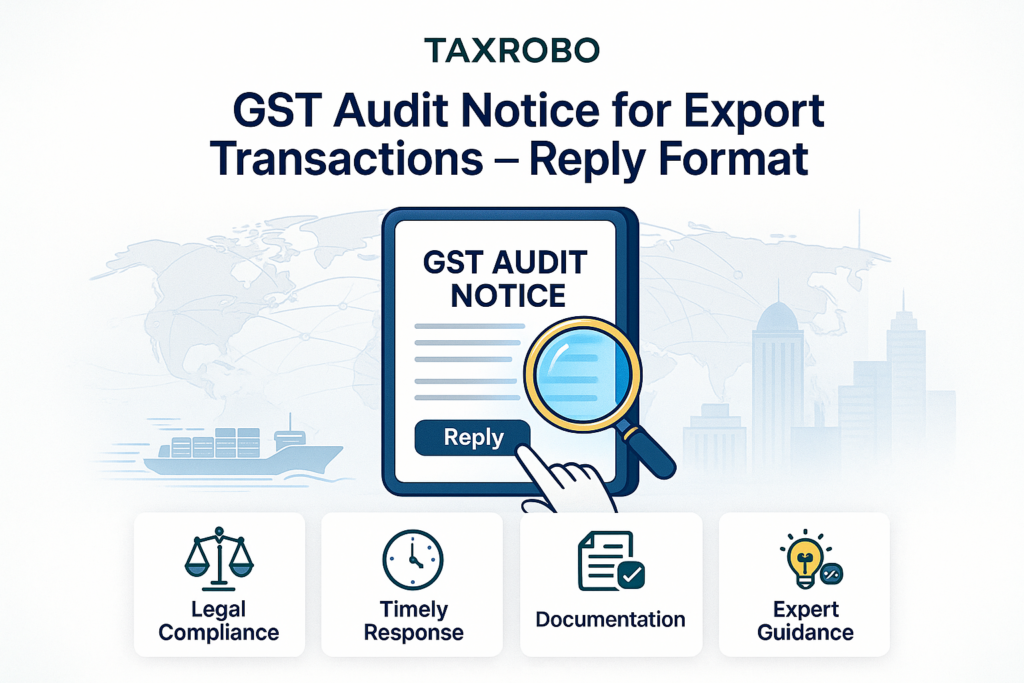

GST Audit Notice for Export Transactions – Reply Format: The Ultimate Guide for Indian Exporters
Receiving an official notice from the tax department can be a stressful experience for any business owner, especially when it concerns your high-stakes export transactions. The complex web of compliance, documentation, and regulations can make such communications feel intimidating. However, understanding the process and knowing how to respond correctly can transform this challenge into a manageable task. This post will serve as your comprehensive guide to understanding and responding to a GST audit notice for export transactions. A timely and correctly drafted response is crucial for maintaining good compliance for export transactions in India. We will break down the entire process, providing a clear GST audit notice for export transactions – reply format to help you handle the situation confidently and avoid unnecessary penalties or legal complications.
What is a GST Audit Notice and Why Do Exporters Receive It?
Before you can draft a reply, it’s essential to understand what the notice means and why your business may have been selected for scrutiny. This knowledge helps demystify the process, reduce anxiety, and allows you to formulate a more effective response. The GST regime is heavily data-driven, and any inconsistency in the information you provide across different platforms can trigger an automated flag, leading to a notice.
Demystifying the GST Audit Notice
A GST audit notice is a formal communication from the GST authorities requesting you to verify the accuracy of the tax returns you have filed. It is an official inquiry into your financial records and compliance procedures for a specific period. It is important to remember that receiving a notice is often a routine procedure and does not automatically imply that you have committed fraud or intentionally evaded taxes. The department uses these notices to ensure the integrity of the tax system by cross-verifying information.
Common forms of notices include:
- GST ASMT-10: This is a notice for the scrutiny of returns. It is issued when the tax officer observes a discrepancy in your filed returns (like GSTR-1, GSTR-3B) based on their internal risk parameters or data analytics.
- GST ADT-01: This is a formal notice for a GST audit to be conducted by the department. It is typically issued at least 15 days before the audit and will specify the records to be verified and the period covered.
Common Triggers for Notices on Export Transactions
Exporters operate under a special set of GST rules, primarily dealing with zero-rated supplies. This unique status makes their transactions a focal point for departmental scrutiny. Here are the most common reasons an exporter might receive a GST notice:
- Mismatch in Data: The most frequent trigger is a discrepancy between the data on the shipping bills or bills of export filed on the ICEGATE portal and the details of export invoices declared in your GSTR-1 return. Any difference in invoice value, invoice number, or port code can raise a red flag.
- Refund Claim Issues: Errors or inconsistencies in claims for IGST refunds on exports or refunds of unutilized Input Tax Credit (ITC) are closely monitored. For instance, claiming a refund for an amount higher than the IGST paid as per your GSTR-3B can lead to a notice.
- LUT Compliance: Exporters can ship goods or services without paying IGST by furnishing a Letter of Undertaking (LUT). A notice may be issued if you have continued to make zero-rated supplies after your LUT for the financial year has expired or if there are procedural lapses in its filing.
- Bank Realisation Certificate (e-BRC): The e-BRC is definitive proof that you have received payment for your exports in convertible foreign exchange. Delays in submitting these certificates or a failure to produce them upon request can lead the department to question the authenticity of the export transaction itself. Proper management of this documentation is a core part of maintaining export transaction GST compliance.
How to Reply to a GST Notice for Export Transactions: A Step-by-Step Guide
Responding to a notice in a structured, professional, and timely manner is your best course of action. Following a clear process ensures you don’t miss any critical details and present your case effectively. Here is a step-by-step guide on how to reply GST notice for export transactions.
Step 1: Analyze the Notice Carefully
The first and most crucial step is to read the notice thoroughly without panicking. Rushing this step can lead to an incomplete or incorrect reply. Set aside time to understand exactly what the tax officer is asking for.
Details to Note:
- Deadline for Submission: This is non-negotiable. Note the date by which you must submit your response and mark it prominently in your calendar.
- Specific Discrepancy: Identify the exact points of concern raised by the officer. Is it a mismatch in invoice values, an issue with an LUT, or a request for e-BRCs?
- Financial Period: The notice will specify the tax period (e.g., FY 2022-23) that is under scrutiny. Ensure all your documentation is relevant to this period.
- Reference Number: Every notice has a unique Notice Number or Document Identification Number (DIN). You must mention this number in all your correspondence.
Step 2: Gather All Essential Documents
Your reply is only as strong as the evidence you provide to support it. Before you start writing, compile a comprehensive file of all relevant documents. This proactive step will help you build a strong, fact-based response. This highlights The Importance of Accurate Record-Keeping to Prevent GST Demand Notices.
Document Checklist:
- A clear copy of the GST Notice you received.
- Export Invoices (Tax Invoices) for the transactions in question.
- Shipping Bills / Bills of Export that have been filed on the ICEGATE portal.
- Bank Realisation Certificates (e-BRC) as proof of receipt of export proceeds.
- A copy of the valid Letter of Undertaking (LUT) that was active during the specified period, if you have exported without IGST payment.
- Proof of IGST payment for exports, if you opted for the refund route. This can be your GSTR-3B return.
- Copies of the relevant GSTR-1 and GSTR-3B returns for the period under scrutiny.
- A detailed reconciliation statement, prepared in a spreadsheet, that clearly explains any differences between your GSTR-1 data, GSTR-3B data, and the data from shipping bills. This is your most powerful tool for explaining mismatches.
Step 3: Draft Your Response Using a Professional Reply Format
The structure and tone of your reply matter significantly. A professional, clear, and well-organized response makes it easier for the officer to understand your position. This is where a proper GST notice reply format India becomes invaluable.
Key Components of the Letter:
- Header: Always use your official company letterhead, which includes your company’s legal name, registered address, and GSTIN.
- Recipient Details: Address the notice to the specific officer and department that issued it. The details will be on the notice itself.
- Reference: Clearly state the Notice Reference Number and Date at the top. This helps the department link your reply to the correct file.
- Subject Line: Be precise. A good subject line would be: “Reply to Notice Regarding Scrutiny of GST Returns for Export Transactions for the period [Specify Period]”. This immediately provides context.
- Body:
- Begin by formally acknowledging the receipt of the notice and the date you received it.
- Address each query or discrepancy raised in the notice one by one, using the same numbering or lettering as in the notice.
- For each point, provide a clear, factual explanation. Avoid vague statements. Directly refer to the supporting documents you are attaching (e.g., “As per the attached Shipping Bill No. 123, marked as Annexure A…”). This is a key part of an effective India export GST letter format.
- Annexures: After the body of the letter, include a numbered list of all the documents you are attaching as annexures.
- Conclusion/Prayer: Conclude politely by stating that you believe your submissions clarify the matter and request the officer to consider the facts and drop the proceedings.
- Signature: The reply should be signed by the authorized signatory (e.g., Proprietor, Partner, Director) with their name, designation, and the company seal.
Step 4: Submit the Reply via the GST Portal
In the digital age of GST, replies are filed electronically. This creates an official, time-stamped record of your submission.
Instructions:
- Log in to the official GST Portal.
- Navigate to: Services > User Services > View Additional Notices/Orders.
- Find the relevant notice and click the “Reply” button.
- You will be given a text box to type your reply and an option to upload your supporting documents (your drafted letter and all annexures) in PDF or JPEG format.
- Pro Tip: Always save a final copy of the submitted reply and the system-generated Acknowledgement Receipt Number (ARN) for your records. This ARN is your proof of submission.
For direct access, you can visit the official GST Portal.
Sample GST Audit Notice for Export Transactions – Reply Format
To make the process even clearer, here is a practical template you can adapt. This sample GST audit notice for export transactions – reply format covers the key components discussed above and provides a professional structure for your submission.
Template for Replying to GST Notice
[Your Company Letterhead]
[Your Company Name]
[Your Address]
[Your GSTIN]
Date: [Date of Reply]
To,
[Designation of the Officer]
[Jurisdiction/Address of the GST Office]
Reference No.: [Notice Number/DIN as mentioned in the notice]
Dated: [Date of Notice]
Subject: Reply in response to the notice regarding export transactions for the period [Start Date] to [End Date]
Respected Sir/Madam,
This is with reference to the notice cited above, which we received on [Date of Receipt]. We have carefully reviewed the observations raised by your good office concerning our export transactions for the specified period.
Our point-wise reply to the discrepancies mentioned in the notice is as follows:
- Observation 1: [State the query from the notice, e.g., “Mismatch in taxable value between GSTR-1 and Shipping Bill No. XYZ dated DD/MM/YYYY.”]
- Our Submission: We wish to clarify that the total value declared in our GSTR-1 for the month of [Month, Year] was Rs. X, while the value on the corresponding shipping bills was Rs. Y. The difference of Rs. Z is attributable to a clerical error during data entry for Invoice No. ABC in our GSTR-1 return. This has since been rectified via an amendment in Table 9A of our GSTR-1 for the subsequent tax period of [Month, Year]. For your reference, we have attached the following documents:
- Copy of original Export Invoice No. ABC (Annexure A)
- Copy of Shipping Bill No. XYZ (Annexure B)
- Screenshot of the corrected GSTR-1 return (Annexure C)
- Our Submission: We wish to clarify that the total value declared in our GSTR-1 for the month of [Month, Year] was Rs. X, while the value on the corresponding shipping bills was Rs. Y. The difference of Rs. Z is attributable to a clerical error during data entry for Invoice No. ABC in our GSTR-1 return. This has since been rectified via an amendment in Table 9A of our GSTR-1 for the subsequent tax period of [Month, Year]. For your reference, we have attached the following documents:
- Observation 2: [State the second query, e.g., “Non-submission of Bank Realisation Certificate (e-BRC) for Export Invoice No. PQR.”]
- Our Submission: We acknowledge the query regarding the e-BRC for Invoice No. PQR. At the time of filing, the remittance from our overseas client was pending. We have since received the payment in foreign currency, and the e-BRC has been generated by our authorized dealer bank. A copy of the said e-BRC, dated DD/MM/YYYY, is attached herewith as Annexure D for your perusal and record.
(Continue this point-wise format for all observations raised in the notice)
We are a compliant taxpayer and are committed to adhering to all provisions of the GST law. We believe the explanations and documentary evidence provided above sufficiently clarify the matter.
List of Annexures:
- Annexure A: Copy of Export Invoice No. ABC
- Annexure B: Copy of Shipping Bill No. XYZ
- Annexure C: Screenshot of amended GSTR-1
- Annexure D: Copy of e-BRC for Invoice No. PQR
In light of the above submissions and the supporting documents, we humbly request your good office to review our case favorably and drop the proceedings initiated by the said notice.
Thanking you.
Yours Sincerely,
For [Your Company Name]
[Your Signature]
[Your Name]
[Your Designation]
[Company Seal]
Common Mistakes to Avoid When You Respond to GST Notice for Exports
Knowing what not to do is just as important as knowing what to do. Here are some common pitfalls that can weaken your case and lead to further complications:
- Ignoring the Deadline: This is the most serious mistake. Failing to reply within the stipulated timeframe can result in the officer passing an ex-parte (one-sided) order, often with penalties, based on the information they have. Always prioritize a timely submission.
- Providing Vague or Incomplete Replies: Do not provide generic answers like “the discrepancy is being checked.” Be specific, factual, and quantitative. A reply without supporting documentary evidence holds little value. Your goal is to resolve the query, not just acknowledge it.
- Submitting Incomplete Information: Ensure you attach all documents requested in the notice and any other evidence that supports your explanation. If you only address two out of three queries, the officer will likely proceed with action on the third one. A comprehensive reply is key.
- Not Seeking Professional Help: GST law is complex. For high-value discrepancies or complex legal arguments, it is always wise to consult a tax expert or a Chartered Accountant. An incorrectly handled notice can escalate into a larger legal issue, leading to demands for tax, interest, and heavy penalties.
Conclusion
Facing a GST audit notice for export transactions can seem daunting, but a structured, timely, and well-documented response is the key to resolving it efficiently. Remember to carefully analyze the notice, meticulously gather all your supporting documents, and draft a clear, point-by-point reply. Following a proper GST audit notice for export transactions – reply format ensures you present your case in the most effective and professional manner possible. Adhering to these GST export reply guidelines is your best defense against potential penalties and serves as a testament to your business’s commitment to compliance. A strong response not only resolves the immediate issue but also builds a positive compliance history with the tax department.
If you need expert assistance in drafting a professional reply, managing your exporter GST compliance format in India, or handling any other GST-related matters, TaxRobo’s team of financial and legal experts is here to help. Contact us today to ensure your export business runs smoothly without any compliance hurdles.
Frequently Asked Questions (FAQs)
1. What is the time limit to reply to a GST scrutiny notice (ASMT-10)?
Typically, a taxpayer is given 30 days from the date of service of the notice to furnish an explanation or pay the discrepancy amount. However, the exact deadline will always be specified in the notice you receive. It is crucial to adhere to this timeline strictly to avoid adverse actions.
2. What happens if the GST officer is not satisfied with my reply?
If the officer finds your reply or explanation unsatisfactory, or if you fail to reply, they may initiate further action. This could involve issuing a show-cause notice (SCN) under Section 73 (for non-fraud cases) or Section 74 (for fraud cases) of the CGST Act, leading to the determination of tax, interest, and penalty. They may also refer the matter for a formal audit.
3. Is it mandatory to have a Bank Realisation Certificate (e-BRC) for all exports?
Yes, an e-BRC is a critical document for exporters. It serves as official proof that you have received payment in foreign currency against your export invoices. It is essential for claiming export-related benefits under GST (like refunds) and other government schemes. During an audit, the absence of an e-BRC for a transaction can lead the authorities to question whether the transaction qualifies as an export at all.
4. Can I submit my reply offline?
The GST framework is built on a digital platform. While a notice might sometimes be served physically, the standard procedure is to file your reply and upload all supporting documents through the official GST portal. Submitting online creates a verifiable trail and ensures that your response is officially recorded in the system. Offline submissions are generally not accepted unless specifically permitted by the officer under exceptional circumstances.