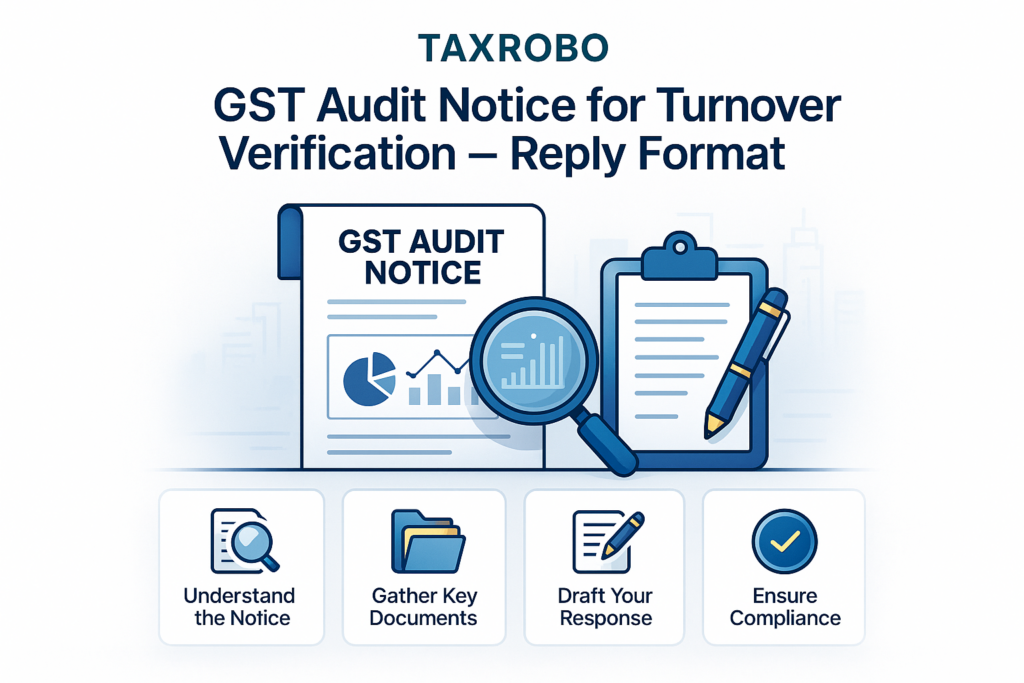

GST Audit Notice for Turnover Verification – Reply Format
Introduction: Don’t Panic! A Guide to Replying to Your GST Notice
Receiving a notice from the GST department can be a stressful experience for any business owner. One of the most common reasons is a mismatch in your declared turnover. But don’t worry, it’s often a manageable issue. This comprehensive guide will walk you through everything you need to know about GST audit notice handling in India, providing a clear and effective turnover verification response format to help you reply with confidence. Understanding the right procedure is the first step towards resolving the query efficiently and ensuring your business remains compliant without unnecessary penalties. This article aims to demystify the process, turning a moment of anxiety into a structured and confident response.
Understanding the GST Audit Notice for Turnover Verification
Before drafting a reply, it’s crucial to understand why you received the notice in the first place. This section breaks down the basics of what the notice means and the common triggers that lead to its issuance. A thorough understanding of the “why” will empower you to formulate a precise and effective “how” in your response.
What is a GST Audit Notice?
A GST audit notice is an official communication from the tax authorities informing you that they will be reviewing your financial records, returns, and other documents to ensure you are complying with GST laws. Notices for turnover verification, such as Form ASMT-10, are issued when the system’s automated data analytics or a tax officer’s review detects a discrepancy between the turnover you’ve reported in different filings. The goal of these GST verification procedures for businesses is to ensure that the correct amount of tax has been paid on your total sales. It is not an accusation of wrongdoing but a request for clarification. The department’s objective is to reconcile the figures and ensure there is no revenue leakage for the government.
Common Reasons for Receiving a Turnover Mismatch Notice
Tax authorities compare data across various platforms to create a 360-degree view of a taxpayer’s financial activities. A mismatch in any of these cross-referenced documents can trigger a notice. Being aware of these common pitfalls can help you maintain better records in the future.
- GSTR-1 vs. GSTR-3B: This is the most frequent cause. Your outward supplies (sales) declared in GSTR-1, which is a detailed, invoice-level return, might not match the consolidated figures you report and pay taxes on in your GSTR-3B summary return. This can happen due to last-minute amendments, credit notes not accounted for correctly, or simple data entry errors.
- GST Returns vs. Books of Accounts: The total turnover recorded in your internally maintained, audited financial statements (like the Profit & Loss Account) is different from what you’ve declared in your GSTR-9 annual return. This discrepancy often arises from the treatment of non-GST income (e.g., interest from bank deposits) or differences in accounting principles versus GST law.
- GST Returns vs. Income Tax Returns (ITR): A significant red flag for tax authorities is when the gross receipts or turnover you report in your ITR do not align with the total taxable turnover reported under GST for the same financial year. While legitimate reasons for differences exist, they must be properly reconciled and explained. For more details on this specific issue, refer to our guide on ASMT-10 Notice for GST vs Income Tax Turnover Difference – Reply Format.
- GST Returns vs. Form 26AS/AIS: A mismatch between your declared supplies and the income details reflected in your Form 26AS (TDS details) or the comprehensive Annual Information Statement (AIS). For instance, if a client has deducted TDS on a payment to you and reported it, that income will reflect in your Form 26AS. If this amount is higher than your declared GST turnover, it may trigger scrutiny.
- Clerical Errors: Sometimes, the issue is as simple as a data entry mistake, like transposing numbers or misplacing a decimal point. While unintentional, these errors still create discrepancies that the system flags and require a formal clarification.
Step-by-Step Guide to Responding to a GST Audit Notice in India
A systematic and calm approach is key to an effective and successful response. Rushing the process or providing incomplete information can lead to further complications. Follow these turnover verification steps for GST compliance to ensure you cover all your bases and present your case in the most professional manner possible. For a comprehensive overview, you can also see our article on How to Respond to a GST Show Cause Notice: A Step-by-Step Guide.
Step 1: Scrutinize the Notice Carefully
The very first action upon receiving any official notice is to read it, not once, but several times. First, verify the authenticity of the notice on the official GST portal using the Reference Number (RFN) or Document Identification Number (DIN). This protects you from fraudulent communications. Once verified, read the notice carefully to understand:
- The specific discrepancy being pointed out: The notice will usually pinpoint the exact returns or documents that are mismatched (e.g., “Difference in turnover between GSTR-1 and GSTR-3B”).
- The financial year(s) in question: Ensure you are looking at the correct accounting period for your reconciliation.
- The deadline for submitting your reply: This is crucial. Missing the deadline can have adverse consequences, so mark it on your calendar immediately.
Step 2: Reconcile Your Data and Gather Documents
This is the most critical and time-consuming step. You must dive deep into your records to find the root cause of the mismatch. Create a detailed reconciliation statement in a spreadsheet that clearly explains the difference, item by item. You will need to gather the following documents to perform this reconciliation and to submit as evidence:
- Copies of GSTR-1, GSTR-3B, and GSTR-9/9C for the relevant period.
- Audited Profit & Loss Account and Balance Sheet.
- Copy of your filed Income Tax Return (ITR).
- Form 26AS and Annual Information Statement (AIS) for the financial year.
- Bank statements to corroborate transactions.
- Specific invoices, credit notes, or debit notes that might be the source of the difference.
Step 3: Draft a Clear and Factual Reply
Once you have identified the precise cause of the discrepancy and have the reconciliation statement ready, it’s time to draft a formal reply. Your goal is to provide a clear, logical, and factual explanation supported by the documents you’ve gathered. Avoid vague language. Be direct and address the points raised in the notice head-on. This is where a structured GST notice reply format for Indian businesses becomes essential, as it lends credibility and clarity to your submission.
Step 4: Submit Your Reply and Documents on the GST Portal
Your reply must be filed electronically through the GST portal within the stipulated time frame. Navigate to the appropriate section to view the notice and find the option to file your reply. Upload your detailed explanation letter and attach all supporting documents (like the reconciliation statement, financial statements, etc.) as PDF files.
- Pro-Tip: Always keep a copy of the final reply submitted and the acknowledgment receipt (ARN) generated by the portal for your records. This serves as proof of your timely compliance.
The Ideal Turnover Verification Response Format
Using a professional and structured format is not just about appearances; it makes your reply easy for the tax officer to read, understand, and process. A clear format helps guide the officer through your logic and evidence, increasing the chances of a swift and favorable resolution. Here is a sample turnover verification response format that you can adapt for your specific situation.
Essential Components of Your GST Notice Reply
- Header: Use your official company letterhead for a professional touch.
- Date and Addressee: Include the date of the reply and the full designation and address of the issuing officer as mentioned in the notice.
- Reference Details: This is critically important. Clearly mention the Notice Reference Number (RFN/DIN) and the date of the notice so that your reply can be correctly mapped to your case file.
- Subject Line: The subject should be concise and informative. Example: “Reply to Show Cause Notice for Turnover Mismatch for FY [YYYY-YY] – GSTIN: [Your GSTIN]”
- Introduction: Begin by formally acknowledging the receipt of the notice, mentioning its date and reference number, and stating that you are providing the required explanation in response.
- Point-wise Explanation: This is the body of your letter. Address each discrepancy raised in the notice in a separate, numbered point. Clearly explain the reason for the mismatch and directly refer to the attached reconciliation statement and other supporting documents. For instance, “Regarding Point 1 of the notice concerning the mismatch in GSTR-1 and GSTR-3B, please refer to Annexure-A for a detailed reconciliation…”
- Conclusion & Prayer: Summarize your submission by stating that the explanations and documents provided clarify the alleged discrepancies and that no tax is payable. Respectfully request the officer to review your explanation and drop the proceedings. This formal closing is known as a “prayer” in legal parlance.
- Signature and Enclosures: Sign the letter (by an authorized signatory) and include a list of all the documents you are attaching (e.g., “Enclosures: 1. Annexure-A: Reconciliation Statement…”).
Sample Turnover Verification Response Format India (Template)
[Your Company Letterhead]

Date: [DD/MM/YYYY]

To,
The [Designation of the Officer],
[Address of the GST Office]

**Ref: Notice DIN/RFN [Reference Number] dated [Date of Notice]**

**Subject: Reply to Notice regarding Turnover Mismatch for FY [YYYY-YY] - [Your Company Name], GSTIN: [Your GSTIN]**

Respected Sir/Madam,

This is with reference to the notice cited above, received by us on [Date of Receipt], regarding an alleged mismatch in turnover for the financial year [YYYY-YY]. We have diligently reviewed our records pertaining to the observations made in the notice and would like to submit the following point-wise explanation for your kind consideration and perusal.

We assure you of our fullest cooperation in this matter. Our explanations are as follows:

1.  **Mismatch between GSTR-1 and GSTR-3B:** The alleged mismatch of Rs. [Amount] as highlighted in the notice is due to [Provide a clear and specific reason, e.g., a credit note No. CN-123 for Rs. XX was issued in March but was reported in GSTR-1 of March, while the corresponding tax adjustment in GSTR-3B was made in April as per the provisions of Section 34 of the CGST Act.]. We have attached a detailed month-wise reconciliation statement as **Annexure-A** which clarifies this timing difference.

2.  **Mismatch between GSTR-9 and Audited Financials:** The difference of Rs. [Amount] between our annual return and audited financials is on account of [Provide a clear reason, e.g., the inclusion of non-GST supplies like 'Interest Income from Bank FD' and 'Rental Income from Residential Property' in the Profit & Loss account, which are exempt from GST and therefore not part of the taxable turnover declared in GSTR-9.]. A detailed reconciliation between our audited financials and GSTR-9 is provided in **Annexure-B**.

(Add more points as required to address every single query raised in the notice)

In light of the detailed explanations and documentary evidence provided herewith, it is evident that the alleged discrepancies are purely reconcilable in nature and there has been no short payment of tax from our end. We humbly request your good office to review our submission in detail and kindly drop the proceedings initiated by the aforementioned notice.

We are ready to provide any further information, clarification, or documentation as may be required from our end.

Thank you for your time and consideration.

Sincerely,

For [Your Company Name],

[Your Name/Authorized Signatory]
[Your Designation]

**Enclosures:**
1. Annexure-A: Reconciliation Statement for GSTR-1 vs. GSTR-3B.
2. Annexure-B: Reconciliation Statement for GSTR-9 vs. Audited Financials.
3. Copy of Audited Financials for FY [YYYY-YY].
4. Copy of relevant GSTR returns and Challans.
Conclusion: Proactive Compliance is the Best Defence
Receiving a GST notice for turnover verification can be managed effectively with a timely, transparent, and well-documented response. By following a structured approach, gathering the right evidence, and using a clear turnover verification response format, you can present your case confidently and resolve the issue efficiently. Remember, the foundation of a stress-free tax journey is accurate bookkeeping and performing regular reconciliations yourself. This proactive approach is your best defense, helping you ensure GST compliance and minimizing the chances of receiving such notices in the future. To understand more on prevention, read about The Importance of Accurate Record-Keeping to Prevent GST Demand Notices.
If you need expert assistance in responding to a GST audit notice in India, TaxRobo’s team of professionals is here to guide you through every step of the process. Contact Us Today!
Frequently Asked Questions (FAQs)
Q1: What is the time limit to reply to a GST notice like ASMT-10?
The taxpayer is generally given a period of 15 to 30 days to furnish a reply to a notice issued under Form ASMT-10 for scrutiny of returns. However, this is a general guideline. You must check the specific deadline mentioned in the notice you have received, as it is legally binding.
Q2: Can I get more time to submit my reply?
Yes, if you believe you need more time to gather documents and prepare a comprehensive response, you can file an application for an extension with the proper officer through the GST portal. You must state valid reasons for the delay (e.g., complexity of the reconciliation, unavailability of key personnel). The officer has the discretion to grant an extension based on the merits of your request.
Q3: What happens if I ignore a GST turnover verification notice?
Ignoring a notice is a serious compliance lapse and is not advisable. If you fail to respond within the stipulated time, the officer may proceed with a “best judgment assessment” under Section 62 of the CGST Act. This means they will assess your tax liability based on the information they have available, which can result in a confirmed demand order with tax, interest, and penalties levied against you.
Q4: Is it necessary to hire a professional to draft the GST notice reply?
While you can reply on your own, especially for very simple discrepancies, it is highly recommended to seek professional help from a Chartered Accountant or a Tax Consultant. They possess the technical knowledge of GST law and the practical experience of dealing with tax authorities. A professional can ensure your reply is legally sound, properly formatted, and supported by the right documents, which significantly increases the likelihood of a favorable and quick resolution.
Q5: Where can I check the authenticity of a GST notice?
You can and should verify every notice on the official GST Portal to protect yourself from fraud. Log in to the portal and go to `Services > User Services > View Notices and Orders` to check its validity and download it directly. Alternatively, for notices carrying a Reference Number (RFN), you can use the “Verify RFN” option available on the portal’s dashboard without logging in. Link to Official GST Portal: https://www.gst.gov.in/