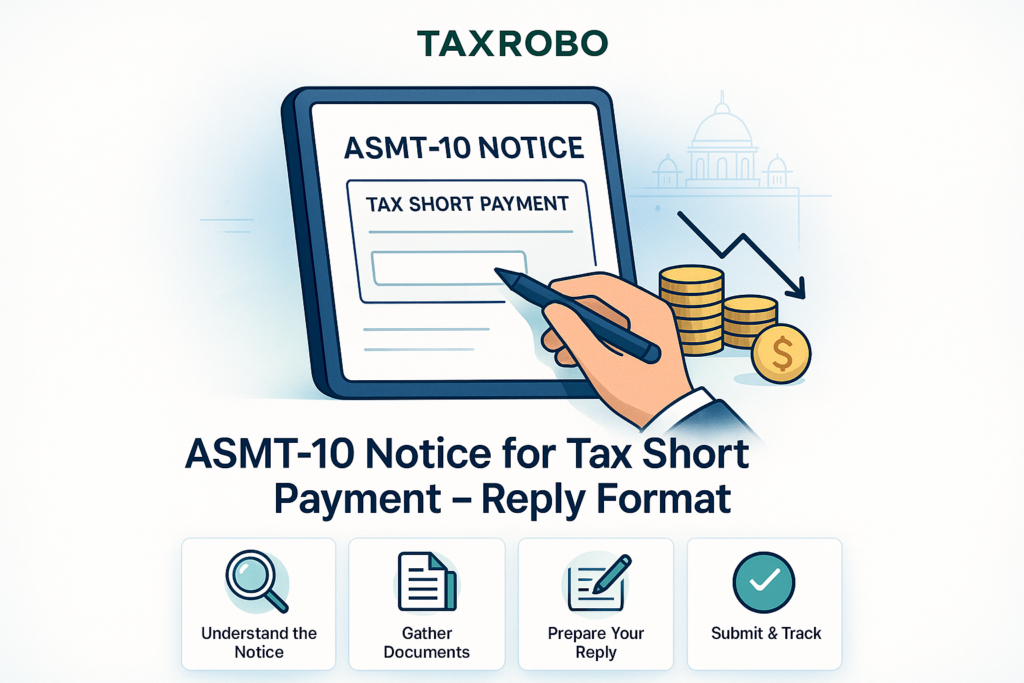

ASMT-10 Notice for Tax Short Payment – Reply Format
Receiving a notice from the tax department can be a daunting experience for any small business owner or salaried individual. The formal language and official seal can cause immediate concern. But what if the notice is simply an inquiry and not a final demand? This is often the case with Form GST ASMT-10. This guide provides a detailed, step-by-step breakdown of the ASMT-10 notice reply format, helping you respond effectively, ensure compliance, and resolve the issue smoothly. Understanding this notice is the first step towards managing your tax obligations confidently. We will cover everything from understanding why you received the notice to drafting and filing a proper reply, ensuring you have all the information you need for a successful tax short payment reply India.
What is an ASMT-10 Notice and Why Did You Receive It?
Before drafting a response, it’s crucial to understand what an ASMT-10 notice is and the common triggers that lead to its issuance. This knowledge forms the foundation for a precise and effective reply, helping you maintain strong ASMT-10 tax compliance in India. An informed taxpayer is better equipped to handle such communications from the tax authorities without unnecessary stress.
Understanding Form GST ASMT-10
Form GST ASMT-10 is officially titled the ‘Notice for intimating discrepancies in the return’. It is a preliminary scrutiny notice issued by a GST officer when they find inconsistencies or errors in your GST returns. The most important thing to remember is that this is not a tax demand. Instead, it is an opportunity for you, the taxpayer, to explain the discrepancies and provide clarifications or corrections. This notice is issued under the legal framework of Section 61 of the Central Goods and Services Tax (CGST) Act, 2017, read with Rule 99 of the CGST Rules, 2017. Its purpose is to promote voluntary compliance and resolve issues before they escalate into more formal proceedings like audits or show-cause notices. For more information on GST regulations, you can always refer to the official GST Portal.
Common Reasons for Receiving an ASMT-10 Notice
A GST officer may issue an ASMT-10 notice for various reasons, typically stemming from a mismatch between the data you have filed and the data available with the department. Understanding these common triggers can help you proactively avoid them in your future filings.
- Mismatch in GSTR-1 and GSTR-3B: This is one of the most frequent reasons. It occurs when the total taxable value or the tax amount (CGST, SGST, IGST) you declared in your GSTR-1 (statement of outward supplies) does not match the figures you reported and paid in your GSTR-3B (summary return) for the same tax period.
- Mismatch in GSTR-3B and GSTR-2A/2B: You may receive a notice if the Input Tax Credit (ITC) you claimed in your GSTR-3B is higher than the eligible ITC reflected in your auto-populated GSTR-2A or GSTR-2B. This suggests you might have claimed credit for invoices that your suppliers have not uploaded.
- Incorrect Tax Rate: Applying a lower tax rate than what is prescribed for your goods or services can trigger a notice. For instance, charging 5% GST on a product that falls under the 12% slab will lead to a short payment of tax.
- Delay in Filing GSTR-1 after GSTR-3B: While uncommon, if you file your GSTR-3B but significantly delay filing the corresponding GSTR-1, it can create reconciliation issues for the tax department, potentially leading to a notice.
- Non-payment of Tax on Reverse Charge Mechanism (RCM): Failing to declare and pay tax on supplies that fall under the Reverse Charge Mechanism is another common discrepancy. The department’s systems can often flag transactions where RCM liability was expected but not reported.
How to Respond to an ASMT-10 Notice: Initial Steps
Once you receive an ASMT-10 notice, a calm and methodical approach is essential. Panicking can lead to mistakes. Following these initial steps will help you organize your response efficiently and adhere to the ASMT-10 notice response guidelines. The goal is to address the department’s queries systematically and build a strong case supported by evidence. Knowing how to respond to an ASMT-10 notice begins with these foundational actions.
Step 1: Verify the Notice and Note the Deadline
The first action should always be to verify the authenticity of the notice. Every genuine notice from the GST department will have a unique Document Identification Number (DIN). You can verify this DIN on the official GST portal to ensure the communication is legitimate. After verification, immediately and carefully note the deadline for submitting your response. Typically, you are given 15 to 30 days from the date of service of the notice to file your reply. Missing this deadline can lead the tax officer to assume you have no explanation, which may result in further adverse action. Mark this date on your calendar and start preparing your response well in advance to avoid any last-minute rush.
Step 2: Analyze the Discrepancies and Gather Documents
Next, you must thoroughly read the notice and understand each discrepancy pointed out by the tax officer. The ASMT-10 will clearly list the points of concern. Analyze each one carefully and compare it with your own records. This is the stage where your bookkeeping plays a critical role. Begin compiling all necessary supporting documents that can substantiate your claims and explain the perceived inconsistencies.
Your document checklist should include:
- Tax invoices, debit notes, and credit notes related to the transactions in question.
- Copies of your GSTR-1, GSTR-3B, GSTR-2A, and GSTR-2B for the relevant tax period.
- Detailed reconciliation statements. For example, prepare a spreadsheet reconciling your sales register with GSTR-1, or your ITC register with GSTR-2B.
- Bank statements, especially if payments can help prove a transaction’s legitimacy.
- Any relevant contracts, agreements, or e-way bills that support your position.
Having all these documents organized will make drafting your reply much easier and more convincing.
A Detailed Guide to the ASMT-10 Notice Reply Format
The core of your response lies in the reply itself, which is filed online using Form GST ASMT-11. Your approach will depend on whether you agree or disagree with the discrepancies raised in the notice. The clarity and structure of your response are paramount. This section provides a detailed guide to the ASMT-10 notice reply format, covering both scenarios to ensure your submission is comprehensive and professional, following the best tax short payment reply format India.
Option 1: Accepting the Discrepancy
If, after analyzing the notice and your records, you find that the tax officer’s observations are correct and you have indeed made an error resulting in a short payment of tax, the correct course of action is to accept the discrepancy. This demonstrates your commitment to compliance and can help avoid higher penalties that may be imposed in later proceedings. The process is straightforward and involves rectifying the error through payment and formally communicating this to the department.
Here is the step-by-step process for accepting the discrepancy:
- Calculate the Total Liability: First, calculate the exact amount of tax that was short-paid. To this, you must add the applicable interest for the delay in payment (calculated from the original due date to the date of actual payment) and any penalty mentioned in the notice.
- Make the Payment: The entire amount (tax + interest + penalty) must be paid using Form GST DRC-03. This form is specifically designed for making voluntary tax payments or payments in response to a notice.
- File the Reply in ASMT-11: After making the payment, you must file your reply in Form GST ASMT-11 on the GST portal. In this reply, you will state that you accept the discrepancy. It is crucial to mention the ARN (Application Reference Number) of the GST DRC-03 challan as proof of payment. This closes the loop and informs the officer that you have taken corrective action.
Option 2: Disagreeing with the Discrepancy (The Rebuttal)
If you believe the discrepancies pointed out are incorrect and your returns are accurate, you must prepare a detailed rebuttal. This is the most critical scenario, as the onus is on you to provide a clear, logical, and evidence-backed explanation. Your reply in Form GST ASMT-11 should be structured as a point-by-point response to each query raised in the ASMT-10. Present your case professionally and attach all the supporting documents you gathered earlier.
Here is a sample structure for the reply that you can enter in the text box of Form GST ASMT-11:
- Opening Statement:
- “With reference to the Notice bearing Reference No. [Your Notice Number] dated [Date of Notice], we have reviewed the discrepancies noted therein. We would like to submit our point-wise response as follows:”
- Point-by-Point Rebuttal (Address each discrepancy separately):
- “Regarding Discrepancy 1: Mismatch in ITC claimed in GSTR-3B vs. GSTR-2B for the period [Month, Year]”
- Our Explanation: “We respectfully submit that the Input Tax Credit (ITC) of Rs. [Amount] claimed in our GSTR-3B is accurate and has been claimed in accordance with the provisions of the CGST Act, 2017. The perceived difference of Rs. [Difference Amount] arises because an invoice from our supplier, [Supplier Name], bearing Invoice No. [Invoice No.] dated [Invoice Date], was not uploaded by them in their GSTR-1 on time. However, the supplier has since rectified this in the subsequent tax period. We confirm that we are in possession of the tax invoice and have made the payment for the same. A copy of the tax invoice, proof of payment, and communication with the supplier are attached herewith for your kind perusal and verification.”
- “Regarding Discrepancy 2: Short payment of tax on outward supplies”
- Our Explanation: “We submit that there is no short payment of tax. The difference noted by your good office is due to a credit note issued to [Customer Name] bearing No. [Credit Note No.] dated [Date], which was correctly reported in Table 9B of our GSTR-1. This reduced our net tax liability for the period, which has been accurately reflected in our GSTR-3B. A detailed reconciliation of our sales register, GSTR-1, and GSTR-3B, along with a copy of the said credit note, is attached for your reference.”
- Closing Statement:
- “In light of the above explanations and the supporting documents attached, we humbly request your good office to review our submission and consider the facts presented. We believe our filings are in order and request you to kindly drop the proceedings initiated via the said notice.”
Remember to attach all supporting documents and name them clearly (e.g., ‘Invoice_123_Reconciliation.pdf’, ‘Supplier_Communication.pdf’). These detailed guidelines for ASMT-10 notice reply are designed to help you present a compelling case.
What Happens After You Submit Your Reply?
After you have carefully drafted and submitted your reply in Form GST ASMT-11, the tax officer will review your explanation and the accompanying documents. The outcome will depend on how convincing and well-supported your response is. There are two primary scenarios that can unfold.
Scenario 1: The Officer is Satisfied
If your explanation is found to be satisfactory and the supporting documents are in order, the officer will accept your reply. In this case, they will conclude the proceedings by issuing an order in Form GST ASMT-12. This order formally informs you that your response has been accepted and no further action is required concerning the discrepancies mentioned in the ASMT-10 notice. Receiving an ASMT-12 is the best possible outcome, as it marks the closure of the inquiry.
Scenario 2: The Officer is Not Satisfied
If the tax officer finds your reply to be inadequate, unconvincing, or if you fail to file any reply at all, they may decide to take further action. The officer is not obligated to engage in further back-and-forth communication. Instead, they may proceed with more formal and stringent measures to recover the perceived short-paid tax. These actions could include:
- Issuing a Show-Cause Notice (SCN): The officer may issue an SCN under Section 73 (for non-fraudulent cases) or Section 74 (for cases involving fraud, willful misstatement, or suppression of facts). Understanding the Key Differences Between Sections 73 and 74 of the CGST Act in GST Demand Notices is crucial at this stage. An SCN is a formal demand for you to explain why the proposed tax, interest, and penalty should not be levied.
- Initiating further proceedings: Depending on the case, the officer could also initiate a departmental audit under Section 65 or an inspection under Section 67 to conduct a more in-depth examination of your books of accounts and records.
Special Considerations for Our Audience
While the process for responding to an ASMT-10 notice is standardized, different types of taxpayers may have unique concerns or perspectives. This section addresses the specific situations of our target audience: salaried individuals and small business owners.
ASMT-10 Notice for Salaried Individuals
It might seem unusual for a salaried person to receive a GST notice. However, an ASMT-10 notice for salaried individuals is possible if they have a GST registration for secondary income sources. This could include freelance work, professional consultancy, or earning rental income from a commercial property that exceeds the GST threshold. If you are a salaried individual with a GSTIN for such activities, you are treated as a regular taxpayer under GST law. Therefore, the response process and the ASMT-10 notice reply format discussed in this guide remain exactly the same for you. You must maintain proper records for your GST-registered activities and be prepared to respond to any discrepancies just like a business would.
Key Takeaways for Small Business Owners
For small business owners, an ASMT-10 notice should serve as a crucial feedback mechanism for their compliance practices. Here are some key takeaways to minimize the chances of receiving such notices in the future:
- Maintain Meticulous Records: Accurate and organized bookkeeping is your first line of defense. It’s vital to understand The Importance of Accurate Record-Keeping to Prevent GST Demand Notices to avoid such issues altogether.
- Perform Monthly Reconciliations: Make it a non-negotiable monthly habit to reconcile your GSTR-1 with GSTR-3B and, most importantly, your ITC claimed in GSTR-3B with the auto-populated GSTR-2B. This proactive step can help you identify and correct errors before filing.
- Never Ignore a Notice: Timeliness is key. Ignoring a notice or providing a delayed, incomplete response can lead to more serious consequences. A prompt and accurate reply demonstrates your diligence and is crucial for maintaining good ASMT-10 tax compliance in India.
Conclusion
Facing an ASMT-10 notice can be managed effectively with a clear, calm, and structured approach. The key is to not panic, but to methodically analyze the notice, gather your evidence, and submit a well-drafted response using the correct ASMT-10 notice reply format well within the stipulated deadline. Remember, Form ASMT-10 is an opportunity for you to clarify discrepancies before they escalate into a formal demand. A proper, evidence-backed reply can often resolve the matter completely, saving you from potential penalties and further legal proceedings.
Navigating GST notices requires expertise and attention to detail. If you need assistance in drafting a professional reply or managing your overall GST compliance to avoid such issues, TaxRobo’s experts are here to help. Contact our TaxRobo GST Service today to ensure your response is accurate, effective, and professionally handled.
FAQs
1. Q: What is the difference between an ASMT-10 notice and a show-cause notice (SCN)?
A: An ASMT-10 notice is a pre-notice inquiry or an intimation of discrepancy. Its purpose is to seek clarification from the taxpayer before any formal action is taken. An SCN, on the other hand, is a more formal and serious notice issued when the department has already formed a preliminary view that tax is due. It requires you to “show cause” as to why a specific tax demand, along with interest and penalty, should not be raised against you. If proceedings escalate, you will need a guide on How to Respond to a GST Show Cause Notice: A Step-by-Step Guide.
2. Q: What happens if I ignore an ASMT-10 notice?
A: Ignoring an ASMT-10 notice is highly inadvisable. If you do not respond within the given timeframe, the tax officer will assume that you have no explanation to offer and that you accept the discrepancy. They may then proceed to confirm the tax liability based on the information available to them and issue a demand order, potentially under Section 73 or 74 of the CGST Act, which may include significant penalties.
3. Q: Can I request an extension to file my reply?
A: Yes, you can request an extension for filing your reply to an ASMT-10 notice. You should submit a written request to the concerned tax officer, either through the GST portal or manually, clearly stating a valid reason for the extension (e.g., complexity of the query, unavailability of key personnel). The officer has the discretion to grant an extension, which is typically for a period not exceeding 15 days.
4. Q: The notice I received is about income tax. Is the reply format the same?
A: No, the reply format is completely different. ASMT-10 is a notice issued specifically under GST law. An income tax notice response format depends entirely on the section of the Income Tax Act, 1961, under which the notice has been issued (e.g., a response to a notice under Section 143(2) for scrutiny assessment is very different from a reply to a notice under Section 139(9) for a defective return). Always check the notice details carefully to understand which law it pertains to.