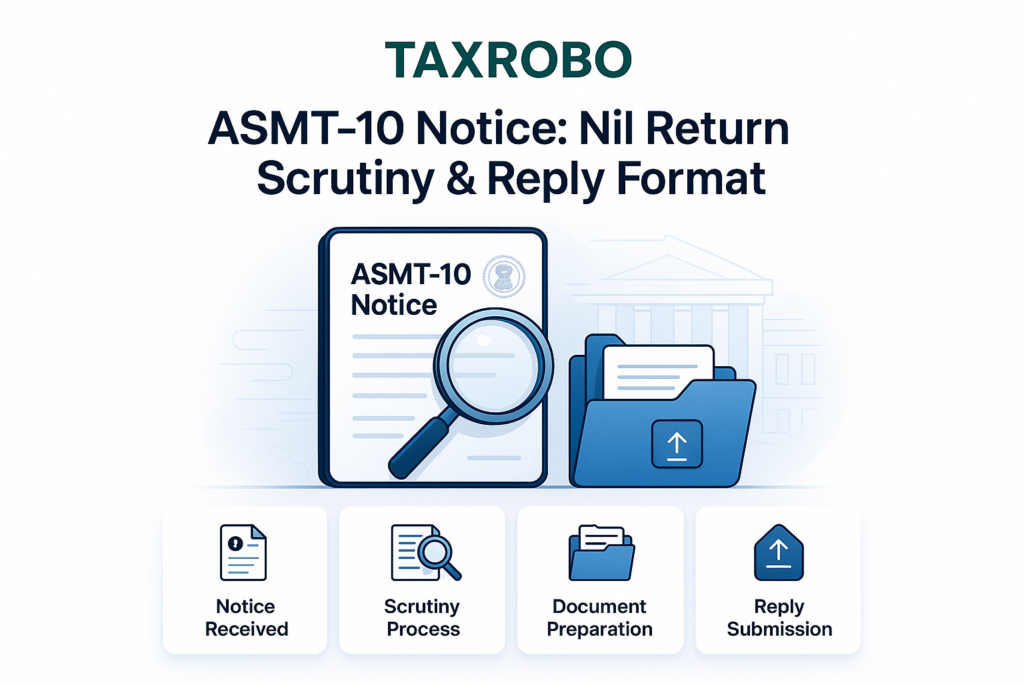

A Comprehensive Guide to ASMT-10 Nil Return Scrutiny Reply Format
Receiving a notice from the GST department can be a stressful experience for any business owner. This anxiety can be particularly confusing when you’ve diligently filed a nil return, indicating no business activity. If you’ve found yourself in this situation with a Form ASMT-10, you’re not alone. This is a common but entirely manageable scenario. This comprehensive guide will demystify the notice, explain why you might have received it despite filing a nil return, and provide a detailed, step-by-step nil return scrutiny reply format to help you respond confidently and effectively. Understanding the correct procedure is the first step in handling the Indian tax nil return process and ensuring your business remains compliant without unnecessary complications.
What is a GST ASMT-10 Notice?
Decoding Form ASMT-10
Form GST ASMT-10 is a notice issued by a tax officer under Section 61 of the Central Goods and Services Tax (CGST) Act, 2017. It is formally known as a ‘Notice for intimating discrepancies in the return’. It’s crucial to understand that ASMT-10 is not a demand notice; it is a form of preliminary scrutiny. Its primary purpose is to bring to your attention certain discrepancies or inconsistencies that the tax officer has identified in your GST returns when compared with other available data. The notice provides you with an opportunity to explain these discrepancies. Think of it as the department’s way of asking for clarification before taking any further action. The officer issues this notice based on their analysis of your filings, seeking a valid reason for the observed mismatches to ensure that the correct tax has been paid and all reporting is accurate.
Why Would You Get an ASMT-10 for a Nil Return?
This is the question that puzzles most business owners. If you had no transactions, no sales, and no purchases, why would your return be scrutinized? The GST system is highly automated and relies on data analytics to flag potential issues. Even a nil return can trigger a notice if it doesn’t align with other data points in the system. The nil return filing procedure requires consistency across all related filings and data sources.
Here are some common reasons you might receive an ASMT-10 for a nil return:
- Mismatch with Recipient’s Returns: Another taxpayer might have mistakenly entered your GSTIN in their GSTR-1 for a supply they made. This would appear in your GSTR-2A/2B as an inward supply, creating a discrepancy with your nil GSTR-3B, which shows no purchases.
- Delayed Filing of Previous Returns: If you filed previous returns (even nil ones) after the due date, the system might flag your account for a closer look, even if the current return is a nil return filed on time.
- Discrepancies in Annual Returns: There could be an inconsistency between the nil returns filed monthly/quarterly (GSTR-3B/GSTR-1) and the data reported in your annual return (GSTR-9), prompting scrutiny.
- System-Generated Flags: The GSTN’s data analytics and risk management systems may identify patterns that they consider unusual. For instance, if you have consistently filed returns with transactions and suddenly file a nil return, the system might flag it for a human review to ensure it’s not an error.
- Third-Party Information: Information from other government departments (like the Income Tax department) might suggest business activity that doesn’t align with your nil GST filing, leading to a query.
Many of these flags are raised to ensure a simple reporting error hasn’t occurred. It’s always a good practice to know How to Correct Errors in Your GST Returns to maintain a clean record.
Preparing to Respond: Guidelines for ASMT-10 Notice Compliance
First Steps: Don’t Panic, Act Promptly
The most important rule when you receive any tax notice, including an ASMT-10, is not to ignore it. Procrastination can lead to more serious consequences. The notice itself will specify the deadline for your response, which is typically within 15 to 30 days from the date it was served. Acknowledging the notice and preparing a timely, well-documented reply is the best course of action. Failing to respond can lead the officer to conclude that you accept the discrepancy and have tax to pay. This could result in further action under Section 62 (Best Judgement Assessment) or the issuance of a Show Cause Notice in Form DRC-01, which is a more formal and serious step towards demanding tax, interest, and penalties. Acting promptly demonstrates your diligence as a taxpayer and helps resolve the matter quickly.
Gather Your Documentation
A strong reply is always backed by solid evidence. Even though you filed a nil return, you need to gather documents that prove there was no business activity during the period in question. Having these documents ready will make drafting your response much easier and more credible. Adhering to these guidelines for ASMT-10 notice compliance will ensure your reply is comprehensive and leaves no room for doubt. This preparation underscores The Importance of Accurate Record-Keeping to Prevent GST Demand Notices in the first place.
Here is a checklist of essential documents:
- A copy of the ASMT-10 notice: Keep it handy to reference the specific discrepancies and the notice reference number (ARN).
- Filed GST Returns: Download copies of your GSTR-1 and GSTR-3B filings for the tax period mentioned in the notice to prove you filed them as nil.
- Bank Statements: This is a crucial piece of evidence. Your business bank account statements for the period can effectively prove that no business-related transactions (payments or receipts) occurred.
- Proof of No Business Activity (if applicable): If your business was temporarily shut down or inactive for a specific reason (e.g., renovation, off-season, awaiting permits), any supporting documentation like rental agreements showing non-occupancy, or official communications about the temporary closure can be very helpful.
The Perfect Nil Return Scrutiny Reply Format (Step-by-Step Guide)
Understanding the Structure of the Reply
Your official response to an ASMT-10 notice must be submitted online through the GST portal using Form ASMT-11. Your reply needs to be formal, factual, and directly address the points raised in the notice. Essentially, you have two options when filing ASMT-11. The first is to accept the discrepancy, pay any associated tax, interest, and penalty, and inform the officer. The second option, which is almost always the case for nil return filers, is to contest the discrepancy by providing a detailed explanation and supporting documents. For a nil return scenario, your entire focus will be on clearly and politely explaining why your filings are correct and why no tax is due. This structured explanation forms the core of an effective reply.
Drafting Your Explanation: The Core of the ASMT-10 Response Format India
Knowing how to prepare ASMT-10 reply in India involves drafting a clear and logical explanation. Your written submission, which you can attach as a PDF to your ASMT-11 filing, should be structured professionally. Breaking it down into sections makes it easier for the tax officer to understand your position.
Here’s a step-by-step guide to drafting the content of your reply:
- Subject Line: Make it crystal clear. Use a subject line like: “Reply to Scrutiny Notice in Form ASMT-10 dated [Date of Notice] for GSTIN [Your GSTIN]”.
- Reference: Always quote the Notice Reference Number (also known as ARN) and the date of the notice. This helps the officer immediately locate your case file.
- Introduction: Begin by formally acknowledging the receipt of the notice. State the tax period the notice pertains to, showing that you have understood the communication correctly.
- Point-by-Point Rebuttal: This is the most critical part of your reply. Do not write a single, long paragraph. Instead, address each discrepancy listed in the ASMT-10 notice as a separate point.
- First, quote the exact discrepancy from the notice. For example: “Observation 1: As per the notice, a discrepancy has been noted between the taxable supplies declared in GSTR-1 and the auto-populated data in GSTR-2A of the recipient.”
- Next, provide your clear and factual explanation. For example: “In response to the above observation, we wish to state that our company had no business operations during the tax period of [Month, Year]. Consequently, we have correctly filed a nil GSTR-1 and a nil GSTR-3B. We believe the discrepancy might have arisen due to an erroneous entry by a third-party taxpayer. We are attaching our bank statements for the period as evidence of no commercial activity.”
- Concluding Statement: End your reply with a polite and firm conclusion. Reiterate that your filed returns are accurate and in accordance with GST law. Humbly request the officer to review your submission and the attached documents and to drop the proceedings initiated via the ASMT-10 notice.
Sample Notice Reply Format for Nil Return
Here is a ready-to-use template that you can adapt for your specific situation. Ensure you replace the bracketed information with your own details.
Subject: Reply to Notice to Return Scrutiny under Section 61 (Form ASMT-10) for GSTIN [Your GSTIN] for the tax period [Tax Period, e.g., April 2023]
Reference: Notice No. [Enter Notice Reference Number/ARN] dated [Date of Notice]
Respected Officer,
1. This is with reference to the scrutiny notice (ASMT-10) cited above, issued to us for the tax period [Tax Period]. We acknowledge the receipt of the same and appreciate the opportunity to provide clarification.
2. The notice highlights the following discrepancy/observation:
- [Clearly state the discrepancy mentioned in the ASMT-10 notice, e.g., “Mismatch in liability declared in Form GSTR-1 and Form GSTR-3B.” or “ITC claimed in GSTR-3B appears in excess of that available in GSTR-2B.”]
3. In this regard, we would like to submit the following explanation and facts for your consideration:
- We confirm that for the tax period [Tax Period], our business had no outward or inward supplies. Our operations were temporarily inactive during this entire period.
- Consequently, we have correctly and diligently filed a Nil Return for both Form GSTR-1 (for outward supplies) and Form GSTR-3B (summary return of outward and inward supplies).
- There were no business transactions conducted, and therefore, no tax liability arises, and no Input Tax Credit (ITC) was claimed.
- To substantiate our position, we are attaching the following documents for your kind perusal and verification:
- Copy of our filed Form GSTR-1 for [Tax Period].
- Copy of our filed Form GSTR-3B for [Tax Period].
- Bank statements of our registered business account from [Start Date] to [End Date] confirming no commercial transactions.
4. Conclusion: In light of the above facts and the supporting documents provided, the discrepancy noted in the notice is not applicable to us. We humbly request your good office to accept our explanation, find it satisfactory, and conclude the proceedings for the said period by issuing an order in Form ASMT-12.
Thank you for your consideration.
Sincerely,
[Your Name/Authorized Signatory Name]
[Your Business Name]
[GSTIN]
[Date]
How to Respond to a Nil Return Scrutiny Notice Online
Submitting your reply is done electronically through the GST portal. It is a straightforward process if you follow the correct steps.
Step-by-Step Guide for GST Portal Submission
- Step 1: Log in to the official GST Portal using your credentials. You can access it here: GST Portal.
- Step 2: Once logged in, navigate to the main dashboard. Click on `Services > User Services > View Additional Notices/Orders`.
- Step 3: On the next screen, you will see a list of all notices and orders issued to your GSTIN. Find the relevant ASMT-10 notice by its reference number and click on the ‘View’ link in the action column.
- Step 4: The details of the notice will be displayed. Switch to the ‘Replies’ tab. Here, you will see an option to ‘ADD REPLY’. Click on it and then select ‘ASMT-11’ from the dropdown.
- Step 5: An online form for ASMT-11 will open. You can either type your detailed reply directly into the text box provided or, more professionally, attach the reply you have already prepared in a PDF format. It is highly recommended to attach a signed PDF on your company’s letterhead.
- Step 6: Use the “Attachments” section to upload all your supporting documents. This includes the PDF of your detailed explanation, scanned copies of bank statements, and any other evidence you have gathered. Ensure the file size is within the prescribed limit.
- Step 7: After filling in the details and uploading all documents, you must file the reply using either a Digital Signature Certificate (DSC) for companies and LLPs or an Electronic Verification Code (EVC) for other taxpayers.
Conclusion: Stay Compliant and Stress-Free
Receiving an ASMT-10 notice for a nil return can be initially alarming, but it is a procedural check that can be handled smoothly with the right approach. The key is to act promptly, understand the reason for the notice, gather your supporting evidence, and submit a clear, factual, and professional response using the correct nil return scrutiny reply format. By following the steps outlined in this guide—from drafting the reply in Form ASMT-11 to filing it on the GST portal—you can address the department’s queries effectively. A timely and well-drafted response is crucial as it demonstrates your commitment to compliance and helps in closing the scrutiny proceedings without any further complications.
Feeling overwhelmed by GST notices? TaxRobo’s team of experts can help you draft a professional reply and ensure your GST compliance is flawless. Contact us today for a consultation!
Frequently Asked Questions (FAQs)
1. What is the time limit to reply to an ASMT-10 notice?
The time limit to submit your reply is always mentioned in the notice itself. Typically, the taxpayer is given 15 to 30 days from the date the notice is served to provide an explanation or pay the amount due. It is extremely important to adhere to this deadline to avoid adverse action.
2. Can I ignore an ASMT-10 notice if I have filed a nil return?
Absolutely not. Ignoring any notice from a tax authority is a serious mistake. If you fail to respond to an ASMT-10, the tax officer may presume that you have accepted the discrepancy and have a tax liability. This can lead them to proceed with a best-judgment assessment under Section 62 of the CGST Act, where they will determine your tax liability based on the information they have, or issue a show-cause notice (DRC-01) to demand the tax. In such an escalated scenario, you would need to know How to Respond to a GST Show Cause Notice: A Step-by-Step Guide.
3. What happens after I submit my reply in Form ASMT-11?
Once you have filed your reply, the tax officer will review your explanation and the supporting documents. If your response is found to be satisfactory and adequately explains the discrepancy, the officer will conclude the proceedings by issuing an order in Form ASMT-12. This order formally closes the matter. If the officer is not satisfied with your reply, they may initiate further action, which could include issuing a show-cause notice for demanding tax, interest, and penalty.
4. Do I need a professional’s help to draft a notice reply format for nil return?
While our guide provides a comprehensive template and a clear process to draft the reply yourself, seeking professional assistance is highly recommended, especially if you are unsure about any aspect of the notice. A Chartered Accountant or a tax consultant from a firm like TaxRobo can ensure that your notice reply format for nil return is legally sound, addresses all observations precisely, and is supported by the correct documentation. Their expertise can significantly minimize the risk of an unsatisfactory response and prevent the issue from escalating.