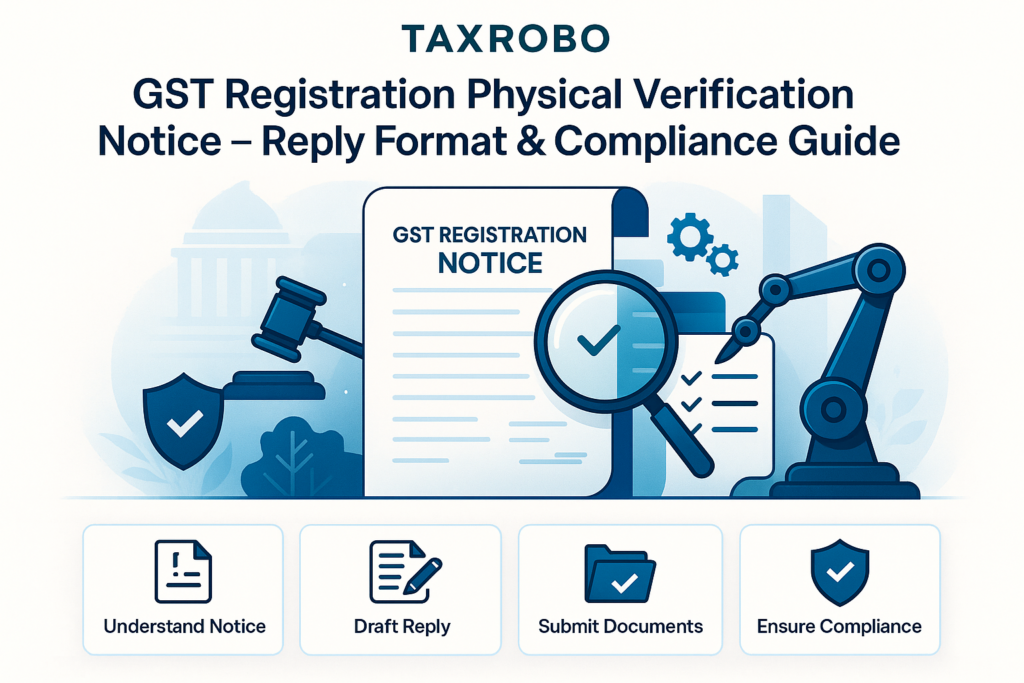

GST Registration Physical Verification Notice – Reply Format & Compliance Guide
A notice from the GST department can be intimidating, but it doesn’t have to be a crisis. For any small business owner, receiving official correspondence from a tax authority can cause immediate concern, but understanding the process is the first step toward resolving it effectively. This guide is designed to demystify one such common communication: the notice for physical verification of your business premises. A timely and well-drafted GST registration notice reply is not just a procedural formality; it is a critical step to ensure your business remains compliant and avoids potential penalties, suspension, or even cancellation of your GST Identification Number (GSTIN). Understanding why this notice is issued and how to respond correctly is crucial for your business’s uninterrupted operation.
This comprehensive guide will provide you with a clear roadmap for preparing an effective response. We will explore what a physical verification notice for GST entails, delve into a step-by-step process for drafting a professional reply, provide a ready-to-use GST registration notice reply format, and offer proactive tips to help you avoid such notices in the future, ensuring you adhere to all GST compliance guidelines India.
What is a Physical Verification Notice for GST?
A physical verification notice is a formal communication from the GST department indicating that a designated officer has visited or intends to visit your principal place of business. This procedure is a key part of the department’s efforts to ensure the genuineness of registered businesses. It acts as a safeguard against fraudulent activities, such as the creation of “shell” companies for the sole purpose of issuing fake invoices and illegitimately claiming Input Tax Credit (ITC). When an officer conducts a verification, they are essentially confirming that a legitimate business operates from the address declared in the GST registration. If they find discrepancies, they issue a notice, giving you an opportunity to explain and provide evidence to support your registration’s authenticity.
Why GST Officers Conduct Physical Verification
The GST department employs robust data analytics and risk assessment tools to identify taxpayers who may pose a compliance risk. Physical verification, as outlined in Rule 25 of the CGST Rules, is a powerful tool to weed out bogus entities and protect government revenue. It is not a random check for all businesses but is typically triggered by specific red flags. Understanding these triggers can help you ensure your own business profile remains clean and compliant.
Common reasons for initiating a physical verification include:
- High-Risk Taxpayer Profile: The GSTN portal’s analytics may flag a registration as high-risk based on various parameters, such as the applicant’s financial history or associations with other non-compliant businesses.
- Incomplete or Suspicious Address: Providing an address that is vague, incomplete, or located in a known high-risk area can trigger a verification visit to confirm the business’s existence.
- Failure of Aadhaar Authentication: If a new applicant fails the mandatory Aadhaar authentication or voluntarily opts for physical verification instead, a site visit becomes a standard part of the registration process.
- Adverse Reports: Information or adverse reports received from other government departments, tax authorities, or law enforcement agencies can prompt the GST department to conduct a physical check.
- Prolonged Non-Filing of Returns: Businesses that have been registered for a significant period but have consistently failed to file their GST returns (like GSTR-1 and GSTR-3B) are often seen as potentially non-operational or fraudulent, leading to verification.
The On-Site Verification Process: What to Expect
When a GST officer visits your registered place of business, their goal is to gather tangible proof of your operations. It is essential to be prepared and cooperate fully to ensure a smooth process. The officer is authorized to verify several aspects of your business to confirm its legitimacy. If you or an authorized representative are present, they will interact with you; if not, they will conduct the verification based on available evidence and may speak with neighbors or the property owner.
Here’s what the officer typically checks during the visit:
- Business Signboard: The presence of a signboard or nameplate prominently displaying the business name and GSTIN is one of the first things an officer looks for.
- Books of Accounts: They may ask to inspect your financial records, purchase and sales registers, and other statutory documents to verify that business records are maintained at the declared location.
- Stock and Inventory: The officer will check for the presence of raw materials, finished goods, or capital goods relevant to your declared line of business.
- Photographic Evidence: They are authorized to take photographs of the premises, including the signboard, inventory, and office setup, as evidence for their official report.
- Document Verification: The officer may ask to see original documents like the rent agreement, property ownership papers, utility bills, and other business-related licenses.
A Step-by-Step Guide to Replying to a GST Registration Notice
Receiving a notice after a physical verification can be stressful, but a systematic and professional approach can resolve the issue efficiently. The key is to address every point raised by the officer with clear explanations and solid documentary evidence. Following a structured process ensures that your reply is comprehensive, compliant, and convincing, significantly increasing the chances of a favorable outcome.
Step 1: Decode the Notice (Form GST REG-30)
The first and most critical step is to thoroughly understand the notice you have received. The findings and discrepancies observed during the physical verification are officially communicated in a notice issued in Form GST REG-30. Do not panic or rush to draft a reply. Instead, sit down and carefully read every line of the notice. Identify the specific objections or points of concern raised by the verifying officer. These could range from a missing signboard to the unavailability of business records on-site.
Most importantly, locate the deadline for submission mentioned in the notice. Typically, you are given 15 working days to respond, but this can vary. Missing this deadline can lead to serious consequences, including the suspension of your GSTIN, so mark it in your calendar and start preparing your response immediately.
Step 2: Gather All Supporting Documents
Your reply is only as strong as the evidence you provide to support it. Once you have understood the discrepancies listed in the notice, your next task is to compile a comprehensive set of documents that directly counter each objection. This file will form the annexures to your formal reply. Being organized and thorough at this stage is crucial for building a strong case and demonstrating your compliance.
Here is a checklist of essential documents you should gather:
- Proof of Address: A copy of the Rent/Lease Agreement (if the property is rented) or Property Ownership documents like a sale deed or property tax receipt.
- Utility Bills: The latest Electricity Bill, water bill, or landline telephone bill. Ensure it is recent and, if possible, in the name of the business or the property owner.
- No Objection Certificate (NOC): If the premises are rented or shared, an NOC from the property owner stating they have no objection to you operating your business from their address is vital.
- Photographs: Clear, recent photographs of your business premises. Include pictures of the exterior with the signboard, the interior showing your office setup or inventory, and a close-up of the business name and GSTIN displayed on the board.
- Proof of Business Activity: Documents like recent sales invoices, purchase bills, or bank statements that clearly show ongoing business transactions linked to the registered address.
- Identity and Address Proof: A copy of the PAN card and Aadhaar card of the proprietor, partners, or directors, as applicable.
- Other Specific Documents: If the notice requests any other specific document or information, ensure you provide it.
Step 3: Draft Your GST Registration Notice Reply
With your documents in order, it’s time to draft the formal reply. The tone of your reply should be professional, respectful, and factual. Avoid emotional language or making excuses. The goal is to provide clear, point-by-point clarifications for each discrepancy noted in Form GST REG-30. Using a structured GST registration notice reply format will ensure your response is clear, easy for the officer to understand, and addresses all concerns comprehensively.
Here is a standard format to follow:
- Header: Place your business name, GSTIN, and registered address at the top.
- Date and Recipient: Mention the current date and address the reply to the “Proper Officer” as specified in the notice.
- Subject Line: A clear and concise subject line is essential. Use: “Reply to Notice for Physical Verification under GST – Reference No. [Insert Notice Number from Form GST REG-30]“
- Reference: Clearly state the Notice Number and the Date it was issued.
- Body of the Letter:
- Begin by acknowledging receipt of the notice. For example: “Dear Sir/Madam, This is with reference to the notice (Ref No. XXX) dated DD/MM/YYYY, issued in Form GST REG-30 regarding the physical verification of our principal place of business.”
- Address each point from the notice separately. Use numbered paragraphs or bullet points that correspond to the discrepancies listed in the notice.
- For each point, provide a factual explanation and explicitly refer to the supporting document you have attached. For example:
- “Regarding Point 1 (Absence of Signboard): We would like to clarify that a signboard displaying the firm’s name and GSTIN was temporarily removed for maintenance on the day of the visit. It has since been reinstalled. Please find attached a photograph of the current signboard as Annexure A.”
- “Regarding Point 2 (Non-availability of Books of Accounts): Our accountant, who maintains the books, works remotely. However, all statutory records are accessible and can be presented upon request. A summary of our sales and purchase registers for the last quarter is attached as Annexure B.”
- List of Annexures: After the body of the letter, create a numbered list of all the documents you are attaching. For example: “List of Enclosures: 1. Annexure A – Photograph of Signboard, 2. Annexure B – Sales and Purchase Registers…”
- Closing: End with a polite closing statement, such as: “We believe the above clarifications and supporting documents sufficiently address the concerns raised in the notice. We request you to kindly drop the proceedings and oblige.”
- Signature: The reply must be signed by the authorized signatory, along with their name and designation (e.g., Proprietor, Director).
Step 4: Submit the Reply and Follow Up
Once your reply and all supporting documents are ready, the final step is to submit them through the official channel. The reply to any notice under GST must be filed electronically on the GST Common Portal, which can be accessed at `https://www.gst.gov.in/`. Log in to your account, navigate to the ‘Notices’ section, and upload your reply along with all the scanned annexures.
It is absolutely critical to submit your response before the deadline mentioned in the notice. Timely submission is a key aspect of GST compliance guidelines India and demonstrates your commitment to following the law. After successfully uploading your reply, the portal will generate an Application Reference Number (ARN). Save this ARN carefully, as it is your proof of submission.
After the Reply: Outcomes and Proactive Compliance
Submitting your reply is a major step, but it is important to understand what happens next and how you can proactively manage your GST compliance to prevent such issues from arising in the future. A strong compliance posture not only saves you from the stress of dealing with notices but also builds a foundation of trust with the tax authorities.
What Happens After You Submit the Reply?
After reviewing your reply and the attached documents, the GST officer will decide on the next course of action. There are generally two possible outcomes:
- Positive Outcome: If the officer is satisfied with your explanation and the provided evidence, they will find your reply acceptable. The proceedings initiated by the notice will be dropped, and your GST registration will continue to be active without any disruption. You will typically receive an order confirming this decision.
- Negative Outcome: If the officer is not satisfied with your reply or finds the evidence insufficient, they may proceed with adverse action. This usually involves issuing a Show Cause Notice (SCN) proposing the suspension and eventual cancellation of your GST registration. You can learn more about this process in our guide on GST Registration Cancellation – Step-by-Step Guide & Practical Issues. It is important to know that this is not the end of the road. You will have an opportunity to be heard and can appeal this decision before higher authorities.
A Proactive Compliance Guide for GST Registration to Avoid Notices
The best way to handle a notice is to avoid receiving one in the first place. By adopting a proactive approach to GST compliance, you can significantly reduce the risk of your business being flagged for verification. This involves maintaining good records, ensuring transparency, and being diligent with your filings.
Here are some preventive tips to keep your business off the department’s radar:
- Maintain an Accurate Address: Always ensure that the “Principal Place of Business” address listed on the GST portal is current and accurate. If you move, update the address immediately through a registration amendment.
- Display Your GSTIN: It is mandatory to display your GST registration certificate at your principal place of business. Additionally, your business name and GSTIN must be displayed on a signboard outside your premises.
- Be Return-Compliant: File your GSTR-1 and GSTR-3B returns on time, every single month or quarter, as applicable. Consistent and timely filing is one of the strongest indicators of a genuine, operational business. You can follow our How to File GSTR-1 & GSTR-3B Correctly – Step-by-Step Guide 2025 for detailed instructions.
- Keep Documents Handy: Maintain a dedicated file at your registered office containing all essential documents, such as the rent agreement, NOC, utility bills, and incorporation documents. This underscores The Importance of Accurate Record-Keeping to Prevent GST Demand Notices and ensures you are always prepared for a surprise visit.
- Cooperate with Officials: If a GST officer visits your premises, be polite, cooperative, and transparent. Providing the required information promptly and respectfully can lead to a much smoother verification process.
Conclusion
Receiving a notice for physical verification can feel daunting, but it is a manageable compliance requirement. By following a structured approach—understanding the notice, gathering the right documents, drafting a clear and factual response using the correct format, and submitting it on time—you can address the department’s concerns effectively. A prompt and accurate GST registration notice reply is more than just a legal obligation; it is about safeguarding your business’s GSTIN, which is essential for its day-to-day operations and continuity. By staying vigilant and proactive with your compliance, you can focus on what truly matters: growing your business.
Navigating GST notices can be complex. Don’t risk your business registration. The experts at TaxRobo GST Service specialize in GST compliance and can help you draft a perfect, legally sound reply. Contact us today for professional assistance!
Frequently Asked Questions
1. What is the time limit for replying to a GST physical verification notice?
The time limit is usually mentioned in the notice itself, which is typically 15 working days from the date of the notice. However, you must always refer to your specific notice for the exact deadline, as it can vary.
2. Can a GST officer visit my business premises without prior intimation?
Yes, in certain high-risk cases or where there is a strong suspicion of fraudulent activity, a GST officer is authorized to conduct a surprise visit to the registered place of business to verify its existence and genuineness without any prior intimation.
3. What happens if I fail to provide a GST registration notice reply?
Failure to reply within the stipulated time can lead to serious adverse actions. The officer may proceed with the suspension and eventual cancellation of your GST registration based on the assumption that the discrepancies noted in their report are correct and that the business is not genuine.
4. My business is run from my home. Can physical verification be done there?
Yes. If you have registered your residential address as your principal place of business on the GST portal, it is treated as your official business premises. Therefore, a GST officer has the full right to visit and verify the location to ensure genuine business activities are being conducted from there.
5. What if the officer’s report (Form GST REG-30) contains factual errors?
Your formal reply is the perfect opportunity to correct any factual errors made by the officer. In your response, clearly state the error, explain the correct facts, and provide strong documentary evidence (e.g., a correct rent agreement, updated photographs, utility bills) to substantiate your claim and set the record straight.