
ASMT-10 vs DRC-01 vs DRC-01A – Difference & Reply Strategy
Receiving a notice from the GST department can be a daunting experience for any business owner. The complex forms and legal jargon can be overwhelming, leading to confusion and stress. Among the most common communications are Forms ASMT-10, DRC-01A, and DRC-01, each signifying a different stage of scrutiny by the tax authorities. This blog will provide a clear ASMT-10 DRC-01 difference analysis, breaking down what each form means and outlining an effective reply strategy to navigate these communications confidently. Understanding this comprehensive ASMT-10 DRC-01A overview India is crucial for ensuring compliance, avoiding unnecessary penalties, and maintaining a healthy financial standing for your business. For any official correspondence or filing, you can always refer to the official GST Portal homepage.
Decoding GST Notices: What, Why, and How to Respond
Before diving into the specifics of each form, it’s essential to understand why these notices are triggered in the first place. The GST system is built on a foundation of self-assessment and data matching. When the sophisticated algorithms of the GST Network (GSTN) or a vigilant tax officer detects inconsistencies in the data you’ve filed, it raises a red flag. These discrepancies are the primary reason for the issuance of notices. A clear understanding of these triggers, along with maintaining accurate accounting records for tax purposes, can help businesses implement better internal controls and minimize the chances of receiving such communications from the department in the future.
Why Do GST Officers Send Notices?
GST officers issue notices to seek clarification or demand tax when they identify potential discrepancies during their review of your filed returns and other data. These notices are a formal mechanism to ensure tax compliance and recover any revenue that may have been underreported. Common triggers include:
- Mismatch between GSTR-1 and GSTR-3B: One of the most frequent reasons is a difference between the total outward supplies declared in your GSTR-1 (statement of outward supplies) and the summary figures reported and taxed in your GSTR-3B (monthly summary return).
- Excess Input Tax Credit (ITC) Claims: If the ITC you’ve claimed in your GSTR-3B is significantly higher than the amount appearing in your GSTR-2A or GSTR-2B (auto-populated statements of inward supplies), the department will seek an explanation.
- Data Discrepancies: Mismatches between the data reported in your GST returns and information available from other sources, such as e-way bills, customs data (for imports), or TDS/TCS returns filed by your counterparts, can trigger a notice.
- Non-filing or Delayed Filing: Consistently failing to file your GST returns on time or not filing them at all for several consecutive tax periods is a major compliance issue that will invariably lead to a notice.
Form ASMT-10: The First Warning for Discrepancies
The journey of GST scrutiny often begins with Form ASMT-10. This is the initial communication from the tax department and should be treated with seriousness, but not panic. It represents an opportunity to clarify your tax position before the matter escalates to a more formal stage. Viewing ASMT-10 as a dialogue rather than an accusation is the first step in formulating a successful response. The officer has found a potential error and is simply asking for your side of the story, backed by evidence. A timely and well-documented reply at this stage can often resolve the issue entirely, preventing further proceedings and saving significant time and resources.
What is Form ASMT-10?
Form ASMT-10 is a scrutiny notice issued by the proper officer under Section 61 of the CGST Act, read with Rule 99. It is crucial to understand that this is not a demand notice. Instead, it is a formal intimation that points out specific discrepancies observed in your GST returns and requests an explanation from you, the taxpayer. Think of ASMT-10 as a query from the department, not an accusation. The officer has used the system to compare the details you have filed across different returns and has found a mismatch worth questioning. This notice provides you with an opportunity to explain the difference or correct any bona fide errors you may have made in your filings.
An Effective ASMT-10 Strategy India Businesses Should Follow
Responding to an ASMT-10 notice requires a methodical and timely approach. Ignoring it is not an option, as it will lead to more stringent actions from the department. The core of an effective ASMT-10 strategy India-based businesses should adopt is clarity, supported by documentation.
- Timeline is Key: The most critical first step is to note the deadline. You are typically given 30 days from the date of the notice to submit your response. An extension may be sought if you require more time to gather the necessary documents.
- Use the Right Form: Your reply must be filed electronically on the GST portal using Form ASMT-11.
- Scenario 1: You Agree with the Discrepancy: If, upon review, you find that the officer’s observation is correct and there has been a short payment of tax, the correct course of action is to accept the discrepancy. You must calculate and pay the required tax, along with any applicable interest and penalty, using Form DRC-03. After making the payment, you must inform the officer of this action in your ASMT-11 reply, providing the payment details.
- Scenario 2: You Disagree with the Discrepancy: If you believe your filings are correct and the officer’s query is based on a misunderstanding, you need to prepare a detailed justification. This is a vital part of the overall ASMT-10 DRC-01 reply strategy. Your reply in Form ASMT-11 should include a clear, point-wise explanation for each discrepancy raised. This explanation must be supported by strong documentary evidence, which could include tax invoices, credit/debit notes, ledgers, detailed reconciliation statements (e.g., GSTR-1 vs. GSTR-3B or GSTR-3B vs. GSTR-2B), and any other relevant records that substantiate your claim.
Form DRC-01A: The Pre-Show Cause Notice Intimation
If a matter is not resolved at the ASMT-10 stage, or if the officer has already determined a specific tax liability through an audit or investigation, the next step may be the issuance of Form DRC-01A. This form serves as a crucial intermediary step, acting as a bridge between an initial query and a formal, legally binding demand. It essentially gives the taxpayer a final opportunity to settle the matter voluntarily before the department initiates formal adjudication proceedings. Understanding this form is essential, as a strategic response here can prevent the issuance of a much more serious Show Cause Notice.
What is the Purpose of Form DRC-01A?
Form DRC-01A is an intimation of tax liability issued under Rule 142(1A) of the CGST Rules. Its primary purpose is to communicate the tax, interest, and penalty as ascertained by the proper officer *before* a formal Show Cause Notice (SCN) is issued. This highlights the key DRC-01A difference India-based businesses must understand—it is a pre-notice consultation. The form provides a summary of the alleged liability and gives the taxpayer a chance for voluntary compliance. By paying the indicated amount, you can often conclude the proceedings without receiving a formal SCN, which can be a lengthy and costly process.
The Right DRC-01A Response Strategy in India
Your response to DRC-01A can determine the future course of action. You have two primary options, and choosing the right one requires careful consideration of the facts and your supporting evidence. A well-thought-out DRC-01A response strategy India can be highly effective in mitigating potential liabilities.
- Payment and Closure: If you agree with the liability ascertained by the officer, you can make the full payment of the tax, interest, and penalty using Form DRC-03. You must then inform the department of this payment. In many cases, this voluntary payment will lead to the closure of the proceedings without the issuance of a formal SCN. You can also make a partial payment for the amount you agree with.
- Contest the Liability: If you do not agree with the officer’s calculations or legal interpretation, you must file a detailed reply in Part B of Form DRC-01A. In this submission, you should clearly state your objections and provide reasons, legal arguments, and supporting documents to contest the proposed liability. A strong, well-reasoned reply at this stage might convince the officer to drop the proceedings or reduce the proposed demand.
Form DRC-01: The Formal Show Cause Notice (SCN)
Receiving a Form DRC-01 marks a significant escalation in the GST compliance process. This is no longer a preliminary query or an invitation for voluntary payment; it is a formal and serious legal document. A DRC-01 is a Show Cause Notice (SCN) that initiates formal adjudication proceedings against the taxpayer. It means the department is not satisfied with your earlier responses (if any) or has grounds to believe that tax has been evaded or short-paid, and it is now formally asking you to “show cause” as to why the proposed demand should not be confirmed and recovered from you.
What Does Receiving a DRC-01 Mean?
Form DRC-01 is a formal Show Cause Notice issued under Section 73 (for non-fraud cases) or Section 74 (for cases involving fraud, willful misstatement, or suppression of facts). Understanding the key differences between Sections 73 and 74 of the CGST Act in GST demand notices is crucial as it determines the severity of penalties. It is a detailed document that lays out the department’s allegations, the specific provisions of the law that have allegedly been violated, and the calculation of the tax, interest, and penalty being demanded. The issuance of a DRC-01 signifies that the department has formed a preliminary opinion of your liability and is now providing you a formal opportunity to defend your case. The DRC-01 comparison India context is critical here: while ASMT-10 and DRC-01A are preliminary, DRC-01 is the start of a formal legal battle. For a detailed walkthrough, read our guide on How to Respond to a GST Show Cause Notice: A Step-by-Step Guide.
How to Formulate a Reply to DRC-01
Responding to a DRC-01 is a formal legal process and should be handled with utmost care and professionalism. Unlike ASMT-10 or DRC-01A, the reply is not a simple form-based submission but a detailed legal document.
- Analyze the Notice: Carefully read and analyze every allegation, calculation, and legal provision cited in the SCN.
- Prepare a Detailed Rebuttal: Draft a comprehensive, point-by-point written submission that refutes each of the department’s allegations. Your reply should be grounded in legal provisions, citing relevant sections of the GST Act, rules, circulars, notifications, and any supporting case laws from tribunals or courts.
- Attach All Evidence: Compile and attach all supporting documents, reconciliations, and evidence that strengthen your case.
- Request a Personal Hearing: Always request a personal hearing in your reply. This gives you an opportunity to explain your case in person before the adjudicating authority, which can be crucial in complex matters.
Replying to a DRC-01 requires expertise in GST law and litigation. It’s highly recommended to seek professional help to build a strong defense. Contact TaxRobo for expert assistance in drafting and representing your case.
The Core Difference: ASMT-10 vs DRC-01A vs DRC-01 at a Glance
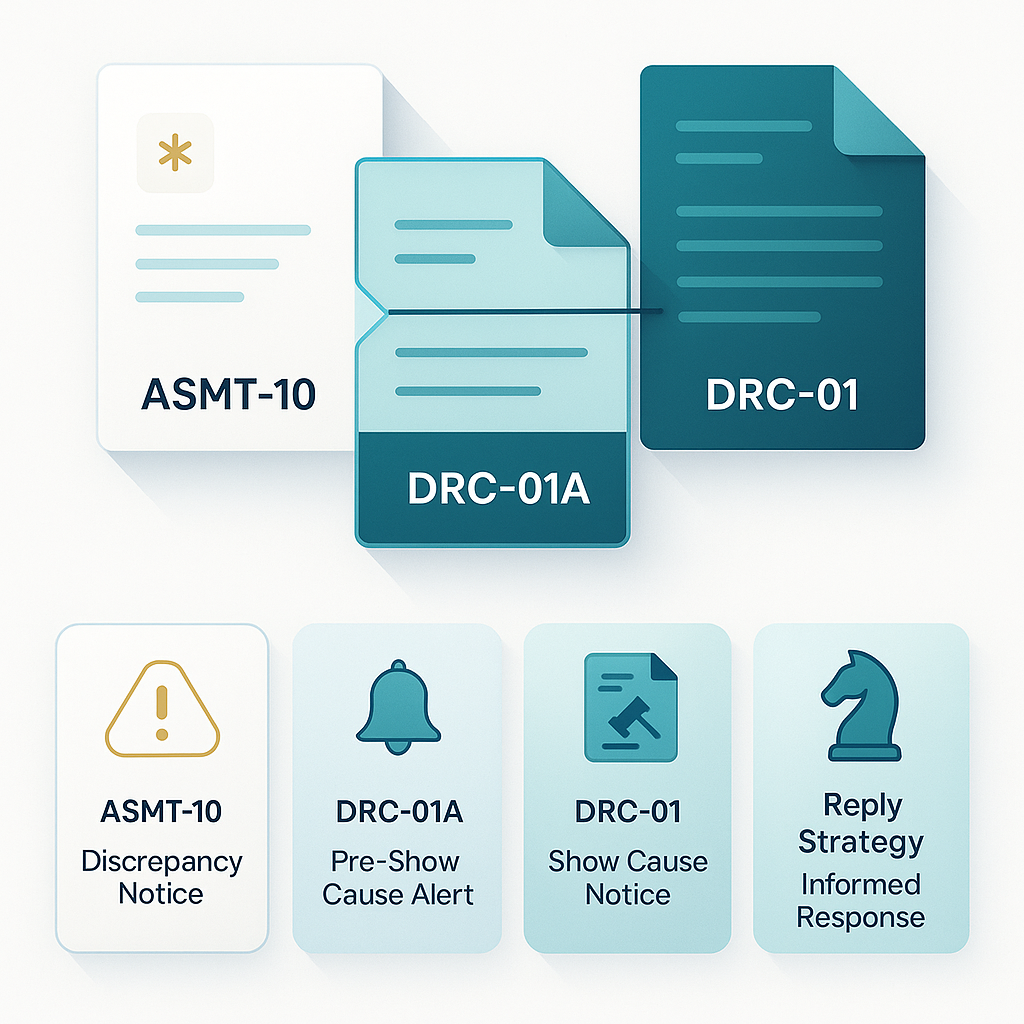
To simplify the ASMT-10 DRC-01 difference and the role of DRC-01A, here is a quick comparison. Understanding these key distinctions is fundamental to crafting the correct government reply strategies for ASMT-10 DRC-01 and associated notices.
| Parameter | Form ASMT-10 | Form DRC-01A | Form DRC-01 |
|---|---|---|---|
| Nature | Scrutiny Intimation (A query) | Pre-SCN Intimation (Voluntary payment) | Formal Show Cause Notice (A demand) |
| Legal Basis | Section 61, Rule 99 | Rule 142(1A) | Section 73 or 74 |
| Severity | Low | Medium | High |
| Response Form | ASMT-11 | Part B of DRC-01A | Detailed Written Submission |
| Next Step | If reply is unsatisfactory, officer may proceed with audit or issue SCN (DRC-01). | If payment is not made or reply is unsatisfactory, officer will issue DRC-01. | Adjudication order (Demand confirmation). |
This table provides a quick ASMT-10 DRC-01A analysis India business owners can use to immediately gauge the severity and required response for each notice, clarifying the fundamental differences between ASMT-10 DRC-01 and DRC-01A.
Conclusion
Navigating the landscape of GST notices can be challenging, but understanding the hierarchy and purpose of each form is the first step toward effective compliance. To summarize, ASMT-10 is an initial query about discrepancies, DRC-01A is a final opportunity to settle a determined liability voluntarily, and DRC-01 is a formal demand notice that marks the beginning of legal proceedings. Knowing the ASMT-10 DRC-01 difference and the intermediary role of DRC-01A empowers you to respond appropriately at each stage. A prompt, accurate, and strategically crafted reply is critical to resolving these issues efficiently and protecting your business from undue financial strain.
Don’t let GST notices disrupt your business. Whether you need an ASMT-10 strategy in India or assistance with a complex DRC-01 reply, TaxRobo’s team of experts is here to guide you. Get in touch with us for a consultation today!
FAQs on GST Notices ASMT-10, DRC-01, and DRC-01A
1. What happens if I ignore an ASMT-10 notice?
If you fail to respond to an ASMT-10 notice within the stipulated time, the GST officer may assume that the discrepancy pointed out is accepted by you. Consequently, the officer can proceed with further action under the GST Act, which may include initiating proceedings under Section 73 or Section 74 to recover the tax, which involves issuing a formal demand notice (DRC-01).
2. Can I make a partial payment after receiving a DRC-01A?
Yes, the framework allows for flexibility. You can pay a part of the proposed tax liability that you agree with using Form DRC-03. For the remaining disputed amount, you can contest it by filing a detailed submission in Part B of Form DRC-01A, explaining why you believe that portion of the demand is not payable.
3. Is it mandatory to hire a professional to reply to a DRC-01?
While it is not legally mandatory to hire a professional, it is highly advisable. A DRC-01 is a formal legal notice that initiates adjudication proceedings. An incorrect, incomplete, or weak reply can result in the confirmation of the proposed tax demand, along with interest and heavy penalties. A tax professional can build a robust case using legal precedents, proper documentation, and effective arguments.
4. Where can I view these notices on the GST Portal?
You can find and download all notices issued to you by the tax department by logging into the GST Portal. After logging in, navigate to the following path: Services > User Services > View Notices and Orders.
5. What is the main difference between a DRC-01 issued under Section 73 vs. Section 74?
The primary difference lies in the intent behind the tax default.
- Section 73 is invoked for tax non-payment or short-payment for reasons other than fraud, willful misstatement, or suppression of facts. The penalties under this section are generally lower (up to 10% of the tax amount).
- Section 74 is invoked specifically for cases where tax has been evaded due to fraud, willful misstatement, or suppression of facts. This section carries much stricter and higher penalties, which can be as high as 100% of the tax amount demanded.