
How to Handle a GST Department Visit (A Preventive Wing Inspection Guide)
A surprise visit from the GST department can be a daunting experience for any business owner. The sight of tax officials at your doorstep is enough to cause significant stress, but with the right preparation and knowledge, you can navigate it smoothly and professionally. This guide is designed to demystify the process and reduce the anxiety associated with a departmental inspection for GST in India. We will provide clear, actionable GST department visit guidelines to help you understand the process, know your rights, and handle the situation with confidence. This is an essential guide for a GST departmental visit for small business owners across India.
Understanding Why the GST Department Visits: Audit vs. Inspection
Not all visits from the tax authorities are the same. Understanding the purpose of their visit is the first step in handling it correctly. A routine audit is very different from an inspection by the Preventive Wing. An audit is generally a pre-scheduled event where the department informs you in advance, allowing you time to prepare your books and records for a comprehensive review. Its primary goal is to verify that the returns you’ve filed and the tax you’ve paid are accurate according to your financial records. An inspection, on the other hand, is often unannounced and more targeted, driven by specific intelligence that suggests potential tax evasion. For a detailed breakdown, it’s helpful to understand the Difference Between GST Audit, Inspection, Search & Seizure Explained.
What is a GST Preventive Wing Inspection?
The GST Preventive Wing, often referred to as the anti-evasion wing, is a specialized branch of the GST department. Its primary function is to detect, check, and prevent tax evasion. Unlike a broad-based audit, an inspection by this wing is typically initiated based on specific information, data analysis, or credible intelligence pointing towards non-compliance. These are not random checks; they are targeted actions based on suspected irregularities.
Common triggers for a visit from the Preventive Wing include:
- Major Discrepancies: Significant mismatches between data reported in GSTR-1 (outward supplies), GSTR-3B (summary return), and E-way bills generated.
- Third-Party Information: Reports or tips from suppliers, customers, or other government agencies that indicate fraudulent activities.
- Unusually High Input Tax Credit (ITC) Claims: Claiming an amount of ITC that appears disproportionately high compared to your turnover or industry standards can raise a red flag.
- Non-Filing or Delayed Filing of Returns: Consistent failure to file GST returns on time can lead the department to believe that business activities are being suppressed.
The officers follow specific preventive wing inspection procedures, which empower them to enter any place of business, inspect goods and documents, and even seize records if they have reason to believe tax evasion is occurring.
Know Your Rights as a Taxpayer
While it is your duty to cooperate with the officials, it is equally important to be aware of your rights as a taxpayer. Knowing your rights empowers you to ensure the process is conducted fairly and lawfully, which is a critical aspect of handling GST visits for businesses.
- Right to Verification: You have the absolute right to ask the visiting officers for their official identity cards. You must also request to see the Search Authorisation Letter (Form GST INS-01), which gives them the legal authority to conduct the inspection. Verify that the name and address of your business are correctly mentioned on this document.
- Right to be Present: The search and inspection procedures must be carried out in the presence of the business owner, an authorized representative (like a manager or accountant), or a family member. An inspection cannot be conducted in your absence.
- Right to Counsel: While officers may not pause the inspection to wait for your consultant, you have the right to call and inform your tax consultant or Chartered Accountant (CA) about the visit. Their guidance over the phone can be invaluable, and they may be able to join you during the process.
- Right to Dignity: Tax officers are public servants and are required to conduct themselves in a professional and respectful manner. They cannot use abusive language, threats, or coercion. Your personal dignity and that of your staff must be respected at all times.
- Right to a Panchnama: At the conclusion of the inspection, if any documents, records, or goods are seized, the officers must prepare a Panchnama. This is a detailed record of the proceedings and a list of all seized items, which must be signed by two independent witnesses. You are legally entitled to receive a copy of this Panchnama.
Before the Visit: A Proactive Compliance Checklist
The best way to handle a GST department visit is to be prepared for one at all times. Strong internal controls and immaculate record-keeping are your first and best line of defense. A business that prioritizes compliance has very little to fear. By adopting a proactive approach, you can turn a potentially stressful event into a routine check. This proactive stance is the most crucial piece of GST compliance inspection advice any business can receive.
Maintain Flawless Documentation
Organized and accurate documentation is the backbone of GST compliance. When officers visit, their primary activity will be to scrutinize your records. Having everything in order not only speeds up the process but also demonstrates your commitment to transparency and compliance. This highlights The Importance of Accurate Record-Keeping to Prevent GST Demand Notices.
Here is a checklist of must-have documents that should be readily available:
- GST Registration Certificate: A copy must be displayed prominently at your principal place of business, as required by law.
- All GST Returns Filed: Keep organized files for GSTR-1, GSTR-3B, GSTR-9 (Annual Return), and GSTR-9C (Reconciliation Statement).
- Core Financial Registers: Maintain updated Sales and Purchase Registers.
- Transactional Documents: Keep systematic records of all tax invoices, bills of supply, delivery challans, credit notes, debit notes, and E-way bills.
- Input Tax Credit (ITC) Records: A detailed ITC register along with the corresponding purchase invoices is crucial, as ITC claims are a common area of scrutiny.
- Financial Statements: Have your bank statements, bank reconciliation statements, and audited financial statements (if applicable) accessible.
- Inventory Records: Maintain accurate stock records and inventory registers that reflect the physical stock present at your premises.
Conduct Regular Internal Reconciliations
Do not wait for the department to find discrepancies in your data. By conducting regular internal reconciliations, you can identify and rectify errors proactively. This practice of self-auditing significantly reduces the risk of adverse findings during an inspection.
Perform these key reconciliations at least once a month:
- GSTR-1 vs. GSTR-3B: Ensure the taxable value and tax liability declared in your summary return (GSTR-3B) match the details of outward supplies reported in GSTR-1.
- GSTR-3B vs. Books of Accounts: The turnover reported in your GST returns should align with the revenue recorded in your accounting books.
- GSTR-2A/2B vs. Purchase Register: Meticulously match the ITC available as per your GSTR-2A/2B with the ITC claimed in your books and GSTR-3B. This is one of the most litigated areas in GST.
Train Your Staff
Your employees are often the first point of contact during a departmental visit. Their reaction and conduct can set the tone for the entire inspection. Therefore, preparing them is a vital component of managing GST department visits India.
- Appoint a Single Point of Contact (SPOC): Designate a senior person—such as the owner, director, finance head, or accountant—as the primary person to interact with the GST officers. This prevents confusion and ensures that information is provided by a knowledgeable individual.
- Establish a Protocol: Instruct all other staff members on a simple protocol: be polite and cooperative, do not engage in arguments or debates, and immediately inform the designated SPOC as soon as the officers arrive. Staff should be trained not to provide any documents or answer technical questions themselves, but rather to direct the officers to the SPOC.
During the Visit: Key GST Department Visit Guidelines to Follow
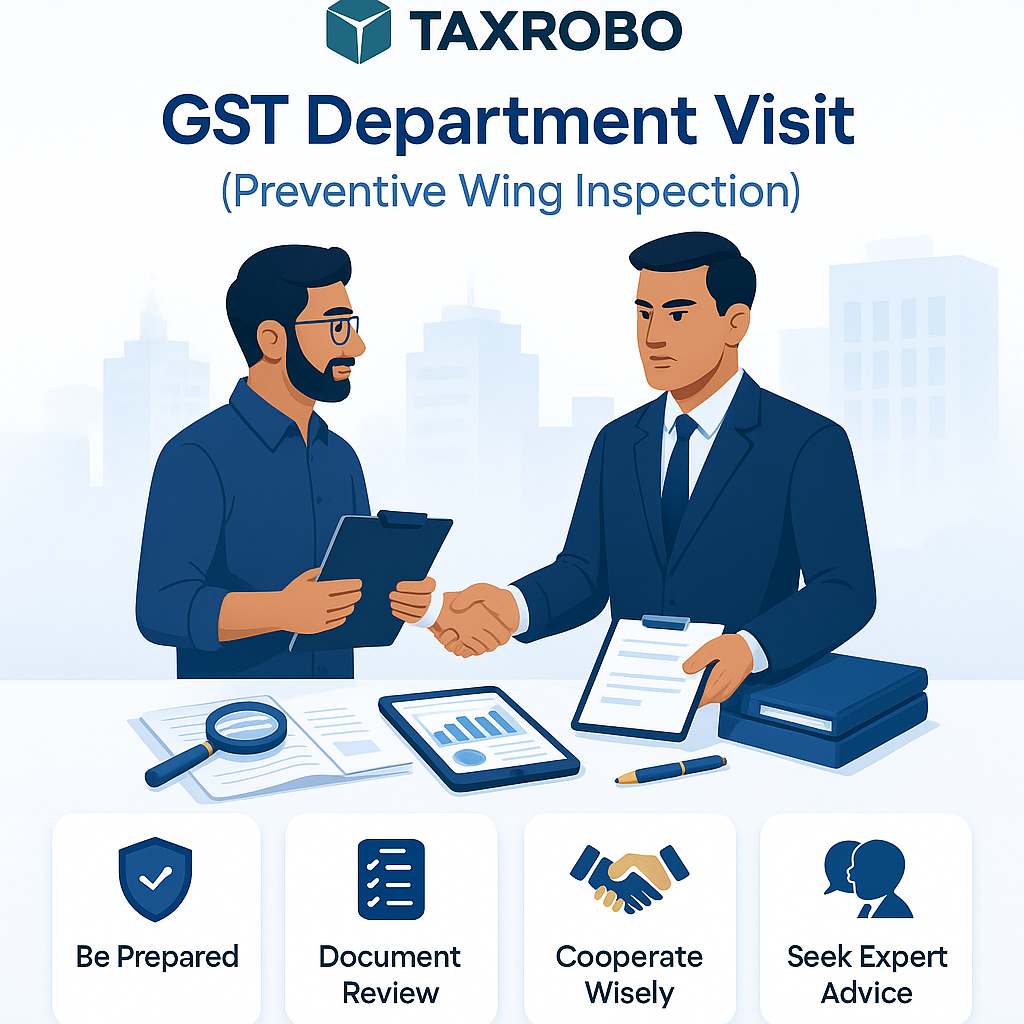
When the officers arrive, your conduct and adherence to a clear procedure can significantly influence the outcome. Staying calm, organized, and cooperative while being firm about your rights is the key to managing the situation effectively. Follow these steps to navigate the inspection professionally.
Step 1: Welcome and Verify Authority
First impressions matter. Greet the officers calmly and professionally. Offer them a comfortable and suitable place to sit, such as a conference room or an office cabin, where they can conduct their work with minimal disruption to your business operations. Before the inspection begins, you must verify their credentials. Politely request to see their official ID cards and the Authorisation Letter (Form GST INS-01). Scrutinize the letter to ensure that the business name, address, and GSTIN mentioned are correct. If there is any discrepancy, bring it to their attention immediately. Do not allow the inspection to proceed if the authorization is not for your premises.
Step 2: Cooperate and Communicate Clearly
Cooperation is non-negotiable. Provide the documents and records the officers request in a timely manner. To maintain a clear record, it is a good practice to have a staff member make a list of all the documents you hand over. Answer all questions truthfully, concisely, and to the point. Avoid the temptation to volunteer unsolicited information or speculate on matters you are unsure about. If you do not know the answer to a specific question, it is perfectly acceptable and far better to say so. You can state, “I will need to check my records for that information and will provide it to you,” rather than giving an incorrect or incomplete answer that could lead to further complications. These are some of the most practical GST preventive wing inspection tips.
Step 3: Understand the Statement and Panchnama Process
During the inspection, the officers may require you to give a formal statement, which they will record in writing. It is crucial that you read this statement very carefully before signing it. Ensure that it is an accurate and complete record of what you said. If you disagree with any part of it or feel it has been recorded incorrectly, do not sign it until the necessary corrections are made. You are legally entitled to receive a copy of the statement you have signed. Similarly, if any documents, electronic devices, or goods are seized, the officers must prepare a Panchnama. This document, prepared in the presence of two independent witnesses, lists every single item being taken into custody. Insist on a thorough review of the Panchnama and ensure you receive a signed copy before the officers leave.
Step 4: Responding to On-the-Spot Tax Demands
This is one of the most critical aspects of the GST departmental visit guidelines India. During the inspection, officers might identify certain discrepancies and, based on their preliminary findings, ask you to make an immediate payment of the differential tax, often through Form DRC-03. It is extremely important to understand that you are not legally obligated to pay any tax on the spot. You cannot be coerced or pressured into making such payments. Your response should be polite but firm. State that you will need to review their observations with your tax consultant to verify the liability. Assure them that if any tax is indeed due, you will make the payment through the proper legal channels after due verification.
After the Visit: Next Steps and Follow-Up Actions
The departure of the GST officers does not mark the end of the process. The actions you take immediately after the visit are just as important as your conduct during it. Proper follow-up ensures you are prepared for any subsequent communication from the department and can build a strong case to defend your position.
Document Everything Immediately
As soon as the officers have left your premises, you should create a detailed internal memo or report documenting the entire visit while the events are still fresh in your mind. This internal record is invaluable for future reference and for briefing your tax consultant. Your notes should include:
- The date and time of the officers’ arrival and departure.
- The names and designations of all the visiting officers.
- A comprehensive list of all the questions asked and the answers you provided.
- A detailed inventory of every document, file, or electronic device that was inspected, photocopied, or seized.
- Any verbal observations or comments made by the officers regarding potential discrepancies.
Contact Your TaxRobo Advisor
This is the moment to bring in professional expertise. Immediately contact your tax advisor or consultant. Share your detailed internal memo, along with copies of the Panchnama and any other document provided or signed during the visit. Your advisor will analyze the situation, interpret the department’s observations, and advise you on the potential implications. They will help you formulate a strategy, anticipate the department’s next move, and prepare a robust defense if necessary.
Don’t navigate complex GST matters alone. If you’ve received a notice or need expert GST compliance inspection advice, TaxRobo’s team of professionals is here to provide the support and guidance you need. Contact us today.
Prepare for Formal Communication
An inspection by the Preventive Wing is often followed by formal communication from the department. This could be in the form of a summons requiring you to appear before an officer to provide further clarification, or a Show Cause Notice (SCN) detailing the alleged non-compliance and asking you to explain why tax, interest, and penalty should not be levied. Learning How to Respond to a GST Show Cause Notice: A Step-by-Step Guide is crucial at this stage. It is crucial to monitor your dashboard on the official GST Portal for any notices. Work closely with your tax advisor to draft a timely, detailed, and legally sound reply that addresses every point raised in the notice, supported by relevant documents and legal provisions.
Conclusion
A GST department visit doesn’t have to be a crisis that disrupts your entire business. By staying prepared with organized records, knowing your legal rights, and cooperating calmly and professionally, you can handle the process effectively and with confidence. The key is to shift from a reactive state of anxiety to a proactive state of compliance. Following these GST department visit guidelines ensures that your business interests are protected while you fulfill your obligations as a responsible taxpayer. Remember, preparation and knowledge are your strongest assets in demonstrating your commitment to compliance.
Don’t navigate complex GST matters alone. If you’ve received a notice or need expert GST compliance inspection advice, TaxRobo’s team of professionals is here to provide the support and guidance you need. Contact us today.
Frequently Asked Questions (FAQs)
1. Can GST officers visit my business without any prior notice?
Answer: Yes. While formal GST audits under Section 65 are usually pre-scheduled with prior intimation, inspections by the Preventive Wing under Section 67 are often surprise visits. These are conducted when an officer, not below the rank of Joint Commissioner, has a “reason to believe” that tax evasion is taking place. However, they must always carry a valid authorization letter in Form GST INS-01.
2. What is the difference between seizure and detention of goods?
Answer: Detention is a temporary measure where the department prohibits the owner from accessing or removing certain goods while an investigation is ongoing. It is done to prevent the disposal of goods suspected to be involved in tax evasion. Seizure is a more definitive action where the department takes actual possession of goods or documents that they believe are liable for confiscation or are crucial evidence of non-compliance. A seizure memo must be provided for any seized items.
3. Am I forced to make a tax payment during the inspection?
Answer: No. You cannot be coerced or forced to make an on-the-spot tax payment during an inspection. The CBIC has issued clear instructions that recovery of tax during a search or inspection must be strictly voluntary. Any payment for discrepancies should be made via Form DRC-03 only after you have had the opportunity to verify the liability, preferably with the advice of your tax consultant.
4. Can officers search my residential premises?
Answer: Officers can only search residential premises under specific conditions. They can do so if your residence is listed as an additional place of business in your GST registration. Alternatively, if it is not a registered place of business, they can only search it if they have a specific reason to believe that goods or business records have been hidden there to evade tax, and this must be explicitly mentioned in the search authorization letter.
5. What should I do if I feel the officers are being unfair or harassing me?
Answer: It is important to remain calm and avoid any direct confrontation during the visit, as this can escalate the situation. Make a careful note of the officers’ names, designations, and specific instances of unfair conduct. After the visit is concluded, you can file a formal complaint with their senior officers (e.g., the Principal Commissioner or Chief Commissioner of GST). You can also utilize the GST Grievance Redressal Cell. Having your CA or tax consultant present, even if they arrive later, can also help ensure the process is conducted professionally.