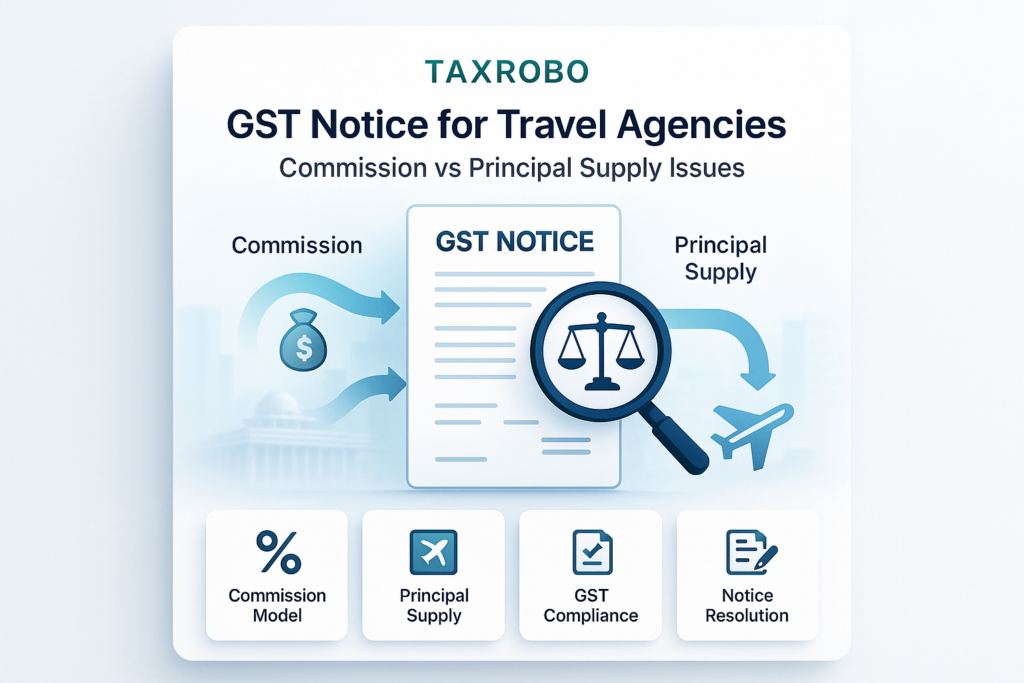

GST Notice for Travel Agencies – Commission vs Principal Supply Issues
As a travel agency owner, your focus is on creating dream vacations and seamless travel experiences for your clients. But a sudden official envelope from the tax department can quickly turn that dream into a compliance nightmare. If you’ve received a GST notice for travel agencies, you are not alone. One of the most common and complex reasons for such notices is the confusion between acting as a ‘principal supplier’ versus a ‘pure agent’. This critical distinction fundamentally changes how GST is calculated, reported, and paid. This guide will demystify the core reasons behind these notices, break down the crucial differences between commission (agent) and principal supply models, and provide actionable steps to ensure robust GST compliance for travel businesses India.
Why Do Travel Agencies Receive GST Notices? The Core Confusion
The Goods and Services Tax (GST) regime brought significant changes to how services are taxed in India, and the travel industry was no exception. The primary source of conflict and scrutiny from tax authorities stems from the dual role a travel agency can play in any given transaction. Understanding this duality is the first step toward avoiding common pitfalls and responding effectively to notices. The lack of clarity in accounting and invoicing for these distinct roles often leads to discrepancies that are easily flagged by the GSTN’s data analytics systems.
The Fundamental Misunderstanding: Agent vs. Principal
In the eyes of GST law, a travel agency can operate in one of two distinct capacities, and failing to correctly identify and account for your role is a major travel industry GST concern. Tax authorities closely scrutinize this classification because it directly impacts the taxable value of your service and the amount of tax you remit to the government.
- Principal: In this model, your agency acts as the primary seller. You procure various travel components like flights, hotel stays, local transport, and sightseeing tours, and you bundle them into a single, consolidated package. This package is sold under your agency’s name, brand, and at your own risk. You are fully responsible for the quality and delivery of all services included in the tour.
- Agent: Here, you act as a pure intermediary or a facilitator. Your role is simply to connect the customer with the end service provider, such as an airline, a hotel, or a cruise line. The main contract for the service exists directly between the customer and that provider. Your income is the commission or a service fee you charge for this facilitation service.
Common Triggers for a GST Notice
When your accounting records and GST filings do not clearly reflect the correct role for each transaction, it raises red flags. These inconsistencies are the most common triggers for a travel agencies GST notice.
- Incorrect Valuation: This is the most frequent error. An agency acting as a ‘pure agent’ might incorrectly charge GST on the entire ticket or hotel booking value instead of just their commission. Conversely, a ‘principal’ might wrongly calculate GST only on their profit margin instead of the full package price.
- Input Tax Credit (ITC) Mismatches: Claiming ITC on the GST component of a flight ticket or hotel booking when you are merely acting as an agent is a major compliance violation. As a pure agent, you are not the recipient of that service, so you are not eligible for its ITC.
- GSTR Filing Discrepancies: Significant mismatches between the turnover declared in your GSTR-1 (outward supplies) and GSTR-3B (summary return and tax payment) are automatically flagged. This often happens when reimbursements are incorrectly shown as part of your taxable turnover. Following a proper guide on How to File GST Returns Online: A Step-by-Step Guide of the GST Filing Process & Procedure can help prevent such errors.
- Incorrect Place of Supply: The travel industry involves numerous cross-state transactions. Applying the wrong GST type—CGST/SGST for intra-state transactions versus IGST for inter-state ones—can lead to scrutiny. The rules for determining the place of supply for travel-related services can be complex.
These GST issues for travel agencies India are common but can be entirely avoided with a proper understanding of the legal framework and meticulous bookkeeping.
The Principal Supply Model: When You Are the Seller
Operating under the principal model means your agency takes on greater responsibility but also has different GST obligations and benefits. This model is common for tour operators who sell pre-designed or customized holiday packages. When you are the principal, you are not just a facilitator; you are the provider of a comprehensive travel experience, and the customer holds you accountable for every component of the trip. This level of control and responsibility must be accurately reflected in your GST compliance.
What is a Principal Supply in the Travel Industry?
In a principal supply model, your travel agency procures various services from different vendors (airlines, hotels, transporters, guides) and combines them to create a unique product—a tour package. This package is then sold to the customer as a single, all-inclusive supply under your agency’s brand and invoice. The key characteristic is that you are liable for the delivery and quality of all the underlying services. The customer sees you as the single point of contact and service provider.
Example: Your agency designs and markets a ‘7-Day Golden Triangle Tour’ for a total price of ₹80,000 per person. This package includes flights, hotel accommodation, local transportation, and guided tours. Even though you are sourcing these services from third parties, you are selling the entire package to the customer under your name. In this scenario, you are unequivocally acting as the principal.
GST Implications for Principal Suppliers
The GST treatment under the principal model is straightforward but requires careful calculation and record-keeping. The primary principal supply issues travel agencies face relate to correct valuation and the proper claiming of Input Tax Credit.
- GST Calculation: As a principal, GST is levied on the full transaction value of the package. In the example above, GST would be calculated on the entire ₹80,000. The applicable GST rate for tour operator services is typically 5% without ITC or 12%/18% with ITC, depending on the nature of the services.
- Input Tax Credit (ITC) Availability: A significant advantage of the principal model is the ability to claim ITC. You can claim credit for the GST you paid on the input services procured to create the package, such as the GST paid to hotels, transport providers, and other vendors. This helps reduce your final GST liability.
- Invoicing: Your agency must issue a tax invoice to the customer for the full package amount (e.g., ₹80,000 plus applicable GST). The invoice should be under your agency’s name and GSTIN, clearly describing the service as a ‘Tour Package’.
The Pure Agent Model: When You Earn a Commission
The pure agent model is fundamentally different and is most commonly used for standalone bookings like flights or hotels. Here, your agency’s role is limited to that of a facilitator, and your revenue is strictly the commission or a service fee for the booking you enable. Mistaking this for a principal transaction is where most GST compliance issues arise, particularly concerning travel agency commission GST. Correctly identifying and invoicing under this model is crucial for avoiding tax disputes.
What Does it Mean to Act as a Pure Agent?
As a pure agent, you act as a conduit between your customer and the main service provider (e.g., Indigo Airlines or Taj Hotels). You make a payment to the third-party provider on behalf of your customer. The service itself is provided directly by that third party to your customer, and the contract for that service is between them. To qualify as a ‘pure agent’ under GST, you must satisfy all the conditions laid out in Rule 33 of the CGST Rules, 2017.
- Key Conditions to be a Pure Agent:
- You act as an agent for the recipient based on a contractual agreement.
- You do not hold any title to the goods or services procured.
- You do not use the procured services for your own interest.
- You only receive the actual amount incurred to procure the services, in addition to your commission/fee.
- The payment made to the third party is separately indicated in the invoice you issue to your customer.
Example: A customer asks you to book a flight ticket from Delhi to Mumbai. The ticket costs ₹8,000. You book the ticket on their behalf and charge a separate service fee of ₹400 for your effort. In this case, you are a pure agent.
Understanding Travel Agency Commission GST
The GST implications for a pure agent are vastly different from those of a principal supplier. The valuation of your service is the key differentiator.
- GST Calculation: GST is levied only on the value of your commission or service fee, not on the entire amount collected from the customer. In the example above, GST (typically 18%) would be calculated only on your ₹400 service fee. The ₹8,000 paid for the flight ticket is treated as a reimbursement and is excluded from your taxable value.
- Invoicing: Your invoice must be transparent. It should clearly show the actual cost of the flight ticket (₹8,000) as a reimbursement and your service fee (₹400) plus GST on the fee as a separate line item. This transparent invoicing is proof of your role as a pure agent.
- ITC: You cannot claim Input Tax Credit on the GST component of the main service you procured on behalf of the customer. In this case, you cannot claim ITC on the GST paid on the ₹8,000 flight ticket, as you are not the ultimate consumer of that service.
Here’s a quick comparison to summarize the differences:
| Feature | Principal Supply Model | Pure Agent Model |
|---|---|---|
| Role of Agency | Seller of a bundled package | Facilitator / Middleman |
| GST Calculation | On the full value of the package | On the commission/service fee only |
| ITC Claim | Can claim ITC on input services | Cannot claim ITC on the main service |
| Invoice Issued By | Travel Agency for the full amount | Travel Agency for commission + reimbursement |
| Risk & Responsibility | Lies with the travel agency | Lies with the end service provider |
Responding Effectively to a GST Notice for Travel Agencies
Receiving a notice from the GST department can be intimidating, but a calm, structured, and timely response is the best course of action. Ignoring the notice is not an option and can lead to severe consequences. The key is to understand the query, gather your evidence, and present a clear, factual reply that substantiates your business practices.
Step 1: Analyze the Notice and Don’t Panic
First, carefully read the notice to understand its nature and scope. Don’t panic. Most initial notices are for scrutiny and seek clarification.
- Identify the Notice Type: Is it a Scrutiny Notice (ASMT-10), a Show Cause Notice (SCN), or a Demand Notice? Each has different implications and response requirements.
- Understand the Reason: The notice will specify the exact discrepancy the tax officer has identified. It could be a mismatch in turnover between GSTR-1 and GSTR-3B, an incorrect ITC claim, or questions about the valuation of your services.
- Note the Deadline: Every notice has a strict deadline for submission of the reply. Mark this date and ensure you respond well within the time limit.
Step 2: Reconcile Your Records and Gather Documents
Your response is only as strong as the evidence that backs it up. Begin a thorough internal review and collect all relevant documentation for the period mentioned in the notice.
- Compile Essential Documents:
- Contracts or agreements with airlines, hotels, and other suppliers that define your role (agent or principal).
- Sample invoices issued to customers, clearly demonstrating your invoicing pattern for packages vs. standalone bookings.
- Copies of GST returns filed (GSTR-1 and GSTR-3B).
- Detailed bank statements to correlate payments received and made.
- Your complete ITC ledger and corresponding purchase invoices.
- A detailed reconciliation statement explaining any discrepancies.
Step 3: Draft a Clear and Factual Reply
Your reply should be professional, well-structured, and directly address the queries raised in the notice. Avoid vague statements and stick to the facts as supported by your documents. For a detailed walkthrough, you can refer to our guide on How to Respond to a GST Show Cause Notice: A Step-by-Step Guide.
- Structure the Reply: Address each point or query from the notice separately. Use the same numbering or lettering as in the notice for easy reference.
- State Your Business Model: Clearly explain your business model. If you use both principal and agent models, explain how you differentiate and account for them.
- Attach Supporting Documents: Annex all the documents you gathered in Step 2. Refer to each annexure in your reply to support your claims (e.g., “A sample invoice is attached as Annexure-A”).
- Cite Relevant Laws: To strengthen your case, refer to relevant provisions of the GST Act, such as Rule 33 of CGST Rules for pure agent transactions or Section 16 for ITC eligibility.
Step 4: Seek Professional Assistance
Navigating travel agencies taxation requirements and drafting responses to legal notices can be complex. An incomplete or incorrect reply can lead to confirmation of demand, penalties, and prolonged litigation. It is highly advisable to consult with a tax professional.
- CTA for TaxRobo: The experts at TaxRobo specialize in handling GST matters and can help you draft a legally sound, comprehensive response. We can represent your case before the tax authorities, ensuring a professional approach and a smooth resolution. For assistance, check your notices on the GST Portal and connect with our team.
Conclusion
The key to avoiding a GST notice for travel agencies lies in a foundational understanding of your role in every transaction. Correctly identifying your business model—whether as a principal supplier for a tour package or a pure agent for a simple booking—and maintaining meticulous, segregated records is paramount. Proper invoicing that clearly reflects your role and accurate, timely GST return filing are non-negotiable pillars of GST compliance travel businesses India. The single biggest pitfall is misclassification, which leads to a domino effect of incorrect valuation, improper ITC claims, and filing mismatches.
Don’t let GST compliance issues ground your business. Whether you need help understanding the GST implications for travel agents or have already received a notice, proactive measures and expert guidance are your best defense. For a comprehensive overview, read our guide for Travel Agents and Tour Operators – GST Compliance Simplified. Contact TaxRobo’s GST Service today for expert guidance and the peace of mind to focus on what you do best—creating unforgettable travel experiences.
Frequently Asked Questions
Frequently Asked Questions
- Q: Can my travel agency use both the principal and agent models simultaneously?
- A: Yes, absolutely. Many travel agencies operate on a hybrid model. The critical requirement is to maintain separate and clear accounting and documentation for each type of transaction. Your invoices must distinctly show whether you are acting as a principal (for a tour package with a single price) or an agent (showing the actual cost as reimbursement and your service fee separately), as the GST treatment is completely different for each.
- Q: What is the standard GST rate on commission for a travel agent?
- A: The services provided by a travel agent fall under SAC (Services Accounting Code) 9985. The GST rate applicable to the commission or service fee earned by the agent is 18%. This is levied as 9% CGST + 9% SGST for intra-state supplies and 18% IGST for inter-state supplies.
- Q: I received a GST notice for travel agencies about a mismatch between my GSTR-1 and GSTR-3B. What should I do?
- A: First, conduct an immediate internal reconciliation of your sales records, e-way bills (if any), and books of accounts against the data filed in both GSTR-1 and GSTR-3B for the tax period in question. Identify the source of the error—it could be a clerical mistake, an invoice reported in GSTR-1 but not accounted for in GSTR-3B tax payment, or an amendment made in a subsequent month. Prepare a detailed reconciliation statement with a clear explanation for the difference and submit it as part of your formal reply to the notice.
- Q: What are the consequences of ignoring a GST notice?
- A: Ignoring a GST notice is a serious lapse in compliance and can lead to severe consequences. The tax officer may proceed to pass an ex-parte (one-sided) order based on the information they have, confirming the tax demand against you. This can result in the levying of heavy penalties and interest, and the department can initiate recovery proceedings, which may include freezing your bank accounts and attaching property. It is crucial to respond professionally within the stipulated time.