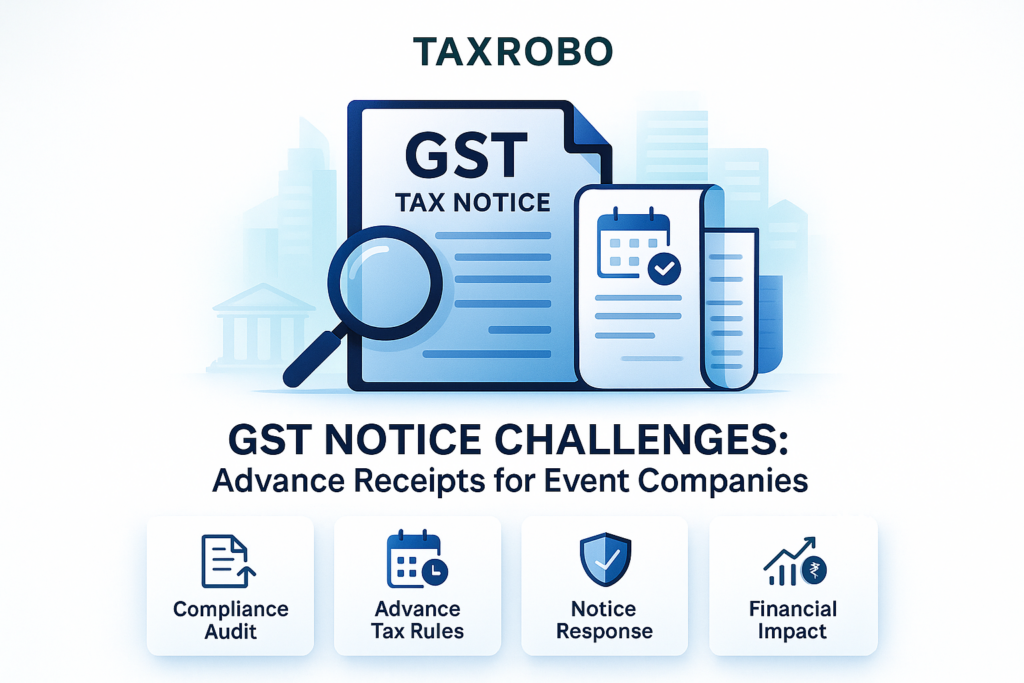

GST Notice for Event Management Companies – Advance Receipt Tax Issues
The event management industry in India is a vibrant, growing sector filled with creative entrepreneurs. Turning a passion for planning into a successful business is a common dream, but this exciting journey often comes with complex administrative hurdles. One of the most significant challenges is navigating GST compliance. For many, the dream can turn into a nightmare upon receiving a dreaded GST notice event management companies frequently encounter, often due to confusion surrounding advance payments. These official communications can be intimidating, but they are usually a result of simple, avoidable mistakes. This guide will demystify GST on advance receipts, explain why these notices are issued, and provide a clear roadmap on how to manage your tax obligations effectively, helping you avoid common GST challenges in event management.
Understanding GST Basics for Event Planners
Before diving into the complexities of notices and advance payments, it’s essential to have a firm grasp of the fundamental GST principles that apply to your event management business. Getting these basics right is the first and most crucial step toward seamless tax compliance. Think of this as the foundation upon which your entire financial structure is built; a weak foundation can lead to significant problems down the line.
What is “Event Management” as a Service Under GST?
Under the Goods and Services Tax (GST) regime, “Event Management” is classified as a service. This means that every time you provide your planning, coordination, and execution services to a client, you are liable to charge GST. This service is categorized under a specific Service Accounting Code (SAC), which is 998596 for “Events, exhibitions, conventions and trade shows organization and assistance services.” The standard rate of GST applicable to these services is 18%. This tax must be collected from your client on the taxable value of your service and deposited with the government.
CGST, SGST, and IGST: What’s the Difference for Your Event?
The 18% GST you charge is not a single tax; it’s split into different components based on the location of your business and your client. Understanding this distinction is vital for correct invoicing and filing.
- CGST (Central GST) + SGST (State GST): This combination applies to intra-state transactions. For instance, if you are
handling GST for events Delhiand your business is registered in Delhi and your client is also located in Delhi, you will charge 9% CGST and 9% SGST on your invoice. - IGST (Integrated GST): This single tax applies to inter-state transactions. Using the same example, if your business is in Delhi but you are organizing an event for a client registered in Mumbai, you will charge a single 18% IGST on your invoice.
The Critical Concept: “Time of Supply”
This is perhaps the most important concept to understand, as it is the root cause of issues related to advance payments. In simple terms, the “Time of Supply” determines the exact point in time when the GST liability arises, meaning the moment you become responsible for paying the tax to the government. Under GST law, the time of supply for services is the earlier of the following two dates:
- The date on which you issue your invoice to the client.
- The date on which you receive the payment (full or partial) from the client.
This “earlier of” rule means that your tax liability is triggered the moment your client’s advance payment hits your bank account, even if the event is months away and you haven’t issued a final invoice yet.
The Core Problem: GST on Advance Receipts
The concept of “Time of Supply” directly leads us to the central issue that triggers most GST notices for event planners: the tax treatment of advance payments. In the event industry, receiving an advance to block dates, book vendors, and begin planning is standard practice. However, many business owners mistakenly believe that GST is only payable after the event is completed and the final invoice is raised. This misunderstanding is a significant compliance gap.
Why GST is Charged on Advances: The Official Guidelines
The requirement to pay GST on advance payments isn’t a suggestion; it’s a legal mandate. The advance receipt tax guidelines India are clearly laid out in the CGST Act, 2017. Specifically, Section 12(2)(a) of the Act states that the time of supply of services shall be the date of issue of invoice or the date of receipt of payment, whichever is earlier. Because the law prioritizes the date of payment receipt, your GST liability is triggered as soon as you receive an advance. The government’s logic is that the receipt of consideration (money) marks the beginning of the taxable event, and therefore, the tax should be paid in that corresponding tax period.
How to Calculate and Pay GST on an Advance Received
Calculating the GST on an advance is straightforward. You must treat the advance amount as inclusive of GST and work backward to determine the taxable value, or simply calculate GST on the gross advance amount if it’s treated as the base value. Here is a clear numerical example:
- Total Event Contract Value: ₹2,00,000 + GST
- Advance Received (50%): ₹1,00,000
- Applicable GST Rate: 18%
Calculation:
- GST payable on the advance = 18% of ₹1,00,000
- GST Amount = ₹18,000
This ₹18,000 is not your money to keep. It must be declared in your GST return for the month you received the advance and paid to the government by the due date. When you issue the final invoice, you will only charge GST on the remaining balance.
The Most Important Document: The Receipt Voucher
Merely paying the tax is not enough; you must also issue the correct documentation. Whenever you receive an advance payment, you are legally required to issue a Receipt Voucher to your client. This is a formal document acknowledging the receipt of an advance and is different from a tax invoice. A proper receipt voucher must contain the following mandatory details:
- Your business name, address, and GSTIN.
- A consecutive serial number.
- Date of issue.
- Client’s name, address, and GSTIN (if registered).
- Description of the services.
- Amount of advance received.
- The rate of tax (CGST, SGST, IGST).
- The amount of tax charged on the advance.
- Place of supply.
Actionable Tip: To avoid manual errors and ensure compliance, use modern accounting software. Most platforms can automatically generate compliant receipt vouchers and help you track your tax liabilities on advances.
Decoding a GST Notice for Event Management Companies
Receiving an official notice from the tax department can be stressful, but understanding why you received it is the first step toward resolving it. A GST notice event management companies receive is often a data-driven inquiry pointing to a specific mismatch or non-compliance issue. Panicking is counterproductive; a methodical approach is key.
Top 3 Reasons Event Planners Receive a GST Notice
While there can be various reasons for a notice, the vast majority of event management companies tax issues related to GST boil down to these three common mistakes:
- Mismatch in GSTR-1 and GSTR-3B: This is the most common trigger. You might receive an advance in your bank account but forget to declare it as a liability in your GSTR-1 and subsequently fail to pay the tax on it in your GSTR-3B. The GST department’s systems are designed to flag these discrepancies between your declared liabilities and your tax payments.
- Failure to Issue Receipt Vouchers: During a departmental audit or assessment, the tax officer will scrutinize your bank statements. If they see large credit entries that correspond to advance payments but cannot find corresponding receipt vouchers or tax payments in your records, it raises a red flag for tax evasion.
- Incorrect Input Tax Credit (ITC) Claims: While not directly related to advances, event planners often make purchases for events (decor, rentals, etc.) and claim ITC. A notice can be issued if you claim ITC on items that are not eligible (e.g., food and beverages, unless part of a composite supply) or if the ITC claimed does not match the details filed by your supplier in their GSTR-1.
Your Action Plan: What to Do When You Get a Notice
If a GST notice lands in your inbox, follow this structured action plan to address it systematically and professionally.
- Don’t Panic, Verify First: The first step is to remain calm. Before taking any action, verify the authenticity of the notice. Log in to your account on the official GST Portal and check the “View Notices and Orders” section to confirm that the notice is genuine.
- Read Carefully and Understand: Read the notice thoroughly multiple times. Identify the exact reason for the notice, the specific tax period in question, and the discrepancy they have pointed out. Understanding the core issue is critical for drafting an effective reply.
- Gather Your Documents: This is your evidence. Compile a complete file of all relevant documents for the period mentioned in the notice. This should include tax invoices, receipt vouchers, credit/debit notes, bank statements showing the transactions, and copies of the GSTR-1 and GSTR-3B you filed.
- Draft a Professional Reply: Prepare a clear, concise, and point-by-point response to the queries raised in the notice. Address each allegation or discrepancy separately. Attach supporting documents as annexures and reference them clearly in your reply.
- Seek Expert Help: This is the most crucial step. A GST notice for event management can have serious financial implications if not handled correctly. Consulting a tax professional, like the experts at TaxRobo, is highly recommended. A professional can ensure your reply is legally sound, accurate, and submitted within the stipulated deadline, significantly increasing your chances of a swift resolution.
Proactive Steps for Better Tax Compliance for Event Planners
The best way to deal with a GST notice is to prevent it from being issued in the first place. Adopting proactive and disciplined financial habits is the key to long-term tax compliance for event planners. By implementing robust systems from the start, you can focus on what you do best—creating amazing events—without the constant worry of tax issues.
Best Practices for Documentation and Invoicing
Your documentation is your first line of defense in any tax matter. Make it a non-negotiable rule in your business to issue the correct document at the right time.
- Immediately Issue a Receipt Voucher: The moment an advance payment is credited to your account, generate and send a GST-compliant Receipt Voucher to your client.
- Issue a Tax Invoice for Milestones/Completion: When a specific part of the service is completed or upon the final delivery of the event, issue a proper Tax Invoice. This invoice should clearly show the total value, the advance already received (and tax paid on it), and the final balance amount on which GST is now due.
Mastering the Event Management Tax Filing Process
Understanding how to correctly report these transactions in your monthly GST returns is essential. The event management tax filing process for advances has specific fields that must be filled out correctly.
- Declaring Advances in GSTR-1: All advances received during a tax period must be declared in Table 11A of your Form GSTR-1. This table requires you to provide details of the advances received on which tax is payable.
- Paying the Tax in GSTR-3B: The tax liability calculated on these advances is then added to your total output tax liability for the month and paid through Form GSTR-3B.
- Adjusting Advances: When you later issue the final invoice against this advance, you need to report it in Table 11B of GSTR-1 to adjust the advance and avoid double taxation.
The Power of Monthly Reconciliation
Do not wait for the end of the year to review your books. Make it a monthly practice to reconcile your accounts.
- Bank Statement vs. Books: Compare every credit in your bank statement with your accounting records to ensure every single revenue entry is accounted for.
- Books vs. GST Returns: Cross-check the sales and advances recorded in your books with the figures you have declared in your GSTR-1 and GSTR-3B. This simple monthly check can help you catch discrepancies before they are flagged by the tax department, saving you immense time, money, and stress.
Conclusion
Navigating the complexities of GST can seem daunting for creative entrepreneurs in the event management industry. However, the rules surrounding advance receipts are clear: GST is payable the moment you receive the money. By understanding this fundamental principle, maintaining meticulous documentation like Receipt Vouchers, and adopting a proactive approach to monthly reconciliation, you can significantly reduce your risk of facing a GST notice event management companies so often dread. Proper compliance is not just about avoiding penalties; it’s about building a strong, sustainable, and professional business.
Feeling overwhelmed by GST compliance? Received a notice and don’t know where to start? The experts at TaxRobo are here to help. From GST registration and filing to professional notice reply services, we’ve got you covered. Contact us today for a consultation and let us handle the tax complexities so you can focus on creating unforgettable events.
FAQs
Q1. What is the current GST rate for event management services in India?
A: The standard GST rate for event management services is 18%, categorized under SAC 998596. This rate is applicable to the taxable value of the services you provide.
Q2. What happens if an event is cancelled after the client has paid an advance and I have already paid GST on it?
A: If an event is cancelled and you refund the advance to the client, you are entitled to get the GST back. You can do this by issuing a credit note to the client for the advance amount and the GST. This credit note is then declared in your GSTR-1 for the month, which will reduce your overall tax liability, effectively adjusting the tax you had already paid.
Q3. Do I need to issue a separate receipt voucher for every small advance payment received?
A: Yes. As per GST law, a receipt voucher must be issued for any and every advance payment received against a service, regardless of the amount. This is a critical compliance requirement that helps maintain a clear audit trail and ensures you correctly calculate and pay tax on all receipts.
Q4. How can TaxRobo help me if I receive a GST notice for event management?
A: TaxRobo provides end-to-end assistance. Our process begins with a thorough analysis of the notice to understand the department’s query. We then review your documentation, GST filings, and financial records to identify the root cause. Based on this, our team of experts will draft a legally sound, comprehensive, and factual reply on your behalf and guide you on submitting it to the GST authorities, ensuring a swift and favourable resolution.