
A Complete Guide to Replying to a GST Notice for E-Invoice GSTR-1 Mismatch
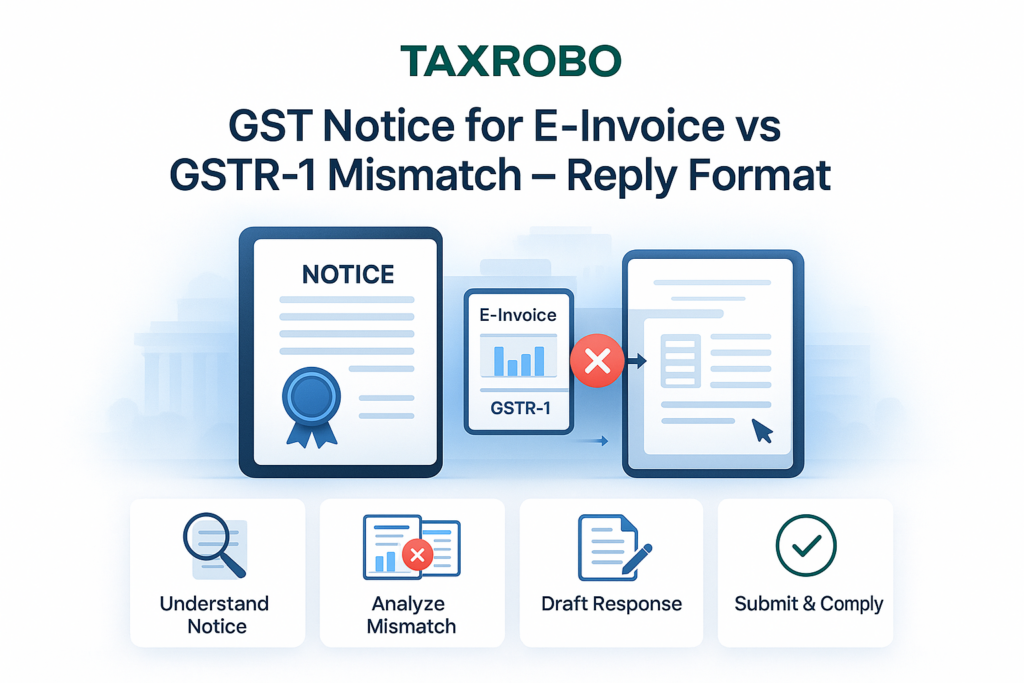
Receiving a notice from the GST department can be stressful for any business owner. One of the most common notices today is regarding an E-Invoice GSTR-1 mismatch, which can cause significant anxiety if you don’t know how to handle it. This notice is issued when the sales data reported in your GSTR-1 return does not match the data from your e-invoices generated on the Invoice Registration Portal (IRP). A timely and accurate response is not just a formality; it’s a critical step to avoid penalties, further scrutiny, and potential disruption to your business operations. This article provides a comprehensive guide and a ready-to-use E-Invoice GSTR-1 mismatch reply format India to help you navigate the process confidently. We’ll cover everything from understanding the root cause of the mismatch to drafting a professional, effective reply that satisfies the authorities.
What Exactly is an E-Invoice GSTR-1 Mismatch?
To effectively address a mismatch notice, it’s essential to first understand the components involved and how they interact. For many business owners, the relationship between e-invoicing and GSTR-1 filing can be confusing. This section breaks down the core concepts to provide clarity, helping you pinpoint where things might have gone wrong. A clear understanding is the first step in formulating a successful reply to GSTR-1 mismatch notice India, ensuring you can explain the situation accurately to the tax officer.
A Quick Refresher: E-Invoicing and GSTR-1
E-invoicing is a system mandated by the government for businesses exceeding a certain turnover threshold. Under this system, all specified B2B (Business-to-Business) invoices must be electronically authenticated by the GST Network (GSTN) before being issued to the customer. Each invoice is assigned a unique Invoice Reference Number (IRN) by the Invoice Registration Portal (IRP). This process standardizes invoicing and allows for real-time tracking of transactions by the tax department, preventing tax evasion.
GSTR-1, on the other hand, is the monthly or quarterly return that a registered taxpayer files to declare all their outward supplies, or sales. It is a detailed summary of all invoices, debit notes, credit notes, and revised invoices issued during a specific tax period. The connection between these two is direct and automated: for businesses under the e-invoicing mandate, the data from the IRP is supposed to be auto-populated into the relevant tables of the GSTR-1. An E-Invoice GSTR-1 mismatch occurs when the final data filed in your GSTR-1 does not align with this auto-populated data from the IRP, triggering a notice from the department.
Common Reasons for an E-Invoice GSTR-1 Mismatch
Discrepancies can arise for a variety of reasons, ranging from simple human error to complex technical issues. Identifying the specific cause is crucial for drafting an accurate reply. Here are some of the most common reasons behind a mismatch:
- Manual Errors: This is the most frequent cause. It includes mistakes like manually adding an invoice in GSTR-1 that was already generated through the e-invoicing portal, leading to duplication. Conversely, failing to manually add invoices that are not covered by e-invoicing (like B2C sales) can also cause discrepancies.
- Technical Glitches: Sometimes, there can be a delay or failure in the transmission of data from the IRP to the main GSTN portal. This can result in e-invoice data not appearing in the auto-populated GSTR-1 tables, forcing a taxpayer to enter it manually, which might lead to errors.
- Amendments & Cancellations: Incorrect procedures for corrections are a major source of mismatches. For instance, if you need to amend an e-invoice, you cannot change it directly on the IRP after 24 hours. The correct procedure is to cancel the original e-invoice within 24 hours and issue a new one, or issue a debit/credit note later. Making amendments directly in the GSTR-1 without following this protocol creates a mismatch.
- Incorrect Reporting: Miscategorizing sales can lead to significant issues. For example, reporting a B2B transaction (which requires an e-invoice) as a B2C transaction (which does not) in the GSTR-1 will create a clear discrepancy with the IRP data.
- Time Lag: Discrepancies can also arise due to timing differences. An e-invoice might be generated on the last day of a month, but due to delays, it might get accounted for in the next month’s GSTR-1, leading to a temporary mismatch for the given tax period.
The Consequences of Ignoring a Mismatch Notice
Ignoring a GST notice is never a good idea. The department’s systems are designed to flag inconsistencies, and a lack of response is interpreted as an admission of non-compliance. The consequences can be severe and can escalate quickly, impacting your business’s financial health and operational stability. Understanding these risks underscores the importance of preparing a diligent GSTR-1 E-Invoice notice response India.
- Increased Scrutiny: The initial notice is often a system-generated alert (Form ASMT-10) for preliminary discrepancies. Ignoring it signals to the tax authorities that your accounts may not be in order, which can trigger a more detailed investigation or a full-fledged departmental audit.
- Penalty and Interest: If the mismatch resulted in a short payment of taxes, the GST Act has provisions for levying penalties for incorrect return filing, along with interest on the tax deficit. These financial penalties can accumulate and become a significant liability.
- Impact on ITC for Recipient: This is a critical business consequence. If your GSTR-1 data is incorrect, it directly affects your customer’s ability to claim Input Tax Credit (ITC), as their GSTR-2A/2B will not reflect the transaction correctly. This can lead to disputes and damage valuable business relationships.
- Disruption of Operations: In cases of persistent non-compliance or significant discrepancies, the GST authorities have the power to take stringent measures. This can include blocking the generation of E-way bills, which would effectively halt the movement of your goods and bring your supply chain to a standstill.
Step-by-Step Guide: How to Prepare Your Reply to a GSTR-1 Mismatch Notice
A structured and methodical approach is key to resolving the notice effectively. Panicking or sending a vague reply can complicate the matter. Follow these steps to prepare a comprehensive and convincing response.
Step 1: Analyze the GST Notice (ASMT-10)
The first step is to read the notice you’ve received, which is typically in Form GST ASMT-10, with utmost care. Do not rush this step. The notice will contain crucial details that form the basis of your reply. Look for the following information:
- Discrepancy Details: The notice will specify the exact tax period (e.g., April 2023) in which the mismatch was found.
- Specific Invoices: It will often list the specific invoice numbers, dates, and amounts that are in question.
- Amount of Mismatch: The notice will quantify the difference in taxable value and tax amounts (CGST, SGST, IGST) between your e-invoice data and GSTR-1 data.
- Deadline for Reply: Note the due date for submitting your response. Missing this deadline can lead to further action.
Step 2: Reconcile Your Data Thoroughly
Once you understand what the department is asking, your next task is to conduct a detailed internal reconciliation to find the source of the discrepancy. This is the most critical part of your preparation.
- Download Reports:
- Go to the GST Portal and download your filed GSTR-1 data for the specified period.
- Log in to the E-Invoice Portal (IRP) or use your ERP/accounting software to download a detailed report of all e-invoices generated during the same period.
- Compare Line-by-Line: Use a spreadsheet tool like Microsoft Excel or Google Sheets to place the two data sets side-by-side. Create columns for Invoice Number, Invoice Date, Taxable Value, CGST, SGST, and IGST for both GSTR-1 and the e-invoice report. Compare each entry meticulously.
- Pinpoint the Cause: This comparison will help you identify the exact reason for each mismatch. For example, you might find an invoice that exists in the e-invoice data but is missing from GSTR-1, or an invoice where the taxable value was manually entered incorrectly in GSTR-1. Document the reason for each specific mismatch clearly.
Step 3: Compile Your Supporting Documents
Your reply is only as strong as the evidence you provide to support it. A well-documented submission shows the tax officer that you are diligent and transparent. Gather the following documents to attach with your reply:
- A scanned copy of the GST notice (ASMT-10) that you received.
- Your detailed reconciliation statement prepared in Step 2, preferably in both Excel and PDF format. This statement should clearly explain the reason for every single discrepancy.
- Scanned copies of the tax invoices and their corresponding e-invoices (with IRN and QR code) that were pointed out in the notice.
- Copies of any relevant credit notes or debit notes issued for those transactions.
- If you have already taken corrective action (e.g., paid the differential tax through Form DRC-03 or made a correction in a subsequent GSTR-1), include proof of such action.
E-Invoice GSTR-1 Mismatch Reply Format (Template)
Once your analysis is complete and your documents are ready, you can draft the reply. This GSTR-1 correction notice reply format is a template that can be adapted to your specific situation. Always present your reply on your official company letterhead for a professional presentation.
[Your Company Letterhead]
Date: [Date of Reply]
To,
The Proper Officer,
[Designation of the Officer],
[Jurisdiction/Address of the GST Office as per notice]
From,
[Your Company Name]
[Your Company Address]
GSTIN: [Your GSTIN]
Reference No: [Notice Reference Number/DIN from the notice]
Dated: [Date of the Notice]
Subject: Reply to GSTR-1 mismatch notice concerning E-Invoice data for the tax period [e.g., April 2023]
Respected Sir/Madam,
This is with reference to the notice cited above, which we received on [Date of Receipt], regarding certain discrepancies observed between the data auto-populated from the E-Invoice system and the data reported in our filed GSTR-1 for the period [Tax Period].
We have carefully reviewed the notice and have conducted a thorough internal reconciliation of our records. The findings and explanations for the pointed-out discrepancies are presented below for your kind perusal.
[Option 1: If there was a genuine error]
We acknowledge the mismatch and the reason for the same is [e.g., a clerical error during data entry / a technical glitch where data was not auto-populated]. We have taken the following corrective action: [e.g., The shortfall/excess tax has been paid via Form DRC-03 (copy enclosed) / The correction has been made in the GSTR-1 for the month of [Month, Year]].
[Option 2: If there was no error and the notice is incorrect]
We have reconciled our data and have found no discrepancies. The data filed in our GSTR-1 is accurate and complete. A detailed reconciliation sheet is attached as Annexure-A to substantiate our claim and explain the perceived differences.
Summary of Reconciliation:
(Use a table to clearly present the findings)
| Invoice No. | As per E-Invoice Portal (Value) | As per GSTR-1 Filed (Value) | Reason for Difference |
|---|---|---|---|
| INV-001 | ₹10,000 | ₹10,500 | Clerical error in GSTR-1, corrected via Debit Note No. DN-01. |
| INV-002 | ₹5,000 | ₹0 | Data not auto-populated from IRP. Manually added in GSTR-1 of next month. |
We have attached the following documents for your verification:
1. Detailed Reconciliation Statement (Annexure-A)
2. Copies of relevant Tax Invoices and E-Invoices (Annexure-B)
3. Proof of corrective action, if any (DRC-03 Challan / Subsequent GSTR-1 screenshot) (Annexure-C)
In light of the above facts and supporting documents, we humbly request your good office to review our submission and consider this matter as resolved. We request you to kindly drop the proceedings initiated by the aforementioned notice.
We assure you of our full cooperation.
Thanking you.
Yours faithfully,
For [Your Company Name]
(Authorized Signatory)
[Name of Signatory]
[Designation]
Proactive Steps to Avoid Future Mismatches
Receiving a notice is a learning opportunity. The best way to handle notices is to prevent them from being issued in the first place. By implementing robust internal processes, you can significantly reduce the chances of future mismatches and ensure smooth compliance. A key part of this is understanding The Importance of Accurate Record-Keeping to Prevent GST Demand Notices.
- Use Integrated Software: The era of manual data entry is prone to errors. Invest in good accounting or ERP software that seamlessly integrates e-invoicing and GST return filing. Automation minimizes manual intervention and ensures data consistency across platforms.
- Regular Reconciliation: Do not wait for a notice from the department. Make it a mandatory monthly practice to reconcile GSTR-1 data with e-invoice data before filing the return. This allows you to catch and correct discrepancies proactively.
- Standard Operating Procedures (SOPs): Create and implement clear SOPs for your accounting team. This should cover the correct procedures for generating e-invoices, handling cancellations, issuing debit/credit notes, and making amendments. Following a proper E-Invoice compliance response format India starts with strong internal discipline.
- Verify Auto-Populated Data: Never blindly trust auto-populated data. Always cross-verify the information populated from the IRP into your GSTR-1 with your internal sales records before submitting the return. This final check can prevent most common errors.
Conclusion
Responding to an E-Invoice GSTR-1 mismatch notice doesn’t have to be a daunting task. If approached systematically, it is a manageable process. The key is to act promptly and professionally. Remember the crucial steps: carefully analyze the notice, conduct a thorough data reconciliation to find the root cause, draft a clear and factual reply using a proper format, and submit it along with all necessary supporting documents before the deadline. Timely and accurate compliance is not just about avoiding penalties; it’s fundamental for maintaining a healthy GST compliance rating, building trust with the tax authorities, and ensuring smooth business operations.
Navigating the complexities of GST notices can be challenging. If you need expert assistance in drafting a professional reply, conducting detailed reconciliations, or streamlining your overall GST compliance, contact the experts at TaxRobo today. We provide end-to-end GST solutions for businesses across India, ensuring you stay compliant and stress-free.
Frequently Asked Questions (FAQ)
1. What is the time limit to reply to a GST notice for GSTR-1 mismatch?
Typically, the time limit to reply to a notice in Form ASMT-10 is within 15 to 30 days from the date of service of the notice. The exact deadline will be clearly mentioned in the notice itself. It is crucial to adhere to this timeline to avoid any adverse action from the department.
2. Can I revise my GSTR-1 to correct a mismatch after filing?
No, a GSTR-1 return, once filed, cannot be revised. However, the GST law allows you to correct any mistakes or omissions in the GSTR-1 of a subsequent tax period. You can learn more about How to Correct Errors in Your GST Returns in our detailed guide. For example, an invoice missed in April’s GSTR-1 can be added in May’s return. You should clearly mention this corrective action in your notice reply.
3. What happens if my reply is not accepted by the GST officer?
If the proper officer is not satisfied with your explanation or the documents you have provided, they may proceed with further action. This could involve issuing a show-cause notice (SCN) under Section 73 (for non-fraud cases) or Section 74 (for fraud cases) of the CGST Act, which can lead to formal demand and recovery proceedings. For a detailed walkthrough on this next step, see our guide on How to Respond to a GST Show Cause Notice: A Step-by-Step Guide.
4. Where do I submit the reply to the GST notice online?
The reply to the notice (which should be filed in Form ASMT-11) must be submitted electronically on the official GST Portal. To do this, you need to log in to your GST account and navigate to Services > User Services > View Additional Notices/Orders. Here you will find the notice and an option to “Reply”. You can then upload your detailed explanation and supporting documents.
5. Is it mandatory to get professional help to reply to a GST notice?
While it is not legally mandatory, it is highly recommended. A tax professional, such as a Chartered Accountant or a GST Practitioner, has the expertise to understand the nuances of the law and can help ensure your reply is accurate, comprehensive, and legally sound. Following proper GST notice reply guidelines India with professional help minimizes the risk of your reply being rejected and protects you from further legal complications.