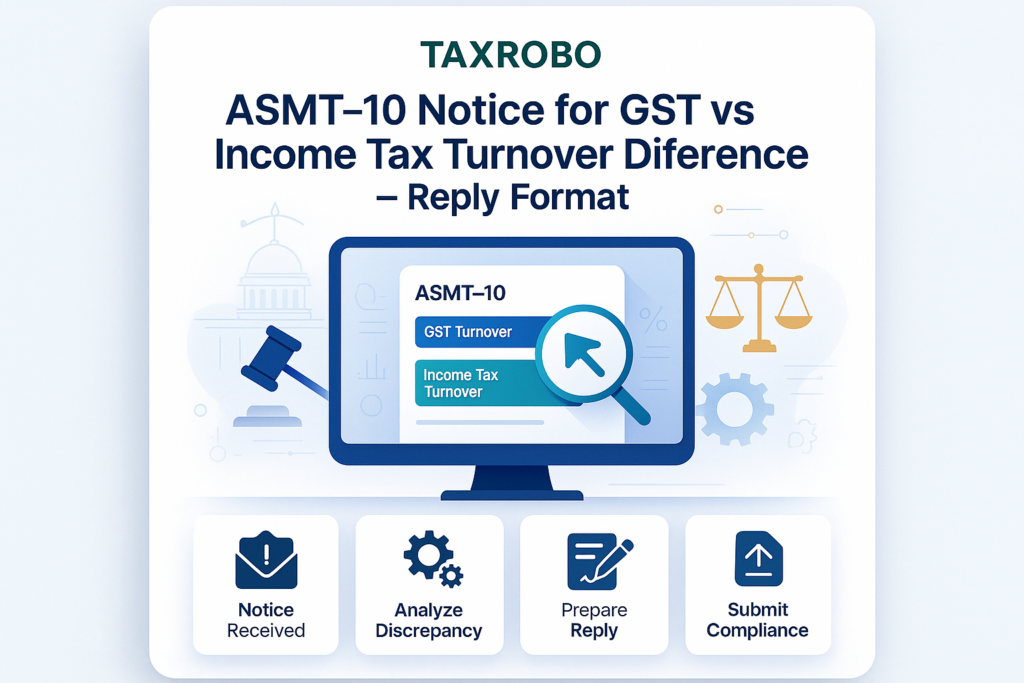

ASMT-10 Notice for GST vs Income Tax Turnover Difference – Reply Format
Received a GST ASMT-10 notice? You’re not alone. This notice often points to a mismatch between your GST returns and your Income Tax Return (ITR), and understanding how to respond is crucial. The central issue authorities scrutinize is the income tax turnover difference, a common compliance check the tax department uses to ensure transparency between your various filings. This comprehensive guide will demystify the ASMT-10 notice, break down the common reasons for these discrepancies, and provide a clear, actionable reply format for ASMT-10 notice. We’ll also cover the essential guidelines for ASMT-10 notice in India to help you navigate this process confidently. This article is designed for small business owners, freelancers, and even salaried individuals who may have other sources of income reported in their ITR.
Understanding ASMT-10 Notice in India
Receiving any official communication from the tax department can be unsettling, but it’s important to approach it with clarity and knowledge. The ASMT-10 notice is a preliminary step in the scrutiny process, giving you an opportunity to explain your position before any further action is taken. Understanding its purpose is the first step toward a successful resolution. It’s less of an accusation and more of a request for information, designed to ensure that the data across different tax platforms is consistent and accurate. A broader understanding of How to Handle GST Notices – ASMT-10, DRC-01, DRC-07 Explained Simply can provide valuable context.
What is Form GST ASMT-10?
Form GST ASMT-10 is fundamentally a scrutiny notice, not a demand notice. This is a critical distinction. It is an inquiry from a GST officer asking for clarification on discrepancies, errors, or omissions they have found while examining your GST returns. This notice is issued under Section 61 of the Central Goods and Services Tax (CGST) Act, which empowers the proper officer to scrutinize a registered person’s returns and related particulars to verify their correctness. The goal of understanding ASMT-10 notice in India is to recognize it as the department’s first move to seek justification for any irregularities they have flagged. It provides you with a formal opportunity to explain any differences and submit supporting documents, potentially resolving the matter without it escalating to a show-cause notice or a demand order.
Why the Focus on GST vs. Income Tax Turnover Comparison?
In the current data-driven tax administration era, tax authorities leverage powerful analytics tools to cross-verify information submitted across different tax filings. They systematically compare the turnover you have declared in your GST returns (like GSTR-1, GSTR-3B, and the annual GSTR-9) with the turnover, revenue, or gross receipts declared in your Income Tax Returns (ITR) and the data available in your Form 26AS. A significant income tax turnover difference acts as a major red flag for the system, suggesting potential tax evasion or incorrect reporting. This automated income tax turnover comparison is one of the primary methods the department uses to identify taxpayers who may be under-reporting their sales in GST while correctly declaring them in their income tax filings, or vice versa. Understanding the nuances of Income Tax vs. GST: What Every Business Owner Should Know is crucial for all business owners. Therefore, this notice is a direct consequence of the department’s effort to create a 360-degree profile of a taxpayer and ensure that all financial declarations are harmonized.
Common Reasons for an Income Tax Turnover Difference
Before you begin drafting a reply, it’s crucial to identify the root cause of the discrepancy. In many cases, the difference is not due to tax evasion but arises from legitimate accounting, reporting, and legal distinctions between GST and Income Tax laws. Understanding these common reasons will help you prepare a precise and effective reconciliation statement.
Reporting and Timing Differences
One of the most frequent reasons for a mismatch is the difference in the timing of revenue recognition between GST and income tax. Under GST, the “time of supply” rules dictate when a transaction must be reported. For instance, an advance received for goods or services must be reported in your GSTR-1 for the month it was received, and GST must be paid on it. However, for income tax purposes, this advance might not be recognized as revenue in your Profit & Loss account until the service is rendered or the goods are delivered. Similarly, a supply might be completed at the end of a financial year (e.g., March 31st), but the invoice is raised in the next financial year (e.g., April 1st). This creates a temporary mismatch between the GST turnover of one financial year and the ITR turnover of the same year.
Inclusion of Non-GST Supplies in ITR
This is perhaps the most common and easily explainable reason for a higher turnover in your ITR compared to your GST returns. Your Income Tax Return requires you to report all sources of income, many of which are not subject to GST. This creates a natural and legitimate income tax turnover difference.
- Interest income from bank savings accounts, fixed deposits (FDs), or loans given.
- Rental income from a residential property, which is exempt from GST.
- Sale of fixed assets or investments, which results in Capital Gains and is reported in the ITR but is not a part of your regular business turnover for GST purposes.
- Dividend income from shares or mutual funds.
- Other exempt supplies or “No Supply” items that are part of your financial statements but are outside the ambit of GST.
Treatment of Credit/Debit Notes
The accounting treatment of sales returns and discounts can also lead to discrepancies. When a customer returns goods, you issue a credit note, which reduces your taxable turnover for GST in the month it is issued. However, in your financial statements for income tax, sales returns might be shown as a separate deduction from gross sales. If the credit note for a sale made in March is issued in April, it will reduce your GST liability in the next financial year but may have already been accounted for as a sales return in the financial year ending in March. The timing of these adjustments can cause temporary differences that require clear reconciliation in your ASMT-10 notice format India response.
For Salaried Individuals: Why Did I Get This Notice?
The keyword income tax implications for salaried individuals becomes relevant when a person with a regular job (and a Form 16) also has a side business or freelance income. For example, if you are a salaried IT professional who also does freelance web development work, you declare your salary income under “Salaries” and your freelance income under “Profits and Gains from Business or Profession” in your ITR-3 or ITR-4. If your freelance turnover exceeds the GST registration threshold, you must register for GST and file returns. Following a proper Step-by-Step Guide to Filing Income Tax Returns for Salaried Individuals in India is essential. The tax department will compare the business income you’ve declared in your ITR with the turnover reported in your GST filings. If you forget to report certain freelance invoices in your GSTR-1 or if there are other incomes like bank interest included in your ITR’s gross receipts, it will trigger an ASMT-10 notice due to the mismatch.
How to Prepare Your Response: A Step-by-Step Guide
A calm, methodical approach is key to successfully responding to an ASMT-10 notice. Rushing the process or providing an incomplete reply can lead to further scrutiny. Follow these steps to build a robust and convincing response.
Step 1: Acknowledge the Notice and Check the Deadline
First and foremost, do not ignore the notice. Acknowledging its receipt and noting the deadline for response is crucial. Typically, you are given 15 to 30 days to file your reply in Form ASMT-11. If you believe you need more time to gather documents and prepare a detailed reconciliation, you can request an extension. Proactively managing the deadline shows your intent to comply and is generally viewed favorably by tax officers.
Step 2: Conduct a Thorough GST vs Income Tax Analysis India
This is the core investigative part of your preparation. To perform a proper GST vs income tax analysis India, you need to gather the relevant financial documents for the period mentioned in the notice. Download your filed GSTR-9 (Annual Return) or GSTR-9C (Reconciliation Statement), your computed Income Tax Return (ITR), and your audited or finalized Profit & Loss (P&L) statement. Lay these documents side-by-side and compare the gross turnover figures. The goal is to create a clear trail that explains every single rupee of difference between the two sets of records.
Step 3: Prepare a Detailed Reconciliation Statement
The reconciliation statement is the most critical component of your reply. It serves as the primary evidence to justify the income tax turnover difference. Your explanation should be presented in a clear, easy-to-understand table format. This not only makes it easier for the tax officer to understand your position but also demonstrates your diligence.
Here is a simple and effective format:
| Particulars | Amount (₹) |
|---|---|
| A. Turnover as per Audited Financials / ITR | XXXXX |
| B. Add: Items considered for GST turnover but not part of ITR revenue for the period (e.g., advances) | XXXXX |
| C. Less: Items included in ITR revenue but not part of GST turnover | |
| – Interest Income from Bank/FDs | (XXXXX) |
| – Rental Income (Residential) | (XXXXX) |
| – Sale of Fixed Assets / Capital Gains | (XXXXX) |
| – Other Exempt/Non-GST Income | (XXXXX) |
| D. Net Taxable Turnover as per GST Reconciliation | XXXXX |
| E. Turnover as reported in GSTR-9 / Annual Return | XXXXX |
| F. Difference (D – E) | NIL |
Step 4: Gather All Supporting Documents
An explanation without proof is just a story. You must back up every point in your reconciliation statement with documentary evidence. Create a file with scanned copies of all necessary proofs, clearly labeled. This includes a copy of the final reconciliation statement you prepared, copies of relevant invoices or credit notes that explain timing differences, bank statements highlighting the non-GST income like interest, your ITR acknowledgement, and a copy of your audited financial statements if applicable.
ASMT-10 Notice Reply Format for Income Tax Turnover Difference
With your reconciliation and documents ready, the final step is to draft the official reply. Your response should be structured, formal, and to the point, leaving no room for ambiguity.
Structure of the Official Reply (Form ASMT-11)
The official reply is submitted on the GST portal using Form GST ASMT-11. This form has specific fields where you can either accept the discrepancy and state the amount of tax you have paid via Form DRC-03, or you can reject the discrepancy and provide your detailed justifications. Your main explanation, reconciliation statement, and all supporting documents will be attached to this form. The tone of your reply should always be polite and cooperative.
Sample Draft of the Explanation Letter to be Attached
This letter is your primary communication with the tax officer. It should be clear, concise, and reference all the attached documents. You can use the following template as a starting point for the reply format for ASMT-10 notice.
[Your Business Letterhead]
Date: [Date of Reply]
To,
The Proper Officer,
[Jurisdiction/Address as mentioned in the notice]
Reference No.: [Notice Reference Number from ASMT-10]
Subject: Reply to Scrutiny Notice in Form ASMT-10 dated [Date of Notice] regarding income tax turnover difference for FY [Financial Year]
Respected Sir/Madam,
This is with reference to the scrutiny notice issued in Form GST ASMT-10, bearing the reference number mentioned above, for the financial year [Financial Year]. We acknowledge the receipt of the notice and thank you for the opportunity to present our clarifications regarding the discrepancies pointed out.
The primary discrepancy noted is the difference between the turnover declared in our GST returns and that reported in our Income Tax Return. The reasons for this difference in turnover are explained below and are supported by a detailed reconciliation statement.
(Insert the Reconciliation Table from Step 3 here)
The point-wise explanations for the reconciling items are as follows:
- Reconciliation Item C-1: Interest Income (₹XXXXX) – This amount represents interest earned from our business bank accounts and fixed deposits. As interest income is an exempt supply under GST, it was correctly included in our P&L account and ITR but excluded from our taxable turnover for GST. A copy of the relevant bank statement is attached as Annexure-A.
- Reconciliation Item C-2: Sale of Fixed Assets (₹XXXXX) – This amount pertains to the sale of an old office computer. This transaction results in a capital gain/loss for income tax purposes but is not part of our regular business supply under GST. The sale invoice and asset disposal entry are attached as Annexure-B.
- (Continue with explanations for all other reconciling items, referencing your annexures.)
As demonstrated by the reconciliation table above, the difference between the turnover as per our ITR and GST returns is fully accounted for by legitimate and permissible variations in reporting under the two different tax laws. The final reconciled turnover matches the turnover declared in our GSTR-9, and the difference is NIL.
We believe the above explanation and the attached supporting documents (Annexures A, B, etc.) comprehensively clarify the discrepancies highlighted in the notice. We, therefore, request you to kindly review our submission and drop the proceedings initiated via the said ASMT-10 notice. We assure you of our fullest cooperation in any further clarifications you may require.
Thank you for your consideration.
Sincerely,
For [Your Company Name]
[Your Name/Authorized Signatory’s Name]
[Your Designation]
[GSTIN]
Filing ASMT-10 Notice Response Online
Once your reply letter and documents are ready, you need to submit them through the official portal. Following the correct procedure for filing ASMT-10 notice response online is essential for your reply to be officially recorded.
Navigating the GST Portal
The process is straightforward. First, log in to the official GST Portal using your credentials. From the dashboard, navigate through the following path: Services -> User Services -> View Additional Notices/Orders. Here, you will find the ASMT-10 notice issued to you. Click on the “Reply” button to proceed with the submission. For direct access, you can visit the GST Portal.
Uploading Your Reply in Form ASMT-11
When you click on “Reply,” you will be taken to Form GST ASMT-11. The form will ask if you agree with the discrepancies noted. If you have found a genuine error and paid the tax, you must provide the details of the payment made via Form DRC-03. If you do not agree with the notice, select “No” and use the text box provided to enter your detailed reply. It is best practice to write a brief summary in the text box and attach the detailed letter (as drafted above) along with all supporting documents in a single PDF file. After uploading your attachments, submit the form using either a DSC (Digital Signature Certificate) or EVC (Electronic Verification Code).
Conclusion
Receiving a GST ASMT-10 notice can feel daunting, but it is a manageable compliance procedure. By understanding its purpose and approaching it systematically, you can resolve the issue efficiently. Remember these key takeaways:
- ASMT-10 is a preliminary notice for scrutiny, not a final tax demand. It’s an opportunity to explain.
- A detailed and accurate reconciliation statement is your most powerful tool to justify an income tax turnover difference.
- A structured, well-documented, and timely reply submitted through Form ASMT-11 is essential for a swift and favorable resolution.
Handling tax notices requires precision and expertise. If you need professional assistance with your GST vs income tax analysis India or help in drafting the perfect, error-free reply to the tax department, TaxRobo’s team of experts is here to help. Contact us today to ensure your business remains 100% compliant and free from tax-related stress.
FAQs on ASMT-10 Notice Reply
Q1: What happens if I ignore an ASMT-10 notice?
A: If you fail to reply within the stipulated time, the tax officer may conclude that you have accepted the discrepancies. They can then proceed with further action under Section 62 (Best Judgment Assessment) or Section 73/74 of the CGST Act, which can lead to a formal demand order, including the tax amount, penalties, and interest.
Q2: Can I get more time to file the reply?
A: Yes, you can file a request for an extension on the GST portal or through a written application to the concerned officer. You must state a valid reason for the delay, such as the complexity of the data required or the unavailability of key personnel. An extension is typically granted if the reason is genuine.
Q3: Do I have to pay tax immediately after getting an ASMT-10?
A: No. It is not a demand notice. You are only required to pay tax if, during your own reconciliation, you discover an actual shortfall in tax payment. If you agree with the discrepancy, you should pay the tax, along with any applicable interest, via Form DRC-03 and mention the payment details in your Form ASMT-11 reply.
Q4: My turnover is correctly reported, but I still got a notice. What should I do?
A: Even if you are confident that there is no error in your filings, you must file a formal reply. In your response via Form ASMT-11, clearly state that there is no difference and that your returns are correct. Your reply must be supported by the detailed reconciliation statement and other documentary evidence (like financial statements and bank records) that prove your claim. Ignoring the notice is not an option.