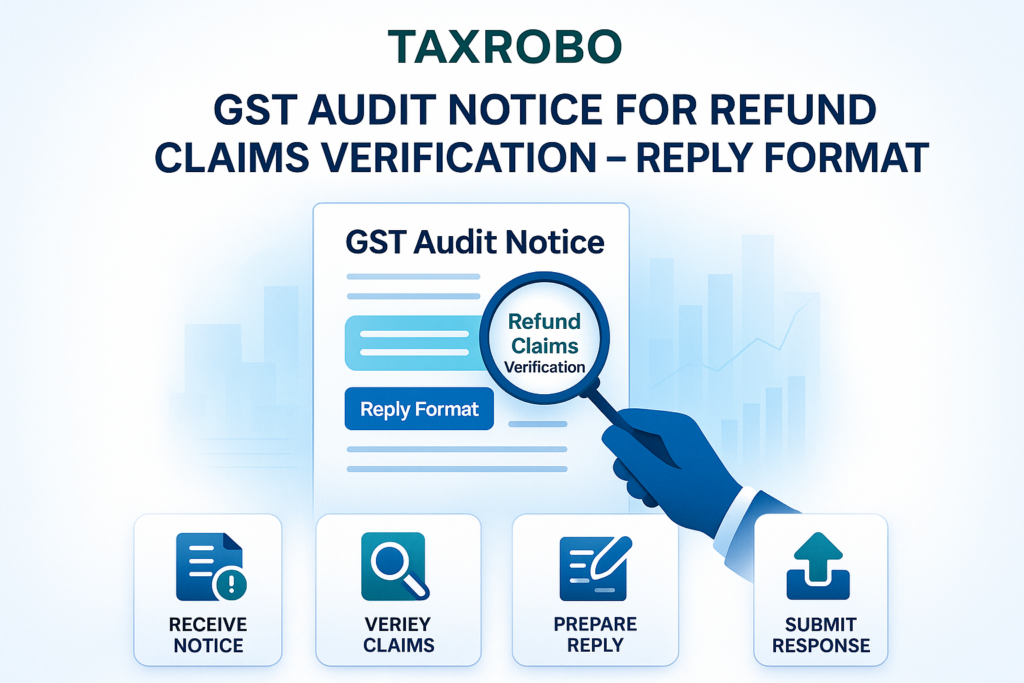

GST Audit Notice for Refund Claims Verification – Reply Format
Receiving a notice from the GST department can be stressful for any business owner, especially when it concerns a refund you were counting on. While it might seem alarming, a GST audit notice for refund verification is often a standard procedure to ensure that all claims are legitimate and backed by proper documentation. This notice is a crucial part of the official refund claims verification process, designed to maintain the integrity of the tax system. However, the importance of a timely, accurate, and professionally drafted response cannot be overstated, as a weak reply can lead to delays, penalties, or even an outright rejection of your refund. This comprehensive guide will walk you through the entire process, explaining why you received the notice, how to navigate the system, and providing a clear response format for GST audit to help you secure your rightful claim.
Understanding the GST Audit Notice: Why Did You Receive It?
The first step in responding effectively is to understand the notice itself. These communications from the tax department are not random; they are triggered by specific discrepancies or red flags identified by the system or the assessing officer during the initial review of your refund application. Instead of panicking, treat it as an opportunity to provide clarity and furnish the necessary proof to validate your claim. By decoding the notice and understanding its origins, you can prepare a targeted and comprehensive reply that directly addresses the department’s concerns, significantly improving your chances of a swift and favorable resolution.
Decoding the Notice: Key Sections to Look For
When you receive a notice, such as Form GST RFD-08 for a query or Form GST ASMT-10 for scrutiny, it’s essential to dissect it carefully. Look for these critical elements to understand the scope and urgency of the required action:
- DIN (Document Identification Number): This is a mandatory, computer-generated number that authenticates the notice. Any communication without a valid DIN might be considered invalid. Always verify the DIN on the official GST Portal to ensure its legitimacy.
- Notice Reference Number & Date: These details are crucial for all future correspondence. You must quote this reference number in your reply to ensure it is correctly mapped to your case file.
- Specific Discrepancies: This is the most important section. The notice will clearly list the specific reasons or discrepancies that prompted the query. The officer might point out mismatches in data, request further documentation, or question the eligibility of your claim.
- Deadline for Reply: The notice will specify a date by which you must submit your response. Adhering to this deadline is non-negotiable. Missing it can lead to an ex-parte decision, which is usually not in your favor.
Common Triggers for a Refund Verification Notice
A verification notice is typically triggered when the GST officer’s preliminary review reveals inconsistencies. Understanding these common triggers can help you maintain better compliance and potentially avoid such notices in the future. Here are some of the most frequent reasons for receiving one:
- Mismatch in Turnover: Discrepancies between the turnover declared in your GSTR-1 (statement of outward supplies) and GSTR-3B (summary return) are a major red flag for tax authorities.
- Errors in Calculation: Simple mathematical errors in calculating the tax, interest, or the final refund amount can lead to a query.
- Input Tax Credit (ITC) Issues: Claiming ITC on goods or services that are ineligible (listed under blocked credits), or a mismatch between the ITC claimed in GSTR-3B and the credit available in your GSTR-2B, is a very common trigger.
- Discrepancies in Export Documentation: For exporters claiming a refund, any mismatch or missing information in documents like the Shipping Bill, Bill of Lading, or Bank Realization Certificate (BRC) will almost certainly result in a notice.
- Claiming a Refund Under the Wrong Category: Applying for a refund under an incorrect category (e.g., claiming a refund for an inverted duty structure when it’s actually for zero-rated supplies) will prompt the officer to seek clarification.
Navigating the Official Refund Claims Verification Process in India
Responding to a notice is just one part of the larger refund claims verification process. Understanding this entire workflow helps you appreciate where you stand and what the next steps are. The GST refund claim process in India is designed to be systematic and transparent, moving through several distinct stages from application to final order. Knowing this sequence helps you anticipate requirements and act proactively.
Step 1: Filing the Refund Application (Form GST RFD-01)
The journey begins when you, the taxpayer, file a refund application in Form GST RFD-01 on the GST Portal. This form requires you to specify the category of refund, the tax period, and the amount being claimed. You must also upload all preliminary supporting documents at this stage, setting the foundation for the entire GST refund claim process in India.
Step 2: Initial Scrutiny and Acknowledgment
Once your application is submitted, a GST officer conducts a preliminary check. They verify the completeness of the application and the attached documents. If everything appears to be in order on the surface, they will issue an acknowledgment of your application in Form GST RFD-02. This acknowledgment confirms that your application has been formally accepted for processing.
Step 3: Issuance of Deficiency Memo or Show Cause Notice
This is the critical stage where a notice is issued. If the officer finds any discrepancies, errors, or requires further information during their detailed scrutiny, they will not proceed with the refund. Instead, they will issue a show-cause notice or a query memo, typically in Form GST RFD-08. This document will detail all the issues they have identified. This is the official start of your journey on how to respond to a GST audit notice.
Step 4: Submitting Your Reply and Documents
Upon receiving the notice, you must prepare a detailed, point-by-point reply. This response, filed in Form GST RFD-09, must be submitted through the GST Portal within the timeframe mentioned in the notice. Your reply should be accompanied by a clear explanation and all necessary supporting documents and evidence to substantiate your claims and counter the officer’s queries.
Step 5: Final Order (Sanction or Rejection)
After reviewing your reply and the evidence provided, the GST officer will make a final decision. There are three possible outcomes, communicated through a final order in Form GST RFD-06:
- Full Sanction: If your explanations and documents are satisfactory, the officer will approve the full refund amount claimed.
- Partial Sanction: The officer may agree with some of your points but not others, leading to the approval of only a part of the refund claim.
- Full Rejection: If your reply is found to be unsatisfactory or fails to address the discrepancies, the officer may reject the entire refund claim, providing detailed reasons for the rejection in the order.
Crafting the Perfect Reply: A Detailed Response Format for GST Audit
A well-structured and professional reply is your best tool for resolving the queries raised in the notice. Your response should be clear, factual, and supported by irrefutable evidence. Vague or emotional language will not help your case. The goal is to make it as easy as possible for the officer to understand your position and verify the facts. Following a standardized response format for GST audit ensures you cover all necessary points methodically.
Essential Components of Your Written Submission
Your written submission should be formal and organized. Here is a template you can follow:
- Header: At the top, clearly state your business’s legal name, GSTIN, and registered address.
- Recipient: Address the reply to the specific designation and office address of the GST officer who issued the notice. This information will be on the notice itself.
- Reference: Mention the Notice Reference Number and Date clearly. This is crucial for linking your reply to the correct file.
- Subject Line: A clear and concise subject line helps in quick identification. For example: “Reply to Show Cause Notice [Notice Number] dated [Date] regarding Refund Claim for the tax period [e.g., April 2023 to June 2023]”.
- Body of the Reply:
- Begin with a formal salutation and an acknowledgment of the notice received.
- The core of your reply should address each query from the notice in a structured, point-by-point format. Using a table is highly effective for clarity.
| Query Raised in the Notice | Our Response / Explanation | Reference to Supporting Document Attached |
|---|---|---|
| e.g., Mismatch in turnover between GSTR-1 and GSTR-3B. | The difference of Rs. X is due to an advance received in the previous month, for which the invoice was raised in the current month. This is correctly reflected as per GST laws. | Annexure 1: GSTR-1 & GSTR-3B reconciliation statement. |
| e.g., ITC claimed on ineligible motor vehicle expenses. | The ITC was claimed on a commercial vehicle used for transporting goods, which is an eligible credit under Section 17(5) of the CGST Act. The vehicle is registered for commercial use. | Annexure 2: Copy of Vehicle RC and relevant tax invoices. |
- List of Annexures: After the body of the reply, create a numbered list of all the supporting documents you are attaching. For example:
- Annexure 1: Copy of GSTR-1 and GSTR-3B reconciliation for the said period.
- Annexure 2: Copies of relevant tax invoices.
- Annexure 3: Bank Realization Certificates (BRCs).
- Prayer/Conclusion: End with a formal closing statement. For example: “In light of the explanations and evidence provided above, we humbly request your good office to kindly drop the proceedings and process our refund claim of Rs. [Amount] at the earliest.”
- Signature: The reply should be signed by the authorized signatory, along with their name and designation.
Pro-Tip: Gather These Documents Before You Write
Having all your documents ready before you start drafting the reply will make the process smoother and ensure you don’t miss anything. Create a dedicated folder for the case and collect the following:
- A scanned copy of the GST Notice you received.
- Copies of relevant GSTR-1, GSTR-3B, and GSTR-9 returns for the period in question.
- All relevant tax invoices, credit notes, and debit notes that support your claim.
- Bank statements highlighting the specific transactions related to the refund claim.
- A detailed ITC ledger and reconciliation statement comparing your books with GSTR-2B.
- For exporters: Shipping Bills, Bills of Lading, Airway Bills, and Bank Realization Certificates (BRCs) or Foreign Inward Remittance Certificates (FIRCs).
Key GST Audit Notice Guidelines: Do’s and Don’ts
Responding to a notice correctly involves adhering to certain best practices. Following these simple GST audit notice guidelines can prevent common errors and strengthen your case significantly. Think of them as the ground rules for effective communication with the tax department.
The Do’s
- ✅ Do reply within the stipulated time. The deadline mentioned in the notice is paramount. If you need more time, you may be able to request an extension, but this is not guaranteed.
- ✅ Do be factual and attach documentary evidence for every claim. Every statement you make in your reply must be backed by a corresponding document.
- ✅ Do maintain a professional and respectful tone. Your reply is a formal legal document. Avoid aggressive or emotional language.
- ✅ Do consult a tax expert. If you are unsure about any query or how to frame your response, seeking professional help from a firm like TaxRobo is a wise investment.
The Don’ts
- ❌ Don’t ignore the notice. This is the biggest mistake you can make. It will lead to the automatic rejection of your refund and can attract further scrutiny and penalties.
- ❌ Don’t provide incomplete or misleading information. This can damage your credibility and may lead to allegations of fraud or misrepresentation.
- ❌ Don’t miss attaching the required supporting documents. An explanation without evidence holds little weight. Double-check that all annexures mentioned in your reply are correctly uploaded.
Conclusion
Receiving a GST audit notice can be intimidating, but it doesn’t have to be a roadblock. By treating it as a procedural query and adopting a structured approach, you can navigate the situation effectively. The key lies in understanding the notice, meticulously following the official refund claims verification process, and crafting a clear, evidence-backed reply using the correct response format for GST audit. Remember to be prompt, professional, and precise in your communication with the tax authorities.
Navigating the GST refund claim process in India can be complex, and the stakes are high. Don’t risk your refund due to a procedural error or a poorly drafted reply. The experts at TaxRobo specialize in handling GST matters and can help you draft a precise and effective response to any notice, ensuring your case is presented in the best possible light. Contact us today for a consultation!
Frequently Asked Questions (FAQs)
Q1: What is the time limit to respond to a GST refund query (Form RFD-08)?
A: You must furnish a reply in Form GST RFD-09 within the time specified in the notice. While the law allows the officer to specify the timeline, it is typically 15 days from the date of receipt of the notice. It is crucial to check the specific deadline mentioned in your notice and adhere to it strictly.
Q2: What happens if I don’t respond to the GST notice?
A: Failure to respond is considered non-compliance. The officer will proceed to make a decision based on the information available to them, which will almost certainly lead to the rejection of your refund claim. This can also trigger further scrutiny of your business’s tax affairs and potential penalties.
Q3: Can I submit the reply online?
A: Yes, the entire process is designed to be digital. You must submit your reply and upload all supporting documents directly on the official GST Portal. You can find this functionality under “Services” > “User Services” > “My Replies” after logging into your account.
Q4: My refund was rejected. What are my options?
A: If your refund claim is rejected via an order in Form GST RFD-06, you have the right to challenge the decision. The next step is to file an appeal with the designated appellate authority. The appeal process has its own set of procedures and timelines, and it is highly recommended to seek professional legal or tax advice for this step.
Q5: Where can I check the official status of my refund application?
A: You can track the real-time status of your application on the official GST Portal. Log in and navigate to “Services” > “Refunds” > “Track Application Status”. You can track the status using either the ARN (Application Reference Number) or your login credentials.