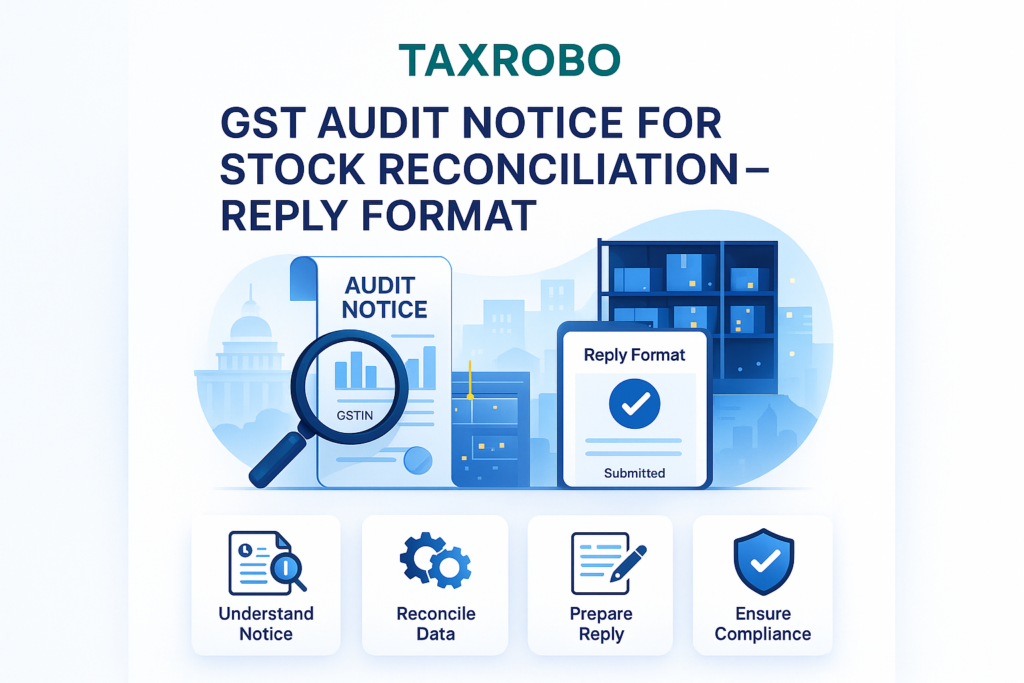

GST Audit Notice for Stock Reconciliation – The Ultimate Reply Format
Receiving a notice from the GST department can be a stressful experience for any business owner, especially when it questions the accuracy of your stock records. However, with the right knowledge and a structured approach, it’s a completely manageable process. This blog post serves as your comprehensive guide, providing a clear and effective GST Audit Notice Reply Format specifically designed for stock reconciliation issues. We will break down why you might have received this notice, how to meticulously prepare your data for a response, and exactly what to include in your reply to ensure you meet all GST compliance requirements. This guide is tailored for small business owners and salaried individuals in India, empowering you to handle the scrutiny process with confidence and precision by using a proper GST Audit Notice Reply Format.
What is a GST Audit Notice for Stock Reconciliation?
Before drafting a reply, it’s crucial to understand what the notice signifies and why the GST department has sent it. Essentially, the tax officer’s automated system or manual review has detected a potential mismatch or irregularity in your stock data as reported in various GST filings. This notice is an official query asking you to explain these discrepancies. It is not an accusation of wrongdoing but rather an opportunity for you to provide clarification and supporting evidence to justify your reported figures. A well-prepared response can often resolve the matter at this initial stage, preventing it from escalating into a more detailed audit or a demand for tax and penalties. Understanding what is a tax audit and how you can prepare for it is the first step toward crafting a successful reply.
Understanding Form GST ASMT-10
Most often, this initial communication from the GST department will be in Form GST ASMT-10. It’s vital to recognize that this is a scrutiny notice, not a demand notice. A scrutiny notice is issued when the proper officer finds a discrepancy in the returns you have filed and seeks an explanation from you. It’s a procedural step that gives you the chance to explain your position before any adverse action is taken. The notice will clearly list the specific discrepancies observed by the officer, such as a mismatch in stock values between different returns. Think of it as a preliminary inquiry—an opportunity to present your case, correct any inadvertent errors, and demonstrate your commitment to compliance without immediately facing financial penalties.
Common Triggers for a Stock Reconciliation Notice
The GST system is data-intensive, comparing information across various forms and documents you file. A notice for stock reconciliation is typically triggered when the system flags inconsistencies. Understanding these common triggers helps you maintain better records and preemptively address potential issues.
- Mismatch between GSTR-1 and GSTR-3B: Your GSTR-1 details your outward supplies (sales), which should logically correspond to a reduction in stock. If the sales figures and the corresponding reduction in stock value implied in your GSTR-3B filings don’t align, it raises a red flag.
- Discrepancies between GSTR-3B and GSTR-9/9C: Your annual return (GSTR-9) and reconciliation statement (GSTR-9C) consolidate your monthly filings. Any mismatch between the total figures reported monthly in GSTR-3B and the annual consolidated data is a primary reason for scrutiny.
- Significant Variations in Stock Levels: If your records show a large increase in stock without corresponding purchases or a sharp decrease without matching sales, the department will want to know why. This could indicate unrecorded sales or purchases.
- Mismatch between E-way Bill Data and Declared Supplies: The tax authorities cross-reference the data from e-way bills generated for the movement of goods with the outward supplies you declare in GSTR-1. A clear guide to GST e-way bill generation is essential to prevent these issues. Significant differences suggest that goods were moved but not accounted for as sales.
- Inconsistencies in Input Tax Credit (ITC) Claims: Your ITC claim on purchases (reflected in GSTR-2A/2B) implies an increase in your stock. If the corresponding outward supply or closing stock declaration doesn’t align with these purchases, it can trigger a notice. A clear understanding of these points is essential for creating an effective
GST audit notice stock reconciliation format.
Pre-Reply Checklist: How to Prepare for Your Response
Before you even start writing your reply, thorough preparation is key. Rushing into a response without gathering all the necessary information can lead to an incomplete or inaccurate submission, which may invite further scrutiny. A systematic approach to data collection and internal analysis will form the backbone of a strong and convincing reply. This preparation phase is arguably more important than the drafting itself, as the quality of your supporting documents and the clarity of your reconciliation will determine the outcome. Follow these steps methodically to build a solid foundation for your response.
Step 1: Gather and Organize Your Documents
The first step is to compile every relevant piece of documentation related to the period mentioned in the notice. Having all your records in one place will make the reconciliation process smoother and ensure you don’t miss any critical evidence. Create a dedicated file for this case and organize the following documents:
- The GST Audit Notice (Form GST ASMT-10) itself.
- Monthly GST returns: GSTR-1 and GSTR-3B for the entire period in question.
- Annual GST returns: GSTR-9 and the reconciliation statement GSTR-9C (if applicable).
- A detailed Stock Register showing item-wise opening stock, all inward supplies (purchases), all outward supplies (sales), and the closing stock for each month.
- Purchase and Sales Registers exported from your accounting software (e.g., Tally, Zoho Books).
- Copies of relevant tax invoices, for both major purchases and sales that might be under review.
- Complete E-way bill records for the period.
- Any Credit Notes or Debit Notes issued or received, as these directly impact stock and tax liability.
Step 2: Conduct a Thorough Internal Reconciliation
With all your documents in hand, the next step is to conduct your own internal audit. The goal is to compare the stock position as per your books of accounts with the stock position that is implied by your GST returns. The fundamental logic for stock movement is straightforward and should be the basis of your reconciliation. This exercise will help you pinpoint exactly where the discrepancy lies and why it occurred.
Here’s the simple reconciliation logic to follow:
| Calculation Element | Description |
|---|---|
| Opening Stock | The value of stock at the beginning of the period. |
| (+) Purchases | The value of all goods purchased during the period (as per books and GST returns). |
| (-) Sales | The value of goods sold during the period (as per books and GST returns). |
| (=) Closing Stock | The resulting value of stock at the end of the period. |
Compare the “Closing Stock” figure from this calculation with the closing stock recorded in your official books of accounts. The difference between these two is the discrepancy you need to explain.
Step 3: Identify the Exact Reasons for Mismatches
A discrepancy doesn’t automatically mean you have evaded tax. There are many legitimate business reasons why the figures in your GST returns might not perfectly match your book’s closing stock at a given point in time. Your task is to identify these specific reasons, quantify them, and prepare to present them clearly in your stock reconciliation notice reply.
Common valid reasons for stock discrepancies include:
- Goods in Transit: You may have recorded a purchase in your books, but the goods have not yet been delivered to your premises. Similarly, you may have issued a sales invoice, but the goods are still awaiting dispatch.
- Stock Loss or Damage: Goods can be lost due to theft, damaged in storage, or become obsolete. Such losses reduce your physical stock but might not have been immediately adjusted in GST filings.
- Free Samples or Promotional Items: Goods given away as free samples or for promotional activities reduce your stock but are not recorded as sales. There are specific GST provisions for handling ITC on such items.
- Clerical Errors: Simple data entry mistakes can happen. It is always best to admit these errors honestly, explain the corrective action taken, and pay any minor tax difference if applicable.
- Job Work Transactions: Goods sent to or received from a job worker can cause timing differences in stock recording if not accounted for correctly under GST rules.
The Definitive GST Audit Notice Reply Format for Stock Discrepancies
Once your internal preparation is complete, you can proceed to draft the response. Using a professional and structured GST Audit Notice Reply Format is crucial. It shows the tax officer that you are organized, have taken the notice seriously, and are providing a clear, point-by-point explanation. A well-formatted reply is easier for the officer to read and understand, which increases the likelihood of a favorable outcome. The following format can be used as a template for your reply. It covers all the necessary components, from the official header to the final declaration, ensuring your submission is comprehensive and compliant.
Part 1: Official Header
Your reply should be drafted on your official business letterhead and must begin with a clear and formal header containing all essential details. This ensures the reply is correctly identified and routed to the concerned officer.
- To:
The [Designation of the GST Officer]
[Address of the GST Office]
(As mentioned in the notice) - From:
[Your Business Name]
[Your Full Address]
GSTIN: [Your 15-digit GSTIN] - Reference No.: [The unique Notice Reference Number (ARN/RFN) from Form ASMT-10]
- Date: [Date of your reply]
- Subject: Reply to Scrutiny Notice (Form GST ASMT-10) for the period [Start Date] to [End Date] regarding stock reconciliation.
Part 2: Introduction & Acknowledgement
The body of the letter should begin with a polite and formal acknowledgement of the notice. This sets a cooperative tone for the entire reply.
- Start by referencing the notice number and date to establish context.
- Example Phrase: “Respected Sir/Madam, With reference to the scrutiny notice bearing Reference No. [Enter Notice Reference No.] dated [Enter Notice Date], we acknowledge its receipt. We have carefully reviewed the discrepancies pointed out in the said notice and wish to submit our point-wise reply, along with necessary clarifications and supporting documents, for your kind consideration.”
Part 3: Point-wise Clarification
This is the most critical section of your reply. To ensure clarity and make it easy for the officer to follow, you should address each discrepancy raised in the notice one by one. Using a table is the most effective way to present this information.
- Instructions: Replicate the points from the notice and provide your explanation for each.
- Table Format:
| S.No. | Discrepancy as per Notice | Our Explanation / Clarification | Supporting Document Attached |
|---|---|---|---|
| 1. | Mismatch in closing stock between GSTR-3B and books of accounts. | The difference of ₹[Amount] is due to goods worth ₹[Amount] lost due to fire on [Date], for which an insurance claim has been filed. We have reversed the ITC on the same as per GST provisions. | Annexure-A: Stock Reconciliation Statement; Annexure-B: Copy of FIR/Insurance Claim. |
| 2. | Variation in outward supplies between E-way bills and GSTR-1. | The variation is due to goods worth ₹[Amount] sent for job work on [Date], for which a delivery challan was issued, not a tax invoice. These goods were returned after processing. | Annexure-C: Copies of Delivery Challans and Job Work Register. |
Part 4: The Stock Reconciliation Statement (Annexure)
Your explanations must be backed by solid data. The main supporting document will be a detailed Stock Reconciliation Statement, which you should attach as an annexure. This statement must clearly show the figures from your books, the figures from your returns, and a detailed breakdown of the reasons for any difference. This is the core GST audit notice stock reconciliation format.
- Suggested Table Format for the Annexure:
| Particulars | As per Books of Accounts (Value in ₹) | As per GST Returns (Implied Value in ₹) | Difference (Value in ₹) | Remarks / Reason for Difference |
|---|---|---|---|---|
| Opening Stock | 10,00,000 | 10,00,000 | 0 | – |
| Add: Purchases | 50,00,000 | 50,00,000 | 0 | – |
| Less: Sales | 45,00,000 | 45,00,000 | 0 | – |
| Sub-Total | 15,00,000 | 15,00,000 | 0 | – |
| Less: Goods Lost in Fire | 50,000 | 0 | 50,000 | ITC reversed. Insurance claim attached. |
| Less: Free Samples | 25,000 | 0 | 25,000 | Not considered sales. ITC reversed. |
| Closing Stock | 14,25,000 | 15,00,000 | -75,000 | Difference fully reconciled. |
Part 5: Prayer and Declaration
Conclude your reply with a formal request and a declaration. This section politely asks the officer to accept your explanation and close the inquiry.
- Prayer/Request: “We believe the above clarifications, along with the detailed stock reconciliation statement and other supporting documents, sufficiently address the concerns raised in the notice. We humbly request your good office to review our submission, find it in order, and kindly drop the proceedings initiated vide the aforementioned notice.”
- Declaration: “We declare that the information provided above is true and correct to the best of our knowledge and belief.”
- Closing:
Yours Sincerely,
For [Your Business Name],[Signature]
[Name of Authorized Signatory/Proprietor]
[Designation]
This detailed structure completes the formal GST notice response format India.
Common Mistakes to Avoid in Your GST Compliance Reply Format for Businesses
Drafting a reply to a GST notice requires careful attention to detail. Even with the right information, simple mistakes can undermine your efforts and lead to a negative outcome. Being aware of these common pitfalls can help you prepare a reply that is not only accurate but also effective. A flawless submission demonstrates professionalism and a serious commitment to compliance, which can significantly influence the officer’s decision. Here are some critical mistakes to avoid when preparing your GST compliance reply format for businesses.
Missing the Deadline
The notice (Form GST ASMT-10) will specify a deadline for your reply, typically 30 days. Failing to respond within this timeframe has serious consequences. The officer is empowered to proceed with the assessment based on the information they already have. This often leads to an ex-parte order confirming the discrepancy as a tax liability, along with interest and penalties. Always treat the deadline as non-negotiable. If you genuinely need more time to gather documents, you can file a formal request for an extension, but do so well before the original deadline expires.
Providing Vague or Generic Explanations
Avoid using generic statements like “the discrepancy is due to clerical errors” or “there was a mismatch in accounting.” These explanations are unhelpful and signal poor record-keeping. Your reply must be specific, factual, and backed by numbers. For example, instead of saying “clerical errors,” state, “An invoice (No. 123) for ₹50,000 was mistakenly entered as ₹5,000 in our GSTR-1 filing for October. We have since filed an amendment in the subsequent return and paid the differential tax.” Quantify every point of difference and provide a clear reason for each.
Not Attaching Supporting Evidence
Your explanations are only as strong as the evidence you provide to support them. Every claim you make in your reply must be backed by a corresponding document. If you state goods were lost in a fire, attach the FIR and insurance claim. If you claim a discrepancy is due to goods sent for job work, attach the delivery challans and job work register. Submitting a reply without annexures is like making an argument without proof. The officer is not obligated to accept your word alone; documentary evidence is non-negotiable.
Making Mathematical Errors in the Reconciliation Statement
The Stock Reconciliation Statement is the centerpiece of your reply. A simple calculation error in this statement can invalidate your entire submission and destroy your credibility. Double-check and even triple-check all the figures. Ensure that the final reconciled figures match perfectly. An accurate, easy-to-understand reconciliation statement shows the officer that you have a firm grasp of your own accounting and have resolved the discrepancy logically. Consider having a second person, preferably a tax professional, review the calculations before submission.
Conclusion: Proactive Compliance is the Best Defence
Receiving a GST audit notice for stock reconciliation can be daunting, but it is a manageable part of doing business in India. By staying calm and following a structured process, you can address the department’s queries effectively. The key is to understand the notice, meticulously gather your documents, perform a thorough internal reconciliation, and present your findings using a clear and professional GST Audit Notice Reply Format. Remember that the goal is to provide a transparent and data-backed explanation for any discrepancies. This highlights the importance of accurate record-keeping to prevent GST demand notices, which is not just a compliance requirement but the best defence and foundation of a healthy business.
Navigating GST notices can be complex. If you need expert assistance in preparing a robust reply format for GST audit notice or managing your overall GST compliance, the experts at TaxRobo are here to help. Contact Us Today for a Consultation!
Frequently Asked Questions (FAQs)
FAQ 1: What is the time limit to reply to a GST audit notice in Form ASMT-10?
Answer: The taxpayer is generally required to furnish a reply in Form GST ASMT-11 within 30 days from the date of service of the notice, or within the time period as specified in the notice itself.
FAQ 2: Can I get an extension to file the reply?
Answer: Yes, you can file a request for an extension with the proper officer, stating valid reasons for the delay. The officer, at their discretion, may grant an extension for a further period not exceeding 15 days. This request must be made before the original deadline.
FAQ 3: What happens if my reply is not considered satisfactory?
Answer: If the officer is not satisfied with your reply or if you fail to reply, they may initiate further proceedings. This could include issuing a show-cause notice (in Form GST DRC-01) or proceeding with actions under Section 65 (Audit), Section 66 (Special Audit), or Section 67 (Inspection, Search, Seizure), which could eventually lead to a demand of tax, interest, and penalties.
FAQ 4: Do I need professional help for this?
Answer: While you can draft the reply yourself if the discrepancy is minor and straightforward, engaging a tax professional is highly recommended for complex cases. A professional can ensure the GST Audit Notice Reply Format is correctly followed, the reconciliation is accurate, the legal language is appropriate, and all necessary evidence is presented effectively, thereby minimizing the risk of adverse action from the department.
FAQ 5: Where can I find the official GST forms and notifications?
Answer: All official GST forms, notifications, circulars, and rules are available on the Central Board of Indirect Taxes and Customs (CBIC) website and the official GST portal. These are the most reliable sources for any official information regarding GST compliance.