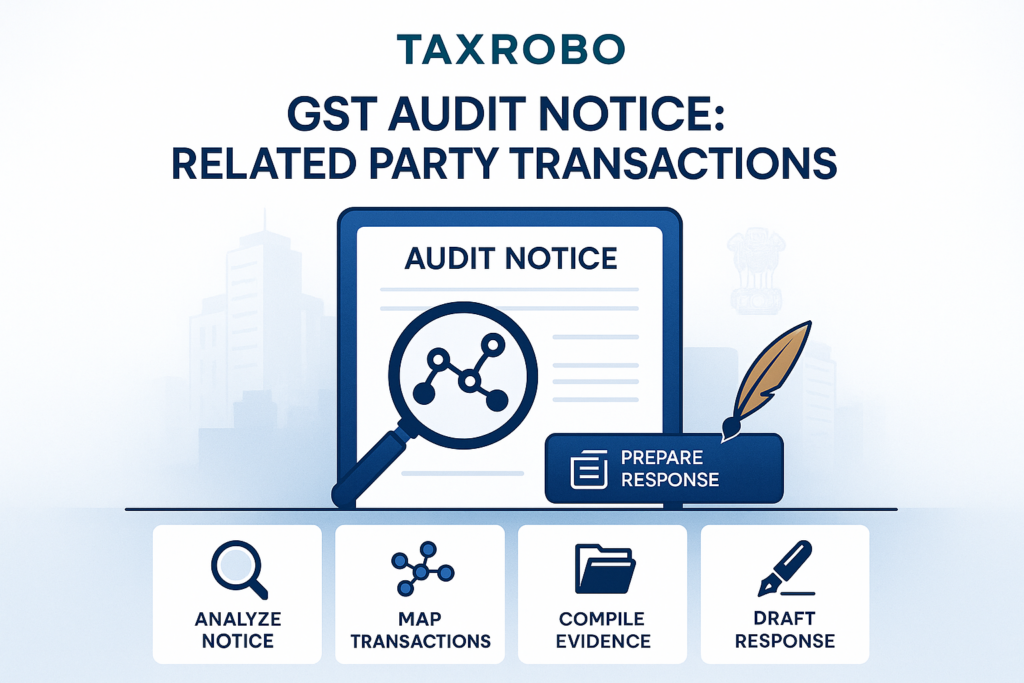

GST Audit Notice for Related Party Transactions – Reply Format
Receiving a notice from the tax department can be stressful for any business owner. A GST audit notice, especially one questioning your related party transactions, requires immediate and careful attention. This official communication from the tax authorities is not something to be taken lightly. It signifies that your business’s financial dealings, particularly with entities you are closely associated with, are under scrutiny. A well-drafted and timely reply is not just a procedural formality; it is a crucial step to demonstrate your commitment to tax compliance, clarify any misunderstandings, and avoid the risk of hefty penalties or further legal complications. This comprehensive guide will provide a clear understanding of the issue and a step-by-step GST audit notice format to help you draft an effective and professional response.
What is a GST Audit Notice and Why Did You Get One?
Understanding the ‘what’ and ‘why’ behind the notice is the first step toward formulating a successful response. It transforms the notice from an intimidating document into a structured set of queries that can be addressed methodically. A GST audit is a standard procedure, but a notice targeting related party transactions suggests the department has specific concerns about your valuation and compliance methods.
Understanding GST Audits in India
A GST audit is an official examination of your business’s records, returns, and other documents by the tax authorities. The primary purpose is to verify the correctness of the turnover you’ve declared, the taxes you’ve paid, any refunds you’ve claimed, and the Input Tax Credit (ITC) you’ve availed. Essentially, the tax department wants to ensure that your financial reporting aligns perfectly with the provisions of the GST law. These audits are conducted under the framework of the GST audit rules in India, which empower officers to scrutinize transactions and demand explanations for any discrepancies they find. It’s a mechanism to ensure a high degree of tax compliance for related party transactions and all other business dealings, maintaining the integrity of the tax system.
Common Triggers for a Notice on Related Party Transactions
Transactions between related parties are inherently on the tax department’s radar because of the potential for price manipulation to reduce tax liability. Here are some of the most common red flags that can trigger a related party transactions notice:
- Valuation Below Market Rates: If you are supplying goods or services to a related entity at a price significantly lower than the fair market value, it raises suspicion that the transaction is designed to lower the overall GST payable.
- Supplies Without Consideration: Providing services or goods for free to a related party is a major trigger. Under GST, even supplies without consideration to related persons are taxable and must be valued correctly.
- Inconsistencies in Filings: Discrepancies between the data reported in your GSTR-1 (outward supplies) and the figures in your audited financial statements or income tax returns can lead to an audit.
- Input Tax Credit (ITC) Mismatches: If a related entity claims ITC on an invoice from you, but the corresponding tax was not paid or was underpaid by you, the entire transaction chain comes under review. For more information, see our How to Resolve ITC Mismatch Issues – GSTR-2A/2B vs 3B Guide.
How to Read and Understand Your Notice
The notice itself contains all the information you need to begin your response. Before you do anything else, carefully examine the document and identify these key details:
- DIN (Document Identification Number): This is a unique number that authenticates the notice. Every communication from the department must have a valid DIN.
- The Financial Period: The notice will specify the exact financial year or period that is being audited. This helps you narrow down the scope of documents you need to collect.
- Specific Queries: The officer will list the exact discrepancies, transactions, or documents they need clarification on. Do not make assumptions; read each point carefully.
- Response Deadline: The notice will clearly state the date by which you must submit your reply. Missing this deadline can have serious consequences.
Demystifying Related Party Transactions Under GST
To effectively reply to the notice, you must first have a solid grasp of how GST law defines and treats related party transactions. The rules are specific and designed to prevent tax evasion through pricing arrangements that are not at arm’s length. For a deeper dive, review the guide on Related Party Transactions: Compliance Under Section 188.
Who Qualifies as a “Related Party”?
The term “related party” is explicitly defined under the explanation to Section 15 of the CGST Act, 2017. Understanding this definition is fundamental to ensuring your tax compliance for related party transactions. You are considered a related party if:
- You are officers or directors of one another’s businesses.
- You are legally recognized partners in business.
- You are an employer and employee.
- One of you directly or indirectly controls the other.
- Both of you are controlled by a third person.
- Together, you control a third person.
- You are members of the same family.
- One of you is the sole agent, sole distributor, or sole concessionaire of the other.
This includes directors, key managerial personnel, their relatives, holding companies, subsidiary companies, and associate companies.
The Importance of “Fair Market Value”
This is the most critical concept. For related party transactions, the value of the supply is not necessarily the price you charge. As per Section 15 of the CGST Act and Rule 28 of the CGST Rules, the transaction must be valued at its “Open Market Value” (OMV). OMV is the price the same goods or services would fetch in a transaction between unrelated parties.
Example: Imagine your company (A Pvt. Ltd.) provides software development services to a sister concern (B Pvt. Ltd.). The market rate for these services is ₹2,00,000. However, you only invoice B Pvt. Ltd. for ₹50,000. For GST purposes, the tax must be calculated and paid on the Open Market Value of ₹2,00,000, not the invoiced amount of ₹50,000. Even if you provided the service for free, GST would still be liable on ₹2,00,000.
Common Compliance Mistakes to Avoid
Many businesses inadvertently make mistakes that attract scrutiny. Being aware of these common pitfalls can help you maintain better compliance moving forward:
- Not Issuing a Tax Invoice: Every taxable supply, including those to related parties (even without consideration), must be covered by a valid tax invoice showing the correct value and GST.
- Undervaluing Transactions: Intentionally or unintentionally recording a transaction below its fair market value to save on GST is a major compliance failure.
- Incorrect GSTR-1 Reporting: Failing to declare these transactions accurately in your GSTR-1 filings creates a data mismatch that is easily flagged by the department’s analytics systems.
How to Respond to a GST Audit Notice: A Step-by-Step Guide
Receiving a notice can be unnerving, but a structured approach can make the process manageable and effective. Follow these steps to prepare and submit a robust reply.
Step 1: Don’t Panic – Acknowledge and Analyze
The first rule is not to ignore the notice. Acknowledging its receipt internally and noting the deadline is your immediate priority. Set aside dedicated time to sit with your finance team or consultant to analyze each query raised by the tax officer. Break down the notice into individual points and understand exactly what information or justification is being sought for each one. This calm and methodical analysis forms the foundation of your entire response strategy.
Step 2: Compile Your Documents and Evidence
Your reply is only as strong as the evidence supporting it. Before you start writing, gather all relevant documents. Create a master file for the audit period and organize your proof systematically. The GST Audit Checklist 2025 – Documents Required & Common Red Flags can be a useful resource here. Your evidence checklist should include:
- Invoices: Copies of all tax invoices raised on the related party.
- Agreements: Contracts, Memorandums of Understanding (MoUs), or agreements that detail the terms of service, scope of work, and pricing.
- Ledger Accounts: The complete ledger account of the related party from your books of accounts.
- Valuation Justification: If you have any third-party valuation reports, market comparisons, or internal costing sheets used to determine the transaction price, these are invaluable.
- Bank Statements: Proof of payment received from the related party, showing that the transaction was commercially genuine.
- Corporate Approvals: Copies of board resolutions or other internal approvals for the transactions.
Step 3: Draft a Clear and Factual Reply
Now, it’s time to draft the response. The key is to be clear, concise, and factual. Here’s how to respond to a GST audit notice effectively:
- Use a Point-by-Point Format: Address each query from the notice separately. Quote the officer’s query and then write your submission directly below it. This makes it easy for the officer to follow and review.
- Be Factual and to the Point: Avoid vague language or emotional responses. Stick to the facts of the transaction.
- Reference Your Evidence: For every claim you make, refer to the supporting document. For example, “In response to this query, we submit that the transaction was valued at the Open Market Value. A copy of the third-party valuation report is attached as Annexure-A.”
Step 4: When to Call an Expert
While you may be able to handle simple information requests internally, certain situations demand professional intervention. If the notice involves complex valuation disputes, significant tax implications, or interpretations of law, it is highly advisable to seek expert help. A tax professional can help you frame a legally sound argument, ensure your documentation is robust, and represent your case before the authorities if needed.
Need help with your GST notice? The experts at TaxRobo specialize in handling complex tax matters. We can help you draft a professional and legally sound
reply to GST audit noticeto protect your business interests. Contact us for an Online CA Consultation today.
The Ultimate GST Notice Response Format
Using a structured format ensures your reply is professional, comprehensive, and easy for the tax officer to understand. This template covers all the essential components of an effective GST notice response format.
Structure of an Effective Reply Letter
[Your Company Letterhead]
Date: [Date of Reply]
To,
The Proper Officer,
[Designation of the Officer]
[Address of the GST Office as per the notice]
Reference/DIN: [Mention the DIN and Notice Number from the notice]
Subject: Reply to GST Audit Notice for the period [e.g., FY 2022-23] regarding Related Party Transactions.
Respected Sir/Madam,
Body Paragraph 1 (Introduction):
This is with reference to the GST audit notice dated [Date of Notice] bearing DIN [DIN Number]. We acknowledge receipt of the same and are hereby providing our point-wise submissions and clarifications for your kind perusal. We have enclosed all the relevant supporting documents for your verification.
Body Paragraph 2 (Point-wise Reply):
1. Query raised in the Notice: [Quote the first exact query from the notice here.]
Our Submission: [Provide your detailed explanation for the first query. Be factual and precise. Refer to your supporting documents as annexures.]
Example: “In this regard, we submit that the transaction in question was for the provision of marketing support services to our subsidiary, [Subsidiary Name]. The transaction was conducted at arm’s length price, which is substantiated by our transfer pricing study. A copy of the tax invoice (Ref: XXX) and the relevant extract from the valuation report is attached as Annexure-A.”
2. Query raised in the Notice: [Quote the second exact query from the notice here.]
Our Submission: [Provide your detailed explanation for the second query, again referencing the relevant annexures.]
Example: “With respect to the supply of goods without consideration, we wish to state that this falls under Schedule I of the CGST Act. Accordingly, we have correctly calculated GST on the Open Market Value of the goods. The valuation workings and the corresponding tax invoice (Ref: YYY) are attached as Annexure-B.”
(Repeat this format for all the queries raised in the notice.)
Concluding Paragraph:
We believe the above submissions and the enclosed documents comprehensively clarify the queries raised in the notice. We have strived to maintain full compliance with the GST laws and assure you of our full cooperation in any further proceedings. Should you require any additional information or clarification, please feel free to contact us.
Thank you.
Signature:
For [Your Company Name],
[Digital or Physical Signature]
[Name of Authorized Signatory]
[Designation]
[Contact Number]
Key Tips for Submission
- Label Annexures Clearly: Ensure every document you attach is properly labeled (Annexure-A, Annexure-B, etc.) and referenced correctly in the body of the letter.
- Keep a Complete Copy: Always keep a copy of the entire submitted set—the letter and all annexures—for your records.
- Meet the Deadline: Submit the reply well within the stipulated deadline. If you need more time to compile the information, you can submit a written request for an extension, stating the reason.
Conclusion
Facing a GST audit notice concerning related party transactions can be challenging, but it is a manageable process with the right approach. The key lies in understanding the GST audit rules in India, maintaining meticulous documentation for all such transactions, and following a structured, factual format for your reply. A proactive, transparent, and well-prepared response is your best defense against potential disputes and penalties. By treating the notice as an opportunity to demonstrate your compliance, you can resolve the queries efficiently and maintain a positive standing with the tax authorities.
Navigating a GST audit notice can be complex, and the stakes are high. If you need expert assistance in drafting a professional and compliant reply that safeguards your business, the specialists at TaxRobo are here to help. Contact our GST experts today for a consultation.
Frequently Asked Questions (FAQs)
Q1: What is the time limit for a reply to GST audit notice?
A: The time limit is generally specified in the notice itself, which is often 15 to 30 days from the date of its receipt. It is crucial to adhere to this deadline or formally request an extension if you cannot compile the required information in time.
Q2: What happens if I ignore a GST notice?
A: Ignoring a notice is a serious mistake. It can lead to the tax officer making a “best judgment assessment” based on the information available to them. This usually results in a higher tax demand, along with applicable interest and significant penalties for non-compliance.
Q3: Are transactions between a director and the company considered related party transactions?
A: Yes, absolutely. As per the definition in the CGST Act, directors and key managerial personnel are considered parties related to the company. Any transactions between them, such as salary, reimbursements, or other supplies, are subject to GST provisions for related parties.
Q4: Do I need to get a professional valuation done for all related party transactions?
A: While it is not mandatory to get a third-party valuation for every single transaction, it is highly recommended for high-value or complex transactions. A professional valuation report serves as strong, independent evidence to justify your transaction pricing to the tax authorities and can be invaluable during an audit.
Q5: Where can I find the official guidelines for GST audits?
A: The official guidelines for GST audit notice, rules, and procedures are laid out in the CGST Act, 2017, and the accompanying CGST Rules. You can find these legal texts and related circulars on the official Central Board of Indirect Taxes and Customs (CBIC) website.