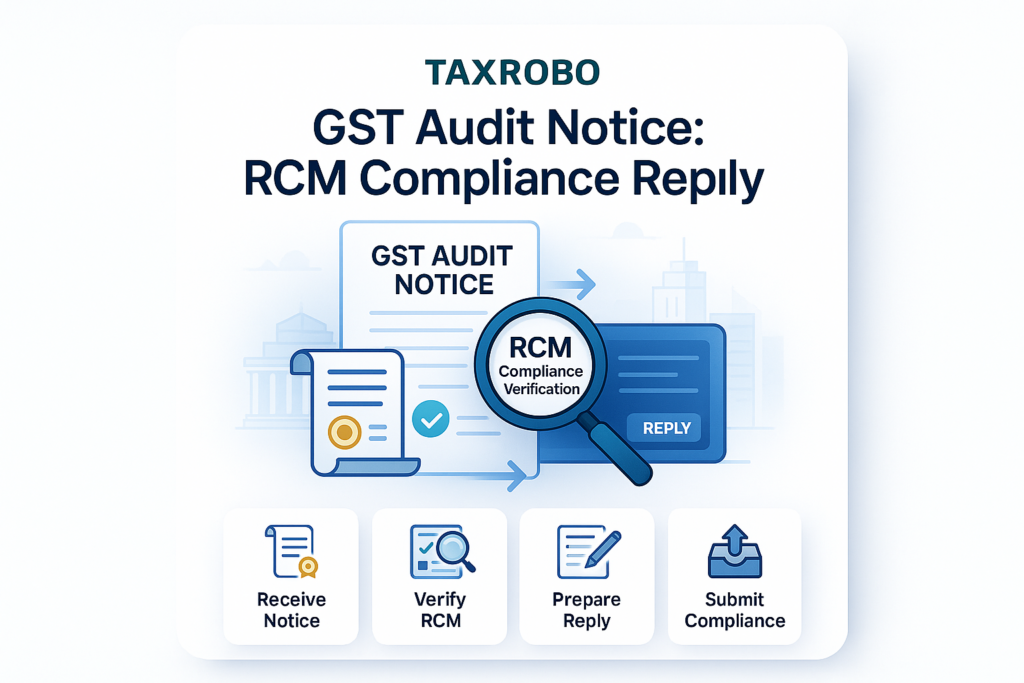

GST Audit Notice for RCM Compliance Verification – Reply Format
Receiving a formal notice from the GST department can be a stressful experience for any business owner. Your mind immediately races with questions about what you might have done wrong and the potential consequences. One of the most common areas of scrutiny is compliance with the Reverse Charge Mechanism (RCM), which is why a notice for RCM compliance verification is frequently issued. This notice essentially asks you to prove that you have correctly identified, paid, and reported GST on services where the payment liability shifts to you, the recipient. A timely, accurate, and professionally drafted response is absolutely critical to avoid hefty penalties, interest, and further legal complications. This article serves as your comprehensive GST compliance response guide, breaking down how to understand the notice, gather the necessary documents, and draft a perfect reply, ensuring you can handle the situation with confidence. This guide will walk you through the entire process of responding to GST audit notices related to RCM.
Understanding Reverse Charge Mechanism (RCM) in GST
Before you can effectively respond to a notice, it’s essential to have a crystal-clear understanding of the Reverse Charge Mechanism (RCM) Under GST itself. RCM is a cornerstone of the GST framework designed to widen the tax base and ensure that transactions in the unorganized sector are properly taxed. It represents a fundamental shift in the tax payment responsibility, which can often be a source of confusion and non-compliance for small businesses. A solid grasp of this concept is the first step in preparing a strong and factual reply to the department.
What is RCM and How Does It Work?
In a standard transaction, the supplier of goods or services is responsible for collecting GST from the buyer and depositing it with the government. However, under the Reverse Charge Mechanism, this responsibility is reversed. The recipient of the goods or services becomes liable to pay the GST directly to the government. Think of it this way: if you, as a registered business, hire a lawyer for legal advice, the lawyer will not add GST to their bill. Instead, you are required to calculate the GST on the lawyer’s fee, pay it directly to the government, and then you can claim it back as an Input Tax Credit (ITC), subject to conditions. This mechanism ensures that the government collects tax on specific services where tracking numerous small, often unregistered, suppliers would be administratively difficult.
Key Services & Goods Covered Under RCM
The government has notified a specific list of goods and services that fall under the RCM ambit. For most small businesses, the services are far more relevant than the goods. It’s crucial to be aware of these transactions as they are often the trigger for a notice. Some of the most common RCM-applicable services include:
- Goods Transport Agency (GTA) Services: When a business hires a GTA that has not opted to pay GST at 12%, the recipient is liable to pay GST at 5% under RCM.
- Legal Services: Any legal or professional services provided by an individual advocate or a firm of advocates to a business entity are covered under RCM.
- Sponsorship Services: When any person provides sponsorship services to a body corporate or partnership firm.
- Services from a Director: Services supplied by a director of a company or a body corporate to the said company.
- Services from an Insurance Agent: When an insurance agent provides services to any person carrying on an insurance business.
- Purchases from an Unregistered Dealer: While this provision has been largely deferred, it applies in specific cases, particularly for promoters in the real estate sector.
Actionable Tip: Regularly review your expense ledgers, especially accounts like ‘Legal & Professional Fees’, ‘Freight & Cartage’, and ‘Consultancy Charges’, to proactively identify any potential RCM transactions you may have missed. This simple internal check can save you from future notices.
Deciphering the GST Audit Notice for RCM Compliance Verification
Once you receive the physical or digital copy of the notice, the first step is to carefully read and understand it without panicking. The notice is a formal communication from the tax authorities that outlines specific discrepancies they have observed in your GST filings. It provides you with an opportunity to present your case with supporting evidence. Proper compliance verification for RCM in India by the department is a data-driven process, and understanding what triggered it is key to formulating your response.
Why Did You Receive This Notice? Common Triggers
The GST department uses sophisticated data analytics tools to identify potential tax evasion or non-compliance. A notice for RCM compliance is usually triggered by specific red flags in your data. Common reasons include:
- Mismatch between GSTR-2A/2B and GSTR-3B: Your suppliers’ filings may indicate you received services under RCM, but your GSTR-3B does not show the corresponding tax payment.
- Failure to Declare RCM Liability: You may have booked an expense in your accounting records (e.g., legal fees) but failed to declare and pay the RCM liability in your GSTR-3B return for that period.
- Incorrectly Claiming Input Tax Credit (ITC): A common error is claiming ITC on an RCM transaction in the same month you declare the liability, without first paying the tax to the government in cash. The rule is to pay the tax first and then claim ITC in a subsequent return or the same one, but only after payment is reflected.
- Data Analytics by the Department: The GST Network (GSTN) may compare your declared expenses in your income tax return with your GST returns, flagging large payments for professional or freight services that lack corresponding RCM tax payments.
Key Elements to Check in the Notice
Every official notice follows a standard format. It is vital to locate and understand the following key pieces of information as they dictate the terms of your response:
- Notice Reference Number (ARN/RFN): This unique identification number is the most crucial piece of information. You must quote it in all future correspondence related to this matter.
- Date of Issue: This date is important as it marks the beginning of the timeline you have to submit your reply.
- Issuing Authority’s Details: Note the name, designation, and address of the officer who has issued the notice. Your reply must be addressed to this specific officer.
- Specific Discrepancies: This is the heart of the notice. It will detail the exact transactions, financial years, and amounts the department is questioning. Read this section multiple times to ensure you understand precisely what information is being requested.
- Deadline for Reply: The notice will clearly state the date by which you must submit your response, typically within 15 to 30 days. Missing this deadline can have serious consequences.
Immediate Actions After Receiving the Notice
Your actions in the first 24-48 hours after receiving the notice are crucial. A structured approach can prevent mistakes and set you up for a successful resolution. Here is a simple checklist to follow:
- Don’t Panic: Remember, a notice is a query, not a final judgment. It is an opportunity for you to clarify your position.
- Verify Authenticity: Before taking any action, ensure the notice is genuine. You can verify its validity on the official GST Portal using the Reference Number (RFN).
- Acknowledge Internally: Immediately block the reply deadline in your calendar and inform your accountant or tax consultant. Do not let it slip through the cracks.
- Gather Documents: Begin compiling all financial records related to the period and transactions mentioned in the notice. This proactive step will save you time later. Adhering to these GST notice guidelines for compliance is the first step in responding to GST audit notices effectively.
How to Draft the Perfect RCM Response for Audit in India
Drafting a reply is a meticulous process that requires attention to detail, factual accuracy, and proper documentation. Your goal is to provide a clear, concise, and evidence-backed response that leaves no room for ambiguity. A well-structured reply demonstrates your commitment to compliance and can often lead to a swift resolution of the matter. This section provides a step-by-step guide on how to reply to a GST audit notice.
Step 1: Document Checklist for Your Reply
Your reply is only as strong as the evidence you provide to support it. Before you start writing, gather and organize all the necessary documents. Having everything in one place will make the drafting process much smoother and ensure you don’t miss any crucial proof.
- A clear copy of the GST notice you received.
- Tax invoices received from suppliers whose services are covered under RCM (e.g., GTA consignment note, advocate’s invoice).
- Self-invoices generated for RCM purchases, especially from unregistered dealers, if applicable.
- Payment vouchers and bank statements that prove you have made payment to the supplier.
- GST challans (Form PMT-06) showing the electronic cash ledger payment of the RCM tax liability.
- Copies of the relevant GSTR-3B returns where the RCM tax was declared and paid (refer to our guide on How to File GST Returns Online: A Step-by-Step Guide of the GST Filing Process & Procedure if needed), and where the corresponding ITC was claimed.
- Ledger copies from your accounting software for the specific RCM-related expense accounts (e.g., Legal Fees, Freight Inward).
Step 2: The Structure – A Clear Reply Format for GST Notices
The structure of your reply is just as important as its content. A professional format makes it easier for the officer to understand your points and review your documents. Follow this standard structure for your formal response.
- Header: Use your official company letterhead, which should include your company name, address, and GSTIN.
- To: Clearly mention the designation and address of the issuing officer, as stated in the notice.
- Reference: State the full Notice Reference Number and the Date of the notice. This is non-negotiable.
- Subject: Write a clear and concise subject line, such as “Reply to Notice for RCM compliance verification for the period [e.g., FY 2022-23]”.
- Salutation: A formal salutation like “Respected Sir/Ma’am,” is appropriate.
- Body Paragraph 1 (Acknowledgement): Begin by acknowledging the receipt of the notice, mentioning its reference number and date.
- Body (Point-wise Clarification): This is the most critical part of your reply. Address each query or discrepancy raised in the notice in a separate, numbered point. For each point, first state the officer’s observation, and then provide your factual submission. Be direct, avoid storytelling, and reference the supporting documents you have attached as annexures (e.g., “A copy of the invoice is attached as Annexure-A”).
- Conclusion/Prayer: Conclude your reply by summarizing that you have provided all necessary clarifications and evidence. Formally request the officer to review your submission and “drop the proceedings” initiated by the notice.
- Closing: End with “Sincerely,” or “Thank you,” followed by the name, designation, and official stamp/seal of the authorized signatory.
Step 3: Submission and Follow-up
Once your reply is drafted and all annexures are attached, the final step is submission.
- Online Submission: The preferred method is to submit the reply via the GST Portal. Navigate to ‘Services’ > ‘User Services’ > ‘View Additional Notices and Orders’ and find the relevant notice to upload your reply and supporting documents.
- Offline Submission: In some cases, the officer may request a physical copy. If so, submit a signed hard copy at the designated GST office and make sure to get a stamped acknowledgment of receipt.
- Follow-up: After submission, keep a record of the acknowledgment. Be prepared for a personal hearing if the officer requires further clarification. Timely and cooperative follow-up can significantly expedite the closure of the case.
Sample GST Notice Reply Format India for RCM Compliance Verification
To make the process easier, here is a practical, adaptable template. You can use this GST notice reply format India as a foundation for drafting your own response. Ensure you customize the details to match your specific case.
[Your Company Letterhead]
GSTIN: [Your GSTIN]
Address: [Your Address]
Date: [Date of Reply]
To,
The [Designation of Officer],
[Address of GST Office]
Ref: Notice No. [Notice Reference Number] dated [Date of Notice]
Subject: Reply to Show Cause Notice for RCM Compliance Verification for the period [Mention Period, e.g., FY 2022-23]
Respected Sir/Ma’am,
This is with reference to the notice cited above, received by us on [Date of Receipt]. We have carefully reviewed the discrepancies pointed out in the notice and wish to submit our detailed, point-wise reply for your kind perusal as follows:
- Observation 1 from Notice: [Quote the exact query from the notice, e.g., “Non-payment of GST under RCM on legal services availed from M/s ABC Law Firm amounting to Rs. 50,000 during October 2022.”]
Our Submission: We respectfully submit that we have duly discharged our RCM liability on the said transaction. The GST amount of Rs. 9,000 (18% of Rs. 50,000) was paid in cash vide GST PMT-06 Challan No. [Challan Number] on [Date]. This liability was declared in our GSTR-3B for the month of October 2022. A comprehensive set of documents including the lawyer’s invoice, our payment challan, and the relevant extract of our GSTR-3B is attached herewith as Annexure-A. - Observation 2 from Notice: [Quote the next query from the notice, e.g., “Mismatch in RCM liability declared on Goods Transport Agency services.”]
Our Submission: [Provide your detailed clarification and reference your next annexure, e.g., “We have reconciled our records and found that the RCM liability on GTA services was correctly paid. The perceived mismatch may be due to… We are enclosing a complete reconciliation statement along with copies of all GTA invoices and payment proofs as Annexure-B.”]
In light of the above submissions and the documentary evidence provided, it is clear that we have been fully compliant with the provisions of the GST Act regarding the Reverse Charge Mechanism. We humbly request your good office to review our case favorably and drop the proceedings initiated by the said notice. We assure you of our full cooperation in any further clarification you may require.
Thank you.
Sincerely,
[Your Name]
[Your Designation]
(Authorized Signatory)
[Company Seal]
Conclusion
Facing a GST audit notice can be daunting, but with a structured and informed approach, it is entirely manageable. The key is to understand the fundamentals of RCM, meticulously analyze the notice, gather all relevant documents, and use the correct reply format for GST notices. Submitting a comprehensive and well-supported reply on time is your best defense. More importantly, proactive compliance is always better than reactive clarification. By Maintaining Accurate Accounting Records for Tax Purposes and regularly reviewing your transactions, you can ensure that your internal process for RCM compliance verification is robust, significantly reducing the chances of receiving such notices in the future.
Navigating GST notices can be complex, and a single mistake can prove costly. If you need expert assistance in drafting a precise reply, reconciling your data, or managing your overall GST compliance, TaxRobo’s team of seasoned professionals is here to help. Contact us today for a consultation and ensure your business remains compliant and stress-free.
Frequently Asked Questions (FAQs)
1. What is the time limit to reply to a GST audit notice?
The time limit to reply is always specified in the notice itself. Typically, this period ranges from 15 to 30 days from the date of issuance of the notice. It is absolutely crucial to adhere to this deadline, as failure to do so can be viewed as non-cooperation by the department.
2. What happens if I ignore a notice for RCM compliance verification?
Ignoring a GST notice is a serious mistake. It can lead to the tax officer passing an ex-parte order, which is an order made without hearing your side of the story. This often results in the confirmation of the proposed tax demand, along with the imposition of maximum penalties and interest. In severe cases of non-compliance, it can even trigger prosecution proceedings.
3. Can I request an extension to file the reply?
Yes, you can request an extension. If you have a valid reason for needing more time—such as the complexity of the data required or the unavailability of key personnel—you can file a written request for an adjournment with the issuing officer. This request should be made well before the original deadline. The grant of an extension is at the discretion of the officer.
4. Do I need a Chartered Accountant (CA) or tax consultant to reply?
While it is not legally mandatory for you to hire a professional, it is highly recommended. A qualified CA or tax consultant possesses the technical knowledge to interpret the legal language of the notice correctly. They can help you identify the precise documents needed, draft a legally sound and persuasive RCM response for audit in India, and represent you during personal hearings, significantly minimizing the risk of an adverse outcome. Their expertise is invaluable in navigating the complexities of GST law.