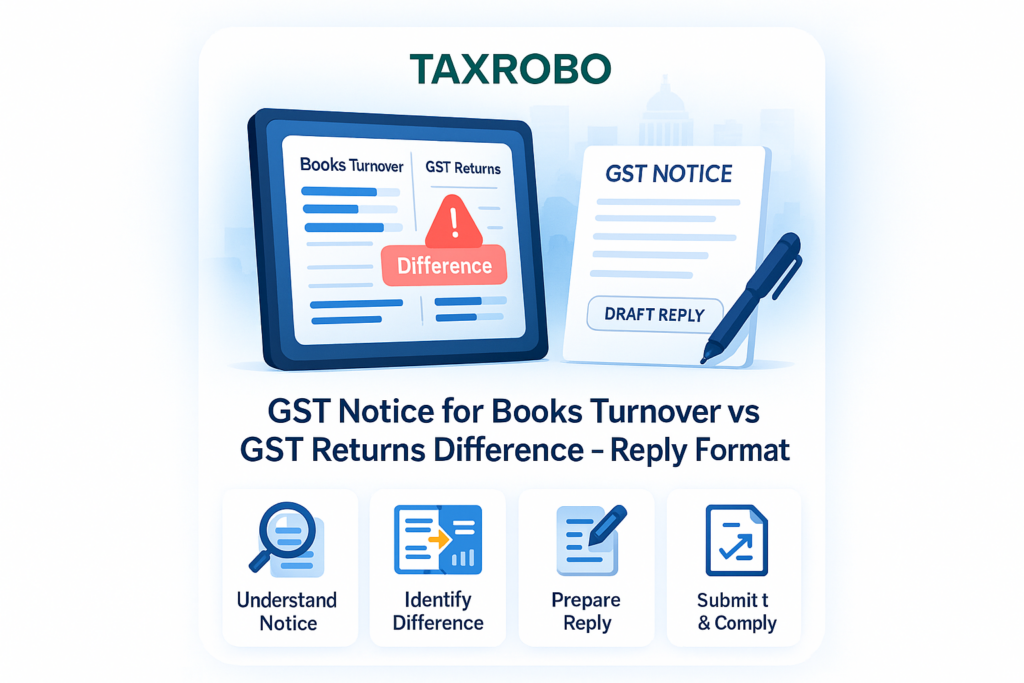

GST Notice for Books Turnover vs GST Returns Difference – Reply Format
That official envelope from the GST department has arrived. You open it to find a notice about a mismatch between your books of accounts and your GST returns. What do you do next? While this can be a stressful moment for any business owner, it’s important to understand that a GST returns difference is a common issue that can be resolved with a clear and methodical approach. A timely and well-drafted reply is crucial to avoid potential penalties and legal complications. This comprehensive guide will break down the common causes of this mismatch, provide a step-by-step reply format GST notice, and offer key GST notice reply guidelines to help you navigate the process confidently and ensure complete compliance.
What is a GST Returns Difference and Why Does it Happen?
Receiving a notice from the GST department often stems from a discrepancy identified by their automated systems, which compare the data you file in your returns with other financial data sources, including your income tax returns. The most frequent reason is a mismatch between the turnover reported in your accounting books and the turnover declared in your GSTR-1 and GSTR-3B filings. Understanding the fundamental definitions of turnover from both perspectives is the first step toward pinpointing the source of the issue and preparing an effective response.
Understanding Turnover: Books of Accounts vs. GST Returns
The term “turnover” can have different meanings in different contexts, and this is often the root of the discrepancy. In your financial statements, turnover represents the total revenue generated from your business operations during a specific period, recorded as per the Indian Accounting Standards. This figure in your Profit & Loss Account is comprehensive and includes all forms of income, whether it is taxable under GST, exempt from GST, or entirely outside the scope of GST law.
On the other hand, turnover as per your GST returns (GSTR-1/GSTR-3B) refers to “aggregate turnover” as defined under the GST Act. This is a more specific figure that primarily includes the value of all your taxable supplies, exempt supplies, exports of goods or services, and inter-state supplies made by you under the same PAN. The GST returns filing process India requires you to report this specific aggregate turnover, and any variation from your book’s total revenue can trigger scrutiny from the tax authorities. For a detailed walkthrough, see our guide on How to File GST Returns Online: A Step-by-Step Guide of the GST Filing Process & Procedure.
Top 7 Reasons for a Books Turnover Difference
A books turnover difference can arise from various genuine business and accounting practices. It doesn’t always imply tax evasion. Here are the top seven reasons why your figures might not match:
- Timing Mismatches: You might receive an advance payment from a customer in March but raise the invoice and supply the goods in April. This advance is recorded as income in your books for that financial year, but for GST purposes, the tax liability arises in the next financial year when the invoice is issued.
- Exempt and Non-GST Supplies: Your business may have income sources that are not subject to GST. For example, interest earned on fixed deposits, rental income from a residential property, or revenue from the sale of non-GST goods like petrol and alcohol. These are included in your book turnover but are not part of your taxable turnover in GST returns.
- Credit/Debit Notes Accounting: There can be a delay or error in how credit or debit notes are reported. A credit note issued in March might be accounted for in your books immediately but reported in the GSTR-1 of a later month, causing a temporary mismatch.
- Incorrect GST Rate Application: If you have inadvertently applied a lower GST rate to certain supplies (e.g., 12% instead of 18%), the total taxable value reported in your GST returns will be lower than the actual revenue recorded in your books for those transactions, leading to a difference.
- Unaccounted Sales: This is a more serious issue where certain sales, often cash transactions, are recorded in the books of accounts but are missed or intentionally not reported in the GST returns. This is a clear case of non-compliance and can lead to significant penalties.
- Inter-Branch Transfers: If you have multiple branches registered under GST in different states, any stock transfer between them is considered a taxable supply under GST and must be reported in GSTR-1. However, from an accounting perspective, this is just an internal stock movement and not recorded as revenue in the company’s consolidated financial statements.
- Clerical Errors: Simple human errors, such as a data entry mistake while manually keying in figures for GSTR-1 or GSTR-3B, are a common and easily rectifiable cause of turnover differences. Understanding the Common Mistakes in GST Return Filing and How to Avoid Them can help prevent such issues.
Decoding the GST Notice: Your First Steps
Receiving a formal notice can be intimidating, but the key is to act promptly and systematically. Panicking or ignoring the notice will only worsen the situation. Your first steps should involve carefully reading and understanding the communication from the department to formulate a precise and effective reply.
Don’t Panic: Identify the Notice Type (e.g., ASMT-10)
The most common notice issued for a turnover mismatch is Form GST ASMT-10. This is a scrutiny notice issued under Section 61 of the CGST Act. Its purpose is not to demand tax but to inform you of the discrepancies the tax officer has observed during the scrutiny of your returns. It provides you with an opportunity to explain the difference and submit clarifications. It’s a formal inquiry, and a proper response can often close the matter without further proceedings. For a broader overview, refer to our guide on How to Handle GST Notices – ASMT-10, DRC-01, DRC-07 Explained Simply. For more details on various notice types, you can always refer to the official GST Portal.
Key Information to Check in the Notice
Before you start drafting a reply, carefully examine the notice and extract the following essential information. This will form the basis of your response and all future communication with the department.
- Notice Reference Number (NRN) & Date: This unique number must be quoted in all your correspondence.
- Financial Year: Identify the specific financial year or tax period for which the discrepancy has been reported.
- Discrepancy Details: The notice will specify the exact
books turnover differenceamount that the department has calculated. Understand their calculation clearly. - Reply Deadline: This is the most critical piece of information. Typically, you are given 30 days to respond. Missing this deadline can lead to further action, so ensuring
GST compliance for books turnovermeans adhering strictly to this timeline.
The Ultimate Reply Format GST Notice for Turnover Mismatch
A well-structured, factual, and evidence-backed reply is your best tool to resolve the notice effectively. The goal is to provide a logical explanation for every rupee of the difference, leaving no room for ambiguity. Follow these steps to prepare a robust response.
Step 1: Prepare a Detailed Reconciliation Statement
This statement is the heart of your reply. It serves as the primary evidence that systematically breaks down the difference between your book turnover and GST turnover, explaining each component. Presenting this information in a clear table format makes it easy for the tax officer to understand and verify.
Here is a sample format for a reconciliation statement:
| Particulars | Amount as per Audited Financials (₹) | Amount as per GST Returns (GSTR-3B/GSTR-1) (₹) |
|---|---|---|
| Gross Turnover | 1,50,00,000 | 1,42,00,000 |
| Add/Less: Reconciliation Items | ||
| Less: Non-GST Supplies (e.g., Sale of Petrol) | (5,00,000) | Not Applicable |
| Less: Exempt Supplies (e.g., Interest Income on FD) | (2,00,000) | Not Applicable |
| Less: Rental Income from Residential Property | (3,00,000) | Not Applicable |
| Add: Advances received in previous FY, invoice in current FY | 2,00,000 | Included in GST Turnover this year |
| Less: Advances received in current FY, invoice in next FY | (1,00,000) | Not included in GST Turnover this year |
| Add: Inter-state branch stock transfer (not revenue in books) | Not Applicable | 1,00,000 |
| Reconciled Turnover | 1,41,00,000 | 1,41,00,000 |
| Difference | NIL | NIL |
Step 2: Drafting the Official Reply Letter
Once your reconciliation statement is ready, you need to draft a formal covering letter to submit along with your supporting documents. This letter should be professional, concise, and directly address the points raised in the notice.
Here is an adaptable template:
[Your Company Letterhead]
Date: [Date of Reply]
GSTIN: [Your GSTIN]
Company Name: [Your Company Name]
Address: [Your Registered Address]
To,
The Proper Officer,
[Jurisdiction/Address as mentioned in the notice]
Subject: Reply to Scrutiny Notice Ref. No. [Notice Reference Number] dated [Notice Date] for FY [Financial Year]
Respected Sir/Madam,
1. Acknowledgement: This is with reference to the scrutiny notice (Form GST ASMT-10) cited above, received by us on [Date of Receipt]. We acknowledge the receipt of the notice and wish to submit our point-wise reply and clarifications for your kind perusal.
2. Explanation of Discrepancy: The primary discrepancy noted in the notice is a GST returns difference in turnover reported in our books of accounts versus that declared in our GST returns for the financial year [Financial Year]. We have prepared a detailed reconciliation statement (attached herewith as Annexure A) which comprehensively explains the reasons for this variation.
3. Point-wise Clarification: As elaborated in the attached reconciliation statement, the difference of ₹[Amount of Difference] is primarily attributable to the following reasons:
* Inclusion of non-GST and exempt income, such as interest on fixed deposits and sale of non-GST goods, in our Profit & Loss statement, which is not liable for GST.
* Timing differences related to advances received in the current financial year for which invoices will be raised in the subsequent year.
* [Mention any other key reasons from your reconciliation table].
4. Conclusion and Request: We believe the above explanation and the attached supporting documents sufficiently clarify the queries raised in the notice and satisfactorily explain the turnover difference. We reiterate our commitment to full tax compliance. We humbly request your good office to kindly review our submission and consider the matter dropped.
Thank you for your consideration.
Sincerely,
For [Your Company Name],
[Your Name/Authorized Signatory Name]
[Designation]
Attachments:
1. Annexure A: Detailed Turnover Reconciliation Statement.
2. Copy of Audited Financial Statements (Profit & Loss Account and Balance Sheet) for FY [Financial Year].
3. Copies of relevant ledgers (e.g., Interest Income) or supporting documents.
GST Notice Reply Guidelines: Do’s and Don’ts
Following best practices during this process can significantly impact the outcome.
- Do’s:
- Reply Promptly: Always reply within the stipulated deadline. If you need more time, formally request an extension.
- Be Factual and Precise: Base your entire reply on facts, figures, and documentary evidence.
- Attach Supporting Documents: Your reconciliation statement must be backed by audited financials, ledgers, and any other relevant proof.
- Use the Official Portal: Submit your reply and documents electronically through the GST portal for an official record.
- Don’ts:
- Ignore the Notice: Ignoring a notice is the worst course of action, as it will lead to an ex-parte order with potential tax demands and penalties.
- Provide Vague or Emotional Responses: Stick to the facts. Avoid generic statements or emotional language.
- Admit Liability Without Verification: Do not agree to pay any tax unless you have thoroughly verified the discrepancy and confirmed that tax was indeed short-paid.
- Miss the Deadline: Failing to respond on time signals non-compliance to the authorities.
Conclusion: Proactive Measures and Final Thoughts on GST Returns Difference
Successfully handling a GST notice for a turnover mismatch boils down to maintaining accurate accounting records for tax purposes, a clear understanding of the difference between GST notice and returns, and a proactive approach to compliance. The key takeaways are to act quickly, prepare a detailed data-backed reconciliation, and communicate professionally with the tax department. The best defense is a good offense. We strongly advise businesses to conduct a periodic self-reconciliation, at least quarterly and mandatorily annually, between their audited financials and their GSTR-9 annual return. This practice can help you catch and rectify any potential GST returns difference long before the department’s scrutiny systems do.
Navigating GST notices can be complex and time-consuming. If you need expert assistance in preparing a robust reply, conducting reconciliations, or streamlining your GST returns filing process India, the specialists at TaxRobo are here to help. Contact Us Today for a Consultation!
Frequently Asked Questions (FAQs)
1. What happens if I don’t reply to a GST notice?
If you fail to reply to a scrutiny notice like ASMT-10 within the given time, the officer may proceed based on the information available to them. This can lead to the issuance of a show-cause notice and eventually a demand order under Section 73 or 74 of the CGST Act, confirming the tax liability along with applicable interest and penalties.
2. What is the difference between GST notice and returns?
A GST return (like GSTR-1 or GSTR-3B) is a statement of your transactions that you, the taxpayer, file periodically to declare your tax liabilities. It is a form of self-assessment. A GST notice, on the other hand, is a formal communication from the tax authorities to you. It is typically issued to seek information, point out a discrepancy in your returns, or initiate an inquiry, audit, or assessment.
3. Is it mandatory to pay the difference mentioned in the notice?
No, it is not immediately mandatory. The notice (ASMT-10) is an opportunity for you to explain the difference. If your explanation, supported by documents, is valid and accepted by the officer, the proceedings will be dropped, and you will not have to pay anything. You are only required to pay tax if, after your own verification, you find that tax was genuinely short-paid. This can be done voluntarily using Form DRC-03.
4. What are the best practices for GST notice reply?
The best practices for GST notice reply include:
- Timeliness: Submitting the reply well before the deadline.
- Accuracy: Ensuring all facts and figures are correct and cross-verified.
- Documentation: Preparing a detailed reconciliation statement and attaching all relevant evidential documents.
- Clarity: Drafting a clear, concise, and professional reply letter that is easy for the officer to understand.
- Official Channels: Submitting the reply online via the official GST portal to maintain a proper record of the communication.