
GST Notice for Retail Shops – Turnover Mismatch (GSTR-1 vs 3B vs Books)
That official-looking envelope from the GST department has arrived. Your heart sinks as you read the words: ‘Notice for Mismatch in Turnover’. What does it mean, and what do you do now? For many retail business owners in India, this scenario is all too common. Dealing with a GSTR-1 turnover mismatch can be stressful, but it’s a problem with a clear solution. Ignoring such a notice can lead to hefty penalties, interest, and even the suspension of your GST registration, putting your business at risk. This is not just another piece of paperwork; it’s a critical compliance check that demands your immediate attention. But don’t worry. This blog post will provide a clear, step-by-step guide to understanding why this happens, what the notice means, and exactly how to resolve a GSTR-1 turnover mismatch notice effectively.
Understanding the GSTR-1 Turnover Mismatch: What Does It Mean?
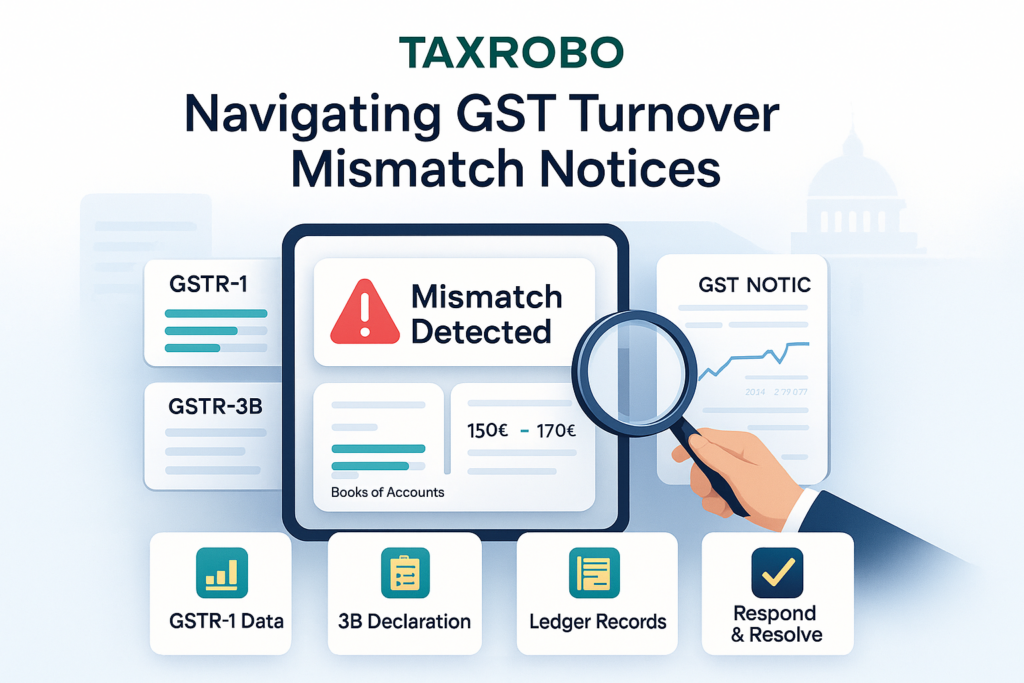
To tackle the notice, you first need to understand the documents involved. The entire issue stems from a disagreement between two key GST returns: GSTR-1 and GSTR-3B. Think of them as two different reports about your business’s sales activity. When the numbers in these reports don’t match, the GST department’s automated system raises a red flag, which results in a notice being sent to you. Understanding their individual roles is the first step toward resolving any discrepancies.
What is GSTR-1? The Record of Your Sales
GSTR-1 is your detailed statement of all outward supplies, which is a formal way of saying it’s a record of everything you sold. It is filed either monthly or quarterly, depending on your turnover. In this return, you provide invoice-level details for your sales to other registered businesses (B2B transactions). For sales to regular customers (B2C transactions), you provide a consolidated, state-wise summary. Essentially, GSTR-1 tells the government, “Here is a complete list of all the sales I made this period and the GST I collected on them.” It is the foundation of the entire GST system, as the information you declare here is used by your buyers to claim their Input Tax Credit (ITC).
What is GSTR-3B? The Summary of Your Tax Liability
GSTR-3B is a monthly summary return. Unlike the detailed GSTR-1, this form provides a consolidated picture of your sales, purchases (on which you claim ITC), and the final GST amount you need to pay to the government. You declare your total sales, calculate your total tax liability, deduct the ITC you are eligible for, and pay the remaining balance. GSTR-3B is the return through which you actually discharge your tax liability for the month. It’s a self-declaration that says, “Based on all my business activities, here is the net GST I owe for this month.”
The Mismatch: When GSTR-1 and GSTR-3B Don’t Talk
The core problem, a GSTR-1 turnover mismatch, arises when the total taxable value of sales you reported in GSTR-1 does not match the total taxable value of sales you declared in your GSTR-3B for the same tax period. For example, if your GSTR-1 for October shows total sales of ₹5,00,000, but your GSTR-3B for October declares sales of only ₹4,50,000, the GST portal’s advanced analytics will automatically detect this difference of ₹50,000. This discrepancy suggests that you may have under-reported your sales in GSTR-3B and, consequently, paid less tax than you were supposed to. The system then automatically triggers a notice to investigate and rectify this difference.
The Critical GSTR-1 vs 3B Comparison for Retail Shops
While any business can face a mismatch, retail shops are particularly susceptible due to the high volume of transactions and specific business practices. Understanding these common pitfalls is key to both resolving current notices and preventing future ones. The dynamic nature of retail operations, with daily cash sales, returns, and promotional offers, creates a complex environment for GST compliance.
Why is a Retail Shops GST Turnover Mismatch So Common?
The unique challenges of the retail sector make it a hotspot for common turnover mismatch issues in GST. A simple data entry error or a misunderstanding of GST rules can easily lead to a notice. Here are some of the most frequent reasons for a mismatch:
- Sales Returns & Credit Notes: This is a major factor. A customer buys a product in March and returns it in April. You correctly issue a credit note in April and report it in your April GSTR-1, which reduces your turnover for that month. However, you might forget to make the corresponding adjustment in your April GSTR-3B, leading to a mismatch where GSTR-1 turnover is lower than GSTR-3B.
- Advance Payments: You receive an advance from a customer for a large order in one month but raise the final invoice and deliver the goods in the next month. As per GST rules, tax is payable when the advance is received. This often leads to confusion, where the tax is paid in GSTR-3B in the month the advance is received, but the invoice is reported in GSTR-1 in the following month.
- Manual Entry Errors: The sheer volume of daily transactions in a retail shop increases the likelihood of human error. A simple typo while entering sales figures into GSTR-3B—like typing ₹1,80,000 instead of ₹1,88,000—can trigger a notice. These small mistakes are easily flagged by the automated system.
- Amendments Made Later: Suppose you discover an error in an invoice from a previous month (e.g., wrong GST rate applied). You can correct this by making an amendment in the GSTR-1 of the current month. However, the corresponding tax adjustment (either paying extra or claiming a refund) must be accurately reflected in the current month’s GSTR-3B. Failing to sync these two actions creates a mismatch.
Don’t Forget Your Books of Accounts!
The reconciliation doesn’t stop with GSTR-1 and GSTR-3B. The third, and most important, pillar of your financial reporting is your books of accounts (like your Tally data, sales ledger, or P&L statement). The GST department has the authority to compare the turnover declared in your GST returns with the turnover reported in your audited annual financial statements filed with the Income Tax department. A significant mismatch between your GST returns and your books is a major red flag for tax authorities and can trigger a detailed audit or investigation. Your books of accounts are your ultimate source of truth, and Maintaining Accurate Accounting Records for Tax Purposes is the gold standard of compliance, ensuring all three—GSTR-1, GSTR-3B, and your books—are perfectly aligned.
How to Resolve a GST Turnover Mismatch Notice in Retail
Receiving a notice can be intimidating, but following a structured process can help you address it efficiently. For a broader understanding of different communications from the department, our guide on How to Handle GST Notices – ASMT-10, DRC-01, DRC-07 Explained Simply can be very helpful. The key is to act promptly and methodically. This section provides the exact steps on how to resolve GST turnover mismatch in retail.
Step 1: Acknowledge the Notice (Form GST DRC-01B)
First and foremost, don’t panic or ignore the communication. The notice for a turnover mismatch is typically issued in Form GST DRC-01B. This is an automated intimation from the GST portal highlighting the difference between your GSTR-1 and GSTR-3B filings. You need to log in to the GST portal to view and respond to this notice. It is crucial to make it a habit to regularly check the portal for any new notices or communications under ‘Services’ > ‘User Services’ > ‘View Notices and Orders’. Acknowledging the notice promptly shows your intent to comply. You can access the official portal here: GST Portal.
Step 2: Perform a Detailed Reconciliation
This is the most critical step. You need to become a detective and find the exact source of the mismatch. Follow this process:
- Gather Your Data: From the GST portal, download your GSTR-1 and GSTR-3B data for the entire financial year or the specific period mentioned in the notice.
- Export Your Sales Records: Export the complete sales data from your accounting software (e.g., Tally, Zoho Books, etc.) or your manual sales register for the same period.
- Compare Month-by-Month: Create a simple spreadsheet with columns for Month, Turnover as per GSTR-1, Turnover as per GSTR-3B, and Turnover as per Books. This will give you a clear view of which months have discrepancies.
- Drill Down to the Source: Once you identify the months with mismatches, dig deeper. Check for the common retail issues mentioned earlier: look for unadjusted credit notes, advances recorded incorrectly, amendments made in GSTR-1 but not adjusted in GSTR-3B, or simple data entry errors. Pinpointing the exact transactions is key to a successful resolution.
Step 3: Prepare Your Reply
Once you have identified the reasons for the mismatch, you have two possible paths for your response, which you must submit via Form DRC-01B Part B on the portal.
- Scenario 1: You Agree with the Mismatch and Shortfall in Tax. If your reconciliation shows that you genuinely under-reported sales in GSTR-3B and paid less tax, you must accept the liability. Your reply should state that you agree with the discrepancy and have paid the differential tax along with applicable interest.
- Scenario 2: You Disagree with the Mismatch. If you believe the mismatch is due to a valid reason (e.g., a credit note from a previous period adjusted in the current GSTR-1 but the tax effect was already given in the previous GSTR-3B), you must prepare a detailed reply. Clearly explain the reasons for the difference and attach your reconciliation statement and any supporting documents (like copies of credit notes, invoice amendments, etc.) as proof. Your explanation must be clear, concise, and backed by evidence.
Step 4: Pay Tax and Interest via Form DRC-03
If your reconciliation confirms a tax shortfall, you cannot simply file the reply. You must pay the differential tax amount plus the applicable interest for the delay. This payment must be made voluntarily using Form GST DRC-03. This form is specifically designed for making payments for liabilities identified after filing returns. Once the payment is made, you will get a payment reference number (PRN), which you must mention in your reply in Form DRC-01B. Closing the loop by paying the due amount is crucial. Failure to respond or pay can lead the tax officer to initiate formal recovery proceedings under Section 79 of the CGST Act.
Proactive Measures: Preventing Future Dealing with GSTR-1 Discrepancies
Resolving one notice is good, but preventing them from occurring in the first place is even better. Adopting good compliance habits can save you significant time, money, and stress. Here are some best practices for GST filing for retail shops in India.
- Monthly Reconciliation is Non-Negotiable: Before filing your GSTR-3B each month, make it a mandatory practice to reconcile the sales figures with your GSTR-1 and your internal sales register. Understanding How to File GST Returns Online: A Step-by-Step Guide of the GST Filing Process & Procedure correctly is the first step. This single habit can prevent over 90% of mismatch notices.
- Use Reliable Accounting Software: Modern accounting software can automate the preparation of GSTR-1 and GSTR-3B from your sales and purchase entries. This drastically reduces the chances of manual errors and makes reconciliation much easier.
- Train Your Staff: Ensure the person responsible for filing your GST returns fully understands the implications of credit notes, debit notes, advances, and amendments. Proper training is an investment in compliance.
- Stay Updated on GST Rules: The GST law is dynamic and subject to changes. Follow reliable sources of information or partner with a tax professional to stay informed about any new rules or procedures that might affect your business.
- Get a Professional Review: Consider having a tax consultant or a Chartered Accountant review your GST filings on a half-yearly or yearly basis. An expert can often spot potential issues that you might miss, helping you correct them before they become a
turnover mismatch notice in India.
Conclusion
A GSTR-1 turnover mismatch notice can seem daunting, but it is a manageable compliance issue. The key is to act quickly, perform a thorough and honest reconciliation of your GSTR-1, GSTR-3B, and books of accounts, and submit a formal, well-documented response to the tax department. By understanding the common pitfalls specific to the retail sector and implementing proactive measures like regular reconciliation, you can significantly reduce the risk of receiving such notices in the future. Remember, accurate GST filing is not just about avoiding penalties; it’s about maintaining a healthy compliance record, which builds credibility for your business in the long run.
Feeling overwhelmed by a turnover mismatch notice in India? Don’t risk your business by navigating this alone. The experts at TaxRobo specialize in resolving complex retail GST issues in India. We can help you with detailed reconciliation, preparing an effective reply, and ensuring your future GST compliance is seamless. Contact us today for a consultation and put your GST worries to rest.
Frequently Asked Questions (FAQs)
1. What is the time limit to respond to a GST notice for turnover mismatch (DRC-01B)?
You are generally required to reply within 7 working days from the date the notice is issued on the portal. It is crucial to adhere to this timeline to avoid any adverse action from the department, which may include initiating recovery proceedings.
2. Can I amend GSTR-3B after filing?
No, GSTR-3B cannot be revised or amended once it has been filed. If you discover an error after filing, any corrections—such as adjusting turnover or tax liability—must be made in the GSTR-3B of a subsequent month.
3. What are the penalties for not resolving a GSTR-1 vs 3B mismatch?
If the mismatch is due to a short payment of tax, you will be liable to pay the deficit tax amount along with interest, which is currently calculated at 18% per annum. In addition to this, the officer may levy a penalty. If you fail to respond or pay, the department can initiate demand and recovery proceedings to collect the dues.
4. How does this turnover mismatch affect my business?
Besides the direct financial impact of tax, interest, and penalties, a frequent turnover mismatch negatively affects your GST compliance rating. A poor rating can damage your business’s credibility with suppliers, customers, and lenders. It may also lead to more frequent and detailed scrutiny from the tax authorities in the future.