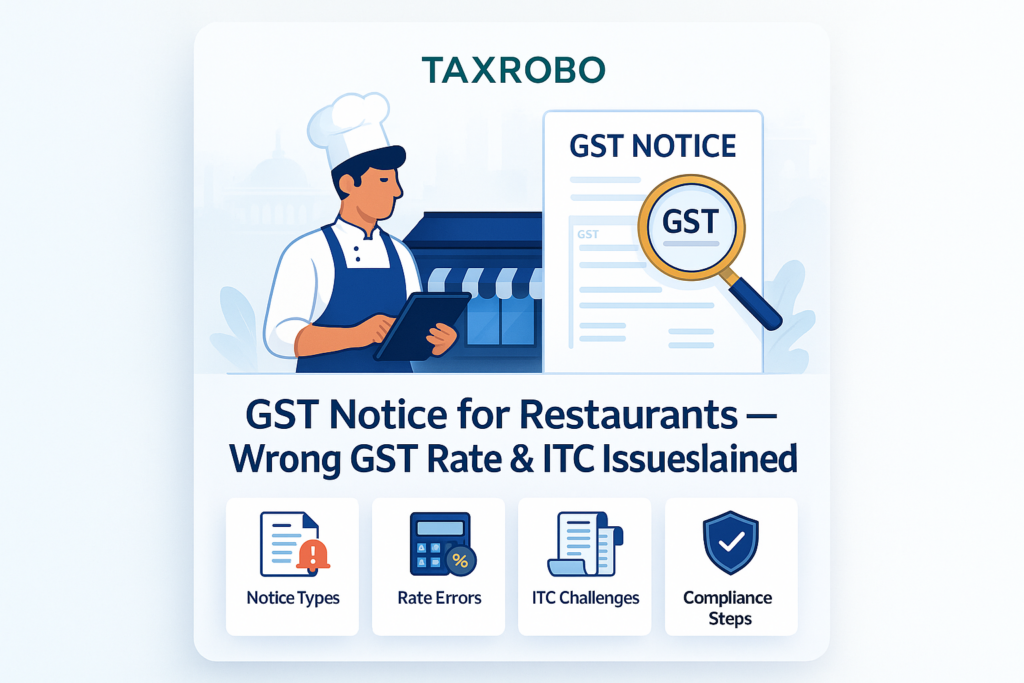

GST Notice for Restaurants – Wrong GST Rate & ITC Issues Explained
Running a restaurant is challenging enough. Between managing staff, delighting customers, and handling daily operations, the last thing you need is a formal notice from the GST department landing on your desk. However, receiving a GST notice for restaurants is more common than many owners think, often stemming from simple misunderstandings of complex tax laws. These notices can cause significant stress and financial strain if not handled correctly. The two biggest culprits behind these notices are confusion over the correct GST rate and the incorrect claiming of Input Tax Credit (ITC), which are some of the key GST challenges facing restaurants in India. This guide will demystify these common issues, explain exactly why they happen, and provide a clear, step-by-step plan to address them, ensuring your business stays compliant and you can focus on what matters most.
Understanding GST for Indian Restaurants: The Root of the Confusion
To effectively tackle a GST notice, it’s crucial to first grasp the fundamental GST rules that often cause the most problems for food and beverage businesses. A solid foundation in understanding GST for Indian restaurants is the first line of defence against compliance issues. The rules might seem straightforward at first glance, but the nuances are what frequently trip up even the most diligent business owners. The core of the confusion lies in the applicable tax rates and the associated conditions regarding Input Tax Credit, which vary significantly based on the nature and location of the restaurant establishment. For a deeper look into this specific area, see our guide on GST on Restaurant Services – Input Credit and Composition Scheme. Misinterpreting these foundational rules is the primary reason why so many restaurants find themselves facing scrutiny from tax authorities, making this knowledge essential for long-term GST compliance restaurants India.
The 5% GST Rule: Simple, But with a Catch
For the vast majority of food businesses, the GST structure is designed to be simple. The standard GST rate applicable to services provided by restaurants, cafes, food parlours, and similar eating joints is a flat 5%. This rate applies whether the service is dine-in or takeaway, and it applies to the total value of the food and beverages served. However, this simplicity comes with a very important and non-negotiable condition: restaurants charging 5% GST cannot claim any Input Tax Credit (ITC).
So, what is ITC? In simple terms, Input Tax Credit is a mechanism that allows a business to reduce its final tax liability by claiming a credit for the GST it has already paid on its inputs. These inputs include everything from raw materials (vegetables, grains, spices) and capital goods (kitchen equipment) to services like rent, marketing fees, and professional consultations. By disallowing ITC, the government has simplified the tax calculation for restaurants, but it also means the GST paid on all business expenses becomes a part of the restaurant’s operational cost.
When Does the 18% GST Rate Apply?
While the 5% rule is the norm, there are specific exceptions where a higher GST rate of 18% is applicable. Understanding these exceptions is critical to avoiding GST rate issues restaurants India. If your establishment falls into one of these categories, you must charge the higher rate, but the silver lining is that you also become eligible to claim Input Tax Credit on your business expenses. This can significantly alter your financial calculations and tax filing strategy.
Here are the primary scenarios where 18% GST applies:
- Restaurants within Hotels: If a restaurant is located within the premises of a hotel, guesthouse, or inn where the declared tariff for any accommodation unit is ₹7,500 or more per day, the restaurant services are subject to 18% GST. In this specific case, the restaurant is fully eligible to claim ITC on its inputs.
- Outdoor Catering Services: If your business provides outdoor catering services for events like weddings, parties, or corporate functions, the GST rate is 18%, and you are entitled to claim ITC benefits.
Actionable Tip: The very first step to ensuring GST compliance restaurants India is to accurately determine which category your business falls into. Are you a standalone cafe or a restaurant inside a luxury hotel? This single distinction dictates your GST rate and ITC eligibility, forming the bedrock of your tax compliance.
| Feature | Standalone Restaurants / Restaurants in budget hotels | Restaurants in Hotels (Room Tariff ≥ ₹7,500/day) | Outdoor Catering |
|---|---|---|---|
| Applicable GST Rate | 5% | 18% | 18% |
| Input Tax Credit (ITC) | Not Available | Available | Available |
Top 3 Reasons Your Restaurant Received a GST Notice
Let’s dive into the most common triggers for a GST notice restaurants receive. The GST Network (GSTN) uses sophisticated data analytics to flag discrepancies in tax filings. When the system detects a mismatch or an anomaly in your returns, it automatically generates a notice. Understanding these red flags can help you proactively avoid them. For a broader overview, it is useful to understand How to Handle GST Notices – ASMT-10, DRC-01, DRC-07 Explained Simply.
Reason #1: Charging the Wrong GST Rate
This is perhaps the most frequent and easily detectable error. The problem arises when a standalone restaurant, which is mandated to charge 5% GST, incorrectly levies 18% on its customer invoices. This is a critical issue related to wrong GST rate restaurants India and is immediately flagged by the tax authorities.
- Why it happens: This mistake often occurs for two reasons. First, a new business owner might be genuinely unaware of the specific rules and assume the standard 18% rate applies to their services, just as it does for many other sectors. Second, and more concerningly, some owners might intentionally charge 18% under the mistaken belief that this will allow them to claim ITC, hoping to reduce their tax outgo. They fail to realize that their eligibility is determined by their business category, not the rate they choose to charge.
- Consequence: Charging a higher rate means you are collecting excess tax from your customers, which belongs to the government. The GSTN system can easily cross-reference your business registration details with the tax rate you are declaring in your GSTR-1 returns. When it sees a “Restaurant Service” HSN code paired with an 18% tax rate from a standalone establishment, it’s an instant red flag, leading to a notice demanding an explanation and remittance of the excess tax collected.
Reason #2: Incorrectly Claiming Input Tax Credit (ITC)
This mistake is directly linked to the 5% GST rule and is a major source of ITC issues restaurants India. As established, restaurants operating under the 5% GST scheme are explicitly barred from claiming ITC. However, many business owners accidentally make this claim, leading to serious compliance problems. For a complete understanding, review our GST Input Tax Credit (ITC) Full Guide 2025 – Eligibility, Limits & Common Issues.
- Why it happens: The confusion often starts at the GST portal itself. When your suppliers file their GSTR-1 returns, the invoices they issue to you are automatically reflected in your GSTR-2A and GSTR-2B statements as eligible ITC. An owner who is not fully aware of the “no ITC” condition for restaurants might see this available credit on their dashboard and assume they are entitled to claim it. They then proceed to offset their GST liability with this ITC while filing their GSTR-3B return.
- Consequence: This is a direct violation of GST law. The department’s backend system is programmed to know that businesses registered under the restaurant service category (charging 5%) cannot claim ITC. When the system detects that such a business has claimed ITC in its GSTR-3B, it triggers a notice. This notice will demand the reversal of the wrongly claimed credit and the payment of the tax liability in cash, along with mandatory interest and potentially heavy penalties for non-compliance.
Reason #3: Mismatches in GSTR-1 and GSTR-3B Filings
Beyond the specific rate and ITC rules, general filing discipline is crucial. Discrepancies between different GST returns are a major red flag and a common cause of GST filing problems for restaurants India. The two most important returns in this context are GSTR-1 and GSTR-3B.
- Explain the forms simply:
- GSTR-1: This is your detailed statement of all sales (outward supplies) for the tax period. You report every single invoice issued to customers here. It tells the government, “This is what I sold.”
- GSTR-3B: This is a monthly summary return. It summarises your total sales, ITC claimed (if applicable), and calculates the final tax you need to pay to the government for that month. It tells the government, “This is the net tax I am paying.”
- Why it happens: Mismatches can occur for simple human errors. A typo while entering the total turnover in GSTR-3B, forgetting to include a last-minute invoice in GSTR-1 that was included in the GSTR-3B summary, or an incorrect adjustment can all lead to a difference between the liability declared in GSTR-1 and the tax paid via GSTR-3B.
- Consequence: The GSTN system is designed to perform a constant reconciliation between these two forms. If the turnover reported in your GSTR-1 is higher than what you’ve declared and paid tax on in your GSTR-3B, the system assumes you have underpaid your taxes. This automatically triggers a scrutiny notice, often in the form of ASMT-10, asking you to explain the discrepancy and pay the differential tax along with interest.
Your Step-by-Step Guide to Responding to a GST Notice
Receiving a notice can be intimidating, but a calm, structured, and timely response is key to resolving the issue efficiently. Panicking or ignoring the communication will only escalate the problem. Follow these steps to navigate the process professionally.
Step 1: Do Not Ignore the Notice
This is the most critical rule. A GST notice is a formal communication that requires a formal response within a specified timeframe. Ignoring it can lead to more severe consequences, including penalties, ex-parte orders (where the officer makes a decision without hearing your side), and even recovery proceedings. The notice will clearly mention the deadline for a response, which is typically between 15 and 30 days. Mark this date and ensure you act well before it expires. Acknowledging the notice promptly demonstrates your intent to comply.
Step 2: Carefully Analyze the Discrepancy
Before you draft a reply, you must fully understand the issue raised by the tax officer. Read the notice carefully, multiple times if needed. Identify the specific discrepancy it points to. Is it related to the wrong tax rate, an incorrect ITC claim, a mismatch between GSTR-1 and GSTR-3B, or something else? The notice will usually specify the tax period in question and the exact amount of the discrepancy. Once you understand the allegation, begin gathering all the necessary supporting documents. This includes your GST registration certificate, all filed returns (GSTR-1, GSTR-3B) for the period, your sales and purchase ledgers, bank statements, and any specific invoices that might be mentioned in the notice.
Step 3: Prepare a Detailed, Factual Reply
Your response must be clear, factual, and directly address the points raised in the notice. It should be submitted in the prescribed format, such as Form ASMT-11 in response to a scrutiny notice in ASMT-10. Your reply should be structured logically. Start by acknowledging the notice and then address each allegation one by one. If the department is correct and you have made a genuine error (like wrongly claiming ITC), accept the mistake. You should pay the required tax, interest, and any applicable penalty, and submit proof of payment along with your reply. If you believe the notice is incorrect, your reply must provide a strong rebuttal supported by documentary evidence. Clearly explain your position and attach all relevant documents (e.g., ledgers, invoices, reconciliations) as annexures to substantiate your claims.
Step 4: Consult a GST Professional
Navigating GST regulations for restaurants India can be complex, and the language of official notices is often technical. A small error in your written reply or a misunderstanding of the legal provisions can lead to larger liabilities. It is highly advisable to consult with a tax expert or a Chartered Accountant. A professional can help you understand the precise implications of the notice, prepare a legally sound and effective reply, and represent your case before the tax authorities if needed. Their expertise ensures that your response is comprehensive, accurate, and positions you for the best possible outcome. The team at TaxRobo specializes in handling such matters and can provide the expert guidance you need.
Proactive Steps for Long-Term GST Compliance
The best way to handle a GST notice is to avoid receiving one in the first place. By adopting proactive compliance practices, you can significantly reduce the risk of scrutiny and keep your business financially healthy.
To summarize the key takeaways, always remember these three golden rules. First, ensure you are charging the correct 5% GST rate unless you fall under the specific hotel category that mandates 18%. Second, never claim Input Tax Credit if you are operating under the 5% scheme, regardless of what your GSTR-2B shows. Third, before filing your GSTR-3B each month, diligently reconcile your sales figures with your GSTR-1 to eliminate any mismatches. Staying vigilant with these key areas is the best way to avoid a GST notice restaurants fear and allow you to focus on what you do best—serving your customers and growing your business.
Don’t let GST compliance become a recurring headache. The expert team at TaxRobo is here to manage your GST filings, handle notices, and provide strategic advice to keep your restaurant financially healthy and compliant. Contact us today for a consultation!
Frequently Asked Questions about GST Notices for Restaurants
1. Can my small restaurant opt for the 18% GST rate just so I can claim ITC?
No. The GST law is very clear on this. If you are a standalone restaurant or a restaurant in a hotel with a room tariff below ₹7,500, you are mandated to charge 5% GST without the benefit of ITC. You cannot voluntarily opt for a higher tax rate to gain ITC benefits. The 18% rate is strictly applicable only under the specific conditions prescribed by law.
2. What happens if I have already claimed ITC by mistake?
If you have realized that you have wrongly claimed ITC, the best course of action is to correct the error voluntarily. You must reverse the wrongly claimed ITC amount in your subsequent GSTR-3B filing. Additionally, you are liable to pay interest on the amount from the date the credit was utilized until the date it is reversed. Taking this corrective step before a notice is issued can potentially reduce or even waive the penalties that would otherwise be imposed.
3. The notice I received is a Form ASMT-10. What does that mean?
A notice in Form ASMT-10 is a formal intimation of scrutiny. It is issued by a GST officer when they find discrepancies or anomalies in your GST returns during their review of your file. It is not a demand notice but rather a request for an explanation. You are required to reply to this notice (in Form ASMT-11), either accepting the discrepancy and paying the tax, or providing a detailed factual explanation with supporting documents to contest the officer’s observation.
4. Where can I check the official GST rates for restaurant services?
For the most accurate and up-to-date information, you should always refer to official government sources. You can find the latest notifications, circulars, and GST rate schedules on the official website of the Central Board of Indirect Taxes and Customs (CBIC). This ensures you are always aligned with the current law. You can check the official rates here: CBIC GST Rates Page.