
GST Notice for Traders: Your Complete Guide to Replying to an ITC Mismatch
Receiving an official-looking envelope from the GST department can be a stressful experience for any business owner. The technical jargon and the pressure of a deadline can cause instant confusion and anxiety. For many, an Input Tax Credit (ITC) mismatch notice is a common but daunting challenge. This guide is here to change that. We will break down everything you need to know about handling a GST notice for traders, explaining the core issue, outlining a clear response procedure, and providing a ready-to-use reply format. Properly addressing these notices is fundamental to maintaining good GST compliance for traders in India and avoiding unnecessary penalties or legal complications.
What is an ITC Mismatch? A Simple Explanation for Traders
Before you can draft a reply, it’s essential to understand exactly what the notice is about. At its heart, an ITC mismatch is a discrepancy between the tax credit you’ve claimed and the tax credit the GST system says you’re eligible for. Let’s break it down further.
Understanding Input Tax Credit (ITC)
Think of Input Tax Credit (ITC) as a discount the government gives you. As a trader, you pay GST when you purchase goods or services for your business (these are your “inputs”). When you sell your goods, you collect GST from your customers (this is your “output”). ITC allows you to subtract the GST you already paid on your inputs from the GST you collected on your outputs. This means you only pay the government the difference, preventing the double taxation of the same item. It’s a cornerstone of the GST system designed to make business more efficient.
The Root of the Mismatch: GSTR-2A/2B vs. GSTR-3B
The entire issue of an ITC mismatch arises from a comparison between two different GST returns. Understanding their roles is key to resolving the notice.
- GSTR-2A/2B: This is not a return you file but an auto-generated statement available on the GST portal. It acts as your digital purchase ledger. GSTR-2A is dynamic and updates in real-time, while GSTR-2B is a static statement for a specific month. Both statements show the amount of ITC available to you based on the sales invoices (GSTR-1) uploaded by all your suppliers.
- GSTR-3B: This is the monthly summary return that you file. In this form, you declare your total sales, output GST liability, and the total ITC you are claiming for that particular month.
The Mismatch: A discrepancy, or mismatch, occurs when the ITC amount you have claimed in your GSTR-3B is higher than the amount that appears as eligible in your auto-populated GSTR-2A/2B. The GST department’s systems automatically flag this difference, which often triggers a notice to seek an explanation. For a detailed breakdown, see our guide on How to Resolve ITC Mismatch Issues – GSTR-2A/2B vs 3B Guide.
Common Reasons Why You Received a GST Notice for Traders in India
Receiving a GST notice for traders in India doesn’t automatically mean you’ve made a fraudulent claim. More often than not, the mismatch is due to simple clerical errors or timing issues. By identifying the root cause, you can formulate a precise and effective reply.
Here are some of the most common reasons for an ITC mismatch:
- Supplier Errors: The most frequent cause is when your supplier makes a mistake. They might have entered the wrong GSTIN, used an incorrect invoice number, or simply filed their GSTR-1 sales return late, causing the invoice not to reflect in your GSTR-2B for that month.
- Invoice Detail Mismatch: A minor difference in the invoice number (e.g., ABC/001 vs. ABC-001), invoice date, or taxable value entered by you versus your supplier can lead to a mismatch.
- Typographical Errors: A simple data entry mistake on your part while filing your GSTR-3B can result in claiming an incorrect ITC amount. For example, typing ₹55,000 instead of ₹5,500.
- Timing Differences: You might have received the goods and the invoice in one month and claimed the ITC correctly. However, your supplier might have reported that invoice in their GSTR-1 in the following month. This creates a temporary mismatch that usually self-corrects in the next tax period.
- B2B vs. B2C: Your supplier may have mistakenly reported your business-to-business (B2B) purchase as a business-to-consumer (B2C) sale. B2C sales don’t contain a GSTIN, meaning the credit will not appear in your GSTR-2A/2B.
How to Respond to a GST Notice India: A Step-by-Step Guide
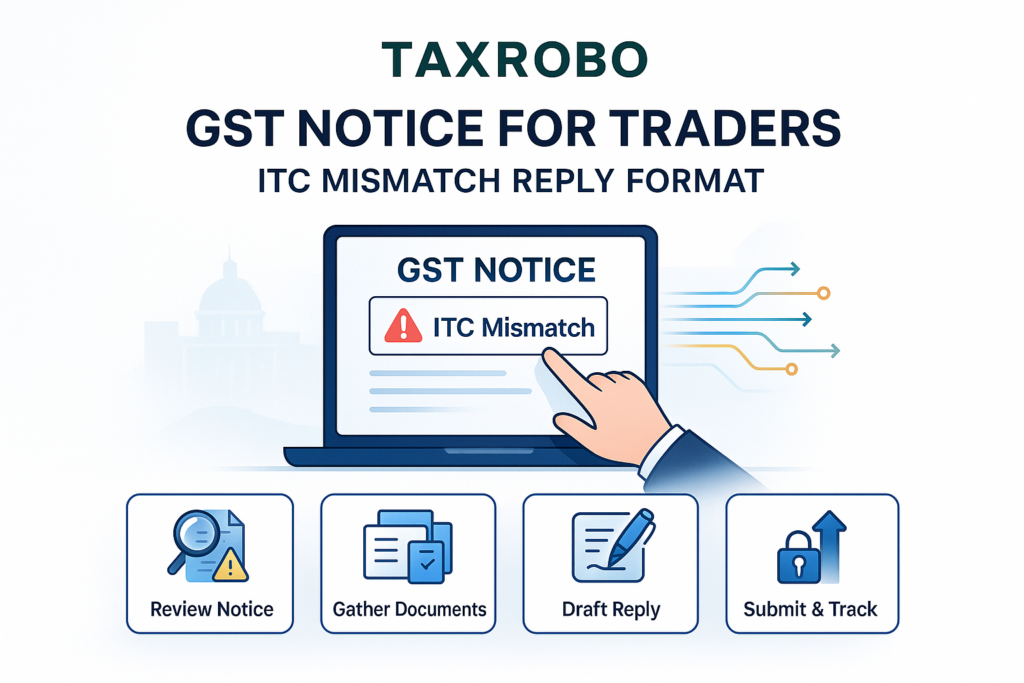
A structured and methodical approach is the best way to handle the notice. Follow these steps for a smooth and effective traders GST notice reply.
Step 1: Don’t Panic – Acknowledge and Verify the Notice
The first rule is to stay calm. Carefully read the notice, which is typically Form ASMT-10 (Scrutiny Notice) or DRC-01 (Show Cause Notice). Pay close attention to the specific discrepancies mentioned, the tax period in question, and most importantly, the deadline for your reply. Before proceeding, always verify the authenticity of the notice by logging into the Official GST Portal and checking under “Services” > “User Services” > “View Notices and Orders”. For more details, our article on How to Handle GST Notices – ASMT-10, DRC-01, DRC-07 Explained Simply can be very helpful.
Step 2: Conduct a Thorough ITC Reconciliation
This is the most critical step in preparing your response. You need to reconcile your records with the GST portal data. Compare your detailed purchase register (the list of all invoices you’ve paid) for the specified period with the data available in your GSTR-2A and GSTR-2B. Use accounting software or a simple spreadsheet to go line-by-line and identify the exact invoices that are causing the mismatch. This detailed analysis will form the backbone of your reply. Understanding ITC Reconciliation: Importance and Best Practices for Businesses is key to this process.
Step 3: Gather Your Documents and Evidence
Your explanation is only as strong as the evidence you provide to support it. Once you have identified the reasons for the mismatch, start collecting all the necessary documentation. This is crucial when replying to GST notice traders.
Your document checklist should include:
- Clear copies of the tax invoices for the purchases in question.
- Proof of payment to the supplier, such as bank statements or transaction receipts.
- Proof of receipt of goods/services, like signed delivery challans, e-way bills, or transporter receipts.
- Any communication with the supplier (emails, letters) where you have requested them to correct their GSTR-1 filing.
Step 4: Draft Your Response using the Correct GST Notice Response Format
Your reply should be factual, polite, and directly address the points raised in the notice. Avoid vague statements. Clearly explain each discrepancy and reference the supporting documents you have attached. Using a proper GST notice response format shows professionalism and makes it easier for the tax officer to understand and accept your justification.
The Perfect ITC Mismatch Reply Format India
Using a standardized template ensures you cover all the necessary details and present your case clearly. This section provides the key components and a sample GST mismatch notice reply template you can adapt.
Key Components of Your Reply Letter
A professional reply should always contain these elements:
- Header: Use your company’s official letterhead, including your business name, address, and GSTIN.
- Recipient Details: Clearly mention the designation and address of the GST officer or department that issued the notice.
- Reference Number: This is crucial. Prominently state the Notice Reference Number (ARN) and the date of the notice.
- Subject Line: Write a clear and concise subject, such as “Reply to Show Cause Notice for ITC Mismatch for the Tax Period [e.g., April 2023 to June 2023]”.
- Body: This is the main part of your reply. Start by acknowledging the notice. Then, provide a point-by-point explanation for the discrepancies. Using a table is highly recommended to present the information clearly.
- Annexures: At the end of the body, list all the supporting documents you are attaching as annexures (e.g., Annexure-A: Copy of Invoice, Annexure-B: Bank Statement).
- Closing: End with a professional closing, your name, designation, and signature.
Sample GST Mismatch Notice Reply Template
You can use this fill-in-the-blanks template to structure your official response.
[Your Company Letterhead]

Date: [Date of Reply]

To,
The [Designation of the Officer],
[Address of the GST Department]

Reference No: [Notice ARN/Reference Number] dated [Date of Notice]
GSTIN: [Your GSTIN]

**Subject: Submission of Reply in response to Notice regarding discrepancy in Input Tax Credit (ITC)**

Respected Sir/Madam,

This is with reference to the notice cited above, received by us on [Date of Receipt], concerning an alleged excess claim of ITC in our GSTR-3B for the tax period [Mention Tax Period].

The discrepancy pointed out is for an amount of ₹[Amount]. We have thoroughly reviewed our records and would like to submit the following reason-wise explanation for the same:

| S.No. | Supplier GSTIN | Invoice No. | Invoice Date | Reason for Mismatch | Remarks & Supporting Document Attached |
|---|---|---|---|---|---|
| 1. | [Supplier GSTIN] | [Invoice No.] | [Date] | [Example: Supplier filed GSTR-1 in the subsequent month] | [Example: Copy of tax invoice and bank statement attached as Annexure-A] |
| 2. | [Supplier GSTIN] | [Invoice No.] | [Date] | [Example: Typographical error in supplier's GSTR-1; our claim is correct] | [Example: Copy of tax invoice and communication with supplier attached as Annexure-B] |
| 3. | [Supplier GSTIN] | [Invoice No.] | [Date] | [Example: Typographical error in our GSTR-3B, actual ITC is correct] | [Example: Reconciled statement attached as Annexure-C] |

We have attached the following documents for your kind perusal:
1.  Annexure-A: Copy of Tax Invoice & Bank Statement.
2.  Annexure-B: Copy of Tax Invoice & Email to Supplier.
3.  Annexure-C: ITC Reconciliation Statement.

We believe we have fulfilled all the conditions for availing ITC as per Section 16 of the CGST Act, 2017. We request you to kindly review our submission and drop the proceedings.

Thank you.

Sincerely,
[Your Name]
[Your Designation]
[Company Name]
Common Mistakes to Avoid When Replying to GST Notice for Traders
Knowing what not to do is as important as knowing what to do. Avoid these common pitfalls to ensure a successful resolution.
- Ignoring the Notice: This is the worst mistake you can make. It can lead to an ex-parte order where the officer confirms the full tax demand, along with interest and hefty penalties, without considering your side of the story.
- Missing the Deadline: Always reply within the time frame mentioned in the notice. If you need more time, you can request an extension, but never let the deadline pass without communication.
- Giving Vague or Incomplete Replies: Simply stating “the claim is correct” is not enough. You must provide specific reasons and evidence for each mismatch. A data-backed explanation is always more effective.
- Not Attaching Supporting Documents: Your reply is incomplete without proof. Ensure every claim you make in your letter is backed by a corresponding document attached as an annexure.
- Failing to Consult a Professional: While simple cases can be handled independently, complex situations involving large amounts or multiple suppliers are best handled by a tax expert. Professional advice can be crucial for drafting a legally sound reply and achieving a favorable outcome.
Conclusion
Facing a GST notice can be intimidating, but it doesn’t have to derail your business. By understanding the root cause, following a systematic approach to reconciliation, gathering solid proof, and using a structured reply format, you can address the issue confidently. Remember, a timely and accurate response to a GST notice for traders is not just about avoiding penalties; it’s a critical part of maintaining financial discipline and ensuring long-term GST compliance for traders in India.
Feeling overwhelmed by a GST notice? The experts at TaxRobo are here to help you draft the perfect reply and ensure your business stays compliant. Contact us today for a consultation!
Frequently Asked Questions (FAQs)
Q1: What is the time limit to reply to a GST notice for ITC mismatch (ASMT-10)?
A: Typically, you are given 15 to 30 days to respond. The exact deadline will be mentioned in the notice itself. It is crucial to adhere to this timeline to avoid adverse action.
Q2: Can I file the reply to the GST notice online?
A: Yes, the reply to most notices, including ASMT-10, must be filed electronically on the GST portal. You can file your response using Form ASMT-11, where you can also upload your detailed explanation letter and all supporting documents as PDF files.
Q3: What happens if I don’t respond to the GST notice?
A: If you fail to respond, the tax officer may proceed based on the information available to them (an ex-parte order). This could lead to the confirmation of the full tax demand, along with applicable interest and penalties, which you will then be liable to pay.
Q4: My supplier made a mistake. Am I still liable?
A: Yes, under the GST law, the initial responsibility to prove the legitimacy of an ITC claim lies with the recipient (you). You must provide all necessary proof (invoice, proof of payment, proof of receipt of goods) and actively coordinate with your supplier to have them amend their returns. A professional traders GST notice reply will clearly explain this situation and your efforts to the officer, which can work in your favor.