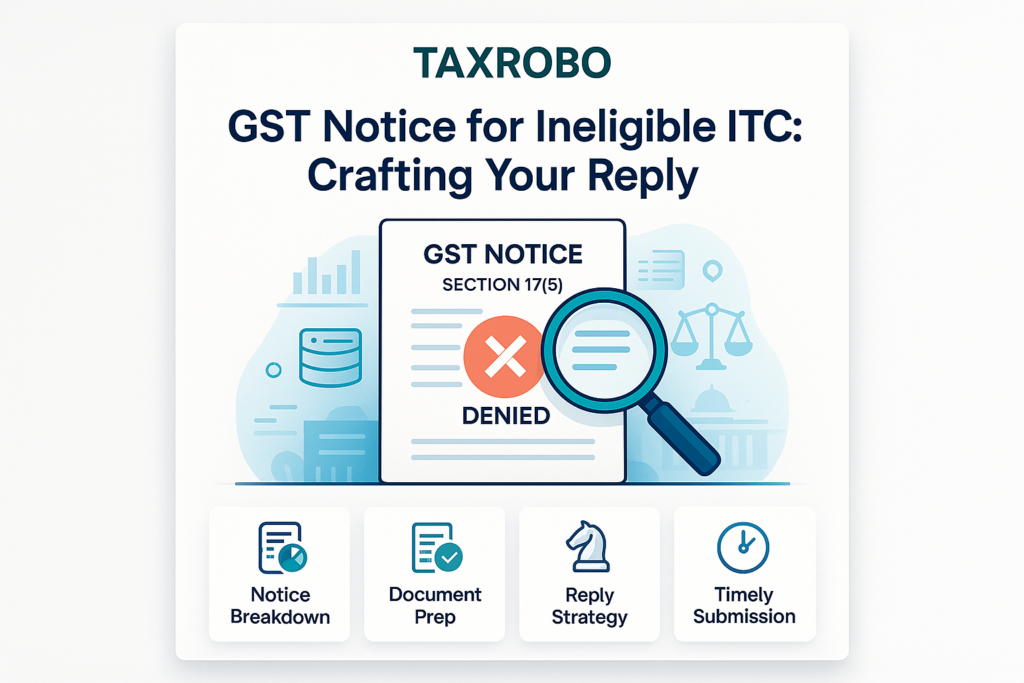

GST Notice for Ineligible ITC under Section 17(5) – A Complete Guide with Reply Format
Receiving a notice from the GST department can be a daunting experience for any business owner. One of the most common communications from the tax authorities is regarding ineligible Input Tax Credit (ITC). This article specifically addresses the GST notice under Section 17(5), which deals with what is commonly known as “blocked credits.” We will break down what this notice means, the common reasons you might have received one, and most importantly, how to draft a professional and effective response. Our aim is to provide a clear, actionable ineligible ITC Section 17(5) reply guide, complete with a sample reply format for GST notice under ITC Section 17(5) India, to help you navigate this process with confidence. A timely and well-documented reply is absolutely crucial for ensuring GST notice compliance response India and protecting your business from unnecessary interest and penalties.
Decoding Section 17(5) of the CGST Act: What is Blocked Credit?
To effectively respond to the notice, it’s essential to first understand the legal foundation upon which it is based. The entire issue revolves around the concept of “blocked credits” as defined under Section 17(5) of the Central Goods and Services Tax (CGST) Act, 2017. Grasping this concept is the first step in determining whether the credit you claimed was truly ineligible or if the notice was issued based on a misunderstanding that you can clarify. Understanding this section will empower you to build a strong and fact-based rebuttal.
A Quick Refresher: What is Input Tax Credit (ITC)?
Input Tax Credit, or ITC, is the cornerstone of the Goods and Services Tax regime. In simple terms, it is the tax that a business pays on a purchase (input) which it can use to reduce its tax liability on a sale (output). For example, if you are a manufacturer and you pay GST on the raw materials you purchase, you can claim that GST amount as a credit when you pay the GST on the sale of your finished goods. This mechanism is designed to prevent the “cascading effect” of taxes—that is, tax on tax—ensuring that tax is levied only on the value added at each stage of the supply chain. This makes the entire tax system more efficient and transparent.
Understanding Section 17(5) – The “Blocked Credits” Clause
While ITC is a fundamental benefit for businesses, it is not an absolute right. Section 17(5) of the CGST Act, 2017, carves out specific exceptions. It provides a definitive list of goods and services on which businesses cannot claim ITC, even if these expenses were incurred in the course or furtherance of business. These are popularly known as “Blocked Credits Under Section 17(5): What ITC Cannot Be Claimed?” or “ineligible ITC.” The rationale behind blocking credit on certain items is often that these goods or services could have a component of personal consumption, are considered luxury expenses, or are related to the construction of immovable property which is outside the GST net. The tax department closely monitors claims related to these categories, which is why they are a frequent subject of notices.
Common Examples of Ineligible ITC under Section 17(5)
To provide more clarity, here is a list of common goods and services where ITC is blocked under Section 17(5). It’s crucial to review this list and see if your flagged transaction falls into one of these categories.
- Motor Vehicles: ITC is blocked on motor vehicles used for the transportation of persons with a seating capacity of up to 13 people (including the driver). However, an exception exists: ITC is available if these vehicles are used for making further taxable supplies of such vehicles, transportation of passengers, or imparting driving training.
- Food and Beverages: Expenses related to food, beverages, outdoor catering, beauty treatments, health services, and cosmetic or plastic surgery generally do not qualify for ITC. The exception is when these goods or services are used to make an outward taxable supply of the same category (e.g., a caterer buying catering services).
- Club Memberships: ITC cannot be claimed on memberships of a club, health, or fitness centre.
- Works Contract Services: ITC on works contract services is blocked when these services are supplied for the construction of an immovable property. The only exception is when it is an input service for the further supply of works contract service or for the construction of plant and machinery.
- Goods for Personal Consumption: This is a straightforward rule. Any goods or services procured for the personal consumption of employees or proprietors are not eligible for ITC.
- Goods Lost or Destroyed: You cannot claim ITC on goods that are lost, stolen, destroyed, written off, or disposed of by way of gift or free samples.
Why You Received a GST Notice Under Section 17(5)
Understanding the potential triggers for a notice can help you diagnose the root cause and prepare a more targeted response. The GST Network (GSTN) has become increasingly sophisticated, using data analytics to flag discrepancies, which means notices are often system-generated and require careful examination of your records to resolve.
Common Triggers for an Ineligible ITC Notice
A notice for ineligible ITC doesn’t appear out of thin air. It is usually triggered by specific red flags that the GST system or a tax officer identifies during their review process. Some of the most common reasons include:
- System-Identified Discrepancies: The most frequent trigger is the automated comparison between the ITC you claimed in your GSTR-3B (your summary return) and the data present in your GSTR-2B (an auto-drafted statement of eligible ITC). If you have claimed ITC on an invoice that falls under a blocked credit HSN code, the system can flag it.
- Scrutiny of Returns (ASMT-10): A GST officer may conduct a manual scrutiny of your returns. If your business profile (e.g., a service-based firm) shows ITC claims for goods that seem unrelated or fall into a blocked category, the officer may issue a notice in Form GST ASMT-10 seeking clarification.
- Third-party Information: Information from audits conducted on your suppliers or customers, or data shared by other government departments like the Income Tax Department, can also trigger scrutiny of your ITC claims.
How to Read Your Notice (Form GST ASMT-10)
The notice you receive will typically be in Form GST ASMT-10, which is a notice for intimating discrepancies in a return. When you receive it, do not panic. Instead, carefully dissect it to understand exactly what is being asked. Pay close attention to the following details:
- DIN (Document Identification Number): This is a unique number that you must use to verify the authenticity of the notice on the official GST Portal.
- Tax Period: The notice will clearly state the specific month(s) or quarter for which the discrepancy has been observed. This helps you narrow down your search in your accounting records.
- Specific Discrepancy: This is the most important part. The notice will list the exact transactions, invoice numbers, or amounts of ITC that the officer considers ineligible under Section 17(5).
- Deadline for Reply: Take immediate note of the due date for submitting your response. This is usually within 15 to 30 days of the notice being issued. Missing this deadline can lead to further complications.
- For a deeper dive into various communications from the department, you can read TaxRobo’s Guide to Different Types of GST Notices.
Your Step-by-Step Guide to Preparing the Perfect Reply
Once you have understood the notice, the next phase is to prepare a comprehensive and factual reply. A methodical approach is key to ensuring you cover all points and provide a convincing explanation to the tax officer. Following these steps will help you build a robust case.
Step 1: Verify the Notice and Stay Calm
Before you do anything else, the first action is to confirm that the notice is genuine. Log in to the official GST Portal and use the ‘Services > User Services > Verify RFN/Notice’ feature to check its authenticity using the DIN mentioned in the document. Once verified, read the notice multiple times to fully understand the query. It’s natural to feel anxious, but panicking can lead to mistakes. Approach the situation calmly and systematically.
Step 2: Reconcile Your Books and Records
This is the investigative phase. Open your accounting software and pull out your purchase register, tax invoices, and GSTR-2B for the tax period mentioned in the notice. Meticulously compare the ITC you claimed in your GSTR-3B for that period with these source documents. This exercise will help you pinpoint the exact transaction(s) that the officer has flagged. Check the nature of the expense and determine if it genuinely falls under the blocked credit list of Section 17(5) or if it qualifies for an exception.
Step 3: Gather All Supporting Documents
Your reply is only as strong as the evidence you provide to support it. Create a dedicated folder (digital or physical) and gather all the necessary documents related to the flagged transactions. These documents are your proof and must be clear and legible. Your file should include:
- Tax Invoices: The primary document for claiming ITC.
- Debit Notes: If applicable to the transaction.
- E-way Bills: To prove the movement of goods.
- Proof of payment to the supplier: Bank statements or transaction receipts.
- Service agreements or contracts: Especially important for works contracts to establish the nature of the service.
- Any other document that can substantiate your claim that the ITC is eligible (e.g., vehicle registration certificate showing it is a goods transport vehicle).
Step 4: Draft a Clear and Factual Response
This is the most critical step where you articulate your position. Your reply must be professional, factual, and directly address the points raised in the notice without any ambiguity. Avoid emotional language or vague statements. Instead, be precise and back every claim with a reference to a specific document. Use the structured GST notice under Section 17(5) response format detailed in the following section to ensure your reply is comprehensive and easy for the officer to understand.
The Ideal Reply Format for a GST Notice on Ineligible ITC
Using a standardized and professional format for your reply is essential. It demonstrates your diligence and makes it easier for the tax officer to review your case. This template provides a clear structure that covers all necessary components and directly addresses the ineligible ITC reply format GST India query.
Part 1: Header and Subject Line
From:
[Your Business Name]
[GSTIN: Your GSTIN]
[Address: Your Registered Business Address]
Date: [Date of Reply]
To:
The Proper Officer,
[Jurisdiction/Address as mentioned in the notice]
Reference No.: [Notice Reference Number/DIN] dated [Date of Notice]
Subject: Reply to Notice regarding alleged ineligible Input Tax Credit (ITC) under Section 17(5) of the CGST Act, 2017
Part 2: Body of the Reply (Point-by-Point Rebuttal)
The body of your reply should be structured logically, addressing each point from the notice individually.
- Paragraph 1: Acknowledgement
Start by formally acknowledging the notice.
“Dear Sir/Madam,
This is with reference to the notice bearing DIN [Enter DIN from Notice] dated [Date of Notice], received by us on [Date of Receipt]. We thank you for the opportunity to present our case and provide the necessary clarifications regarding the discrepancies pointed out in our return for the tax period [Mention Tax Period].” - Paragraph 2: Point-wise Clarification
This is where you provide your detailed explanation. Address each observation from the notice separately.- Scenario A (If you believe the ITC is correctly claimed):
“With respect to the observation regarding ITC of ₹[Amount] claimed on invoice no. [Invoice Number] from [Supplier Name], we humbly submit that the said credit is eligible and has been correctly claimed by us. The goods/services in question are [Describe the Goods/Service], which fall under the exception provided in Section 17(5)(x) of the CGST Act. Our justification is as follows: [Provide your detailed justification, e.g., ‘the motor vehicle was purchased for the transportation of goods and is not a passenger vehicle’ or ‘the works contract service was used for the construction of plant and machinery essential for our manufacturing process’]. We are enclosing the relevant tax invoice, e-way bill, and contract as Annexure-A for your kind perusal.” - Scenario B (If you agree the ITC was incorrectly claimed):
“With respect to the observation regarding ITC of ₹[Amount] claimed on invoice no. [Invoice Number], we have reviewed our records and acknowledge that this credit was claimed inadvertently due to a clerical error. We accept the discrepancy. We have already reversed the ineligible ITC of ₹[Amount] along with applicable interest of ₹[Amount] via Form DRC-03 vide ARN No. [DRC-03 ARN Number] dated [Date of Payment]. A copy of the payment challan is attached as Annexure-A for your records. For further details on this process, one can read about Reversal of ITC: When and How Does It Occur?“
- Scenario A (If you believe the ITC is correctly claimed):
- Paragraph 3: Prayer/Conclusion
Conclude with a respectful request.
“In light of the above submissions and the documentary evidence provided, we humbly request your good office to consider our explanation and drop the proceedings initiated by the said notice. We assure you of our commitment to full compliance with GST laws and are ready to provide any further information or clarification that may be required from our end.”
Part 3: Closing and Enclosures
Sincerely,
For [Your Business Name],
[Digital or Physical Signature]
[Name of Authorized Signatory]
[Designation]
Enclosures:
1. Copy of Tax Invoice(s) (Annexure-A)
2. Copy of DRC-03 Challan (if applicable) (Annexure-B)
3. Copy of Works Contract Agreement (if applicable) (Annexure-C)
4. [List any other supporting documents attached]
Submitting Your Reply and Next Steps
Drafting the reply is only half the battle. Submitting it correctly through the official channel and understanding the potential outcomes are equally important to bring the matter to a close.
How to File Your Reply on the GST Portal
The response to a notice in Form ASMT-10 must be filed online in Form GST ASMT-11. Here is a brief outline of the process:
- Log in to the GST Portal with your credentials.
- Navigate to Services > User Services > View Additional Notices/Orders.
- Find the relevant notice and click the ‘View’ link in the Action column.
- On the next screen, click on the ‘REPLY’ tab.
- You will be redirected to Form GST ASMT-11. Here, you can type your response directly or, more commonly, upload your detailed, pre-drafted reply in PDF format.
- Attach all your supporting documents (invoices, challans, etc.) in the designated section.
- File the form using either a Digital Signature Certificate (DSC) or an Electronic Verification Code (EVC).
What Happens After You Submit the Reply?
After you have successfully filed your reply, the GST officer will review your submission. There are two primary outcomes:
- Case Dropped: If the officer is satisfied with your explanation and the supporting documents you have provided, they will accept your reply and issue an order in Form GST ASMT-12, officially dropping the proceedings. This is the ideal outcome.
- Further Action: If the reply is found to be unsatisfactory, incomplete, or not supported by adequate evidence, the officer is not obligated to accept it. They may then proceed to issue a Show Cause Notice (SCN), which is a more formal step towards demanding the tax, along with interest and a potential penalty. For guidance on the next steps, you can refer to our article on How to Respond to a GST Show Cause Notice: A Step-by-Step Guide. Alternatively, they may call you for a personal hearing to discuss the matter further.
Conclusion
Facing a GST notice under Section 17(5) requires a calm and systematic approach rather than panic. The key is to verify the notice’s authenticity, thoroughly reconcile your financial records, gather all corroborating evidence, and draft a clear, point-wise reply using the professional format provided. While the process may seem intimidating, a well-prepared response can often resolve the issue efficiently and favorably. Ultimately, proactive compliance, meticulous bookkeeping, and a clear understanding of ITC rules are the best defenses against receiving such notices in the first place.
Feeling overwhelmed or unsure about drafting the perfect response to a GST notice? The experts at TaxRobo specialize in GST compliance and litigation support. Let us handle the complexities of your notice so you can focus on running your business. Contact TaxRobo for expert assistance today!
Frequently Asked Questions (FAQs)
- Q1: What is the time limit to reply to a GST notice in Form ASMT-10?
The time limit to reply will be clearly mentioned in the notice itself. Typically, the taxpayer is given 15 to 30 days from the date of service of the notice to file a response. It is absolutely crucial to adhere to this deadline to avoid adverse action. - Q2: What are the consequences of not replying to a GST notice for ineligible ITC?
Ignoring a GST notice is a serious mistake. If you fail to reply within the stipulated time, the GST officer has the authority to pass an ex-parte (one-sided) order based on the information available to them. This will likely confirm the entire proposed tax demand along with interest and penalties, making it much more difficult and costly to challenge later. - Q3: Do I need a CA or tax consultant to reply to a GST notice under Section 17(5)?
While it is not legally mandatory to hire a professional, it is highly recommended. A Chartered Accountant or a tax consultant possesses the technical knowledge to interpret the law correctly, draft a legally sound reply, and present your case in the most effective manner. Their expertise can help you avoid common pitfalls and prevent the issue from escalating. - Q4: I have already reversed the wrongly claimed ITC in my next GSTR-3B. Do I still need to file a formal reply?
Yes, you absolutely must file a formal reply in Form ASMT-11 even if you have already reversed the credit. The notice is a formal proceeding that requires a formal closure. In your reply, you should clearly state that the ITC was claimed inadvertently and has since been reversed in the GSTR-3B of [Month, Year]. However, the professionally recommended method is to reverse the credit and pay the tax and interest via Form DRC-03 and attach the challan as proof with your reply.