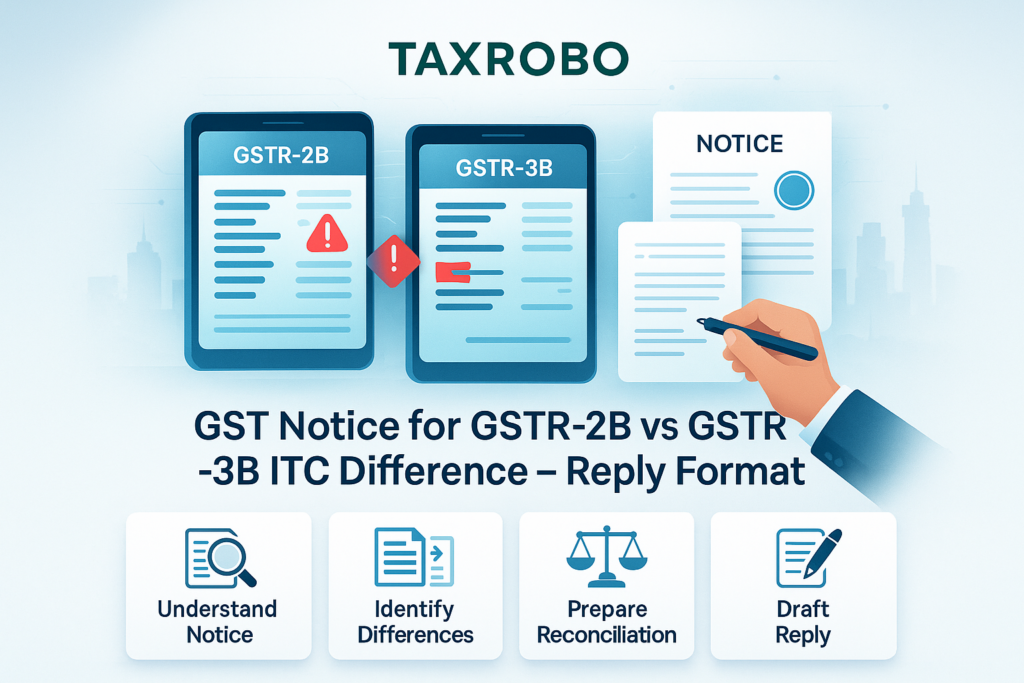

GST Notice for GSTR-2B vs GSTR-3B ITC Difference – Reply Format
Receiving an official-looking envelope or a system-generated notification from the GST department can be a stressful moment for any business owner. One of the most common reasons for such communication is a notice regarding the GSTR-2B vs GSTR-3B ITC difference, an issue that has become increasingly frequent for taxpayers across India. This discrepancy arises when the Input Tax Credit (ITC) you claim in your summary return (GSTR-3B) is higher than the ITC that appears in your auto-generated statement (GSTR-2B). Understanding why this happens and how to respond correctly is not just a procedural formality; it is a critical aspect of understanding GSTR compliance India and essential for avoiding unnecessary penalties or legal complications. This guide will demystify the differences in GSTR forms for ITC, explore the common reasons for a mismatch, and provide you with a clear, actionable reply format for GST notice India.
Understanding the Core Concepts: GSTR-2B vs GSTR-3B
Before diving into the reasons for a mismatch and the reply format, it’s crucial to understand the roles these two forms play in the GST ecosystem. They are related but serve fundamentally different purposes. Grasping this distinction is the first step toward resolving any discrepancies and maintaining a clean compliance record. One form tells you what credit is available, while the other is where you formally claim it, and the GST portal is constantly watching to ensure these two figures align.
What is GSTR-2B? The Source of Truth for ITC
Think of GSTR-2B as an auto-drafted, static statement of your available Input Tax Credit. It is generated by the GST portal on the 14th of every month for the preceding month. This statement is created based on the information your suppliers have furnished in their GSTR-1 (Return for Outward Supplies) and Invoice Furnishing Facility (IFF). Crucially, GSTR-2B is a read-only document. You cannot edit it. It serves as a reliable snapshot, providing a clear view of the ITC that is officially available to you for a specific tax period, as reported by your vendors. This makes it an essential tool for reconciliation, as it acts as the baseline against which your claimed ITC in GSTR-3B is measured by the tax authorities.
What is GSTR-3B? Your Summary Tax Return
In contrast, GSTR-3B is the summary tax return that you, the taxpayer, are required to file every month or quarter. This is the active form where you declare your business transactions for the tax period. In GSTR-3B, you provide a summary of your outward supplies (sales), the tax liability on those sales, the Input Tax Credit you are claiming, and the final tax amount you have paid to the government. While GSTR-2B informs you about your eligible ITC, it is in Table 4 of GSTR-3B that you actually claim that ITC. This self-declaration aspect of GSTR-3B is what can lead to discrepancies if the amount you claim does not match the data presented in your GSTR-2B.
The Crucial Mismatch: Explaining the GSTR-2B vs GSTR-3B ITC Difference
The heart of the issue lies in the automated comparison mechanism built into the GST portal. Every month, the system’s algorithm diligently compares the total ITC you have claimed in your GSTR-3B with the total ITC available as per your GSTR-2B for the same period. If the amount claimed in GSTR-3B exceeds the amount available in GSTR-2B beyond a certain tolerance limit, an automated intimation is triggered and sent to you. This is the core of the GSTR-2B vs GSTR-3B ITC difference India problem. The notice, formally known as Form GST DRC-01C, is not an accusation but an alert, asking you to either explain the reason for the excess claim or pay the differential amount along with interest.
Top 5 Reasons for a GSTR-2B vs GSTR-3B ITC Mismatch
Understanding the common reasons behind these mismatches can help you proactively prevent them. Here are the top five culprits behind the most frequent GSTR-2B and GSTR-3B ITC issues in India.
1. Supplier Errors & Delays
This is perhaps the most common reason and is often outside your direct control.
- Late Filing: Your supplier may have filed their GSTR-1 return for the month after the due date. As a result, the invoice they issued to you did not appear in your GSTR-2B for that specific month and would instead reflect in the subsequent month’s GSTR-2B.
- Incorrect Details: Your supplier might have made an error while filing their GSTR-1. This could include entering your GSTIN incorrectly, mentioning the wrong invoice number or date, or mistakenly reporting a B2B (Business-to-Business) transaction as a B2C (Business-to-Consumer) sale, which prevents the credit from appearing in your GSTR-2B.
2. Clerical Errors in Your GSTR-3B
Mistakes can happen during manual data entry while preparing your GSTR-3B.
- Typographical Errors: A simple typo, such as entering ₹50,000 instead of ₹5,000, can lead to a significant excess claim and trigger a notice.
- Claiming ITC Under the Wrong Head: You might have incorrectly entered an IGST credit amount in the CGST or SGST columns (or vice-versa). While the total ITC amount might be correct, such misclassification is still a compliance error that needs rectification.
3. Legitimate Timing Differences
Not all mismatches are errors. Sometimes, the difference is due to valid reasons related to the timing of transactions as per GST law.
- Goods/Services Received Later: The GST law states that you can only claim ITC after you have received the goods or services. A supplier might issue an invoice in March, but you receive the goods in April. While the supplier would report it in their March GSTR-1 (making it appear in your March GSTR-2B), you are only eligible to claim this ITC in your April GSTR-3B, leading to a temporary mismatch. Conversely, you may have claimed ITC in March after receiving goods, but the supplier files their return late, causing the credit to appear in a later GSTR-2B.
4. ITC on Imports and RCM
Certain types of ITC are not reflected in GSTR-2B but are perfectly legal to claim in GSTR-3B.
- Import of Goods: ITC on goods imported into India can be claimed based on the Bill of Entry filed with Customs. This credit is not populated in GSTR-2B and must be manually declared in your GSTR-3B, creating a natural difference.
- Reverse Charge Mechanism (RCM): For services where you are liable to pay tax under RCM (like services from a Goods Transport Agency or a lawyer), you first pay the tax liability to the government and then claim the same amount as ITC in your GSTR-3B. This self-declared credit doesn’t route through GSTR-2B.
5. Claiming Ineligible ITC
Occasionally, businesses might inadvertently claim ITC on expenses that are specifically blocked under GST law.
- Blocked Credits under Section 17(5): The CGST Act lists certain goods and services on which ITC cannot be claimed. Understanding the complete list of Blocked Credits Under Section 17(5): What ITC Cannot Be Claimed? is crucial. Common examples include motor vehicles for personal transport, food and beverage expenses, club memberships, and goods lost, stolen, or destroyed. Claiming ITC on these items will result in an excess claim compared to your eligible credit.
Received a GST Notice (DRC-01C)? Here’s Your Action Plan
Receiving Form DRC-01C can be daunting, but following a structured approach makes the process manageable. Here is a step-by-step plan to address the notice effectively.
Step 1: Don’t Panic. Analyze the Notice.
The first rule is to stay calm. An automated intimation is a request for clarification, not a final demand. The notice for the GSTR-2B vs GSTR-3B ITC difference is issued in Form GST DRC-01C. You need to carefully read it to understand the exact discrepancy pointed out by the department. To do this, log in to the official GST Portal and navigate to Services > Returns > Compliance > View Notices and Orders. Here, you will find the intimation. Download it and note the tax period, the disputed amount, and the deadline for a response.
Step 2: Reconcile Your Books and Records
Your accounting records are your primary evidence. Conduct a thorough reconciliation for the specified tax period. The process should involve comparing three sets of documents side-by-side:
- Your Purchase Register from your accounting software.
- The GSTR-2B statement downloaded from the GST portal for that month.
- The GSTR-3B return you filed for that month.
Go through this comparison invoice by invoice to pinpoint the exact transactions that have caused the mismatch. For a detailed walkthrough, our guide on How to Resolve ITC Mismatch Issues – GSTR-2A/2B vs 3B Guide can be very helpful. This detailed analysis will form the basis of your reply.
Step 3: Decide Your Course of Action
Once you have identified the reasons for the discrepancy, you have two possible paths to take.
- Option A: You Agree with the Discrepancy: If your reconciliation reveals that you have indeed claimed excess or ineligible ITC by mistake, the correct course of action is to accept the liability. You must pay the excess ITC amount along with applicable interest through Form DRC-03 on the GST portal. After making the payment, you must provide the payment details in Part B of Form DRC-01C to close the notice.
- Option B: You Disagree with the Discrepancy: If you believe your ITC claim is correct and you have a valid reason for the mismatch (such as a supplier’s late filing or an RCM claim), you must prepare and file a detailed reply. This reply is submitted online in Part B of Form DRC-01C, explaining the reasons for the difference and providing supporting documents.
How to Draft the Perfect Reply: GST Notice Response Template India
A well-drafted reply is clear, concise, and supported by evidence. It demonstrates your diligence and can resolve the issue without further escalation. This GST notice response template India will guide you.
Essential Components of Your Reply
- Acknowledge the Notice: Begin by clearly mentioning the notice’s Reference Number (ARN) and date.
- State the Reason: Explain the reason for the mismatch in simple terms. Avoid jargon and be direct.
- Provide Evidence: Attach all necessary supporting documents. This could include a copy of the tax invoice, lorry receipt or e-way bill as proof of goods receipt, supplier communication, or the challan for RCM payment.
Sample Reply Format for GST Notice (Part B of DRC-01C)
Subject: Reply to Intimation in Form GST DRC-01C for [Tax Period, e.g., April 2024]
Reference Number (ARN): [Enter the ARN from the notice]
Dear Sir/Madam,
This is in response to the intimation received regarding the GSTR-2B vs GSTR-3B ITC difference for the above-mentioned tax period. The reasons for the said difference are provided below:
(Choose the most appropriate scenario from the templates below and adapt it to your specific case)
Scenario 1: Supplier Filed GSTR-1 Late
The ITC mismatch of ₹[Amount] is due to our supplier, [Supplier Name & GSTIN], who filed their GSTR-1 for Invoice No. [Invoice No.] dated [Date] after the due date. The credit for this invoice is now reflecting in our GSTR-2B for [Subsequent Month, e.g., May 2024]. We have claimed the ITC correctly in [Original Month, e.g., April 2024] as we had received the goods/services and were in possession of the tax invoice, thereby satisfying the conditions of Section 16 of the CGST Act. A copy of the tax invoice and proof of goods receipt are attached for your reference.
Scenario 2: ITC Claimed on RCM Supplies
The difference of ₹[Amount] is on account of ITC claimed on supplies liable to Reverse Charge Mechanism (RCM). We have discharged our tax liability of ₹[Amount] under RCM in Table 3.1(d) of our GSTR-3B for [Month, Year] and subsequently claimed the eligible ITC in Table 4(A)(3) of the same return, as per the provisions of the law. A copy of the self-invoice and the payment challan are attached for your perusal.
Scenario 3: Typographical Error in GSTR-3B Now Corrected
We acknowledge that an excess ITC of ₹[Amount] was inadvertently claimed in our GSTR-3B for [Month, Year] due to a clerical error during data entry. We have identified this error and have already reversed this excess credit in our GSTR-3B for the month of [Month of Reversal]. Furthermore, we have paid the applicable interest of ₹[Interest Amount] via challan number [Challan Number] dated [Date]. The details of the GSTR-3B reversal and the interest payment challan are attached for your reference.
We request your good office to kindly review our submission and the attached documents and consider the discrepancy as resolved and drop the proceedings.
Thank you.
[Your Name/Authorised Signatory]
[Business Name]
[GSTIN]
Conclusion
The best defense against GST notices is a good offense. Proactive, monthly reconciliation of your purchase records with the auto-populated GSTR-2B is the most effective strategy to prevent a GSTR-2B vs GSTR-3B ITC difference in the first place. This simple habit can save you from the hassle of scrutiny and compliance actions. However, if you do receive a notice, remember to address it promptly and accurately. A clear, well-documented, and timely reply can prevent minor discrepancies from escalating into major legal issues, ensuring your business remains compliant and in good standing with the tax authorities.
Navigating GST compliance can be complex, and a single mistake can be costly. If you need expert assistance in reconciling your ITC, drafting professional notice replies, or managing your end-to-end GST filings, contact TaxRobo today. Our team of experts ensures your business stays compliant, saving you valuable time and money.
Frequently Asked Questions (FAQs)
1. What is the time limit to respond to Form DRC-01C?
You must furnish a reply in Part B of Form DRC-01C or pay the discrepancy amount using Form DRC-03 within seven working days of receiving the intimation on the GST portal.
2. Can I ignore a notice for a small ITC mismatch?
No. You should never ignore any notice from the GST department, regardless of the amount. Our guide on How to Handle GST Notices – ASMT-10, DRC-01, DRC-07 Explained Simply covers the importance of timely responses. Failure to respond can be seen as an admission of the discrepancy, leading to the amount being confirmed as your tax liability and the initiation of recovery proceedings.
3. What happens if I don’t respond to a DRC-01C notice?
If you fail to file a reply or make the payment within the stipulated time, the tax officer is empowered to initiate demand and recovery actions under Section 73 or Section 75 of the CGST Act without any further communication. This can lead to the freezing of bank accounts and other stringent measures.
4. Where do I submit the reply for a GSTR-2B vs GSTR-3B ITC notice?
The reply must be submitted online directly on the GST Portal. Navigate to the notice in the “View Notices and Orders” section, where you will find an option to file your reply using Part B of Form DRC-01C. You can provide your explanation and upload supporting documents there.