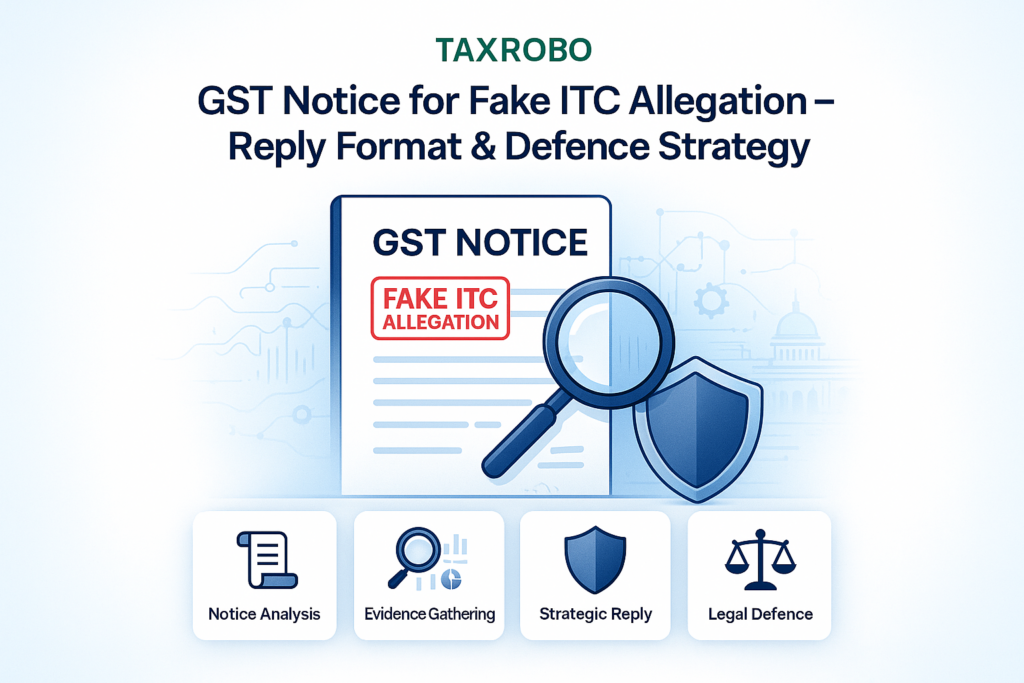

GST Notice for Fake ITC Allegation – Your Complete Reply Format & Defence Strategy
Receiving a formal notice from the GST department can be a stressful experience for any business owner. When that notice accuses your business of claiming fake Input Tax Credit (ITC), the stakes get even higher, threatening significant financial repercussions. This situation, however, is not insurmountable with the right approach. This comprehensive guide is designed specifically for small business owners and taxpayers in India, providing a detailed GST notice reply format and an actionable defence strategy. By understanding the allegations and structuring your response correctly, you can confidently navigate the process and protect your rightful ITC claims. This article will help you understand how to respond to GST notice India and safeguard your business from undue penalties.
First Things First: Understanding the GST Notice for Fake ITC
Before you can draft an effective reply, it’s crucial to understand why you received the notice in the first place. A solid grasp of the underlying concepts and common triggers will form the foundation of your defence. This knowledge empowers you to move from a state of panic to a position of control, allowing you to address the department’s concerns with clarity and precision. A well-informed taxpayer is always better equipped to handle scrutiny and present a compelling case supported by facts and legal provisions.
What is Input Tax Credit (ITC) and Why is it Important?
In simple terms, Input Tax Credit (ITC) is the heart of the GST system. Think of it as a refund for the tax you’ve already paid on your business purchases (inputs). When you buy raw materials, goods, or services for your business, you pay GST on them. When you sell your final product or service (outputs), you collect GST from your customers. ITC allows you to subtract the tax you paid on your inputs from the tax you collected on your outputs. This mechanism is vital because it prevents the “cascading effect” of taxes—tax on tax—which ultimately makes goods and services cheaper for the end consumer and more competitive for your business. Protecting your eligible ITC is essential for maintaining healthy cash flow and profitability.
Common Reasons for Receiving a Fake ITC Allegation Notice
The GST department uses sophisticated data analytics to identify discrepancies in tax filings. A notice for a fake ITC allegation usually stems from a mismatch or a red flag in their system. Understanding these common triggers is the first step in building your defence. This fake ITC allegations reply guide highlights the most frequent reasons you might find yourself under scrutiny:
- Supplier Non-Compliance: This is the most common reason. Your supplier collected GST from you but failed to file their GSTR-1 (sales return) or did not pay the collected tax to the government. From the department’s perspective, if the tax isn’t in their coffers, your claim is invalid.
- Invoice Mismatches: There are significant discrepancies between the ITC you claimed in your GSTR-3B and the details auto-populated in your GSTR-2A or GSTR-2B, which are generated from your suppliers’ filings.
- Transactions with Fake Entities: The GST Identification Number (GSTIN) of your supplier is later discovered to be fake, non-existent, or cancelled. The department alleges that the transaction never occurred.
- Lack of Supporting Documents: The tax invoices you possess may be missing mandatory details required by GST law, or you may lack sufficient proof that you actually received the goods or services (e.g., no e-way bills or delivery challans).
Decoding Common GST Notice Forms (ASMT-10, DRC-01)
GST notices come in specific forms, and knowing what they mean is important. The two most common forms you might encounter in this scenario are ASMT-10 and DRC-01. Understanding their purpose helps you gauge the seriousness of the matter and the stage of the proceedings.
| Form Number | Name | Purpose | Next Step |
|---|---|---|---|
|
GST ASMT-10 |
Notice for Intimation of Discrepancies in the Return |
This is a scrutiny notice. It’s an initial communication from the GST officer pointing out discrepancies found in your returns and asking for an explanation. |
You must reply within the specified time, providing clarification and supporting documents. |
|
GST DRC-01 |
Show Cause Notice (SCN) |
This is a more formal and serious notice. It’s issued before the department demands any tax, interest, or penalty from you, detailing the grounds for the proposed action. |
A detailed, point-by-point reply is essential, often followed by a personal hearing. See our guide on How to Respond to a GST Show Cause Notice: A Step-by-Step Guide. |
Crucially, always verify the authenticity of any notice. You can do this by checking the Document Identification Number (DIN) mentioned on the notice on the official GST Portal.
Your Immediate Action Plan: A 3-Step Defence Preparation
Once you have the notice in hand, immediate and methodical action is key. A rushed or incomplete response can do more harm than good. Follow this three-step plan to prepare a robust and evidence-backed defence before you even start writing the reply.
Step 1: Acknowledge and Analyze the Notice
The first rule is do not ignore the notice. Ignoring it is seen as an admission of guilt and will lead to an ex-parte order against you. Instead, carefully analyze its contents. Note down the deadline for the reply—this is non-negotiable. Scrutinize the notice for key details: the Document Identification Number (DIN) to verify its authenticity, the specific allegations being made, the exact invoices or suppliers in question, the tax period under review, and the total disputed ITC amount. Understanding exactly what the officer is asking for is the first step toward providing a satisfactory answer.
Step 2: Gather All Your Documentary Evidence
Your documents are your soldiers in this battle. A claim without evidence is just a story. The strength of your reply hinges entirely on the quality and completeness of your supporting paperwork. This is the most critical part of your preparation. Begin compiling a dedicated file for this case, including:
- Valid Tax Invoices: Ensure the invoices comply with Section 31 of the CGST Act and contain all mandatory details like GSTIN of supplier and recipient, HSN code, tax rates, and place of supply.
- Proof of Receipt of Goods/Services: This is crucial. Gather delivery challans, Goods Receipt Notes (GRNs), transporter receipts, weighment slips, and e-way bills associated with the invoices in question.
- Proof of Payment to Supplier: Your bank statements clearly showing the payment made to the supplier for the specific invoice are powerful evidence. Also, include your ledger account statement for the supplier.
- Supplier’s Filing Data: Take screenshots or download reports from the GST portal showing that the supplier had, at some point, declared the invoice in their GSTR-1. This data can be found in your GSTR-2A.
- Reconciliation Statements: Provide your internal reconciliation work papers that show how you match your purchase register with GSTR-2A/2B. This demonstrates due diligence on your part.
Step 3: Begin Drafting Your Response
With all your evidence organized, you can now begin outlining your reply. Resist the urge to write a quick, emotional response. A professional, factual, and legally sound reply is what is required. Your goal is to make it as easy as possible for the officer to understand your position and verify your claims. Remember that a proper strategy for GST notice response begins with this solid foundation of analysis and evidence gathering. The next section will provide the exact structure and language to use for a powerful and effective submission.
The Definitive GST Notice Reply Format for Fake ITC Allegations
Structuring your reply in a clear, logical, and professional format is essential. It shows the officer that you are organized, serious, and have a valid case. Follow this section-by-section template to construct a comprehensive and persuasive response to the allegations.
Part 1: Header and Subject Line
This section sets the context and ensures your reply is correctly filed. It should be formatted like a professional letter.
- To: The Proper Officer [Include Designation & Address mentioned in the notice]
- From: [Your Business Name, GSTIN, and Registered Address]
- Date: [Date of your reply]
- Subject: Reply to Notice/Show Cause Notice Reference No. [Enter the Notice Number] dated [Enter the Date of Notice] for the tax period [e.g., April 2023 – June 2023]
Part 2: Preliminary Submissions & Factual Background
Begin your reply with a formal acknowledgment and set a positive tone. State your credentials as a compliant taxpayer.
- Start by formally acknowledging the receipt of the notice. For example: “We acknowledge the receipt of your Notice/SCN bearing Reference No. XXX dated YYY, received by us on ZZZ.”
- Briefly introduce your business and state that you are a registered, law-abiding taxpayer committed to complying with all GST regulations.
- Make a preliminary statement that the Input Tax Credit (ITC) in question has been claimed based on genuine business transactions for which you possess valid documentation, and that all conditions prescribed under the CGST Act, 2017 have been met.
Part 3: Point-by-Point Rebuttal of Allegations
This is the core of your reply. Address every single allegation raised in the notice separately and systematically. Do not club multiple points together.
- Structure for Each Allegation:
- State the Allegation: Clearly quote or paraphrase the allegation from the notice. For example: “1. As per the notice, it is alleged that ITC amounting to ₹50,000 on Invoice No. INV-001 from supplier M/s ABC Traders (GSTIN: 27AXXXX) is ineligible as the said supplier has not filed their GSTR-3B.”
- Provide Your Factual Reply: Present your counter-argument with facts. For example: “We respectfully submit that this allegation is incorrect and the ITC is valid. The said transaction is a genuine purchase of goods required for our business. We have fulfilled all conditions for availing ITC as laid down in Section 16(2) of the CGST Act, 2017.”
- List Your Evidence: This is where you connect your reply to your documents. For example: “In support of our claim and to prove the genuineness of the transaction, we are enclosing the following documents as annexures:”
- (a) Annexure 1: A self-attested copy of the Tax Invoice No. INV-001 dated 15/05/2023.
- (b) Annexure 2: A self-attested copy of the E-way Bill No. 123456789012 for the movement of goods.
- (c) Annexure 3: A self-attested copy of our bank statement dated 25/05/2023, highlighting the payment of ₹1,18,000 to M/s ABC Traders against the said invoice.
- (d) Annexure 4: A screenshot of our GSTR-2A for May 2023 showing that the supplier had uploaded this invoice in their GSTR-1.
Part 4: Legal Arguments and Conclusion
After presenting the facts, bolster your case with legal arguments. This demonstrates that your claim is not just factually correct but also legally sound.
- Cite relevant legal provisions, primarily understanding Section 16 of the CGST Act: Conditions and Time Limits for Availing ITC, which lays down the conditions for taking ITC. Explain how you have fulfilled each condition (possession of invoice, receipt of goods/services, tax paid by supplier, and filing of your return).
- Argue that as a bona fide purchaser who has taken all reasonable steps, you should not be penalized for the default of your supplier. You can mention that any non-payment of tax by the supplier is a matter to be pursued with the supplier directly.
- Prayer: Conclude this section with a formal request. For example: “In light of the facts, documentary evidence, and legal submissions provided above, we humbly request your good office to consider our reply favorably, accept the ITC claimed as valid, and drop the proceedings initiated by the said notice in the interest of justice.”
Part 5: Verification and Enclosures
Finally, close the reply with a formal verification and a list of all attached documents.
- Verification: Add a statement like, “I, [Your Name], in my capacity as [Your Designation], do hereby verify that the contents of this reply from paragraphs 1 to X are true and correct to the best of my knowledge and belief.” Follow this with your signature and company seal.
- Enclosures: Clearly list all the annexures you are submitting. For example: “List of Enclosures: 1. Annexure 1: Copy of Tax Invoice No. INV-001…, 2. Annexure 2: Copy of E-way Bill…,” and so on.
For complex cases, drafting a legally sound reply is crucial. Learn more about how TaxRobo’s GST experts can assist you.
Proactive Strategy: How to Avoid Fake ITC Notices in the Future
The best defence is a good offense. Taking proactive steps in your day-to-day business operations can significantly reduce the risk of receiving such notices in the future.
Implement a Robust Vendor Onboarding Process
Before you start transacting with a new supplier, perform basic due diligence. Use the GST portal to check their GST registration status, filing history, and compliance rating. Avoid vendors with a poor track record of filing returns, as they pose a high risk to your ITC.
Conduct Monthly GSTR-2A/2B Reconciliation
Do not wait until the end of the year to reconcile your purchases. Make it a mandatory monthly process to compare the ITC you have claimed in your GSTR-3B with the data appearing in your GSTR-2B. Identify any missing invoices immediately and follow up with your suppliers to ensure they file their returns on time. This regular check acts as an early warning system. For more details, see our guide on How to Resolve ITC Mismatch Issues – GSTR-2A/2B vs 3B Guide.
Maintain Flawless Documentation
As demonstrated above, your documentation is your ultimate defence. Maintain a systematic and organized record-keeping system for all your purchases. Ensure that every transaction is supported by a valid tax invoice, proof of delivery, and proof of payment. Digital record-keeping can make this process easier and more efficient.
Conclusion
Receiving a GST notice for a fake ITC allegation can be unsettling, but it is a manageable challenge. The key is to not panic, act promptly, gather all your evidence meticulously, and use a structured GST notice reply format to present your case clearly and professionally. A timely, well-drafted, and evidence-backed reply can protect your business from unwarranted tax demands, interest, and penalties, saving you from prolonged and expensive litigation. Your proactive compliance and diligent record-keeping are your strongest assets in the GST ecosystem.
Facing a GST notice can be daunting. If you need expert assistance to respond to GST notice India or want a professional GST fake ITC allegation defence strategy, the specialists at TaxRobo are here to help. Contact us today for a consultation!
Frequently Asked Questions (FAQs)
Q1: What is the time limit to reply to a GST notice like ASMT-10?
A: Generally, you are given 15 to 30 days to reply. The exact timeframe will be mentioned in the notice itself. It is crucial to adhere to this deadline to avoid adverse action.
Q2: What happens if I ignore a GST notice for fake ITC?
A: Ignoring a notice is the worst course of action. It can lead to the GST officer passing an ex-parte order (an order without hearing your side), confirming the entire proposed tax demand along with applicable interest and heavy penalties.
Q3: My supplier has not paid tax to the government. Can my ITC still be denied even if I paid them?
A: This is a highly contentious issue in GST law. While the department’s position is often to deny the ITC to the recipient, several High Court rulings have favored the taxpayer if they can prove the genuineness of the transaction and their own due diligence (valid invoice, payment, receipt of goods). This is precisely why a strong reply with solid evidence is critical to fight such cases.
Q4: Is it mandatory to hire a professional to draft the reply?
A: While not legally mandatory for smaller, straightforward discrepancies, it is highly recommended for complex allegations like fake ITC. A tax professional can frame the reply with the correct legal arguments, cite relevant case laws and precedents, and ensure all procedural requirements are met, significantly improving your chances of a favorable outcome.