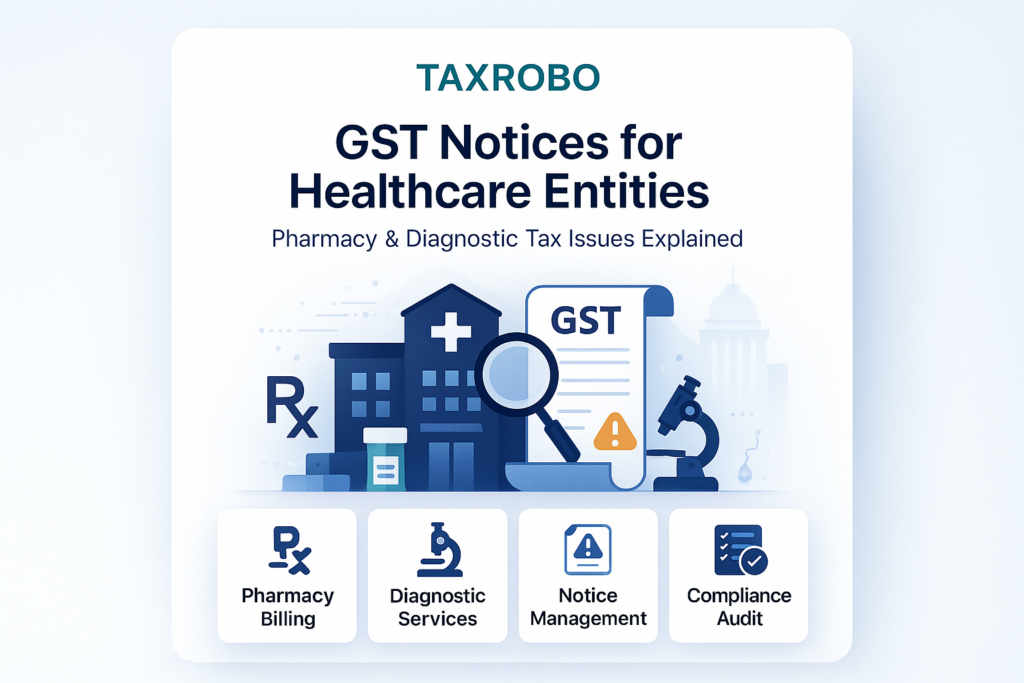

GST Notice for Hospitals & Clinics: A Guide to Pharmacy & Diagnostic Tax Issues
Introduction: Why Healthcare Providers Are Under the GST Scanner
Many healthcare professionals operate under the common belief that their services are entirely exempt from the Goods and Services Tax (GST). While this is largely true for core medical services, it’s a simplification that can lead to significant trouble. A deeper understanding of Healthcare Services Under GST – What’s Taxable, What’s Exempt is essential. In recent times, the GST department has increased its scrutiny of the healthcare sector, issuing a wave of notices to hospitals, clinics, and diagnostic centers. The root of the problem lies in the ancillary services that medical establishments provide, such as in-house pharmacies, diagnostic testing for out-patients, and even the food served in cafeterias. Navigating these complex hospital tax issues is crucial for avoiding hefty penalties, interest, and ensuring the smooth, uninterrupted operation of your practice. This guide aims to demystify the GST landscape for healthcare providers, highlight the common triggers for tax notices, and provide a clear, actionable path toward robust compliance.
Understanding the Core of GST Exemption in Healthcare
To effectively manage your tax obligations, the first step is to understand the foundation of GST law as it applies to the medical field. The government’s intent is to keep essential healthcare affordable and accessible, which is why a broad exemption is provided. However, the definition of what constitutes an exempt “health care service” is specific and leaves many related activities outside its protective umbrella. A clear grasp of these healthcare tax regulations India is not just beneficial; it’s essential for financial stability and legal peace of mind.
What is Exempt? Defining “Health Care Services”
The central piece of legislation governing this area is Notification No. 12/2017- Central Tax (Rate). According to this notification, “health care services” provided by a clinical establishment, an authorised medical practitioner, or para-medics are exempt from GST. This is the bedrock of the exemption. These services are defined as any service by way of diagnosis, treatment, or care for illness, injury, deformity, abnormality, or pregnancy in any recognized system of medicine in India.
This exemption typically includes:
- Doctor’s Consultation Fees: The fees you charge for medical advice and consultation.
- Room Rent: Charges for hospital rooms provided to in-patients. (A critical exception exists, which we will discuss shortly).
- Surgical Charges: Fees related to surgical procedures performed on patients.
- Ancillary Medical Services: Services provided by paramedics, physiotherapists, and ambulance services are also covered under this exemption.
For a service to be exempt, it must be an integral part of the patient’s diagnosis and treatment and must be provided by a recognized clinical establishment or medical practitioner.
What is Taxable? The Gray Areas Causing Confusion
The confusion and the subsequent tax notices arise from services that, while provided within a hospital or clinic, are not considered part of the core “health care service” package. The tax authorities view these as separate, distinct supplies of goods or services, making them subject to GST.
Here are the most common taxable supplies provided by healthcare establishments:
- In-House Pharmacy Sales: Medicines, drugs, and consumables sold to out-patients or their attendants over the counter are taxable.
- Food and Beverages: While food supplied to an admitted patient as part of a prescribed diet under the supervision of a doctor is exempt, food sold in a hospital canteen or cafeteria to visitors, staff, or even patients who are not admitted is taxable.
- Cosmetic and Aesthetic Procedures: Elective procedures that are not for restoring or reconstructing anatomy or functions of the body affected due to congenital defects, developmental abnormalities, trauma, or injury are taxable. This includes services like cosmetic plastic surgery, hair transplants, etc.
- High-Value Room Rent: A significant amendment was made effective from July 18, 2022. Hospital room rent (excluding ICU, ICCU, NICU, CCU) exceeding ₹5,000 per day per patient is now taxable at a rate of 5% (without Input Tax Credit).
- Rental Income: If a hospital rents out space on its premises to a third party, such as an independent pharmacy, a canteen operator, or an ATM, the rental income received is a taxable supply of service.
Decoding the Top 3 Hospital Tax Issues Triggering GST Notices
The GST department’s notices are not random. They are typically triggered by specific discrepancies and non-compliance patterns identified during data analysis. By understanding these triggers, you can proactively strengthen your internal processes and avoid attracting unwanted attention. Let’s break down the most significant hospital tax issues that practitioners face, which often form the basis of a show-cause notice.
Challenge 1: In-House Pharmacy Tax Compliance in India
One of the most contentious areas revolves around the supply of medicines and consumables from the hospital’s own pharmacy to admitted patients (in-patients). The central question is whether this supply is part of a “composite supply” of exempt healthcare services or if it’s a separate, taxable supply of goods. A composite supply is one where two or more supplies are naturally bundled, and the principal supply (in this case, healthcare) determines the tax treatment of the entire bundle. While the industry has long argued that medicines for in-patients are an indispensable part of the treatment and should thus be exempt, the tax department often takes a different view.
The tax authorities frequently argue that the hospital is running a pharmacy as a distinct business vertical. They contend that medicines have a specific MRP and are billed separately (even if included in a consolidated bill), making them a separate taxable supply. This interpretation leads to notices demanding GST on all pharmacy sales, including those to in-patients. To navigate this tricky aspect of pharmacy tax compliance in India, meticulous record-keeping is paramount. It is highly advisable to maintain clear, segregated records for medicines supplied to in-patients as part of a treatment package versus those sold over the counter to out-patients. Your billing system should be robust enough to distinguish between these transactions clearly, as this documentation will be your primary defense during an assessment.
Challenge 2: Diagnostic Tax Problems Hospitals India Face
Similar to the pharmacy issue, the taxability of diagnostic services like lab tests, X-rays, CT scans, and MRIs is another major point of friction. The tax treatment here depends entirely on the context in which the service is provided. If these diagnostic tests are performed on an admitted patient as part of a continuous treatment and diagnosis process for an ailment, they fall under the umbrella of “health care services” and are exempt from GST. For example, if a patient admitted for cardiac issues undergoes a series of blood tests and an ECG, these services are part of the exempt treatment package.
However, the diagnostic tax problems hospitals India typically encounter arise when these services are offered on a standalone basis to walk-in patients or individuals who are not admitted for treatment. In such cases, the hospital or its diagnostic wing is simply providing a testing service, which is a taxable supply. The department closely scrutinizes the revenue from diagnostic centers to ensure that GST is being paid on services rendered to out-patients. Failure to segregate revenue from in-patient and out-patient diagnostic services can lead to a notice alleging under-reporting of taxable turnover. A clear billing protocol that differentiates between services for admitted patients and standalone services for out-patients is essential for compliance.
Challenge 3: Incorrect Claims of Input Tax Credit (ITC)
The concept of Input Tax Credit (ITC) is a cornerstone of the GST regime, allowing businesses to claim credit for the taxes paid on their inputs. However, a fundamental principle of GST law is that you cannot claim ITC on goods and services used for providing exempt supplies. This rule creates a significant compliance challenge for hospitals and clinics. A medical establishment procures numerous goods (like machinery, equipment, furniture) and services (like rent, maintenance contracts, security services) on which it pays GST. These “inputs” are used for providing both exempt services (e.g., doctor consultations, in-patient care) and taxable services (e.g., pharmacy sales to out-patients, canteen services).
Since the inputs are common to both types of supplies, the hospital is not eligible to claim the entire ITC. The law requires a proportionate reversal of ITC attributable to the exempt supplies. This calculation, governed by Rule 42 and 43 of the CGST Rules, can be complex and requires careful apportionment based on the turnover of taxable and exempt supplies. A full grasp of Understanding Input Tax Credit Reversals and Their Role in GST Demand Notices is crucial. Many establishments either incorrectly claim 100% of the ITC or fail to perform the reversal calculation altogether, which is a major red flag for tax authorities and a common reason for receiving a notice. Seeking professional assistance from a tax consultant is highly recommended to ensure the correct calculation and apportionment of ITC, thereby avoiding future demands and penalties.
How to Respond to a GST Notice for Healthcare Providers in India
Receiving a formal communication from the GST department can be intimidating, but a calm and methodical approach is key. Ignoring a notice is the worst possible course of action. Following a structured process will help you address the department’s queries effectively and resolve the matter efficiently. Here is a step-by-step guide for handling a GST notice for healthcare providers India; for more detailed information, see our How to Respond to a GST Show Cause Notice: A Step-by-Step Guide.
Step 1: Analyze the Notice Carefully
The first and most crucial step is to read the notice thoroughly. Do not panic. Understand the specific issue that the tax officer has raised. Is it a discrepancy between your GSTR-1 and GSTR-3B returns? Is it about the non-payment of tax on pharmacy sales? Is it related to an incorrect ITC claim? The notice will contain a unique identification number (usually a DIN or SCN), the legal section under which it has been issued, and, most importantly, a deadline for filing your reply. Acknowledging these details is essential for formulating an appropriate response.
Step 2: Reconcile Your Records
Once you understand the query, begin the process of internal reconciliation. Gather all relevant financial documents for the period in question. This includes your filed GST returns (GSTR-1 for sales, GSTR-3B for summary and tax payment), purchase and sales registers, invoices, e-way bills, bank statements, and your audited financial statements. Meticulously compare your internal records with the data reported in your returns and with the specific discrepancy pointed out in the notice. This deep dive will help you identify if there was indeed an error on your part or if there is a misunderstanding that can be clarified with supporting evidence.
Step 3: Prepare a Detailed, Factual Reply
Your reply is your opportunity to present your case to the tax officer. It must be structured, factual, and backed by evidence. Draft a point-by-point response that addresses each allegation or query raised in the notice directly. If the notice alleges non-payment of tax on pharmacy sales to out-patients, your reply should include a ledger of these sales and proof of tax payment. If the issue is a mismatch, provide a reconciliation statement explaining the difference. Always maintain a professional and objective tone. It is strongly recommended to engage a tax professional or a CA to help draft the reply, as they can ensure it is legally sound and effectively communicates your position.
Step 4: File the Reply and Follow Up
The final step is to submit your prepared response. Most replies to GST notices must be filed electronically through the official GST Portal. Ensure you file the reply well before the stipulated deadline to avoid adverse action. After uploading the reply and all supporting documents, the portal will generate an Acknowledgement Reference Number (ARN). Save this ARN as proof of your submission. Depending on the officer’s satisfaction with your reply, they may either drop the proceedings or call for a personal hearing to discuss the matter further.
Conclusion: Proactive Compliance is the Best Medicine
The GST landscape for the healthcare sector is far more nuanced than a simple “exempt” status suggests. The distinction between exempt core services and taxable ancillary services, particularly concerning pharmacies and diagnostics, remains a significant challenge. Furthermore, the complexities surrounding the correct apportionment and claim of Input Tax Credit add another layer of difficulty. By understanding these core hospital tax issues and implementing robust accounting and billing practices, healthcare providers can significantly reduce their risk of receiving notices, facing penalties, and getting caught in prolonged litigation. Proactive compliance is not just about avoiding trouble; it’s about ensuring the financial health and stability of your medical practice.
Navigating the nuances of clinic tax issues India can be daunting. The rules are complex and subject to interpretation, making professional guidance invaluable. If you’ve received a GST notice or want to conduct a compliance review to ensure your hospital’s financial health, the experts at TaxRobo are here to help. Contact us today for a consultation and let us handle the complexities of tax compliance, so you can focus on what you do best—providing excellent patient care.
Frequently Asked Questions (FAQ)
FAQ 1: Is GST applicable on doctor’s consultation fees in a clinic?
Answer: No, consultation fees charged by an authorized medical practitioner or a clinical establishment are classified under “health care services” and are exempt from GST. This applies to both standalone clinics and hospitals.
FAQ 2: Are medicines sold by my hospital pharmacy to out-patients taxable?
Answer: Yes. Medicines sold over the counter from a hospital’s in-house pharmacy to out-patients, visitors, or the general public are treated as a regular supply of goods. They are subject to GST at the applicable rates printed on the product.
FAQ 3: Can a hospital claim ITC on a new MRI machine?
Answer: This is complex. Since the MRI machine will likely be used for both exempt services (diagnostics for in-patients as part of treatment) and taxable services (standalone scans for out-patients), it is considered a common input. Therefore, Input Tax Credit (ITC) must be calculated and claimed proportionally as per the GST rules on common credits (Rule 42/43). Full ITC is generally not allowed, and the portion of ITC related to exempt services must be reversed.
FAQ 4: What happens if I ignore a GST notice?
Answer: Ignoring a GST notice is a serious mistake. It can lead to the tax officer passing an ex-parte order, which means a decision will be made against you without hearing your side of the story. This often results in the confirmation of the proposed tax demand, along with the imposition of maximum penalties and interest. Following this, the department can initiate coercive recovery actions, such as freezing bank accounts. It is crucial to respond in a timely and appropriate manner.