
GST Notice for Coaching Centres – Exemption vs Taxable Service Issues
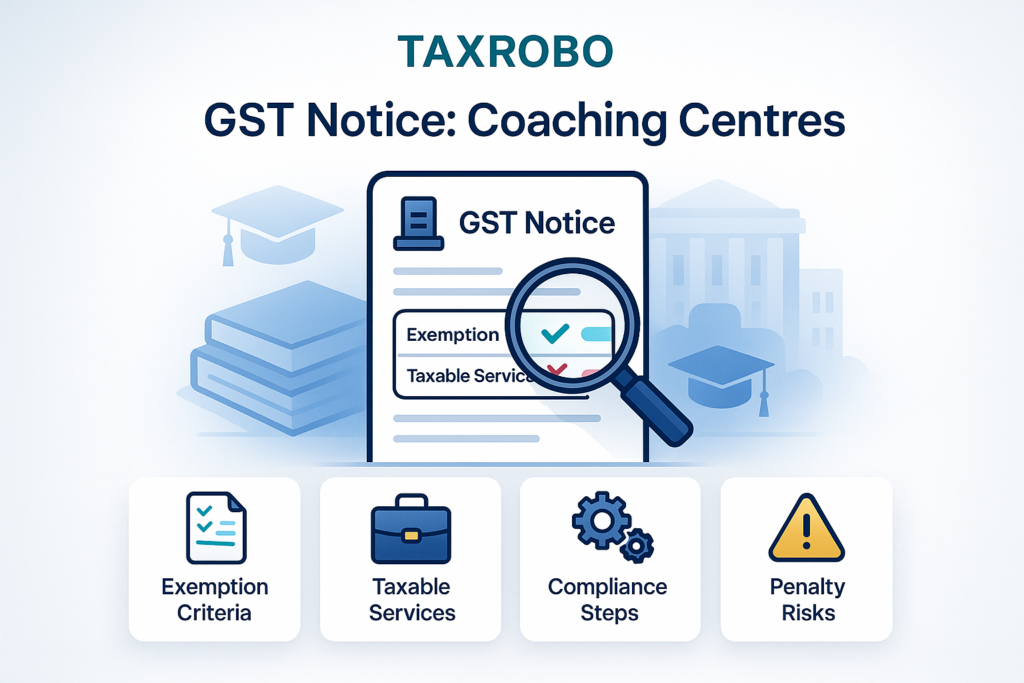
The educational landscape in India is rapidly evolving, and with it, the number of private coaching and tuition centres has surged. While this growth signifies a booming industry, it has also brought these establishments under the keen eye of the GST department. Receiving a GST notice for coaching centres can be a stressful experience, especially when you’re unsure about your tax obligations. The primary source of this anxiety stems from a fundamental confusion: are coaching services exempt from GST like formal education, or are they a taxable service? This uncertainty often leads to unintentional non-compliance, attracting scrutiny from tax authorities. Understanding the nuances of GST law is not just a matter of good practice; it is crucial to avoid hefty penalties, interest, and prolonged legal issues. This guide will demystify the GST rules for coaching centres, explain the common reasons why notices are being issued, and provide a clear, actionable plan to follow if you receive one.
Why are Coaching Centres Under the GST Scanner?
The central point of contention for coaching centres revolves around the interpretation of an “educational institution” under the GST regime. Many business owners mistakenly group their services with schools and colleges, leading them to incorrectly assume they are exempt from tax. The GST department is now actively identifying these discrepancies, leading to a wave of notices across the country. To navigate this, it is essential to first understand the legal distinction drawn by the tax authorities between formal education and private coaching. This distinction is the bedrock of all tax implications for your coaching business.
The General Rule: GST Exemption for “Educational Institutions”
The Goods and Services Tax law provides a specific exemption for services rendered by an “educational institution.” According to GST Notification No. 12/2017-Central Tax (Rate), an educational institution is defined as an institution that provides services by way of:
- Pre-school education and education up to higher secondary school or its equivalent.
- Education as a part of a curriculum for obtaining a qualification recognized by any law for the time being in force.
- Education as a part of an approved vocational education course.
This definition clearly covers traditional schools, colleges, and universities that offer degrees or diplomas recognized under Indian law (like UGC, AICTE, etc.). The core principle here is “recognized qualification.” The services provided by these institutions to their students, faculty, and staff are exempt from GST. This is a critical aspect of understanding GST exemption for coaching services; the exemption is narrowly defined and tied directly to formal, government-recognized educational pathways. Any service falling outside this specific scope is, by default, subject to taxation.
Where Coaching Centres Differ: The Taxable Service Issue
This is where private coaching centres, tuition classes, and institutes preparing students for competitive exams (like JEE, NEET, CAT, UPSC, etc.) find themselves on the other side of the tax line. These establishments do not provide qualifications “recognized by any law.” Instead, they offer commercial training and coaching services designed to supplement the formal curriculum or prepare students for entrance examinations. Consequently, they do not fit the GST law’s definition of an “educational institution.”
Therefore, the services provided by these private coaching centres are classified as a taxable supply. The primary coaching centres taxable service issues in India arise from this classification. These services fall under the Service Accounting Code (SAC) 9992 for “Commercial Training and Coaching Services” and are subject to GST at a standard rate of 18% (9% CGST + 9% SGST or 18% IGST for inter-state services). Failure to recognize this distinction is the most common reason coaching institutes run into compliance problems.
Common Reasons for Receiving a GST Notice for Coaching Centres
The GST department uses sophisticated data analytics tools to cross-verify information from various sources, making it easier than ever to flag non-compliant taxpayers. A notice is not a random occurrence; it is usually triggered by a specific red flag in your financial or tax filing history.
Non-Registration or Late Registration Under GST
Under the GST Act, any service provider whose aggregate turnover in a financial year exceeds ₹20 lakhs is mandatorily required to register for GST. For businesses operating in special category states (like North-Eastern states), this threshold is lower at ₹10 lakhs. Many coaching centre owners are either unaware of this threshold or underestimate their annual revenue. The tax department doesn’t just rely on your declared income; it actively tracks high-value transactions in your bank accounts and cross-references them with your filed Income Tax Returns (ITR). If your bank credits or ITR filings suggest a turnover above the threshold but you haven’t registered for GST, a notice for non-registration is almost inevitable. This notice will demand registration and the payment of tax from the date you became liable to register.
Incorrectly Claiming GST Exemption
This is the most significant and financially damaging reason for receiving a GST notice for coaching centres. As discussed, many owners operate under the false assumption that their services are exempt. They neither charge GST on their fees nor file GST returns. When the department identifies such a business through its data-mining activities, it issues a demand notice. This notice isn’t just for the tax you failed to pay; it includes:
- The principal GST amount for the entire period of non-compliance.
- Interest on the unpaid tax, which can be substantial (typically 18% per annum).
- A penalty, which can be as high as 100% of the tax due.
These cumulative coaching institutes tax implications can be financially crippling, turning a simple compliance oversight into a massive liability. This is why correctly understanding the coaching centres GST notice exemptions—or the lack thereof—is so critical.
Mismatch in Declared Turnover (GSTR-1 vs. GSTR-3B vs. ITR)
For coaching centres that are registered under GST, compliance doesn’t end with registration. You are required to file multiple returns. The most common are GSTR-1, which details your outward supplies (your revenue), and GSTR-3B, which is a summary return for paying your tax liability. The GSTN’s automated systems constantly compare the data in these returns. Furthermore, this data is also compared with the gross receipts or revenue you declare in your annual Income Tax Return. Any discrepancy is immediately flagged. For example, if your ITR shows a revenue of ₹50 lakhs but your GSTR-3B filings for the year only account for ₹40 lakhs, the system will generate a notice (often ASMT-10) asking you to explain the difference and pay the tax on the undeclared ₹10 lakhs.
Non-Filing or Delayed Filing of GST Returns
Consistent discipline in filing returns is a cornerstone of GST compliance for coaching centres in India. The GST portal tracks your filing history meticulously. Failing to file returns on time or skipping them altogether is a major red flag. Initially, you may receive automated reminders and late fees will accrue. However, if the non-compliance persists, the department will issue a formal show-cause notice asking why your registration should not be cancelled and why legal action should not be initiated. This can disrupt your business operations and signals to the authorities that your financial affairs may not be in order, potentially leading to a more detailed audit or investigation.
Your Action Plan: What to Do After Receiving a GST Notice
Receiving a notice from the GST department can be intimidating, but panicking is the worst response. A structured and timely approach is key to resolving the issue effectively. Follow these steps methodically.
Step 1: Read and Understand the Notice Carefully
Before you do anything else, take the time to read the notice thoroughly. Do not ignore it. Look for the following key pieces of information:
- Type of Notice: Identify the form number (e.g., ASMT-10 for scrutiny, DRC-01 for a show-cause notice). This tells you the severity and purpose of the communication.
- Reason for Notice: The notice will clearly state the alleged discrepancy or non-compliance (e.g., mismatch in turnover, non-filing of returns, incorrect exemption claim).
- Time Limit for Response: This is crucial. Every notice specifies a deadline for submitting your reply. Missing this deadline can lead to adverse consequences, including the department passing an order against you without hearing your side.
- Issuing Authority: Note the name and designation of the officer and the jurisdiction that issued the notice.
Step 2: Collate All Necessary Documents
Your reply must be supported by strong documentary evidence. Start gathering all relevant records for the period mentioned in the notice. Create a file with the following documents:
- A copy of your GST registration certificate (if applicable).
- Copies of all GST returns filed (GSTR-1, GSTR-3B, GSTR-9).
- A sample of invoices issued to students.
- Your complete bank statements for the period under scrutiny.
- Copies of your Income Tax Returns and financial statements (Profit & Loss Account, Balance Sheet).
- Fee receipts, ledgers, and any other accounting records.
- Contracts or agreements with students or faculty, if any.
Step 3: Prepare a Detailed, Factual Reply
Your response should be a point-by-point rebuttal to each allegation made in the notice. A vague or emotional reply will not work.
- Be Specific: Address each query or discrepancy raised by the officer directly.
- Provide Evidence: For each point you make, refer to the supporting documents you collected in Step 2. For instance, if there is a turnover mismatch, prepare a detailed reconciliation statement explaining the reasons for the difference.
- Be Factual and Professional: Stick to the facts of the case. Avoid making unsubstantiated claims. The reply should be drafted formally and submitted on your business letterhead.
- Submit on Time: Ensure your reply, along with all supporting documents, is submitted well before the deadline mentioned in the notice.
Step 4: Seek Professional Assistance
While you can reply to a notice yourself, GST law is complex and fraught with technicalities. A small mistake in your reply could be interpreted as an admission of guilt or could fail to address the legal core of the issue, leading to a confirmed demand of tax, interest, and penalty.
Navigating a GST notice for coaching centres requires expert knowledge of tax law, procedural rules, and precedents. Consulting with a qualified tax professional is not an expense; it’s an investment in protecting your business. An expert can help you:
- Correctly interpret the notice and its legal implications.
- Draft a legally sound and comprehensive reply.
- Represent your case before the tax authorities if a personal hearing is required.
- Negotiate and ensure the best possible outcome for your business.
The team at TaxRobo specializes in handling GST compliance and litigation. We ensure your reply is accurate, compliant, and robustly defends your interests. Don’t risk your business’s financial health. Get in touch with TaxRobo’s GST experts for professional assistance.
Conclusion
The message from the GST department is clear: private coaching centres are considered providers of taxable services and must comply with GST regulations. The primary reasons for receiving a notice are non-registration due to crossing the turnover threshold, incorrectly assuming an exemption, and discrepancies in filed returns. Ignoring a notice is never an option and can lead to severe financial consequences. The key to successfully resolving a GST notice for coaching centres is a prompt, well-documented, and professional response. While the process can seem daunting, with the right guidance, it can be managed effectively. Don’t let a GST notice disrupt your business. Ensure complete GST compliance for your coaching centre in India with expert help. Contact TaxRobo today for a consultation on handling your GST matters.
Frequently Asked Questions (FAQs)
Q1: What is the current GST rate for coaching centres in India?
A: The services provided by private coaching and tuition centres fall under SAC 9992 (“Commercial Training and Coaching Services”) and attract a GST rate of 18% (9% CGST + 9% SGST or 18% IGST).
Q2: My coaching centre’s annual turnover is less than ₹20 lakhs. Do I still need to register for GST?
A: No, if your aggregate annual turnover from all your businesses is below the ₹20 lakh threshold (₹10 lakh for special category states), you are not required to register for GST. However, you cannot charge GST from students or claim Input Tax Credit on your expenses.
Q3: Can I claim Input Tax Credit (ITC) on expenses for my coaching centre?
A: Yes, if you are registered under GST and are paying tax, you can claim ITC on business expenses like rent for the premises, advertising costs, purchase of computers, stationery, internet bills, and professional fees, subject to the conditions specified in the GST Act. This is a significant benefit of being GST-compliant.
Q4: I received a notice (ASMT-10) for a mismatch in my returns. What does it mean?
A: An ASMT-10 is a scrutiny notice issued when the GST officer finds discrepancies in your returns (e.g., a mismatch between data in GSTR-1 and GSTR-3B, or between your GST returns and ITR). You are required to submit an explanation for the discrepancy or pay the tax difference along with interest. It is highly recommended to seek professional help from an expert like those at TaxRobo to draft a proper response.
For more information, you can also refer to the official GST Portal.