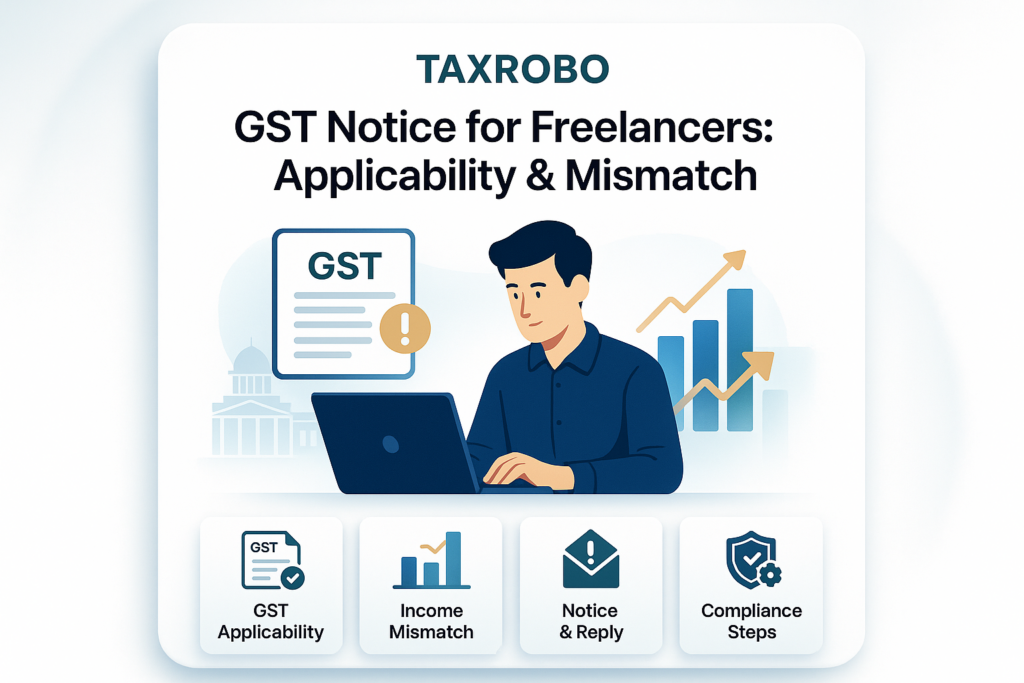

GST Notice for Freelancers – A Complete Guide to GST Applicability & Income Mismatch Issues
As a freelancer in India, you’re focused on delivering great work for your clients, managing projects, and building your brand. The last thing you want to deal with is a stressful, official-looking envelope from the GST department. This experience is becoming increasingly common, which is why understanding the potential triggers for a GST notice for freelancers is more critical than ever. The government has ramped up its use of technology, automatically comparing data between the Income Tax and GST departments, leading to a rise in automated notices. This post will demystify the reasons behind these notices, explain the rules of GST applicability for freelancers in India, show you how to handle income mismatch issues, and provide actionable freelancers tax issues guidance India on the steps to take if you receive one.
Why Are Freelancers Receiving GST Notices?
In today’s digital age, the Indian tax authorities have powerful tools to track financial transactions and ensure tax compliance across different laws. The era of operating in silos is over; government departments now communicate seamlessly, sharing vast amounts of data to create a comprehensive financial profile of every taxpayer, including freelancers. This interconnected system is the primary reason why more freelancers GST notice India are being issued. The core idea is to identify discrepancies between the income you declare to the Income Tax department and the turnover you report (or fail to report) to the GST department. Any significant difference acts as a red flag, prompting the system to generate a notice asking for clarification. This automated scrutiny means that staying compliant is not just a good practice but an absolute necessity for a hassle-free freelance career.
The Power of Data: How Tax Departments Track Your Income
The government’s ability to track your income stems from a robust data-sharing mechanism between the GST Network (GSTN) and the Central Board of Direct Taxes (CBDT). This integration allows them to cross-verify information from multiple sources to detect tax evasion. The key documents that feed this system include your Form 26AS, which details tax deducted at source (TDS) by your clients, and the Annual Information Statement (AIS) along with the Taxpayer Information Summary (TIS). The AIS is a comprehensive statement containing details of all your financial transactions reported by various entities like banks, financial institutions, and your clients. For instance, when a client pays you and deducts TDS, that transaction is reported and becomes visible in your AIS, giving the tax department a clear record of your gross receipts.
Actionable Tip: Make it a habit to log into the Income Tax portal at least once a quarter to review your Annual Information Statement (AIS). Checking this statement regularly helps you spot any discrepancies early and take corrective action before they can trigger a notice.
Top 3 Triggers for a GST Notice
While there can be various reasons for receiving a notice, they usually fall into three main categories for freelancers. Understanding these triggers is the first step toward proactive compliance.
- 1. Exceeding the GST Threshold: This is the most straightforward trigger. Your total income, as reported in your Income Tax Return (ITR) or reflected in your AIS, crosses the GST registration threshold. For service providers, this limit is generally ₹20 lakhs in a financial year. If the system sees your gross receipts exceeding this amount but finds no corresponding GST registration under your PAN, it will automatically flag your profile for scrutiny.
- 2. Income Mismatch: This is a major area of concern and a common reason for notices related to GST and income tax mismatch India. A mismatch occurs when the income you declare in your ITR is significantly different from the turnover reported in your GST returns (if you are registered) or the gross receipts visible in your Form 26AS/AIS. The tax authorities assume the higher of the two figures is your correct income and will issue a notice asking you to explain the difference and pay the potential GST liability on the undeclared amount.
- 3. Mandatory Registration Rules: Many freelancers are unaware that certain conditions make GST registration mandatory, regardless of their turnover. The most common rule affecting freelancers is the provision of inter-state services. If your client is located in a different Indian state than you, you are required to get GST registration from the very first transaction, even if your total income is well below the ₹20 lakh threshold. Ignoring this rule is a direct violation and a frequent trigger for compliance notices.
Understanding GST Applicability for Freelancers in India
To avoid getting on the wrong side of the tax authorities, it is essential to have a clear and accurate picture of GST applicability for freelancers India. The rules can seem complex, but they are generally based on your turnover and the nature of your services. By assessing your own situation against these rules, you can determine your obligations and take the necessary steps to become compliant. This proactive approach is far better than reacting to a notice and is a cornerstone of understanding GST for freelancers India. Your compliance journey begins with knowing whether you are required to register for GST in the first place, which depends on a few key factors. Our Ultimate Guide to GST Registration for Small Businesses provides a comprehensive overview of this topic.
The Basic Registration Threshold
The primary factor determining GST applicability is your “aggregate turnover.” For freelancers providing services, the threshold for mandatory GST registration is an aggregate turnover of ₹20 lakhs in a financial year. However, for a few special category states, this threshold is lowered to ₹10 lakhs. It is crucial to know which category your state falls into.
| Category | GST Turnover Threshold | Applicable States (Examples) |
|---|---|---|
| Normal States | ₹20 Lakhs | Maharashtra, Karnataka, Delhi, Tamil Nadu, Uttar Pradesh, etc. |
| Special Category States | ₹10 Lakhs | Manipur, Mizoram, Nagaland, Tripura, Sikkim |
It’s also vital to understand what “Aggregate Turnover” includes. It is the total value of all your services under the same PAN, which includes:
- All taxable services.
- Exempt services.
- Export of services.
This means you must sum up all revenue streams linked to your PAN to calculate whether you have crossed the threshold.
When GST Registration is Mandatory, Irrespective of Turnover
This is where many freelancers unknowingly fall into a compliance trap. Certain situations require you to register for GST regardless of whether your annual turnover is ₹20 lakhs or just ₹20,000.
- Inter-State Services: This is the most critical rule for freelancers. If you are based in one state (e.g., Maharashtra) and provide services to a client located in another Indian state (e.g., Karnataka), you are making an “inter-state supply of services.” GST law mandates compulsory registration for any person making an inter-state taxable supply. There is no turnover threshold for this rule. One single invoice to an out-of-state client makes you liable for GST registration.
- Other Scenarios: While less common for typical freelancers, mandatory registration also applies if you act as a Casual Taxable Person (providing services temporarily in a state where you don’t have a fixed place of business) or if you provide services through an e-commerce operator that is liable to collect tax at source (TCS).
Export of Services: GST for International Clients
If your client base is primarily international, you are dealing with the “export of services.” Under GST, the export of services is considered a “zero-rated supply.” This means that while the supply is taxable under GST, the tax rate applied is zero. You do not charge GST on your invoices to international clients. However, to claim the status of a zero-rated supply and to be eligible for refunds on the GST you paid on your inputs (like software subscriptions, office rent, etc., known as Input Tax Credit or ITC), you generally need to be registered for GST. You can export services without GST registration by furnishing a Letter of Undertaking (LUT) on the GST portal after registration.
Tackling Income Mismatch Issues for Freelancers in India
One of the most frequent and confusing notices freelancers receive revolves around income discrepancies. These notices are a direct result of the tax department’s data analytics capabilities, flagging differences between various financial declarations made under your PAN. Addressing these income mismatch issues freelancers India requires careful record-keeping and a clear understanding of what the department is looking for. A great starting point is knowing exactly how to report your earnings, which is covered in our guide on Filing Tax Returns for Freelancers and Consultants. Failing to provide a satisfactory explanation can lead to tax demands and penalties, making it a critical aspect of managing your freelancers income tax issues India.
What is a GST and Income Tax Mismatch?
Imagine telling two different government departments two different stories about your income. That, in essence, is a mismatch. The system compares the gross receipts/turnover figures from various sources, and if they don’t align, it raises a red flag. The comparison is typically between the income you declared in your ITR and the data available with the department from other sources.
Here’s a simple example to illustrate:
- Data in Form 26AS/AIS: Your clients across India paid you a total of ₹25 lakhs during the financial year. They deducted TDS on these payments, and this amount is now reflected in your AIS on the income tax portal.
- Data in your ITR: You filed your Income Tax Return showing a business income of ₹18 lakhs, perhaps after incorrectly deducting some expenses from your gross receipts.
- The System Flag: The department’s automated system detects a discrepancy of ₹7 lakhs (₹25 lakhs minus ₹18 lakhs). It will issue a notice asking why GST should not be levied on this differential amount of ₹7 lakhs, as your total receipts appear to have crossed the ₹20 lakh threshold.
How to Reconcile Your Income and Avoid Mismatches
The key to preventing these notices is proactive reconciliation and meticulous record-keeping. Prevention is always better than cure when it comes to tax matters.
- Maintain Clean Books: The foundation of good tax compliance is diligent bookkeeping. Use accounting software or a simple spreadsheet to track every single payment received from clients. Record the date, client name, invoice number, and amount. Ensure your book’s total revenue matches your bank statement credits from professional work.
- Regularly Check AIS/TIS: As mentioned earlier, your Annual Information Statement is the primary data source for the tax department. Review it regularly. If you find any entries that are incorrect (e.g., a payment from a client you don’t recognize), use the feedback facility on the portal to dispute it immediately. This creates a record of your objection.
- Align ITR and GSTR: If you are registered for GST, it is absolutely critical that the annual turnover you report in your GST returns (GSTR-1, GSTR-3B, and the annual GSTR-9) aligns with the gross receipts or turnover you declare in your Income Tax Return (ITR-3 or ITR-4). Any difference between these two filings is a guaranteed trigger for a notice.
Received a GST Notice for Freelancers? A Step-by-Step Action Plan
Receiving a formal notice can be intimidating, but panicking is the worst thing you can do. The key is to approach it systematically and respond in a timely manner. While this guide focuses on freelancers, you can find a broader explanation in our article on How to Handle GST Notices – ASMT-10, DRC-01, DRC-07 Explained Simply. Ignoring the notice is not an option and will only lead to more severe consequences, including ex-parte orders where the officer decides your liability without your input. Follow this structured plan to handle the GST notice for freelancers effectively.
Step 1: Read the Notice Carefully
First, take a deep breath and read the entire notice from start to finish. Do not just skim it. Pay close attention to these key details:
- Issuing Authority: Note which tax office and officer issued the notice.
- Notice Number and Date: This is crucial for all future correspondence. The notice type, often indicated by a form number like ASMT-10 (Scrutiny Notice), will tell you the nature of the inquiry.
- Reason for the Notice: The notice will specify the discrepancies found. For example, it might state, “Difference between turnover reported in ITR and data in Form 26AS.”
- Deadline for Response: This is the most critical piece of information. Note the last date to submit your reply and ensure you adhere to it.
Step 2: Gather All Your Documents
Your reply must be supported by strong evidence. Start collecting and organizing all relevant financial documents for the period mentioned in the notice. Create a file with the following:
- Invoices: Copies of all invoices you issued to clients during the financial year.
- Bank Statements: Highlight all credit entries corresponding to client payments.
- Client Contracts: Any agreements or contracts that define the scope of your work and payment terms.
- ITR Filings: A copy of the Income Tax Return you filed for the relevant year.
- Form 26AS and AIS: Download these from the Income Tax portal.
- GST Filings: If you are registered, have copies of your GSTR-1, GSTR-3B, and annual returns ready.
Step 3: Prepare a Detailed and Factual Reply
Your response should be a formal letter addressing every single point raised in the notice. Structure your reply clearly. If the notice has raised three discrepancies, address them one by one with separate headings. Provide a clear reconciliation of your income, explaining any differences with supporting evidence. For instance, if your bank statement shows higher credits than your declared income, the reason could be a personal loan from a family member, a refund, or income not related to your profession. Attach proof for each claim (e.g., “The extra ₹2 lakhs showing in my bank account was a personal loan from a family member, and here is the bank transfer proof and a declaration from them.”). Always maintain a polite and professional tone.
Step 4: Submit Your Response Online
Replies to GST notices must be filed electronically through the GST Portal. You cannot send a physical copy. Log in to your account, navigate to the “Notices and Orders” section, and find the relevant notice to file your reply and upload your supporting documents.
Drafting a legally sound and factually accurate reply is critical. An incorrect, incomplete, or delayed response can lead to confirmation of the tax demand along with interest and penalties. If you’re unsure about the technical aspects or how to best present your case, it’s highly advisable to seek professional freelancers tax issues guidance in India. Our experts at TaxRobo can analyze your notice, prepare a robust reply, and handle the entire submission process for you. Contact TaxRobo Online CA Consultation Service.
Conclusion
The Indian tax landscape for freelancers is evolving rapidly, with technology playing a central role in compliance enforcement. As a freelancer, your focus should be on your craft, but ignoring the financial and legal aspects of your profession can lead to significant trouble. By being proactive and informed, you can navigate this complex environment successfully.
Here are the key takeaways:
- Tax authorities are actively using data analytics to track freelancers’ income from multiple sources.
- Understanding GST applicability for freelancers in India, especially the rules on inter-state supply, is the first and most crucial step to compliance.
- Proactive and regular reconciliation of your income as per your books, bank account, and tax portals like AIS can prevent a GST and income tax mismatch in India.
- Never ignore a GST notice for freelancers. A timely, well-documented, and professional response is your best defense.
Don’t let tax notices disrupt your freelance career. Ensure your finances are in order and get expert help when you need it. Contact TaxRobo today for a consultation on GST registration, filing, and notice response. Our team is here to provide the support you need to stay compliant and focused on what you do best.
Frequently Asked Questions (FAQs)
1. I am a freelancer earning below ₹20 lakhs, but my client is in another state. Do I need GST registration?
Answer: Yes, absolutely. Providing services to a client in another state is classified as an “inter-state supply” under GST law. This type of supply mandates compulsory GST registration from the very first transaction, regardless of your annual turnover. The ₹20 lakh threshold does not apply in this case.
2. What are the consequences of ignoring a GST notice?
Answer: Ignoring a GST notice is a serious mistake. It can lead to the tax officer making a “best judgment assessment” of your tax liability based on the information they have, which is often much higher than your actual liability. Furthermore, it can result in hefty penalties, interest on the assessed tax amount, and potentially more stringent legal actions, including freezing of bank accounts in severe cases.
3. How can I ensure ongoing GST compliance for freelancers in India?
Answer: To ensure ongoing GST compliance for freelancers in India, you should adopt a few good habits. Always issue proper GST-compliant invoices if you are registered. Maintain accurate and up-to-date records of all your income and business-related expenses. File your monthly or quarterly GST returns (GSTR-1 and GSTR-3B) and annual returns (GSTR-9) on time. Most importantly, reconcile your bank statements with your accounting records every month to ensure everything matches. Using professional accounting services like those offered by TaxRobo can automate this and give you peace of mind.
4. My AIS shows income from a source I don’t recognize. What should I do?
Answer: If your Annual Information Statement (AIS) shows a transaction or income from a source you do not recognize, you must take immediate action. Log in to the Income Tax portal and use the feedback facility within the AIS section to mark the transaction as incorrect or disputed. You should also try to contact the entity that reported the transaction (the “Information Source” mentioned in AIS) and request them to file a correction. This is crucial because this incorrect data could be a primary reason for receiving an income mismatch notice from the tax department.