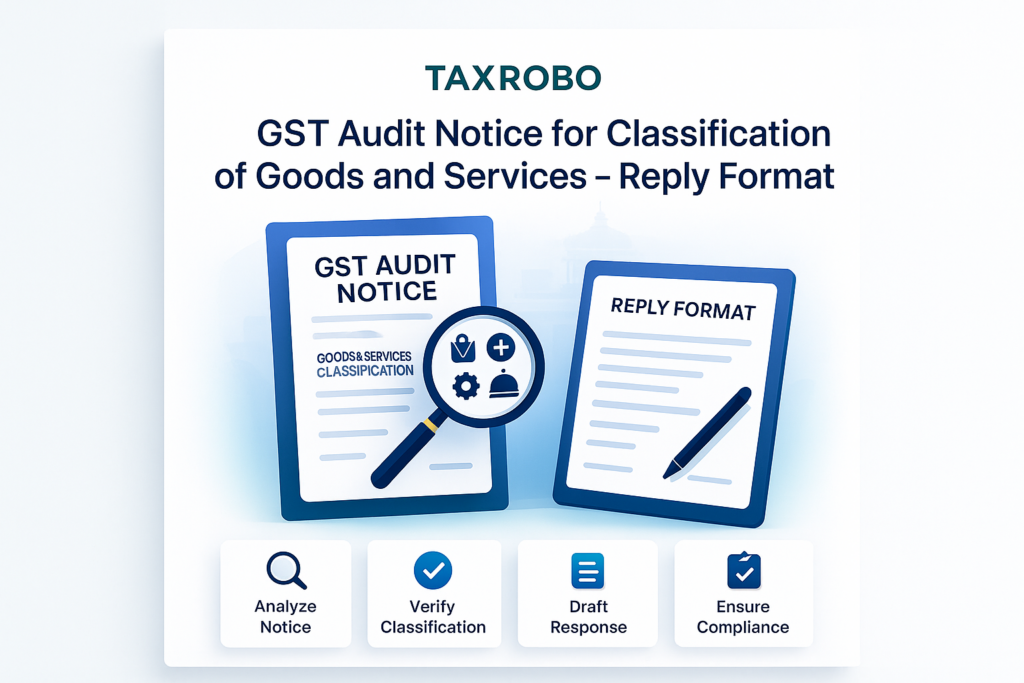

A Comprehensive Guide to Your GST Audit Notice Reply Format for Goods and Services Classification
Receiving an official envelope from the GST department can cause a moment of panic for any business owner. That initial feeling is common, but it’s crucial to approach the situation with a calm, structured mindset. A GST audit notice is not an accusation of guilt; it’s a request for clarification. However, handling it incorrectly, especially when it concerns the classification of goods and services, can lead to significant interest and penalties. This guide is designed to demystify the process by providing a clear and effective GST audit notice reply format, empowering you to respond with confidence. A well-prepared reply format for GST audit notice is your first and most important line of defense.
Why Did You Receive a Notice for Classification of Goods and Services?
At the heart of the Goods and Services Tax system is a classification framework designed to ensure uniformity in taxation across the country. Goods are categorized using the Harmonized System of Nomenclature (HSN), while services are categorized using the Services Accounting Code (SAC). Each code corresponds to a specific GST rate. You likely received a notice because the GST department believes there is a discrepancy between the HSN or SAC code you have used and the one they deem appropriate for your product or service.
The implications of incorrect classification are significant and can cascade through your financial records:
- Wrong GST Rate: The most direct consequence is applying an incorrect tax rate. If you’ve classified a product under a 12% HSN code when it should have been 18%, you have underpaid tax, which attracts interest and penalties.
- Incorrect Input Tax Credit (ITC) Claims: Certain goods or services may have restrictions on ITC. Incorrect classification could lead to claiming credit you weren’t eligible for, which will need to be reversed with interest.
- Interest and Penalties: The department will levy interest on the tax shortfall from the date it was due. In addition, penalties can be imposed for non-compliance.
Understanding the correct classification of goods and services under GST India is not just about compliance; it’s about financial accuracy. You can verify HSN and SAC codes using the official GST Portal.
Before You Draft: Key Steps to Prepare Your Response
A powerful response is built on thorough preparation. Before you even begin writing, dedicating time to organize your facts and documents will make the drafting process smoother and your argument stronger. Rushing into a reply without a solid foundation is a common mistake that can weaken your position.
Step 1: Read the Notice Carefully
Your first action should be to dissect the notice itself. Treat it as a roadmap provided by the department.
- Identify the Core Discrepancy: Pinpoint the exact goods or services that are being questioned. The notice will usually specify the HSN/SAC code you used and the one the department is proposing.
- Note Key Identifiers: Locate the Document Identification Number (DIN) and the specific reference number of the notice. These must be quoted accurately in all your correspondence.
- Check the Deadline: The most critical piece of information is the due date for your submission. Missing this deadline can lead to an ex-parte order passed against you, where the officer makes a decision without hearing your side of the story.
Step 2: Gather All Necessary Documents
Your reply is only as strong as the evidence that backs it up. Start compiling a comprehensive file of all relevant paperwork. This documentary evidence will form the backbone of your justification. Your file should include:
- The original GST audit notice.
- Copies of sales invoices for the goods/services in question.
- Related purchase orders, contracts, or agreements that describe the nature of the transaction.
- Product literature, marketing brochures, technical specifications, or website descriptions that detail the product’s function and composition.
- Any previous communications with the GST department regarding this or similar matters.
- A copy of your company’s GST registration certificate.
Step 3: Research and Justify Your Classification
With the notice understood and your documents in hand, you must now build the legal and factual argument for your classification. This involves going beyond just your opinion and grounding your choice in the official framework.
- Refer to the GST Tariff Schedule: The Customs Tariff Act, 1975, as adapted for GST, is the primary legal document for HSN codes. Review the chapter notes, section notes, and specific tariff headings that apply to your product.
- Consult HSN Explanatory Notes: These notes provide detailed international standards for interpreting HSN codes and can be highly persuasive in justifying your classification.
- Look for Precedents: Research relevant circulars or notifications issued by the Central Board of Indirect Taxes and Customs (CBIC). Additionally, look for any Advance Rulings or court judgments on similar products or services, as these can set a precedent.
The Ultimate GST Audit Notice Reply Format for Classification Disputes
Using a professional and structured format is essential. It demonstrates your diligence and makes it easier for the tax officer to understand your position. This goods and services classification reply template provides a clear structure that can be adapted for your specific situation, serving as an effective GST notice response format for businesses.
Part 1: The Header
(Should be on your official company letterhead)
[Your Company Letterhead]
Date: [Date of Reply]
To,
The Proper Officer,
[Designation of the Officer]
[Address of the GST Office as mentioned in the notice]
Part 2: Subject and Reference
Subject: Reply to Audit Notice/Show Cause Notice regarding classification of goods/services.
Reference:
1. Notice No.: [Enter the Full Notice Number] dated [Enter Date of Notice]
2. Document Identification Number (DIN): [Enter the DIN from the Notice]
Part 3: Body of the Reply – A Point-by-Point Response
Respected Sir/Madam,
Paragraph 1 (Acknowledgement):
With reference to the above-mentioned notice received by us on [Date of Receipt], we acknowledge its receipt. We are grateful for the opportunity to present our case and would like to submit our detailed point-wise response as follows:
Paragraph 2 (Facts of the Case):
We, [Your Company Name], holding GSTIN [Your GSTIN], are engaged in the business of [briefly describe your business activity, e.g., manufacturing, trading, providing services]. The current proceedings concern the classification of [mention the specific Product/Service Name] supplied by us.
Paragraph 3 (The Department’s Observation):
The notice alleges that our product/service, [Product/Service Name], has been incorrectly classified under HSN/SAC [Your Code] attracting a GST rate of [Your Rate%]. It has been proposed that the same should be classified under HSN/SAC [Proposed Code] attracting a GST rate of [Proposed Rate%], leading to a potential differential tax liability.
Paragraph 4 (Your Justification – The Core Argument):
Our respectful submission is that the classification adopted by us under HSN/SAC [Your Code] is correct and in accordance with the provisions of the GST law. We base our contention on the following grounds:
- Ground 1 (Nature of Product/Service): The product in question, [Product/Service Name], is primarily characterized by [describe its nature, composition, primary function, and end-use]. (For example: “The ‘Smart Power Bank’ is not merely a battery; its primary function is that of a portable automatic data processing machine peripheral, as it contains a logic circuit to manage power output to various devices…”)
- Ground 2 (Reference to Tariff/HSN Rules): As per the Rules for the Interpretation of the Harmonized System, the classification is determined by the terms of the headings and any relative Section or Chapter Notes. Our product squarely falls under Chapter Heading [e.g., 8507] which pertains to […]. Specifically, Subheading [e.g., 8507 60 00] covers […], which perfectly describes our product. The competing heading [Proposed Code] is inapplicable because [explain why it doesn’t fit].
- Ground 3 (Supporting Precedents): Our position is further strengthened by [cite a relevant CBIC Circular No. XXX/XX/20XX-GST dated DD/MM/YYYY], which clarifies the classification of similar goods. Furthermore, the Hon’ble Authority for Advance Rulings in the case of [XYZ Ltd.] has held that goods with similar characteristics are classifiable under HSN [Your Code].
Paragraph 5 (Submission of Documents):
To support our submission and for your kind perusal, we are enclosing the following documents:
1. Copy of Sales Invoices (Annexure A)
2. Product Technical Specifications/Brochure (Annexure B)
3. Copy of relevant Circular/Advance Ruling (Annexure C)
Part 4: Conclusion and Declaration
Prayer:
In light of the facts, documentary evidence, and legal provisions presented above, we humbly request your good office to consider our submission favorably and drop the proceedings initiated by the aforementioned notice.
Closing:
We assure you of our full cooperation in this matter and are prepared to provide any further information or clarification as required.
Thanking you.
For [Your Company Name],
[Digital or Physical Signature]
[Your Name / Authorised Signatory Name]
[Designation]
GSTIN: [Your GSTIN]
Common Mistakes to Avoid When Replying to a GST Notice
Even with the perfect format, certain procedural errors can undermine your efforts. Be vigilant and avoid these common pitfalls:
- Missing the Deadline: This is the most critical error. It can lead to an unfavorable order being passed against you without your input.
- Providing an Incomplete or Vague Reply: Avoid generic statements. Your reply must be specific, point-by-point, and address every query raised in the notice.
- Not Attaching Supporting Evidence: Claims without evidence are mere assertions. Always attach the documents you reference in your reply.
- Using Aggressive or Unprofessional Language: Maintain a formal and respectful tone throughout the reply. Professionalism can go a long way in proceedings.
- Ignoring the Notice Entirely: This is the worst possible action. It guarantees penalties, interest, and further legal complications.
Conclusion: Respond Confidently and Correctly
Navigating a GST audit notice for classification can feel daunting, but it is a manageable process. The key lies in a timely, well-documented, and professionally drafted response. Using a proper GST audit notice reply format not only ensures that you cover all necessary legal and factual points but also presents your case in a clear, coherent manner to the tax authorities. By following the steps outlined above, you can significantly reduce the risk of adverse orders, penalties, and prolonged legal disputes.
Feeling overwhelmed? The complexities of a GST audit classification reply format India can be challenging, and the stakes are high. Let the experts at TaxRobo handle your GST notices with precision and expertise. Our team of seasoned professionals understands the nuances of GST law and can craft a compelling response to protect your business interests. Contact us today for a consultation!
Frequently Asked Questions (FAQ)
1. What are HSN and SAC codes in GST?
HSN stands for Harmonized System of Nomenclature, an internationally recognized system for classifying goods. It’s an 8-digit code used to categorize products for GST purposes. SAC stands for Services Accounting Code, which is a classification system used by the service tax department for the taxation of services. Under GST, these codes determine the applicable tax rate for different goods and services, ensuring uniformity in tax administration.
2. What happens if I ignore a GST audit notice?
Ignoring a GST notice is a serious mistake with severe consequences. The GST officer is empowered to issue an “ex-parte” order, which means they will make a final decision based on the information they have, without considering your side of the story. This almost always results in the confirmation of the proposed tax demand, along with maximum penalties and interest. It can also trigger further legal action and even prosecution in some cases.
3. Can I reply to a GST notice myself, or do I need a professional?
For very simple queries, a business owner might be able to reply directly. However, disputes related to the classification of goods and services are highly technical. They involve the interpretation of legal provisions, tariff schedules, and judicial precedents. Engaging a professional like a Chartered Accountant or a tax consultant is highly recommended. They can build a legally sound argument, cite relevant case laws, and represent your case effectively, substantially increasing your chances of a favorable outcome.
4. How do I submit the reply to the GST department?
The method of submission will usually be specified in the notice itself. The two primary methods are:
- Physical Submission: You may need to submit a signed hard copy of your reply along with all annexures at the jurisdictional GST office. Always take an acknowledgement of receipt.
- Online Submission: Many notices can now be replied to electronically via the official GST portal. You would typically navigate to the ‘Notices and Orders’ section of your dashboard to upload your reply and supporting documents.