
A Restaurant Owner’s Guide: How to Reply to a GST Notice for a Wrong GST Rate
Receiving an official-looking envelope from the tax department can send a shiver down the spine of even the most diligent business owner. For restaurant owners, this stress is often compounded by the complexities of GST law. A GST notice for restaurants is a common occurrence, frequently stemming from confusion over the correct GST rates, such as the difference between the 5% and 18% slabs. This situation can feel overwhelming, but it doesn’t have to be. This comprehensive guide is designed to demystify the process and provide a step-by-step framework on how to handle GST notices restaurants receive for charging an incorrect tax rate. We will break down the entire process, from understanding the notice to drafting a professional response, and provide a clear GST reply format for restaurants to help you ensure compliance and peace of mind. For anyone concerned about responding to GST notices in India, this article will serve as your go-to resource.
Common Reasons Your Restaurant Received a GST Notice
The GST authorities issue notices primarily to ensure that businesses are adhering to tax laws and to investigate any discrepancies found in their data. Understanding why you received a notice is the first step toward resolving it. For restaurateurs, notices related to incorrect GST rates are usually triggered by a few common red flags that the department’s automated systems are designed to catch. Proper GST compliance for restaurant owners requires a keen understanding of these potential pitfalls, which are often related to the nuances of GST filing for restaurants in India. Let’s explore the most frequent reasons.
Incorrect GST Rate Application
This is the most significant source of confusion and, consequently, notices for restaurants. The primary issue revolves around the two main GST rates applicable to restaurant services:
- 5% GST (without Input Tax Credit – ITC): This is the standard rate for most standalone restaurants, cafes, and eateries, whether they offer dine-in, takeaway, or delivery services. The critical condition here is that the restaurant cannot claim ITC on its inputs (like raw materials and rent).
- 18% GST (with Input Tax Credit – ITC): This higher rate applies to restaurants located within hotels where the declared room tariff for any unit of accommodation is ₹7,501 or more per night. These establishments are eligible to claim ITC.
A notice is often triggered if a restaurant that should be charging 18% (due to its location in a high-tariff hotel) is found to be charging 5%, or vice-versa.
Mismatch Between GSTR-1 and GSTR-3B
The GST portal is built on a system of cross-verification. Your GSTR-1 is a statement of your outward supplies (sales), detailing every invoice. Your GSTR-3B is a summary return where you declare your total sales, tax liability, and ITC claimed, and then pay the final tax. If the total taxable sales reported in your GSTR-1 do not match the figures you’ve declared and paid tax on in your GSTR-3B for the same period, the system automatically flags this discrepancy. This mismatch is a major reason for the department to issue a notice seeking clarification for the difference.
Errors in Classifying Services
The restaurant industry offers a variety of services, and misclassifying them can lead to applying the wrong GST rate. For instance, while most restaurant services fall under the 5% slab, outdoor catering services attract an 18% GST rate (with ITC). If a restaurant provides both dine-in and catering services but incorrectly applies the 5% rate to its catering revenue, it can lead to a notice for short payment of tax. Similarly, failing to correctly distinguish between different revenue streams in your accounting records can cause compliance issues.
First Steps After Receiving a GST Notice for Your Restaurant
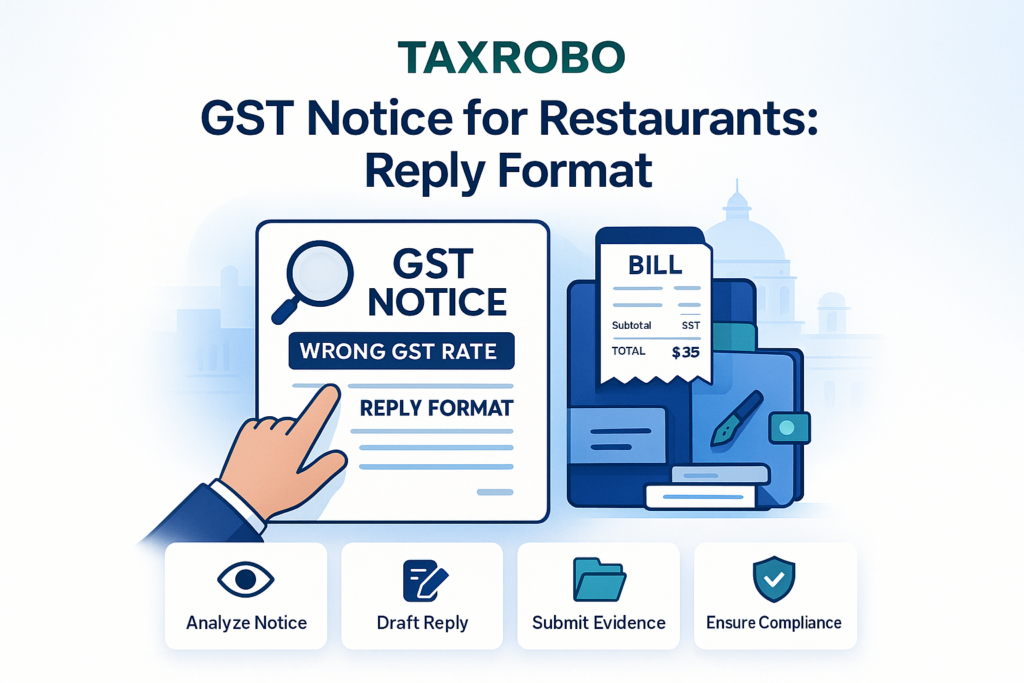
The moment you receive a notice, it’s natural to feel anxious. However, acting calmly and systematically is key to a successful resolution. Panicking can lead to hasty mistakes. Instead, follow this structured approach to prepare for your response. Proper GST audit notice management begins with these initial, crucial steps on how to handle GST notices restaurants receive.
Step 1: Verify the Notice’s Authenticity
Before you do anything else, confirm that the notice is genuine. Unfortunately, there have been instances of fraudulent notices. The Government of India has implemented the Document Identification Number (DIN) system to ensure transparency. Every communication from the GST department must have a unique DIN.
- Action: Go to the official CBIC portal and use the DIN mentioned on the notice to verify its authenticity. You can do this by visiting the CBIC DIN Search Portal. If the DIN is not verifiable, the notice may not be legitimate.
Step 2: Understand the Discrepancy
Read the notice carefully, multiple times if necessary. Do not skim it. You need to fully comprehend what the tax officer is asking. Pay close attention to:
- The Reason: The notice will specify the exact reason for the inquiry. Look for phrases like “levy of GST at a lower rate,” “mismatch in GSTR-1 and GSTR-3B,” or “wrongful availment of ITC.”
- The Period: Identify the specific financial year(s) or tax period(s) the notice refers to.
- The Deadline: The notice will mention a clear deadline for submitting your reply. Missing this deadline can have serious consequences.
Step 3: Collate All Necessary Documents
Your reply must be supported by strong evidence. Begin gathering all relevant documents to build your case. A well-organized file will make drafting the reply much easier and more effective.
- Essential Documents Checklist:
- A clear copy of the GST notice you received.
- Your restaurant’s GST registration certificate.
- Copies of sales invoices issued during the disputed period.
- Filed GSTR-1 and GSTR-3B returns for the period in question.
- Your financial statements, including the Profit & Loss account and Balance Sheet.
- If you have already identified an error and paid the differential tax, keep the challan for the payment made via Form DRC-03 ready.
- Any contracts or agreements related to your location (e.g., if you are situated within a hotel).
The Definitive GST Notice Reply Format for Restaurants
Drafting a clear, factual, and respectful reply is the most critical part of the process. Your response should directly address the queries raised in the notice and be supported by the documents you have collected. Using a structured GST notice format for restaurants ensures you don’t miss any vital information. This wrong GST rate notice reply India template will guide you.
Essential Components of Your Reply Letter
Your reply should be professional and presented on your official business letterhead.
- Letterhead: Should clearly display your restaurant’s legal name, registered address, contact information, and GSTIN.
- Date: The date on which you are sending the reply.
- To: The full designation and address of the GST officer who issued the notice. This information will be on the notice itself.
- Reference Number: Clearly state the Show Cause Notice (SCN) number and its date for easy reference.
- Subject: Make the subject line specific and clear.
- Example: Reply to Show Cause Notice for wrong levy of GST – [Your Restaurant Name] – [GSTIN]
Sample Structure for the Body of the Reply
The body of your reply should be divided into logical paragraphs, each addressing a specific point.
- Paragraph 1 (Acknowledgement):
- Begin by formally acknowledging the receipt of the notice.
- Template: “This is with reference to the Show Cause Notice bearing number [Notice Number] dated [Notice Date] issued by your good office. We hereby acknowledge the receipt of the same and are submitting our reply as under.”
- Paragraph 2 (Factual Submission – Choose the relevant scenario):
- This is where you present your case. Be honest and direct.
- Scenario A (If you believe your GST rate was correct):
- Template: “In the said notice, it has been alleged that we have levied GST at a lower rate of 5% instead of the applicable rate of 18%. In this regard, we would like to humbly submit that our establishment, [Your Restaurant Name], is a standalone restaurant and does not form part of a hotel with a declared room tariff exceeding ₹7,500. Therefore, as per Notification No. 11/2017-Central Tax (Rate), we are correctly liable to charge GST at 5% without availing Input Tax Credit.”
- Scenario B (If you acknowledge an error occurred):
- Template: “We have carefully reviewed our records for the period in question and admit that an inadvertent error occurred in the application of the GST rate. This was due to a clerical mistake in our accounting system, which has since been rectified. We sincerely regret this oversight.”
- Paragraph 3 (Legal Justification & Corrective Actions):
- Back up your claims with legal provisions. If you made an error, detail the corrective measures for GST errors in restaurants that you have taken.
- Template (For Scenario B): “Upon realizing our error, we have taken immediate corrective action to ensure full compliance. We have calculated the differential tax liability of ₹[Amount] and have paid the same, along with applicable interest of ₹[Amount], via Form GST DRC-03 on [Date]. A copy of the payment challan is attached herewith as Annexure-A for your kind perusal and record.”
- Paragraph 4 (Prayer/Conclusion):
- Conclude your letter with a polite request to the officer.
- Template: “In light of the facts presented above and the corrective actions taken by us, we humbly request your good office to kindly consider our submission favourably and drop the proceedings initiated by the aforementioned show cause notice. We assure you of our full compliance in the future.”
- Closing:
- End with “Yours Sincerely,” or “Yours Faithfully,” followed by the signature, name, and designation of the authorized person (e.g., Proprietor, Director).
Attaching Supporting Annexures
Never send a reply without the supporting documents.
- Action: After the closing, list all the documents you are attaching. For example:
- Annexure-A: Copy of DRC-03 Challan for payment of differential tax and interest.
- Annexure-B: Copies of relevant sales invoices.
- Annexure-C: Copies of GSTR-1 and GSTR-3B for the said period.
- Ensure each annexure is clearly labelled.
Conclusion: Proactive Compliance is Key to Avoiding Future Notices
Facing a tax inquiry can be daunting, but a systematic and honest approach can resolve the matter efficiently. The key takeaways are to first verify the notice, meticulously gather your documents, draft a clear and factual reply using the correct format, and most importantly, take prompt corrective action if an error was made. A well-drafted and timely response to a GST notice for restaurants is not just about resolving the current issue; it’s about demonstrating your commitment to compliance, which can prevent penalties and further legal complications. Proactive GST compliance for restaurant owners is the best defense against future notices.
Navigating the nuances of GST law can be complex. If you need expert help in drafting a legally sound reply or want to streamline your GST filing for restaurants in India to avoid such issues in the future, connect with the specialists at TaxRobo today. Ensure your business stays compliant and stress-free.
Frequently Asked Questions (FAQs)
Q1: What is the general time limit to reply to a GST notice?
Answer: The time limit is always specified in the notice itself, but it is typically between 15 to 30 days from the date of receipt. It is absolutely crucial to adhere to this deadline to avoid adverse action.
Q2: What happens if I don’t respond to the GST notice?
Answer: Ignoring a GST notice is a serious mistake. It can lead to the tax officer passing an ex-parte (one-sided) order based on the information they have, confirming the tax demand along with interest and penalties. This can be followed by recovery proceedings, such as freezing bank accounts.
Q3: Can I ask for an extension to file the reply?
Answer: Yes, if you have a valid reason for needing more time (e.g., gathering complex data), you can submit a written request for an extension to the issuing authority before the deadline expires. The decision to grant an extension is at the officer’s discretion.
Q4: I paid the differential tax via DRC-03. Do I still need to reply to the notice?
Answer: Absolutely. Paying the tax via DRC-03 is the corrective action, but it doesn’t close the proceeding automatically. You must file a formal reply to the notice, informing the officer of the payment (attaching the challan as proof) and formally requesting the closure of the proceedings.
Q5: Should I hire a professional for responding to GST notices in India?
Answer: While you can reply yourself, especially for simple queries, hiring a tax professional is highly recommended. A professional can help draft a precise, legally sound response, ensure all supporting documents are correctly presented, and can represent you if a personal hearing is required. This minimizes the risk of errors and significantly improves the chances of a favourable outcome.