
GST Notice for Apartment Associations – GST Liability Reply Format
Your apartment association’s management committee has just received an official-looking envelope. It’s a notice from the GST department. Panic sets in. What’s the next step? This is a common scenario for many Resident Welfare Associations (RWAs) and housing societies, which are often managed by dedicated volunteers who may not be tax experts. The legalese and tight deadlines can be incredibly stressful. This article is your clear guide on responding to GST notices for apartment associations. Understanding the correct GST notice response format is the first and most crucial step toward resolving the issue efficiently and ensuring your association remains compliant. At TaxRobo, we specialize in helping entities like yours navigate complex tax compliance with ease.
Why Did Our Apartment Association Receive a GST Notice?
Before you can draft a reply, it’s essential to understand why the GST department might have contacted your association in the first place. The reason usually lies in the fundamental principles of GST applicability for housing societies and some common compliance gaps.
Understanding GST Applicability for Housing Societies in India
Many management committees are unsure about the rules governing GST liability for residential complexes in India. The rules for GST on Housing Societies are specific, and its applicability is determined by two conditions, and both must be met for GST to be levied on contributions from members:
- The Aggregate Turnover Threshold: The total annual collections (turnover) of the association from all sources must exceed ₹20 lakhs in a financial year.
- The Member Contribution Threshold: The monthly maintenance contribution collected from an individual member must exceed ₹7,500.
If both these conditions are satisfied, GST at 18% becomes applicable. It’s important to note that if a member’s monthly contribution crosses ₹7,500, GST is levied on the entire amount, not just the portion exceeding the threshold. This is a critical aspect of apartment association GST compliance in India that is often misunderstood. For an authoritative reference, you can always consult the latest guidelines, such as the CBIC Circular on this matter. You can find more details in the official circulars on the CBIC website.
Common Triggers for a GST Notice
If your association meets the criteria for GST registration, a notice is typically triggered by a perceived gap in compliance. Here are the most common reasons an officer might issue a notice, rooted in apartment associations and GST regulations:
- Failure to Register: The most common reason. Your association’s annual turnover crossed the ₹20 lakh threshold, but you failed to obtain a Goods and Services Tax Identification Number (GSTIN).
- Non-filing or Late Filing of Returns: GST-registered entities must file monthly or quarterly returns like GSTR-1 (details of outward supplies) and GSTR-3B (a summary return and tax payment). You can learn the specifics in our guide, How to File GST Returns Online: A Step-by-Step Guide of the GST Filing Process & Procedure. Missing these deadlines is a red flag for the tax authorities.
- Data Mismatches: The GST system is built on reconciliation. Notices are often sent for discrepancies between the data in GSTR-1 and GSTR-3B, or mismatches between the Input Tax Credit (ITC) available in your GSTR-2A/2B and the amount you claimed in GSTR-3B.
- Incorrect Input Tax Credit (ITC) Claims: An association can claim ITC on goods and services used for providing its services (e.g., security, housekeeping, lift maintenance). However, claiming ITC on ineligible items, such as those used for new construction, can trigger a notice.
- Non-payment of Tax: If your association collected GST from members but failed to deposit the amount with the government within the stipulated time, it can lead to a serious notice, including demands for tax, interest, and penalties.
How to Draft the Perfect GST Notice Response Format
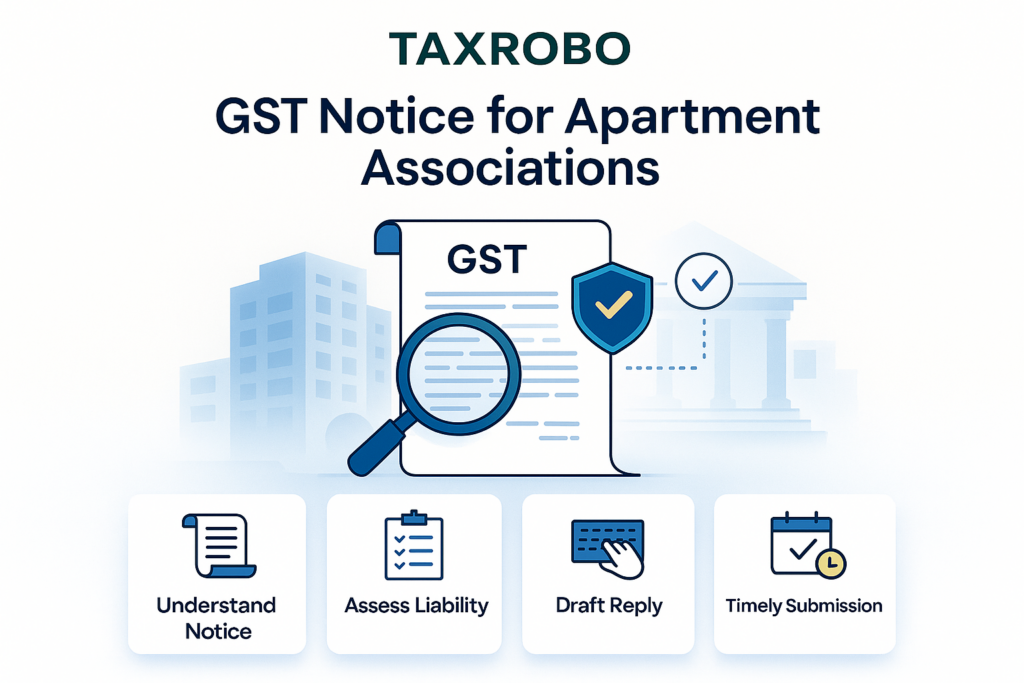
Once you understand the “why,” the next step is the “how.” A well-structured, factual, and timely reply can resolve the issue at the earliest stage. Following a professional GST notice response format shows the tax officer that you are diligent and organized.
Step 1: Analyze the Notice Carefully
Don’t just skim the notice. Read every word carefully and identify the following key details:
- Notice Reference Number: This is often the Document Identification Number (DIN) or Reference Number (RFN), which you must quote in all future correspondence.
- Issuing Section: The notice will mention the section of the GST Act under which it has been issued. This tells you the nature of the inquiry. For example, a notice under ASMT-10 is for scrutiny of returns, while DRC-01 is a Show Cause Notice before a demand is created. Refer to our article on How to Respond to a GST Show Cause Notice: A Step-by-Step Guide for specific actions.
- Specific Discrepancy: Pinpoint the exact reason for the notice. Is it a data mismatch, a query about ITC, or a failure to file returns? The notice will specify the tax period(s) in question.
- Deadline for Reply: This is non-negotiable. Note the last date for submitting your response. Missing this deadline can have severe consequences.
Step 2: Gather All Supporting Documents
Your reply is only as strong as the evidence you provide to support it. Before you start writing, compile a comprehensive file containing all relevant documents. This preparation is key when learning how to draft GST reply for associations.
- A copy of your GST registration certificate (if registered).
- Copies of all filed GST returns (GSTR-1, GSTR-3B) for the period mentioned in the notice.
- Audited financial statements, balance sheets, and profit & loss accounts.
- Detailed ledgers of income and expenses.
- Bank statements for the relevant period to corroborate your financial records.
- Copies of tax invoices for major expenses on which you have claimed Input Tax Credit (e.g., security services, housekeeping, repair contracts).
- Records of member contributions, including invoices or receipts issued to them.
Step 3: Structure Your GST Liability Reply
A professional structure makes your reply easy for the officer to understand and review. Follow this clear, logical flow for your GST notice response format for apartment associations.
- Header: Always use the official letterhead of your Apartment Owners Association. It should clearly display the name, address, and GSTIN of the association.
- Date & Recipient Details: Mention the date you are sending the reply. Address it to the designation and office address of the officer who issued the notice.
- Reference Line: This is crucial. Clearly state the Notice Reference Number (DIN/RFN) and the date of the notice.
- Subject Line: Be specific. For example: “Reply to Notice under Section 61 of the CGST Act, 2017”.
- Introduction: Begin by formally acknowledging the receipt of the notice, mentioning the date you received it.
- Factual Background: In a brief paragraph, state the nature of your association’s activities—that it is a Resident Welfare Association providing services to its members for their collective benefit.
- Point-wise Rebuttal: This is the core of your reply. Address each query, discrepancy, or allegation from the notice one by one. Use separate paragraphs or numbered points with clear headings for each issue. Be factual, objective, and avoid emotional language.
- Legal Basis: If your argument relies on a specific provision of the GST Act, a rule, or a government circular, cite it clearly. This adds significant weight to your submission.
- List of Enclosures: At the end of the reply, list all the supporting documents you are attaching, referring to them as Annexure-A, Annexure-B, and so on.
- Prayer: Conclude the letter with a formal request (known as a “prayer”) asking the officer to consider your submissions and documents and to drop the proceedings initiated by the notice.
- Signature: The reply must be signed by an authorized signatory of the association (usually the President, Secretary, or Treasurer), along with their name, designation, and the association’s official stamp.
Sample GST Liability Reply Format for Associations India
To make it even clearer, here is a template you can adapt. This sample GST liability reply format for associations India covers the essential components discussed above.
[On the Letterhead of the Apartment Owners Association]

Date: [Date of Reply]
GSTIN: [Your Association's GSTIN]

To,
The [Designation of the Officer],
[Address of the GST Office],
[City, State, PIN Code].

Reference No.: [Notice Reference Number/DIN] dated [Date of Notice]

Subject: Reply to the Notice issued under Section [Mention Section] of the CGST Act, 2017

Respected Sir/Madam,

1.  This is with reference to the notice cited above, which was received by us on [Date of Receipt]. We have reviewed the contents of the notice and are providing our point-wise response below.

2.  Facts of the Case: [Your Association Name], holding GSTIN [Your GSTIN], is a Resident Welfare Association engaged in providing maintenance and other related services to its members.

3.  Reply to Allegation 1: [State the first discrepancy from the notice, e.g., "Mismatch in GSTR-1 and GSTR-3B"]
    Our submission on this point is as follows: [Provide a clear, factual explanation for the discrepancy. For instance, mention if a transaction was reported in a different tax period due to an error and has since been rectified.] We are enclosing [mention supporting document, e.g., "a reconciliation statement"] as Annexure-A.

4.  Reply to Allegation 2: [State the second discrepancy, e.g., "Excess ITC Claim"]
    Our submission is that the Input Tax Credit has been claimed correctly on [mention service, e.g., "security services and lift maintenance services"], which are used for providing taxable output services to our members. Copies of the relevant tax invoices are attached as Annexure-B.

5.  Prayer: In light of the above submissions and the documents provided, we humbly request your good office to review our case and drop the proceedings initiated by the said notice. We assure you of our full cooperation.

Thank you.

For [Your Association Name],

(Signature)

[Name of Authorized Signatory]
[Designation, e.g., Secretary/President]
Best Practices: GST Notice Guidelines for Housing Societies
Responding to a notice correctly involves more than just the format. Follow these essential GST notice guidelines for housing societies to ensure a smooth process.
Do’s:
- DO reply within the specified deadline. This is the most important rule.
- DO be factual, polite, and professional in your language, even if you disagree with the notice.
- DO attach clear, legible copies of all relevant supporting documents.
- DO consult a tax expert like TaxRobo if the matter involves complex legal arguments or a significant tax amount.
Don’ts:
- DON’T ignore the notice. Ignoring it will lead to an ex-parte order (a decision made without your input), often resulting in hefty penalties and interest.
- DON’T provide vague, evasive, or incomplete information. This can make the officer suspicious.
- DON’T admit fault or agree to pay a demand without fully understanding the issue and its implications.
Conclusion
Receiving a GST notice can be alarming, but it doesn’t have to be a catastrophe. By understanding the basics of GST applicability, carefully analyzing the notice, gathering your documents, and preparing a response, you can address the department’s queries effectively. Using a proper GST notice response format is not just about procedural compliance; it’s about presenting your association’s case clearly, professionally, and persuasively to the tax authorities. This organized approach significantly increases the chances of a favorable outcome.
Navigating the nuances of apartment association GST compliance in India can be daunting for volunteer-run committees. If you need help drafting a reply or want to ensure your association’s GST filings are handled correctly, TaxRobo’s expert team is here to assist. Contact us for a hassle-free consultation today!
FAQs: GST for Apartment Associations
1. Q: Is GST applicable if our society’s total collection is over ₹20 lakh but no single member pays more than ₹7,500 per month?
A: No. For GST to be applicable on member contributions, both conditions (annual turnover > ₹20 lakh AND monthly maintenance per member > ₹7,500) must be met. However, the association may still need to register and pay GST on other taxable income, such as rent from a community hall to outsiders or income from advertising hoardings.
2. Q: What is the most important thing to remember when replying to a GST notice?
A: The most critical factor is to reply within the deadline. Failure to do so allows the tax officer to make a decision based only on the information they have, which is often not in your favour and can lead to a confirmed demand against the association.
3. Q: Can we request an extension for filing the GST notice reply?
A: Yes, you can file a formal request for an extension with the issuing officer, stating valid reasons for the delay (e.g., waiting for documents, key person unavailable). However, the granting of an extension is entirely at the officer’s discretion and is not guaranteed.
4. Q: Do we need to hire a professional to draft the reply?
A: For simple notices like a reminder to file a return, a well-informed committee member might be able to draft the reply. However, for complex issues involving legal interpretation, mismatches, or significant tax amounts, it is highly advisable to consult a tax professional. They can ensure the GST liability reply format is correct, your arguments are legally sound, and you are represented properly.