
GST Summons for Export Benefit Investigation – The Definitive Reply Format for Indian Businesses
Introduction: Understanding the GST Summons and Why It Matters
Receiving an official notice from the GST department can be a stressful experience, especially when it concerns your hard-earned export benefits. The official language and legal implications can feel overwhelming for any business owner. This is precisely why understanding the correct GST summons reply format is not just helpful—it’s your first line of defense. A GST summons is a formal legal document issued by authorized GST officers under Section 70 of the Central Goods and Services Tax (CGST) Act, 2017. Its purpose is to compel an individual or a business representative to appear before the officer, provide crucial evidence, or produce specific documents related to an ongoing inquiry. This blog serves as a comprehensive guide for Indian exporters, providing a clear, step-by-step framework for responding to GST summons India. We will break down the process, demystify the legal jargon, and equip you with a detailed GST summons reply format India specifically tailored for cases involving an export benefit investigation GST, ensuring you can navigate the process confidently and protect your business interests.
Why Did You Receive a Summons? Unpacking the Export Benefit Investigation
The primary reason exporters receive a summons is that the GST department is scrutinizing export benefit claims in GST India to safeguard government revenue and prevent fraudulent activities. Exports are ‘zero-rated’ under GST, meaning exporters can claim a refund of the Integrated GST (IGST) paid on exported goods or services, or claim a refund of the unutilized Input Tax Credit (ITC). To ensure these claims are genuine and compliant, tax authorities conduct thorough investigations. A summons is a key tool in this process, allowing them to gather direct evidence and statements from the taxpayer. The goal is to verify the legitimacy of the export transactions and the associated ITC claims, ensuring every refund is backed by proper documentation and adherence to regulations.
Common Triggers for a GST Investigation
GST authorities use sophisticated data analytics tools to identify potential red flags. An investigation into your export benefits could be triggered by several factors, often related to data mismatches or suspicious transaction patterns. Being aware of these triggers is the first step towards maintaining robust exporting with GST compliance India.
- Mismatched Data: The most common trigger is discrepancies between the data filed in your Shipping Bills, GSTR-1 (outward supplies), and GSTR-3B (summary return). Any inconsistency in values, invoice numbers, or dates can alert the authorities.
- Suspicious Invoices: The investigation may focus on the Input Tax Credit (ITC) you claimed on goods or services that were subsequently exported. If the invoices from your suppliers are found to be fake, ineligible, or from a non-existent supplier, your refund claim will come under intense scrutiny.
- Non-receipt of Export Proceeds: A fundamental condition for treating a supply as an export is the receipt of payment in convertible foreign exchange. Failure to produce Bank Realization Certificates (BRCs) or Foreign Inward Remittance Certificates (FIRCs) as proof of payment within the prescribed time limit is a major red flag.
- High-Risk Supplier Chain: Even if your records are clean, you can be pulled into an investigation if one of your key suppliers is flagged for tax evasion or fraudulent ITC claims. The authorities will trace the entire supply chain, and your transactions with that supplier will be examined.
The GST Investigation Process for Exporters: What to Expect
Understanding the typical workflow of an investigation can help you prepare and respond more effectively. While the specifics can vary, the GST investigation process for exporters generally follows a structured path. It begins with the department gathering preliminary data and, if they find discrepancies, escalates to direct interaction with the taxpayer.
The process usually unfolds in these stages:
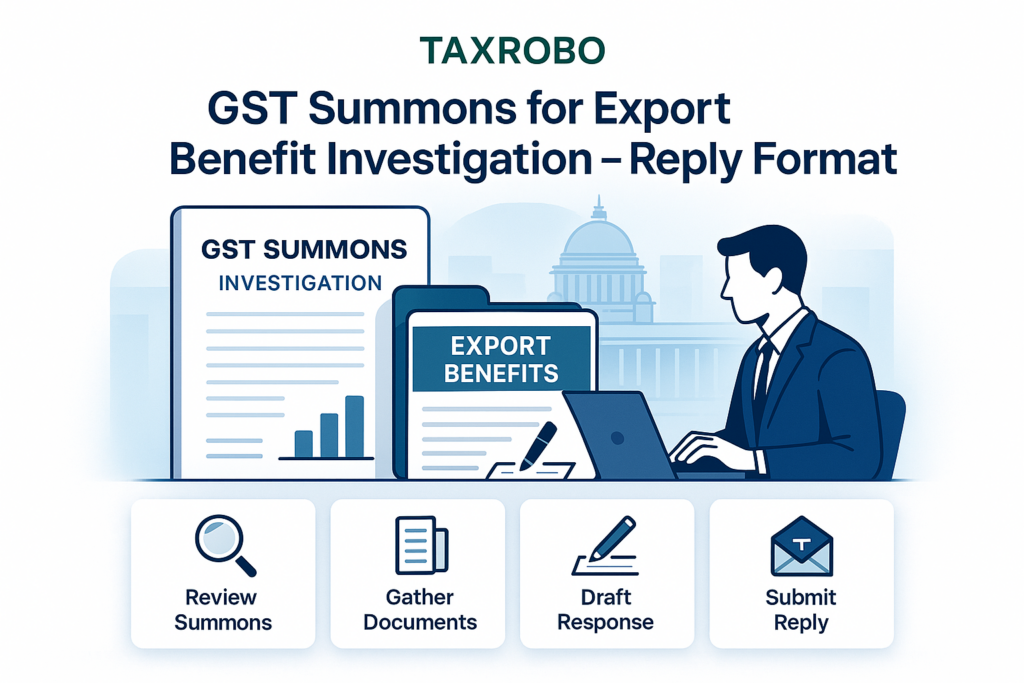
- Summons Issuance: You receive a formal summons under Section 70, specifying the documents required and whether a personal appearance is necessary.
- Document Submission: You are required to submit the requested documents within the given timeframe.
- Statement Recording: An authorized officer will record your statement under oath. This statement is considered judicial evidence and is admissible in court.
- Scrutiny by Officers: The officials will meticulously examine your submitted documents and recorded statement against the data available on the GST portal and other sources like the ICEGATE portal.
- Show Cause Notice (SCN): If significant discrepancies or non-compliance are found, the department will issue a Show Cause Notice (SCN), detailing the allegations and the proposed tax demand, interest, and penalty.
- Final Order: After you reply to the SCN and a personal hearing is conducted, the adjudicating authority will pass a final order, either dropping the proceedings or confirming the demand.
The Essential GST Summons Reply Format: A Section-by-Section Breakdown
A well-structured, professional, and factual reply is your most critical tool when responding to a GST summons. It demonstrates your commitment to compliance and makes it easier for the investigating officer to understand your position. Using a clear and comprehensive legal reply format for GST summons ensures that you address all queries systematically and provide the necessary supporting evidence without ambiguity. This structured approach not only fulfills your legal obligation but also helps in presenting your case in the most favorable light from the very beginning.
Part 1: Official Letterhead and Header
Your reply must be formal and professional. Always use your company’s official letterhead. This immediately establishes the identity and authenticity of your submission. The header section should be clear and contain all necessary identification details.
- Your Company Details: Clearly print your company’s registered name, full address, Goods and Services Tax Identification Number (GSTIN), and Corporate Identity Number (CIN).
- Date: Mention the date on which you are dispatching the reply.
- “To” Section: Address the reply to the specific officer who issued the summons. Include their full name, designation, and the complete address of their office as mentioned in the summons document.
Part 2: Subject and Reference
This section helps the department quickly identify and file your response correctly. It links your reply directly to the summons you received, preventing any administrative confusion.
- Subject Line: The subject should be precise and informative. A good example is: “Sub: Reply to Summons issued under Section 70 of the CGST Act, 2017 in the matter of M/s [Your Company Name]”.
- Reference: This is crucial for record-keeping. Clearly state the original Summons Number (often referred to as DIN – Document Identification Number) and the Date of its issuance. For example: “Ref: Summons No. [XYZ/GST/2023/123] dated [Date of Summons]”.
Part 3: The Body of the Reply
This is the core of your response where you directly address the department’s queries. The body should be structured logically to provide context and answer each point clearly.
- Introductory Paragraph: Begin by formally acknowledging the receipt of the summons. State the reference number and date again. Express your company’s commitment to compliance and your intent to cooperate fully with the ongoing investigation.
- Factual Matrix: In a brief paragraph, provide context about your business. Describe your primary business activities, focusing on your export operations. Mention the nature of goods/services exported, the primary countries you export to, and your general business model. This helps the officer understand the context of the documents you are submitting.
- Point-wise Response: This is the most critical part of your reply. Do not write a generic, long-form essay. Instead, address each specific query or document request from the summons under a separate, clearly numbered heading. For instance:
- “Reply to Query 1: Submission of Shipping Bills for the period April 2022 to March 2023”
- Beneath this heading, state that you are enclosing the requested documents. You can add a brief note if necessary, for example, “We are attaching self-certified copies of all 57 Shipping Bills for the mentioned period as Annexure-A.”
- “Reply to Query 2: Details of Bank Realization Certificates (BRCs)”
- Similarly, state your response clearly. “Copies of all relevant BRCs corresponding to the Shipping Bills are enclosed herewith as Annexure-B.”
- “Reply to Query 1: Submission of Shipping Bills for the period April 2022 to March 2023”
Part 4: List of Annexures (Supporting Documents)
To maintain clarity and ensure no document is overlooked, create a separate section listing all the supporting documents you are attaching with your reply. This acts as a checklist for both you and the officer.
- Create a numbered or bulleted list of every document submitted.
- Each document or set of documents should be labeled as an “Annexure” and clearly described.
- Annexure-A: Self-certified copies of Shipping Bills for FY 2022-23.
- Annexure-B: Self-certified copies of Bank Realization Certificates.
- Annexure-C: Copies of relevant GSTR-1 and GSTR-3B returns.
- Annexure-D: Copies of relevant tax invoices and e-way bills.
- Annexure-E: Reconciliation statement between Shipping Bills and GSTR-1.
Part 5: Concluding Prayer and Signature
The conclusion should be polite and professional, formally closing your submission.
- Conclusion/Prayer: Add a concluding paragraph reiterating your cooperation. You can include a “prayer” such as, “In light of the above submissions and the enclosed documents, we humbly request your good office to review the same and drop the proceedings.” This is a standard formal request.
- Signature Block: The reply must be signed by an authorized signatory (e.g., Director, Partner, Proprietor). The block should include:
- “For [Your Company Name],”
- (Signature)
- Name of the Signatory
- Designation
GST Summons Guidelines for Businesses: Critical Do’s and Don’ts
Your conduct and approach during the investigation process are just as important as the documents you submit. Following proper etiquette and legal guidelines can significantly impact the outcome. Adhering to these GST summons guidelines for businesses will help you manage the process smoothly and avoid unnecessary complications.
The Do’s of Responding to a Summons
- DO respond within the stipulated time. The summons will specify a deadline. Adhering to it shows your respect for the law and your willingness to cooperate. If you need more time, formally request an extension in writing with valid reasons.
- DO gather all required documents meticulously. Before drafting the reply, ensure you have collected every single document requested. Organize them neatly and label them according to your annexure list.
- DO be truthful and accurate in your statements. Providing factual information is non-negotiable. Any false or misleading statement made under oath can lead to severe penalties and even prosecution under the Indian Penal Code.
- DO seek professional help. Navigating a GST investigation requires expertise. Engaging a tax consultant or a lawyer, like the experts at TaxRobo, can help you draft a legally sound reply and guide you through the entire process.
- DO keep a copy of everything. Maintain a complete file containing a copy of the summons, your detailed reply, all the documents you submitted, and proof of dispatch (e.g., courier receipt or acknowledgement from the department).
The Don’ts of Responding to a Summons
- DON’T ignore the summons or miss the deadline. Ignoring a summons is a serious offense. It can lead to penalties under Section 122 of the CGST Act and prosecution under Section 174 of the Indian Penal Code.
- DON’T provide false or misleading information. This can be construed as an attempt to obstruct the investigation and will attract severe legal consequences. Stick to the facts supported by documentary evidence.
- DON’T submit original documents unless specifically requested. Always provide self-certified photocopies. If an officer insists on seeing the originals, present them for verification but do not submit them without obtaining a formal acknowledgement of receipt.
- DON’T engage in arguments with the investigating officer. Maintain a professional and calm demeanor throughout the process, including during the recording of your statement. Your role is to provide facts, not to debate the law with the officer.
How TaxRobo Can Help You Navigate GST Investigations
Facing a GST summons can be daunting, but you don’t have to go through it alone. A professionally drafted response and expert guidance are your best assets in protecting your interests. The team of seasoned tax experts at TaxRobo specializes in GST litigation and compliance, offering end-to-end support to businesses under investigation. We understand the nuances of the law and the procedures followed by the tax authorities, enabling us to represent your case effectively.
Our experts can help you:
- Analyse the summons to understand the core issues and potential implications for your business.
- Draft a precise and legally sound response using the correct GST summons reply format, ensuring every query is addressed accurately.
- Compile and organize all necessary documentation to build a strong, evidence-backed case.
- Represent you before the GST authorities, providing clear and confident explanations during statement recordings and hearings.
- Ensure overall GST compliance for exporters in India, helping you strengthen your internal processes to prevent such issues in the future.
Don’t let a GST summons disrupt your business. Partner with TaxRobo for expert guidance and peace of mind. Contact our GST experts today!
Conclusion: Proactive Compliance is Your Best Defence
A GST summons for an export benefit investigation demands a careful, structured, and timely response. By understanding the reasons behind the scrutiny and meticulously following the correct GST summons reply format, you can present your case clearly and effectively. Remember to be truthful, organized, and professional throughout the process. While this guide provides a robust framework for your reply, the value of professional guidance from experts like TaxRobo cannot be overstated in navigating the complexities of tax law. Ultimately, while a summons requires a strong reactive response, the best long-term strategy for any exporting business is proactive compliance. Maintaining clean, accurate, and transparent books of accounts is your strongest shield against legal complications and the surest path to sustained business growth. For the latest official updates, you can always refer to the GST Council website.
Frequently Asked Questions (FAQs)
Q1. What are the legal consequences of ignoring a GST summons?
Answer: Ignoring a GST summons is a punishable offense with serious repercussions. Under Section 122(3)(d) of the CGST Act, failure to appear when summoned can lead to a penalty of up to ₹25,000. Additionally, it is an offense under Section 174 of the Indian Penal Code (IPC), which can lead to legal prosecution by the department.
Q2. Do I need to be physically present after submitting the reply?
Answer: The summons document will explicitly state whether you need to appear in person to give a statement or simply submit documents. Often, both are required. Even if you submit a comprehensive written reply with all documents, you must attend the personal hearing if the summons specifies it, as the officer needs to record your statement under oath.
Q3. Can I ask for more time to submit my reply?
Answer: Yes, you can request an extension. You should submit a formal written request (an adjournment letter) to the issuing officer well before the deadline, clearly stating the valid reasons for needing more time (e.g., collecting voluminous data, unavailability of a key person). However, the decision to grant an extension is entirely at the discretion of the officer.
Q4. What is the difference between a summons and a regular notice from the GST department?
Answer: A summons under Section 70 is a much more serious and formal legal instrument than a regular notice (e.g., for scrutiny under Section 61). A summons legally compels your presence or the submission of documents for an official inquiry or investigation. Non-compliance with a summons has stricter legal consequences, including penalties and potential prosecution under the IPC. A routine notice is typically a request for clarification or additional information regarding your returns and has less severe penalties for non-compliance.