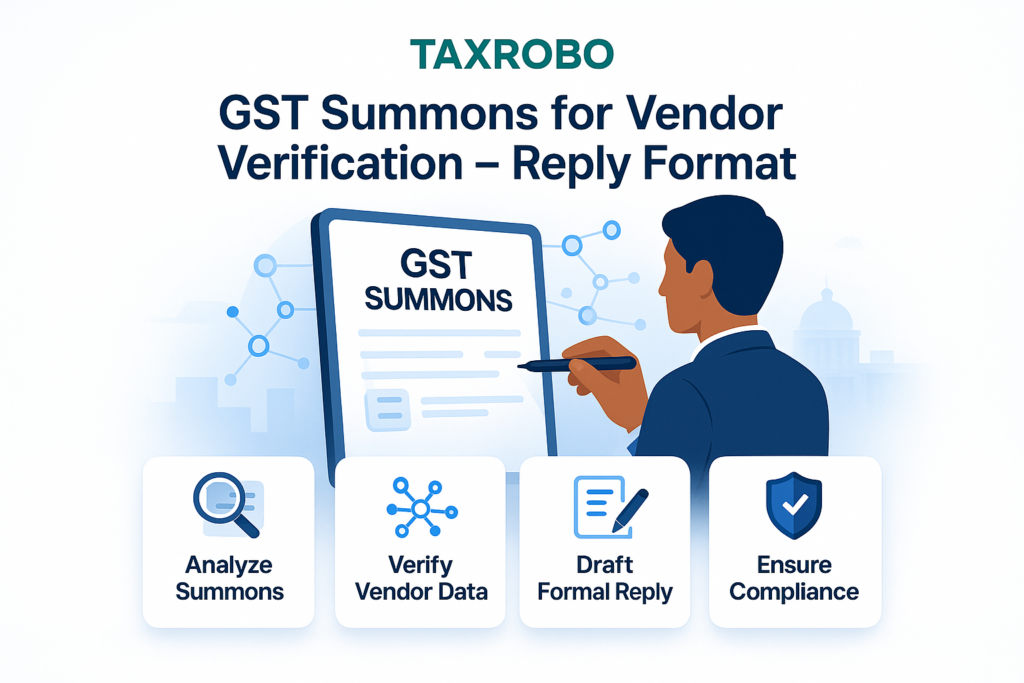

GST Summons for Vendor Verification – Reply Format: A Complete Guide
Receiving an official communication from the GST department can be daunting for any business owner. One such communication, a summons for vendor verification, often causes significant concern. However, it’s essential to understand that this is a standard procedure used by tax authorities to ensure compliance across the supply chain. A GST summons is a legal instrument issued under Section 70 of the CGST Act, 2017, to compel individuals to provide evidence or produce documents for an inquiry. A timely, accurate, and professionally drafted vendor verification summons response is not just a legal obligation but a crucial step in safeguarding your business from potential penalties and legal complications. This guide will provide a step-by-step process and a clear reply format to help you navigate this process with confidence.
What is a GST Summons for Vendor Verification?
A summons from the Goods and Services Tax department is a formal call to appear before a GST officer. When it pertains to vendor verification, the primary goal is to confirm the authenticity of transactions between a buyer and a seller. It’s a key part of the government’s mechanism to maintain a transparent tax system and prevent fraudulent activities. Understanding the purpose and the authority behind such a summons is the first step toward formulating an effective response.
The Purpose Behind the Summons
Authorities issue these summonses to conduct due diligence and curb tax evasion. It is not always an indication that you have done something wrong; often, you may be called upon to simply verify a transaction with another party who is under scrutiny. The purpose is to create a trail of evidence that validates business operations and tax payments.
Common reasons for receiving a summons for vendor verification include:
- Verifying Input Tax Credit (ITC): The most common reason is to verify a genuine Input Tax Credit (ITC) claim made by one of your customers. The department wants to ensure that you, the supplier, have paid the corresponding GST on the supplies.
- Investigating Suspicious Transactions: If a particular transaction is flagged as unusual due to its high value or abnormal pattern, authorities may issue a summons to both the vendor and the recipient for clarification.
- Checking for Fake Invoicing: The GST regime has been battling the menace of fake invoices, where bills are issued without the actual supply of goods or services to fraudulently claim ITC. A summons helps in identifying such rackets.
- Ensuring Overall Compliance: It is a tool for the department to ensure overall adherence to the Indian vendor verification process and to confirm that businesses are maintaining proper records as required by law. This underscores The Importance of Accurate Record-Keeping to Prevent GST Demand Notices.
- Cross-Verification: If one of your vendors or customers is under a detailed investigation or audit, you may receive a summons to provide your side of the transaction records for cross-verification.
Who is Authorised to Issue a GST Summons?
It is crucial to know that not every official can issue a summons. Under the GST law, a summons can only be issued by a “proper officer” who has been duly authorized by the government. This is a quasi-judicial proceeding, which means the officer has powers similar to a civil court for the purpose of the inquiry. Non-compliance with a validly issued summons is a serious offense and can lead to penalties and prosecution. The legal basis for this power is Section 70 of the CGST Act, 2017, which you can read in detail on the official CBIC website. Therefore, you must treat the summons with the seriousness it deserves.
Decoding the Summons: Key Information to Check Immediately
Once you receive the summons, do not panic. The first thing to do is to a carefully read and understand the document in its entirety. It contains specific instructions and requirements that you must fulfill. Verifying the authenticity and understanding the demands of the notice will help you prepare an organized and complete response, which is a cornerstone of the GST summons guidelines for vendors.
Essential Components of the Summons Notice
A valid GST summons will have several key components. Carefully check for the following details to ensure the document is authentic and to understand what is being asked of you:
- Summons Identification Number (SIN): As per CBIC guidelines, every summons must have a computer-generated, unique Summons Identification Number (SIN). This number must be quoted in all future correspondence and is a mark of the notice’s authenticity.
- Issuing Authority: The summons must clearly state the name, designation, and office address of the officer who has issued it.
- Legal Provision: It will explicitly mention the legal section under which it is being issued, which is typically Section 70 of the CGST Act, 2017.
- Date, Time, and Place for Appearance: The notice will specify the exact date, time, and location where you or your authorized representative needs to appear.
- List of Required Documents: This is the most critical part of the summons. It will contain a specific list of documents, records, and information that you are required to produce at the hearing.
Common Documents Requested by GST Authorities
While the exact list of documents can vary depending on the case, authorities typically request a standard set of records to verify a transaction. Preparing these in advance will save you time and stress. Here is a checklist of commonly requested documents:
- GST Registration Certificate: A copy of your Form GST REG-06.
- Identity and Business Proof: The PAN Card of the proprietor, partners, or directors, along with the business’s PAN card.
- GST Returns: Copies of your GSTR-1 (outward supplies) and GSTR-3B (summary return) for the tax period under question. For guidance on this process, refer to our article on How to File GST Returns Online: A Step-by-Step Guide of the GST Filing Process & Procedure.
- Transactional Evidence: This is crucial. You will need to provide:
- Tax invoices related to the specific transaction. Properly formatted invoices are crucial; you can learn more in our guide on Understanding GST Invoicing: A Detailed Guide.
- Purchase orders or contracts.
- E-way bills, if applicable.
- Transport receipts or lorry receipts (LRs) as proof of movement of goods.
- Proof of Payment: Bank statements of your business account clearly showing the receipt of payment from the buyer for the specific invoices under scrutiny.
- Ledger Accounts: A copy of the ledger account of the concerned buyer/customer in your books of accounts.
- Business Premise Proof: Documents like a rent agreement or electricity bill for your registered place of business.
How to Draft a Professional Vendor Verification Summons Response
Drafting a professional and comprehensive response is vital. Your reply should be clear, factual, and supported by all the requested documents. This section details the GST compliance response format and explains how to reply to GST summons effectively, ensuring you meet all legal requirements and present your case clearly. A systematic approach will demonstrate your commitment to compliance and facilitate a smoother inquiry process.
Step 1: Acknowledge and Organize
The first rule upon receiving a summons is to act on it promptly. Ignoring it is not an option and can lead to legal consequences.
- Do Not Ignore: Ignoring a summons can lead to a penalty of up to ₹25,000 and may even trigger prosecution proceedings. Acknowledge the notice internally and begin the process of compiling the required information immediately.
- Gather Documents: Systematically collect every document mentioned in the summons. It is a good practice to make a complete file. Create certified true copies of all documents, arrange them logically (perhaps chronologically or by type), and create an index or a cover letter listing all the enclosed documents. This level of organization is appreciated by the authorities and reflects your professionalism.
Step 2: The Official Reply Format and Structure
Your written reply should be formal and structured. It should be printed on your company’s official letterhead and should clearly address all the points raised in the summons. The following template provides a clear vendor compliance reply structure India that you can adapt for your needs. This structure is a standard for any formal vendor verification reply format in India.
[Your Company Letterhead]
Date: [Date of Reply]
To,
The [Designation of the Issuing Officer],
[Name of the GST Office/Commissionerate],
[Full Address of the Office].
Reference: Summons Identification Number (SIN): [Your SIN] dated [Date of Summons]
Subject: Reply to Summons issued for Vendor Verification in the case of [Your Business Name], GSTIN: [Your GSTIN]
Respected Sir/Madam,
1. This is with reference to the summons cited above, received by us on [Date of Receipt], requiring our presence and the submission of certain documents for verification purposes in connection with an inquiry.
2. We hereby acknowledge the receipt of the said summons. We wish to state that we are a law-abiding and compliant entity registered under the GST Act. We are committed to extending our full cooperation to your office in this matter and providing all necessary information to facilitate the inquiry.
3. As requested in the summons, we are enclosing herewith a complete set of self-attested documents for your kind perusal and record. The documents are arranged as per the annexures listed below:
- Annexure A: Copy of our GST Registration Certificate.
- Annexure B: Copy of the PAN Card of the Proprietor/Company.
- Annexure C: Copies of relevant tax invoices (Invoice No. […] dated […]) pertaining to the transaction under verification.
- Annexure D: The bank statement highlighting the receipt of payment against the aforementioned invoice(s).
- Annexure E: Copy of the complete ledger account of [Customer/Supplier Name] for the relevant financial year.
- Annexure F: Copies of GSTR-1 and GSTR-3B filed for the period [Mention the tax period].
- Annexure G: Copies of E-way bills and transport receipts for the said supply.
(Please adjust this list based on the actual documents requested in your summons)
4. All the information and documents provided herein are true and correct to the best of our knowledge and belief, as extracted from our books of accounts and records. We request you to kindly take these on record and conclude the proceedings at the earliest.
Should you require any further clarification, information, or documentation, please feel free to contact the undersigned.
Thank you for your time and consideration.
Sincerely,
[Your Name/Name of Authorised Signatory]
[Your Designation]
[Company Name & Seal]
[Contact Number & Email ID]
Step 3: Submission and Appearance
Once your reply and document set are ready, you need to ensure they are submitted correctly. You or your representative must appear before the officer at the stipulated time.
- Submission: Submit the reply along with all the indexed and annexed documents. It is always advisable to submit the response through an authorized representative, such as a Chartered Accountant or an advocate, who is well-versed in handling such matters. However, you can also submit it in person.
- Acknowledgment: Always take a copy of your entire submission set for your own records. When you submit the documents at the GST office, get the receiving copy stamped with an acknowledgment seal and date. This is your proof of submission.
Essential Tips and Best Practices
Handling a GST summons can be straightforward if you follow a few best practices. These vendor verification reply tips India will help you manage the process efficiently and avoid common pitfalls. The following GST summons guidelines for vendors are designed to ensure a smooth and compliant interaction with the tax authorities.
Be Prompt and Punctual
Time is of the essence. Always adhere to the deadline mentioned in the summons for both submitting documents and appearing for the hearing. If you genuinely need more time to gather the required information, do not wait until the last day. Submit a formal written request for an extension or adjournment to the issuing officer well in advance, clearly stating the reasons for the delay.
Be Truthful and Accurate
Honesty is the best policy when dealing with tax authorities. Provide only factual information and authentic documents. Any attempt to submit fabricated documents or provide misleading information can be detected and will lead to severe penalties, including prosecution, under the GST law. If a particular document is not available, state the reason for its unavailability in your written reply rather than ignoring the request.
Seek Professional Assistance
Navigating a GST notice response for vendors can be complex. The legal language, procedural requirements, and the stress of appearing before a tax officer can be overwhelming for a business owner. This is where professional help becomes invaluable. The experts at TaxRobo specialize in GST compliance and litigation. We can help you draft a precise and compliant response, represent your case before the authorities, and ensure your rights are protected throughout the process.
Conclusion
Receiving a GST summons for vendor verification is a serious matter that requires a structured, professional, and prompt response. By understanding its purpose, carefully decoding the requirements, gathering the right documents, and using a professional reply format, you can handle the verification process smoothly and without any negative consequences. Remember, the goal of the authorities is to verify facts, and your cooperation with accurate information is the key to a swift conclusion. A well-drafted vendor verification summons response not only fulfills your legal duty but also demonstrates your commitment to compliance and protects your business’s reputation. If you are unsure about any step or feel overwhelmed by the process, don’t hesitate to contact TaxRobo’s GST experts for immediate and reliable assistance.
Frequently Asked Questions (FAQs)
Q1. What are the consequences of ignoring a GST summons?
Answer: Ignoring a summons issued under Section 70 of the CGST Act is a punishable offense. The authorities can impose a monetary penalty of up to ₹25,000 under Section 122 of the Act. Furthermore, non-compliance can be treated as an offense under the Indian Penal Code, and the officer may initiate prosecution proceedings against the person who has failed to appear.
Q2. Do I have to appear in person, or can my CA/lawyer represent me?
Answer: In most cases, you can authorize a representative, such as a Chartered Accountant, an advocate, or a GST practitioner, to appear on your behalf. They can submit the documents, present your case, and answer queries. However, if the summons specifically requires the personal attendance of the proprietor, director, or a key person, then that individual must appear in person.
Q3. Can I request an extension if I cannot gather all documents in time?
Answer: Yes, you can file a formal written application with the issuing officer requesting an adjournment or an extension of the date of appearance. You must state a genuine and compelling reason for the delay, such as the unavailability of a key person or the time required to retrieve old records. The approval of this request is at the officer’s discretion, so it is crucial to file it well before the scheduled date.
Q4. What should I do if the summons asks for documents I don’t have?
Answer: You must be transparent about it. In your written reply, you should clearly and honestly state why a particular document is not available or is not applicable to your business or the specific transaction. For example, if e-way bills were not required for a particular transaction due to its value, you should state that fact. Never submit false or fabricated documents, as this can lead to severe legal action.