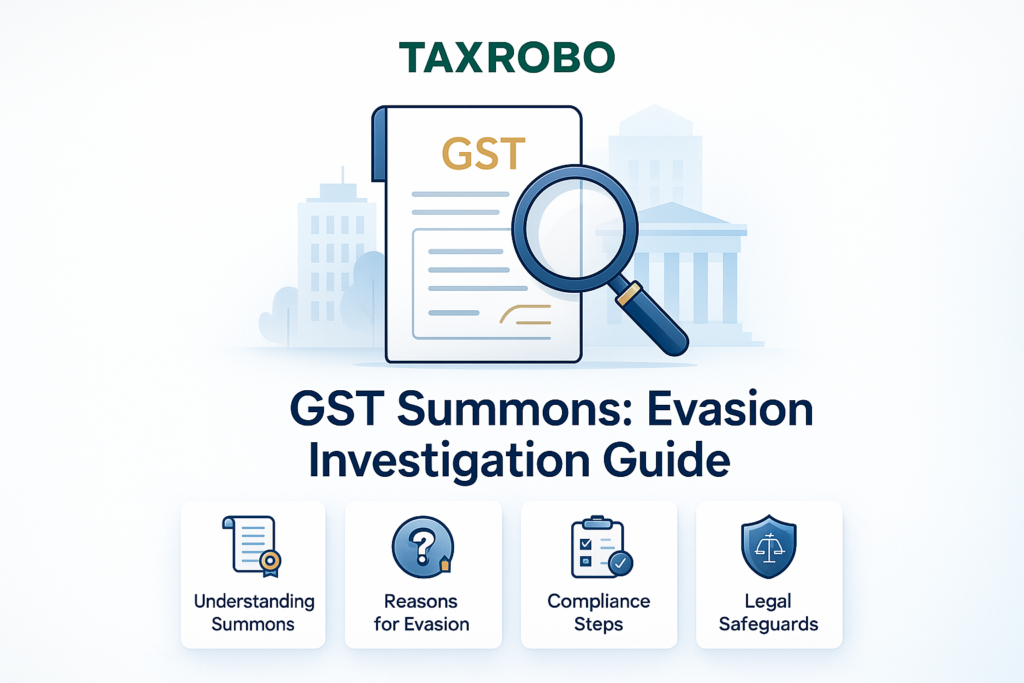

GST Summons for GST Evasion Investigation – A Complete Guide
Receiving an official notice from a government department can be a stressful experience for any business owner. When that notice is a GST summons, the anxiety can be even higher. This document is a formal call from the GST authorities, and understanding how to handle it is crucial. This article serves as a comprehensive GST summons investigation guide, designed to walk you through the entire process, explain your rights and responsibilities, and help you navigate this complex situation with clarity and confidence. Think of this as your essential GST summons investigation guide India for every business owner aiming for complete compliance.
What Exactly is a GST Summons? Understanding the Legal Framework
A GST summons is not just a simple letter; it is a legally binding order issued by a GST officer. It compels a person to either appear in person to give evidence or produce specific documents as part of an ongoing inquiry or investigation. The primary goal is to gather information and evidence related to potential tax evasion or non-compliance. Ignoring a summons is a serious offense with significant legal and financial consequences, making it imperative for businesses to understand its legal foundation.
The Power to Summon under Section 70 of the CGST Act, 2017
The authority for issuing a GST summons comes directly from Section 70 of the Central Goods and Services Tax (CGST) Act, 2017. This section grants a duly authorized GST officer powers similar to those of a civil court under the Code of Civil Procedure, 1908. These powers are specifically for:
- Summoning and enforcing the attendance of any person whose presence is considered necessary.
- Requiring the discovery and production of documents or other material evidence.
- Examining the person on oath.
Essentially, the law treats an inquiry under the GST Act as a “judicial proceeding,” meaning any statement you provide is recorded under oath and can be used as evidence. You can read the full text of the law on the official CBIC website here: CGST Act, 2017.
Who Can Issue a GST Summons?
Not every officer in the GST department has the authority to issue a summons. This power is reserved for a “proper officer” who has been duly authorized by the department. Typically, officers holding the rank of Superintendent or above are empowered to issue a summons. The summons must be in writing and should clearly state the name of the issuing officer, their designation, and the office address. It must also bear an official stamp and a Document Identification Number (DIN) to be considered valid.
Why Are GST Summons Issued? Common Triggers for an Investigation
Understanding what triggers a GST summons can help businesses maintain better compliance and avoid scrutiny in the first place. For any business, understanding GST summons for businesses starts with knowing the red flags the department looks for. These triggers are often the starting point of a broader investigation into potential GST evasion. Avoiding these common mistakes is a core part of any complete guide to GST evasion prevention strategy.
Mismatches in GST Returns
One of the most common triggers is significant discrepancies in the data reported across different GST returns. The GSTN system is designed to cross-verify information. For example, if the sales you declared in your GSTR-1 (outward supplies) do not match the turnover declared in your GSTR-3B (summary return), it raises an immediate red flag. Similarly, if the Input Tax Credit (ITC) you claimed in GSTR-3B is substantially higher than what is available in your GSTR-2A/2B (auto-populated purchase data), the department will likely initiate an inquiry. Understanding How to File GST Returns Online: A Step-by-Step Guide of the GST Filing Process & Procedure is the first step to avoiding such mismatches.
Suspicious Input Tax Credit (ITC) Claims
The government is cracking down heavily on fake ITC claims. A GST summons investigation is often initiated if a business exhibits suspicious ITC patterns. This includes:
- Claiming a very high amount of ITC in proportion to the business’s turnover.
- Claiming ITC from suppliers who are found to be non-existent, non-compliant, or have cancelled their GST registration.
- Engaging in circular trading or transactions involving fake invoices without the actual supply of goods or services.
These are serious allegations, and understanding the nuances of Fake ITC Cases in GST – Latest Rules, Penalties & Defence Strategy can be critical for your defense.
Discrepancies in E-Way Bills
E-way bills are a critical tool for tracking the movement of goods. The GST department’s data analytics systems compare the information declared in e-way bills with the turnover reported in GST returns. If there is a significant mismatch—for instance, if the value of goods transported under e-way bills is much higher than the sales reported in GSTR-1 and GSTR-3B—it suggests that sales are being under-reported, which can trigger a summons.
Third-Party Intelligence
Investigations are not always triggered by your own filings. The GST department often acts on intelligence received from other government agencies like the Income Tax Department, the Directorate of Revenue Intelligence (DRI), or the Enforcement Directorate (ED). If another agency finds evidence of unaccounted income or transactions during their own investigation, they may share this information with the GST authorities. Whistleblower complaints or information from suppliers and customers can also lead to an inquiry.
The GST Summons Investigation Process: A Step-by-Step Guide
The GST evasion summons process India follows a structured procedure. Knowing these GST compliance investigation steps India can help you prepare effectively and handle the situation professionally.
Step 1: Receiving the Summons – What to Check
When you receive a summons, do not panic. The first step is to carefully examine the document for authenticity and key details. Ensure you check the following:
- Document Identification Number (DIN): A valid summons must have a computer-generated DIN. This ensures the communication is legitimate.
- Issuing Officer’s Details: Check the name, designation, and signature of the officer who issued the summons.
- Your Details: Verify that your name and address are correctly mentioned. If it is for a company, it should be addressed to a key person like a director or partner.
- Date, Time, and Place of Appearance: The summons will specify exactly when and where you need to appear.
- Purpose of Summons: It may briefly mention the subject of the inquiry and list the documents you are required to bring.
Step 2: Preparation is Key – Documents and Information
Once you have verified the summons, the next step is to prepare thoroughly. Do not wait until the last minute. Gather and organize all the documents requested. Even if some documents are not explicitly mentioned, it’s wise to have them ready. A typical checklist includes:
- Books of Accounts: Ledgers, cash books, profit and loss statements, and balance sheets for the relevant period.
- GST Filings: Copies of all GSTR-1, GSTR-3B, and GSTR-9 returns filed for the period under investigation.
- Invoices: Both sales invoices (tax invoices) and purchase invoices related to the inquiry.
- Bank Statements: All business bank account statements for the period.
- Other Supporting Documents: E-way bills, stock registers, delivery challans, and any contracts or agreements related to the transactions in question.
Step 3: Attending the Inquiry – Your Conduct and Responsibilities
On the day of the inquiry, it is crucial to conduct yourself professionally.
- Be on Time: Arriving at the designated time shows cooperation.
- Answer Truthfully: You will be giving your statement under oath. Providing false information is a serious offense (perjury).
- Be Clear and Factual: Do not speculate or provide vague answers. Stick to the facts as you know them. If you don’t know an answer, it is better to say so than to guess.
- Stay Calm and Composed: The officer is doing their job. Maintain a cooperative and respectful demeanor.
Step 4: Post-Inquiry Proceedings
After your statement is recorded and documents are submitted, the officer will analyze the information. The outcome can vary:
- Case Closure: If your explanations and documents are satisfactory and clear any doubts, the officer may close the inquiry.
- Show Cause Notice (SCN): If the officer believes there is evidence of tax evasion, they will issue a Show Cause Notice detailing the allegations and the proposed tax demand and penalty. You will be given an opportunity to respond to the SCN, a process for which there is a specific How to Respond to a GST Show Cause Notice: A Step-by-Step Guide.
- Further Investigation: The officer may require more information or summon other individuals related to the business (e.g., accountants, suppliers) to continue the investigation.
Your Rights When Facing a GST Summons Investigation
While you have a legal obligation to comply with a summons, you also have rights that protect you during the process. Being aware of these rights is empowering.
Right to be Treated with Dignity
GST officers must conduct the inquiry in a professional manner. You have the right to be treated with dignity and respect. You cannot be subjected to any form of harassment, threats, or coercion to extract a statement. The inquiry should ideally be conducted during normal business hours.
Right to Request a Copy of Your Statement
After your statement has been recorded and you have signed it, you have the right to request a copy for your records. This is a crucial document, as it is the official record of what you stated under oath. It is advisable to read the statement carefully before signing to ensure it accurately reflects what you said.
Right to Legal Counsel
While the law does not permit a lawyer or tax consultant to be present with you during the recording of the statement inside the inquiry room, you have the absolute right to seek legal counsel. It is highly recommended to consult with a tax expert before attending the summons. They can help you prepare your case, organize documents, and advise you on the potential legal implications. They can wait outside the inquiry room to provide guidance if needed.
Consequences of Non-Compliance and Proven GST Evasion
Ignoring a GST summons or being found guilty of tax evasion carries severe consequences that can impact your business’s financial health and your personal liberty.
Penalties for Non-Appearance
If you fail to appear in response to a summons without a valid reason, you are liable for penalties. Under Section 122(3)(d) of the CGST Act, a penalty of up to ₹25,000 can be imposed for failing to appear when summoned. The department can also initiate prosecution proceedings for non-compliance.
Financial Penalties for Tax Evasion
If the investigation concludes that tax has been evaded, the consequences are much more severe. They include:
- Payment of the evaded tax amount.
- Interest on the unpaid tax from the date it was due.
- Heavy penalties, which can be as high as 100% of the tax evaded in cases of fraud.
Prosecution and Arrest
In serious cases involving significant fraud, fake invoicing, or deliberate tax evasion, the department can initiate criminal proceedings. Section 69 of the CGST Act gives the Commissioner the power to order the arrest of a person if they have committed offenses specified under the act. This can lead to imprisonment, making GST compliance a matter of utmost seriousness.
How TaxRobo Can Help You Navigate a GST Summons
Facing a GST summons investigation can be daunting, and the legal complexities require expert handling. A small mistake in your documentation or statement can lead to significant problems. This is where TaxRobo’s expertise becomes invaluable.
Our team of seasoned tax professionals and CAs understands the intricacies of the GST law and the investigation process. We can assist you with:
- Expert Consultation: We provide a thorough analysis of the summons and help you understand the core issues of the investigation.
- Document Preparation: We guide you in gathering, organizing, and reviewing all necessary documents to build a strong and clear case.
- Guidance on Responding: We prepare you for the inquiry, advising on how to answer questions truthfully and effectively.
- Representation Support: We provide comprehensive support throughout the process, from responding to the initial summons to handling any subsequent notices.
Don’t face a GST summons alone. Contact TaxRobo’s expert team today for professional guidance and peace of mind.
Conclusion
A GST summons is a serious legal matter that demands your immediate and careful attention. The key to successfully navigating it lies in preparation, cooperation, and a clear understanding of your rights and obligations. Proactive compliance is always the best defense; maintaining organized books of accounts, filing accurate returns, and ensuring all your transactions are legitimate can protect you from such scrutiny. However, if you do receive a summons, remember that a structured and informed approach is critical. Navigating a GST summons investigation requires care and expertise. For any assistance with your GST compliance or for expert help in responding to notices and summons, reach out to TaxRobo.
Frequently Asked Questions (FAQ)
Q1: Can I ignore a GST summons?
A: No. Ignoring a summons is a punishable offense under the CGST Act and can lead to financial penalties of up to ₹25,000 and further legal action, including prosecution.
Q2: Do I need a tax consultant to attend a GST summons?
A: While not legally mandatory to have one present during the recording of the statement, it is highly advisable to seek professional guidance from a tax consultant like TaxRobo. They can help you prepare your case, organize documents, and understand the implications of the inquiry.
Q3: What are the most important documents to carry when appearing for a GST summons?
A: Always carry the original summons letter, a valid photo ID, and all documents specifically requested in the summons. This typically includes financial statements, GST returns, invoices, and bank statements for the specified period.
Q4: Can a statement given during a GST summons be used against me in court?
A: Yes. Statements are recorded under oath and are considered evidence as the proceedings are deemed to be “judicial proceedings.” They are admissible in legal proceedings. It is crucial to be truthful and accurate in your statement.
Q5: What is the difference between a simple GST notice and a summons?
A: A notice is typically a formal communication asking for information, clarification, or pointing out a discrepancy (e.g., a scrutiny notice). A summons, issued under Section 70, is a more serious legal order compelling your personal attendance for an inquiry and has the legal force equivalent to a civil court summons. Non-compliance with a summons carries stricter penalties than ignoring a simple notice.