
ASMT-10 Notice for High-Value Transactions Reported in GST – Reply Format
Introduction
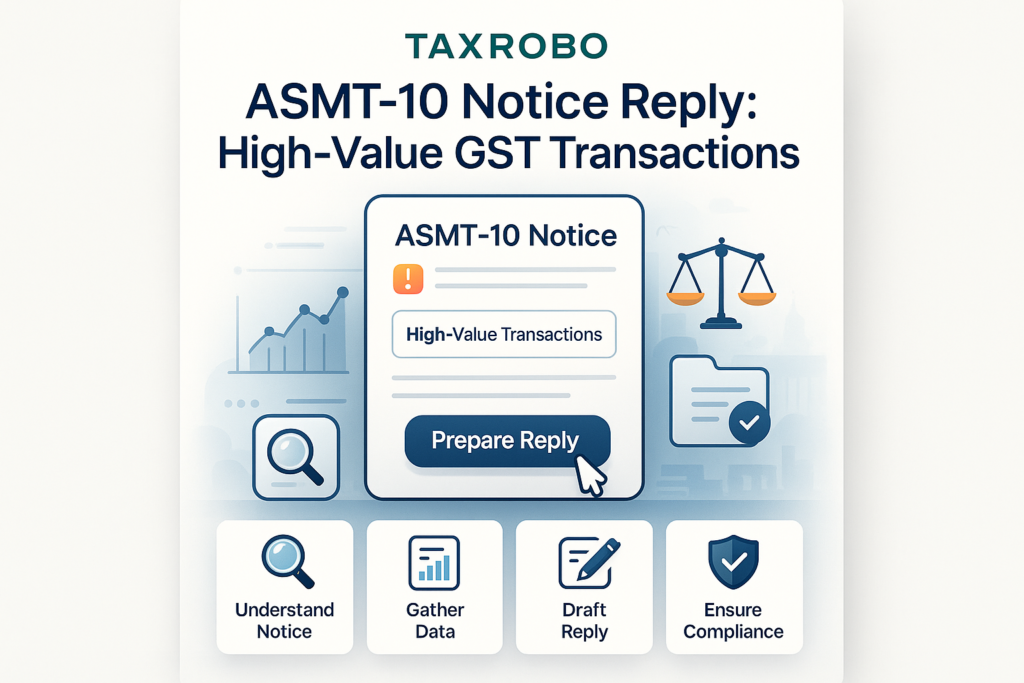
Have you recently received a notice from the GST department flagged as ‘ASMT-10’? Seeing terms like ‘discrepancy’ and ‘high-value transactions’ can be stressful for any business owner or salaried individual. It’s crucial to understand that an ASMT-10 notice for high-value transactions is a preliminary scrutiny notice, not an immediate demand for tax. It’s the GST officer’s way of asking for clarification on potential mismatches they have observed while scrutinizing your filed GST returns. This article will serve as your comprehensive guide to understanding this notice, navigating the ASMT-10 GST notice reply process, and preparing a professional response that addresses all the officer’s concerns. A prompt and accurate reply is absolutely critical for maintaining good understanding ASMT-10 GST compliance and avoiding further, more serious legal complications or financial penalties down the line.
What Exactly is an ASMT-10 Notice under GST?
To effectively respond to this notice, one must first grasp its fundamental purpose and legal standing. An ASMT-10 is not an accusation but rather an initial inquiry, a first step in the GST department’s verification process designed to ensure tax accuracy without immediately resorting to punitive measures. A solid understanding ASMT-10 GST compliance begins with recognizing this notice as an opportunity for dialogue with the tax authorities. It allows taxpayers to proactively clarify their financial records, correct genuine errors, and demonstrate their commitment to transparent tax practices before the situation escalates into a formal audit or demand for payment. Viewing it as a procedural check rather than a fault-finding mission can help businesses approach the reply process with clarity and confidence.
The Purpose of a Scrutiny Notice (Section 61)
Form ASMT-10 is issued under the authority of Section 61 of the Central Goods and Services Tax (CGST) Act, 2017. Its primary nature is that of an “intimation” sent to a registered taxpayer when a proper officer observes discrepancies during the scrutiny of their GST returns. These discrepancies could be mathematical errors, mismatches in data between different returns, or inconsistencies with data from other sources. It is essential to stress that this notice is an opportunity for you to explain your position. It is the first, non-intrusive step taken by the department, providing you a platform to present facts, figures, and documentation to justify the entries in your returns before any formal, adverse action is considered.
Why You Might Receive an ASMT-10 Notice
The GST ecosystem is data-intensive, and advanced analytics are used to flag potential inconsistencies. You might receive an ASMT-10 notice for several reasons, particularly concerning high-value transactions that draw more attention. Common triggers include:
- Mismatch in GSTR-1 and GSTR-3B: This is one of the most frequent reasons. The notice is triggered if the total outward tax liability you declared in your summary return (GSTR-3B) is less than the detailed liability reported in your outward supplies return (GSTR-1). For a detailed walkthrough, you can refer to our guide on How to File GST Returns Online: A Step-by-Step Guide of the GST Filing Process & Procedure.
- Input Tax Credit (ITC) Mismatches: If the Input Tax Credit you have claimed in your GSTR-3B is significantly higher than the credit that is auto-populated and made available in your GSTR-2A or GSTR-2B, a notice may be issued to seek an explanation for the excess claim.
- Discrepancies with E-way Bill Data: The tax authorities cross-reference the value of transactions declared in your GST returns with the data logged on the e-way bill portal. A substantial difference between the turnover reported in GSTR-3B and the value of goods moved via e-way bills can trigger scrutiny.
- Data Mismatch with Income Tax Records: Tax departments now share data more seamlessly. If you have reported high-value transactions in your income tax returns (e.g., in the Statement of Financial Transactions – SFT) that do not seem to align with the turnover reported in your GST filings, it can lead to an ASMT-10 notice seeking reconciliation.
ASMT-10 vs. Other GST Notices (e.g., SCN in DRC-01)
It’s vital to differentiate between an ASMT-10 notice and a more severe notice like a Show Cause Notice (SCN) issued in Form DRC-01. An ASMT-10 is simply an Intimation of Discrepancy, marking the first, preliminary step in the scrutiny process. It asks you to explain. In contrast, a Show Cause Notice (SCN) like DRC-01 is a formal Demand Notice. It is issued when the officer is not satisfied with your reply to ASMT-10 or if you fail to reply at all. An SCN is a much more serious action, alleging that tax has not been paid or has been short-paid, and it formally demands why the proposed tax, interest, and penalty should not be recovered from you.
Step-by-Step Guide: The ASMT-10 GST Notice Reply Process
Responding to this notice requires a methodical and organized approach. Following a clear set of steps ensures that your reply is comprehensive, well-documented, and submitted correctly, maximizing the chances of a favorable outcome. The ASMT-10 GST notice reply process is designed to be transparent and is entirely managed through the online portal, so having a clear roadmap is essential for navigating it successfully. From the initial analysis of the notice to the final submission of your explanation, each stage is critical in demonstrating your compliance and resolving the queries raised by the tax officer efficiently.
Step 1: Do Not Ignore the Notice – Analyze It Thoroughly
The most critical first step is to never ignore the notice. Upon receiving the ASMT-10, you must download it from the GST portal and read it carefully. Pay close attention to the specific discrepancies that the officer has pointed out. The notice will typically list the issues in a table format, making them easy to identify. Make sure to note the DIN (Document Identification Number) for all future correspondence and, most importantly, the deadline for the reply. The law generally provides 15 to 30 days to respond, and adhering to this timeline is non-negotiable to avoid automatic escalation of the issue.
Step 2: Reconcile Your Books and Records
Once you understand the discrepancies, the next step is to conduct a thorough internal reconciliation. This step underscores The Importance of Accurate Record-Keeping to Prevent GST Demand Notices. This involves gathering all relevant financial and transactional documents for the period in question to find the root cause of the mismatch. The documents you should assemble include:
- Sales and Purchase Invoices for the specific tax period.
- Copies of your filed GSTR-1, GSTR-3B, GSTR-2A, and GSTR-2B.
- Bank statements to verify transactional values and tax payments.
- E-way bill records from the portal.
- Your internal accounting records, sales ledgers, purchase ledgers, and trial balance.
Step 3: Prepare Your Explanation and Supporting Documents
Your preparation will depend on whether you agree or disagree with the discrepancy pointed out in the notice.
- If you agree with the discrepancy: Sometimes, the notice correctly identifies a genuine error, such as a clerical mistake or a misinterpretation of a GST provision. In this case, your reply should acknowledge the error and explain its cause. The most important action here is to pay the differential tax amount, along with any applicable interest and penalty, using Form GST DRC-03. You must then attach the payment challan as proof of payment with your reply.
- If you do not agree with the discrepancy: If you believe your returns are correct and the officer’s observation is based on a misunderstanding, you must draft a clear, point-wise rebuttal for each discrepancy. Your explanation should be factual, professional, and backed by strong evidence. For example, you might state, “The transaction in question was recorded in the subsequent month’s GSTR-1 due to a delayed invoice, and the tax was paid accordingly. Please refer to Annexure B for the invoice and GSTR-1 copy of the next month.”
Step 4: File Your Official Reply in Form GST ASMT-11
The formal, official reply to an ASMT-10 notice must be submitted electronically on the GST Portal using Form GST ASMT-11. A manually submitted or emailed reply will not be considered a valid response. You must log in to the portal, navigate to the “Replies/Notices” section, and file your response under the ASMT-11 form. As an actionable tip, you can access the portal directly at the official government website: GST Portal. Remember to upload all your supporting documents (reconciliation statements, invoices, challans, etc.) as annexures along with the form to substantiate your claims.
The Official Reply Format for ASMT-10 Notice India
A well-structured reply is crucial for communicating your position clearly to the tax officer. Using a professional and organized reply format for ASMT-10 notice India ensures that all points are addressed systematically, reducing the chance of misinterpretation. Your response should directly correspond to the discrepancies listed in the notice, making it easy for the officer to review and close the inquiry. This structured approach also serves as a proper record of your clarification, which is important for compliance. The format below can be adapted to present your case effectively, especially when dealing with a high-value transaction reporting format India.
Key Components of Your ASMT-11 Reply
Here is a structured template that you can adapt for your official reply in Form ASMT-11. It is best practice to prepare this as a separate letter, convert it to a PDF, and attach it to the form.
[Your Letterhead, if applicable]To,The Proper Officer,[Jurisdiction/Address as mentioned in the notice]Reference No. (ARN of Notice): [Enter the ARN from your ASMT-10 notice]Date of Notice: [Enter the date from the notice]GSTIN: [Your GSTIN]Legal Name: [Your Legal Name]Subject: Reply to Intimation of Discrepancies in GST Return vide Form GST ASMT-10Respected Sir/Madam,This is with reference to the intimation of discrepancies issued to us via Form GST ASMT-10 for the tax period [Mention Tax Period, e.g., April 2023]. We have reviewed the notice and would like to submit our point-wise explanations as follows:(Use a table for clarity)| S.No. | Discrepancy as per ASMT-10 Notice | Our Explanation / Clarification | Reference to Supporting Document(s) Attached ||-------|------------------------------------------------------------------|--------------------------------------------------------------------------------------------------------------------------------|----------------------------------------------|| 1. | [Example: Mismatch in tax liability between GSTR-1 and GSTR-3B] | [Example: The said transaction was a B2C supply mistakenly reported in the B2B section, but the tax was correctly paid in GSTR-3B.] | Annexure A: Copy of Invoice No. 123 || 2. | [Example: Excess ITC claimed in GSTR-3B compared to GSTR-2A] | [Example: The ITC pertains to an invoice from XYZ Pvt. Ltd. which they failed to upload in their GSTR-1. We are following up.] | Annexure B: Copy of Purchase Invoice & E-way Bill || 3. | [State another discrepancy from the notice] | [Provide your clear explanation] | Annexure C: [Relevant Document] |We believe the above explanations and the attached documents clarify the discrepancies noted in the ASMT-10 notice for high-value transactions. We request you to kindly review our submission and drop the proceedings.Thank you for your consideration.Sincerely,[Your Name/Name of Authorized Signatory][Designation][Digital Signature]List of Annexures:1. Annexure A: [Document Name]2. Annexure B: [Document Name]What Happens After You File the Reply?
Once you have submitted your reply in Form ASMT-11, the ball is in the tax officer’s court. They will review your explanations and the supporting documents you have provided. Based on their assessment of your response, there are two primary outcomes. Understanding these potential scenarios will help you manage expectations and prepare for any subsequent steps that may be required, ensuring you remain in control of the compliance process and are not caught off guard by the department’s decision.
Scenario 1: The Officer Accepts Your Reply
This is the ideal and most common outcome if your reply is clear, well-documented, and satisfactorily explains the discrepancies. If the proper officer is satisfied with the information provided in your ASMT-11, they will conclude the proceedings by issuing an order in Form GST ASMT-12. This form officially informs you that your explanation has been accepted and the scrutiny proceedings initiated by the ASMT-10 notice are now dropped. Receiving an ASMT-12 means the matter is closed, and no further action will be taken regarding the issues raised in the notice.
Scenario 2: The Officer is Not Satisfied
If the reply is found to be unsatisfactory, incomplete, or if you fail to file any reply within the stipulated time, the officer will not be able to close the inquiry. In such cases, they may initiate further proceedings to recover the tax. This usually involves taking action under Section 73 (for non-fraud cases) or Section 74 (for cases involving fraud, willful misstatement, or suppression of facts) of the CGST Act. The next step would be the issuance of a formal Show Cause Notice (SCN) and a demand for the tax, along with applicable interest and penalties, marking a significant escalation of the matter. In such a situation, it becomes crucial to know How to Respond to a GST Show Cause Notice: A Step-by-Step Guide.
Conclusion: Proactive Compliance is Key
In conclusion, receiving an ASMT-10 notice for high-value transactions should be seen not as a threat, but as an opportunity to rectify your records and demonstrate good faith. It is a procedural check that can be resolved smoothly with a systematic approach. A timely, transparent, and well-documented reply using Form ASMT-11 is absolutely non-negotiable. Ignoring this communication or providing an inadequate response can lead to more severe consequences, including hefty penalties and detailed audits. Ultimately, handling these notices correctly is a fundamental aspect of maintaining healthy GST compliance, safeguarding your business’s financial health, and ensuring its continuity without legal hindrances.
Navigating GST notices can be complex. If you need expert assistance in drafting a professional reply or managing your GST compliance, contact the experts at TaxRobo today. Our team will ensure your response is accurate, timely, and protects your business interests.
Frequently Asked Questions (FAQs)
1. What is the time limit to reply to a GST ASMT-10 notice?
You are generally required to furnish a reply within 30 days of the notice being served, or as per the specific time period mentioned in the notice itself. It is crucial to adhere to this deadline to avoid further action.
2. Can I request an extension to file my reply in Form ASMT-11?
Yes, you can submit a request for an extension of time to the proper officer through the GST portal, providing a valid reason for the delay. However, the granting of such an extension is at the sole discretion of the officer.
3. What happens if I ignore an ASMT-10 notice?
Ignoring an ASMT-10 notice is highly discouraged and can have serious repercussions. The officer will presume that you have no explanation for the discrepancies and may proceed with action under Section 73 or 74 of the CGST Act, leading to a demand notice (SCN) with confirmed tax liability, interest, and penalties.
4. Do I need a professional like a CA to reply to ASMT-10?
While it is not mandatory to hire a professional, it is highly recommended. A Chartered Accountant or a GST expert can help you accurately identify the root cause of the issue, gather the correct supporting documents, and draft a legally sound and persuasive reply. This minimizes the risk of your explanation being rejected and avoids further complications.
5. Is receiving an ASMT-10 notice an indication of a future GST audit?
Not necessarily. An ASMT-10 notice is a result of a preliminary scrutiny of your returns. If you provide a satisfactory reply and the matter is closed with an ASMT-12 order, it usually ends there. However, if your reply is unsatisfactory or if discrepancies in your returns are a recurring issue, it could increase the probability of your business being selected for a more detailed departmental audit in the future.