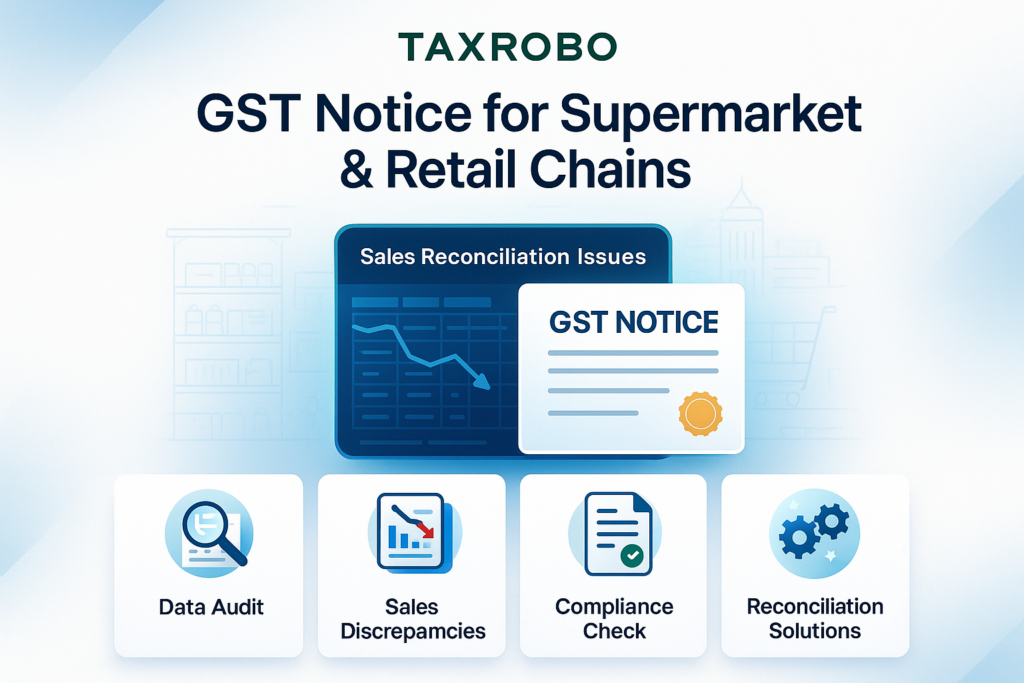

GST Notice for Supermarket & Retail Chains – Sales Reconciliation Issues
You’ve built your supermarket from the ground up, pouring your effort into managing inventory, serving customers, and growing your business. But a single, official-looking envelope from the GST department can bring everything to a halt. It’s a notice, flagging a mismatch in your sales figures. Due to the high volume of daily transactions and a complex web of payment methods, supermarket sales reconciliation issues are becoming increasingly common, often leading to unwanted scrutiny from tax authorities. Understanding the root causes of these discrepancies and proactively managing them is absolutely crucial for maintaining healthy retail sales tax compliance in India and avoiding the stress of notices, interest, and hefty penalties. This guide will break down why these problems occur, how to respond to a notice, and what steps you can take to prevent them from happening in the first place.
Why Supermarkets Face GST Sales Reconciliation Challenges
The unique operational nature of supermarkets and retail businesses makes them particularly vulnerable to GST compliance challenges, especially when it comes to sales reconciliation. Unlike businesses with a few high-value invoices, retailers deal with a massive number of small transactions, each a potential point of error. These minor issues, seemingly insignificant on their own, can accumulate into substantial discrepancies that trigger red flags in the GST department’s automated systems, leading to some of the most common retail chains GST issues.
High Volume of Transactions
A typical supermarket processes thousands of sales every single day. Each transaction, whether it’s for a single pack of milk or a full grocery cart, must be recorded accurately. This sheer volume drastically increases the probability of small errors. A cashier might accidentally enter an incorrect amount, a Point of Sale (POS) system could experience a momentary glitch, or a daily sales report might fail to sync correctly with the central accounting software. While an error of a few rupees on one bill seems trivial, when multiplied by thousands of transactions over a month or a quarter, these small leaks can result in a significant mismatch between your recorded sales and the turnover you declare in your GST returns.
Diverse Payment Modes & Settlement Cycles
The modern retail environment is a complex ecosystem of payment options. Customers pay using a wide variety of methods, and each one comes with its own reconciliation challenges:
- Cash: The simplest to record, but still prone to manual counting errors.
- UPI (GPay, PhonePe, etc.): Instant for the customer, but settlement to the business bank account can be delayed (T+1 or T+2 days).
- Credit/Debit Cards: These transactions come with Merchant Discount Rate (MDR) or Transaction Discount Rate (TDR) charges, meaning the amount credited to your bank account is less than the actual sale value.
- Digital Wallets (Paytm, etc.): Similar to cards, these have their own fee structures and settlement timelines.
- Meal Vouchers (Sodexo, etc.): These have unique settlement processes and often involve a third-party aggregator.
This diversity means that the sales figures from your POS system for a given day will not match the bank credits for that same day. Reconciling these requires meticulously tracking settlement reports from each payment gateway, accounting for all MDR/TDR charges, and matching them to the corresponding sales dates, a process that can quickly become overwhelming.
Complexities of Promotions, Returns, and Discounts
Supermarkets thrive on promotions, discounts, and offers like “Buy One Get One” (BOGO). While great for attracting customers, these activities add another layer of complexity to GST compliance. The ‘taxable value’ of a product, which is the value on which GST is calculated, is affected by these discounts. If a BOGO offer is not accounted for correctly in the POS and accounting systems, it can lead to an overstatement of taxable turnover. Similarly, customer returns and credit notes must be meticulously documented and adjusted in your GST returns. A failure to properly account for these reductions in sales will inevitably lead to a mismatch between your gross sales figures and the net taxable turnover declared in your GSTR-1, a common trigger for a GST notice.
Understanding a GST Notice for Supermarket Sales Reconciliation Issues
When the GST department’s sophisticated, algorithm-driven systems detect a mismatch between the various returns you file or the data available from other sources, they automatically issue a notice. Understanding these notices is the first step toward resolving the underlying sales reconciliation problems in Indian supermarkets. These are not accusations of fraud but are inquiries asking you to explain the discrepancies found in your data.
Common Notices: ASMT-10 and DRC-01
The two most common notices related to sales mismatches are:
- ASMT-10 (Scrutiny Notice): This is typically the first communication you will receive. It is an initial intimation of a discrepancy found during the scrutiny of your GST returns. The notice will specify the exact mismatch (e.g., GSTR-1 vs. GSTR-3B turnover) and ask you to provide an explanation along with supporting documents. It is an opportunity for you to clarify the issue before any formal demand is raised.
- DRC-01 (Show Cause Notice): If the tax officer is not satisfied with your reply to ASMT-10, or if you fail to reply, they may issue a DRC-01. This is a more serious “Show Cause Notice” that details the proposed tax demand, along with interest and a penalty. It is a formal prelude to a legal proceeding, and responding to it requires careful preparation and often professional assistance. For a deeper understanding, you can review our guide on How to Handle GST Notices – ASMT-10, DRC-01, DRC-07 Explained Simply.
Key Discrepancies Flagged by the GST System
The GST Network (GSTN) cross-references data from multiple sources to ensure compliance. Here are the key mismatches that often trigger a notice for retailers:
- GSTR-1 vs. GSTR-3B Mismatch: This is the most frequent issue. Your GSTR-1 is a detailed statement of all your outward supplies (sales), while GSTR-3B is a summary return where you declare your total sales and pay the corresponding tax. Any difference between the turnover declared in these two forms is an immediate red flag. This is such a common issue that we have a detailed article on GST Notice for Retail Shops – Turnover Mismatch (GSTR-1 vs 3B vs Books).
- GSTR-3B vs. Bank Statements: Tax authorities are increasingly using data analytics to compare the total credits in your business bank account with the turnover declared in your GSTR-3B. Significant, unexplained differences can lead to a notice questioning the understatement of sales.
- GSTR-1/3B vs. E-Way Bill Data: For businesses that transport goods, the system compares the value of goods declared in e-way bills with the sales reported in GST returns. A mismatch can suggest that goods were moved but the corresponding sales were not declared.
You can and should regularly review your own data on the official GST Portal to identify potential discrepancies before the department does.
How-To Guide: Resolving Sales Discrepancies for Your Supermarket in India
Receiving a GST notice can be stressful, but panic is not a strategy. A systematic, calm, and evidence-based approach can help in resolving sales discrepancies supermarket India effectively and demonstrate your commitment to compliance. Follow these steps carefully to navigate the process.
Step 1: Do Not Ignore the Notice
This is the most critical rule. Ignoring a GST notice will only escalate the problem. Immediately upon receipt, carefully read the entire notice to understand the specific discrepancy being pointed out. Most importantly, note the deadline for filing a response. GST notices have strict timelines, and failing to meet them can lead to adverse consequences, including the officer making a judgment based solely on the information they possess.
Step 2: Conduct a Thorough Internal Reconciliation
Before you draft a reply, you must first understand the root cause of the mismatch yourself. This requires a deep dive into your own books and records.
- POS Data vs. Accounting Software: Begin by comparing the daily, weekly, and monthly sales reports generated by your Point-of-Sale (POS) system with the sales entries in your accounting software (like Tally, Zoho Books, etc.). Check for any data sync errors or manual entry mistakes.
- Bank Statement Reconciliation: This is the most crucial part for a retail business. Create a detailed reconciliation worksheet. List your gross sales from the POS system. Then, track the credits received from each payment gateway (UPI, card swipes, wallets) in your bank account. The key is to account for the differences:
- Settlement Delays: Match credits received on a T+1 or T+2 basis back to the actual sale date.
- MDR/TDR Charges: Clearly document the fees deducted by payment processors to explain why the bank credit is lower than the sales invoice value.
- GSTR-1 vs. Books of Accounts: Finally, compare the sales figures recorded in your own books of accounts with the data that was uploaded in your GSTR-1 return for the period in question. Sometimes, an error might have occurred during the data entry process for filing the return itself.
Step 3: Prepare a Clear and Factual Reply
Once you have identified the reason for the discrepancy, draft a formal reply. Your response should be clear, factual, and to the point. Avoid vague statements. Clearly explain the reason for the mismatch, referencing the reconciliation you have performed. For instance, if the mismatch is due to MDR charges, state it clearly and provide a worksheet showing the calculation. You must attach supporting documents as evidence for your claims. These can include:
- A detailed sales reconciliation worksheet (in Excel or PDF format).
- Bank statements for the relevant period, with corresponding entries highlighted.
- Copies of your sales ledgers from your accounting software.
- A summary of payment gateway reports showing MDR deductions.
Step 4: File the Reply on the GST Portal
Your prepared reply and all supporting documents must be filed electronically on the GST portal. The reply to a notice in Form ASMT-10 is filed using Form ASMT-11. Ensure you file it well within the deadline mentioned in the notice. It is always advisable to have a tax professional review your reply before submission to ensure it is accurate and complete.
Proactive Steps for Flawless Retail Sales Tax Compliance in India
The best way to handle the stress and effort of a GST notice is to prevent it from ever being issued. By implementing robust internal processes and leveraging technology, you can significantly strengthen your compliance framework and ensure your records are always accurate.
Automate and Integrate Your Systems
Manual data entry is a major source of errors. Invest in a modern, integrated system where your Point-of-Sale (POS) software communicates directly with your accounting and inventory management software. When these systems are synced, sales data flows automatically, eliminating the risk of manual input mistakes and ensuring that your accounting records always reflect your actual sales in real-time. This is one of the most effective steps towards better retail sales tax compliance in India.
Implement Regular Reconciliation Checks
Don’t wait for the end of the year or a GST notice to reconcile your accounts. Make sales reconciliation a mandatory part of your business routine. Conduct these checks weekly or, at the very least, monthly. This practice helps you catch small discrepancies before they snowball into large, unmanageable problems. A regular reconciliation habit means you will always have clear, accurate data ready for your GST filings and can spot any operational issues (like a faulty payment terminal) much faster. Maintaining Accurate Accounting Records for Tax Purposes is foundational to this proactive approach.
Train Your Staff
Your employees are your first line of defense against compliance errors. Ensure that your billing staff and your accounting team are well-trained on GST fundamentals. This includes:
- Using the correct GST rates and HSN codes for different products.
- Properly applying discounts and processing returns in the system.
- Understanding how promotions like BOGO affect the taxable value.
Regular training ensures that everyone follows a standardized, compliant procedure for every transaction.
Get Professional Assistance
Managing the complexities of supermarket sales reconciliation issues while also running a business can be incredibly time-consuming and demanding. This is where professional help becomes invaluable. An expert firm like TaxRobo can take the entire burden of GST compliance off your shoulders. We can handle your monthly GST filings, perform meticulous reconciliations, and provide expert, timely responses to any departmental notices, allowing you to focus on what you do best: serving your customers and growing your supermarket.
Conclusion
While the high-volume, multi-payment environment of a retail business makes supermarket sales reconciliation issues a significant challenge, they are entirely manageable with the right systems, processes, and mindset. Moving from a reactive to a proactive approach is the key to long-term success. By automating your systems, conducting regular checks, and training your staff, you can build a robust compliance framework that minimizes errors and keeps your business on the right side of the law, ensuring smooth operations free from the disruption of tax notices and penalties.
Feeling overwhelmed by GST compliance or have you already received a notice? The experts at TaxRobo are here to help. We specialize in providing comprehensive GST services tailored for the retail sector. Contact us today for a consultation and let us ensure your business stays compliant and stress-free.
Frequently Asked Questions (FAQs)
Q1. What is the most common reason for sales reconciliation problems in Indian supermarkets?
A: The most common reason is the mismatch between the gross sales value recorded in the POS system and the net amount credited to the business bank account. This difference arises from two main factors: settlement delays (money from UPI/card sales today might reflect in the bank tomorrow or the day after) and TDR/MDR charges deducted by payment gateways, which reduce the final credited amount.
Q2. My GSTR-1 and GSTR-3B have a mismatch. Can I correct it now?
A: You cannot revise a GST return that has already been filed. However, you can rectify the mistake. If you have under-reported sales, you can declare the missed invoices in the GSTR-1 of a subsequent month. It is crucial to pay any differential tax liability along with the applicable interest using Form DRC-03 to demonstrate your intent to comply and avoid harsher penalties.
Q3. What happens if I don’t reply to a GST notice like ASMT-10?
A: Failing to reply to an ASMT-10 notice is a serious mistake. The tax officer will assume that you have no explanation to offer and agree with the discrepancy they found. They may then proceed to confirm the tax demand and issue a more severe Show Cause Notice (DRC-01), which could be followed by an order to pay the tax, along with mandatory interest and penalties.
Q4. How can professional GST services help my retail business?
A: Professional GST services provide end-to-end support. Experts can ensure the accurate and timely filing of your GSTR-1 and GSTR-3B returns, conduct meticulous monthly reconciliations to identify and fix discrepancies before they become problems, and draft expert, legally sound replies to any department notices. Ultimately, this helps you maintain flawless retail sales tax compliance in India, saving you significant time, potential financial losses, and mental peace. Explore TaxRobo’s GST Services to learn more.