
GST DRC-01 Notice – Draft Reply with Practical Example
Receiving a notice from the GST department can be daunting for any business owner, often causing confusion and anxiety. But with the right information and a clear plan, you can handle it effectively and professionally. This comprehensive guide is designed to demystify Form GST DRC-01, a summary of a Show Cause Notice that intimates a tax demand from the department. Understanding this notice is the first step toward preparing a proper GST DRC-01 notice reply. We will walk you through a step-by-step process for drafting a thorough response, complete with a practical example and a downloadable template to simplify the entire process for you. This is an essential read for small business owners in India who want to ensure their GST compliance notice response India is accurate, timely, and protects their interests.
What is a GST DRC-01 Notice and Why Did You Receive One?
Before you can draft a reply, it’s crucial to understand what the notice signifies and the common triggers that lead to its issuance. This knowledge will empower you to analyze your specific situation and formulate the most appropriate response.
A Simple GST DRC-01 Notice Explanation
Many people mistake Form GST DRC-01 for the final Show Cause Notice (SCN), but it is actually a summary of the SCN. Issued electronically under Rule 142(1) of the CGST Rules, its primary purpose is to formally communicate the total amount of tax, interest, and penalty calculated by the GST officer. It serves as a formal intimation, providing you with a clear summary of the proposed demand and giving you an opportunity to respond before a final order is passed. Think of it as a critical checkpoint in the GST adjudication process, where the department presents its findings and invites you to present your side of the story. This form is always accompanied by a detailed notice that explains the grounds and reasons for the demand, which you must analyze carefully.
Common Reasons for Receiving a DRC-01 Notice
A GST DRC-01 notice doesn’t appear out of nowhere. It is typically the result of discrepancies detected by the GST system or during an officer’s scrutiny of your returns. Here are some of the most common reasons why a business might receive this notice:
- Mismatch in GSTR-1 and GSTR-3B: This is one of the most frequent triggers. It occurs when the total taxable value or tax liability you declared in your outward supplies statement (GSTR-1) is higher than the tax you actually paid through your summary return (GSTR-3B).
- Excess Input Tax Credit (ITC) Claimed: A notice may be issued if there’s a significant mismatch between the ITC you claimed in your GSTR-3B and the credit that is auto-populated and available in your GSTR-2A or GSTR-2B.
- Non-payment or Short Payment of Tax: If an audit, scrutiny, or inspection by the department reveals that you have not paid the correct amount of tax or have short-paid it for a specific period, a DRC-01 will be issued to demand the difference.
- Incorrectly Availed ITC: The GST law has strict conditions for claiming ITC. You might receive a notice for claiming credit on blocked items (e.g., motor vehicles for personal use), availing ITC from suppliers whose GST registrations have been cancelled, or not being in possession of a valid tax invoice.
- E-way Bill Discrepancies: The authorities often cross-verify data. Mismatches found between the value of goods declared in the e-way bills you generated and the turnover reported in your GSTR-1 or GSTR-3B can lead to an inquiry and a subsequent DRC-01 notice.
How to Read and Understand Your GST DRC-01 Notice
Once you receive the notice, the first step is to dissect it carefully without panicking. Understanding its components is key to formulating a precise and effective reply. Pay close attention to the details provided, as your entire response will be based on refuting or clarifying these specific points.
Key Components to Scrutinize
Your DRC-01 form is a condensed document, but it contains all the vital information you need. Look for these key fields to get a complete picture of the department’s claim against your business.
- Notice Reference Number (NRN) & Date: This unique number is your primary identifier for this specific case. You must quote this NRN and the date of the notice in all future correspondence and in your reply.
- Tax Period: This field will clearly state the specific month(s) or quarter(s) that are under the department’s review. This helps you narrow down your focus and gather relevant documents for that particular period.
- Grounds and Quantification: This is the heart of the notice. It provides a brief summary of the reasons for the proposed demand and a table that quantifies the tax, interest, and penalty amounts being levied under different heads (CGST, SGST, IGST).
- Legal Provisions: The notice will cite the specific sections of the GST Act (e.g., Section 73 for non-fraud cases, Section 74 for fraud cases) under which the notice is being issued. Knowing this helps you understand the severity of the allegations.
- Deadline for Reply: Critically, the notice will specify the date by which you must submit your response. Missing this deadline can lead to an ex-parte (one-sided) order being passed against you, confirming the demand.
Actionable Tip: The DRC-01 form on the GST Portal is just a summary. Always ensure you download the detailed attachments, annexures, or the full Show Cause Notice attached with it. These documents contain the officer’s detailed workings and reasoning, which are essential for preparing your rebuttal. If you need help interpreting these complex documents, seeking professional help is a wise step. You can explore TaxRobo GST Service for expert assistance.
Step-by-Step Guide to a Perfect GST DRC-01 Notice Reply
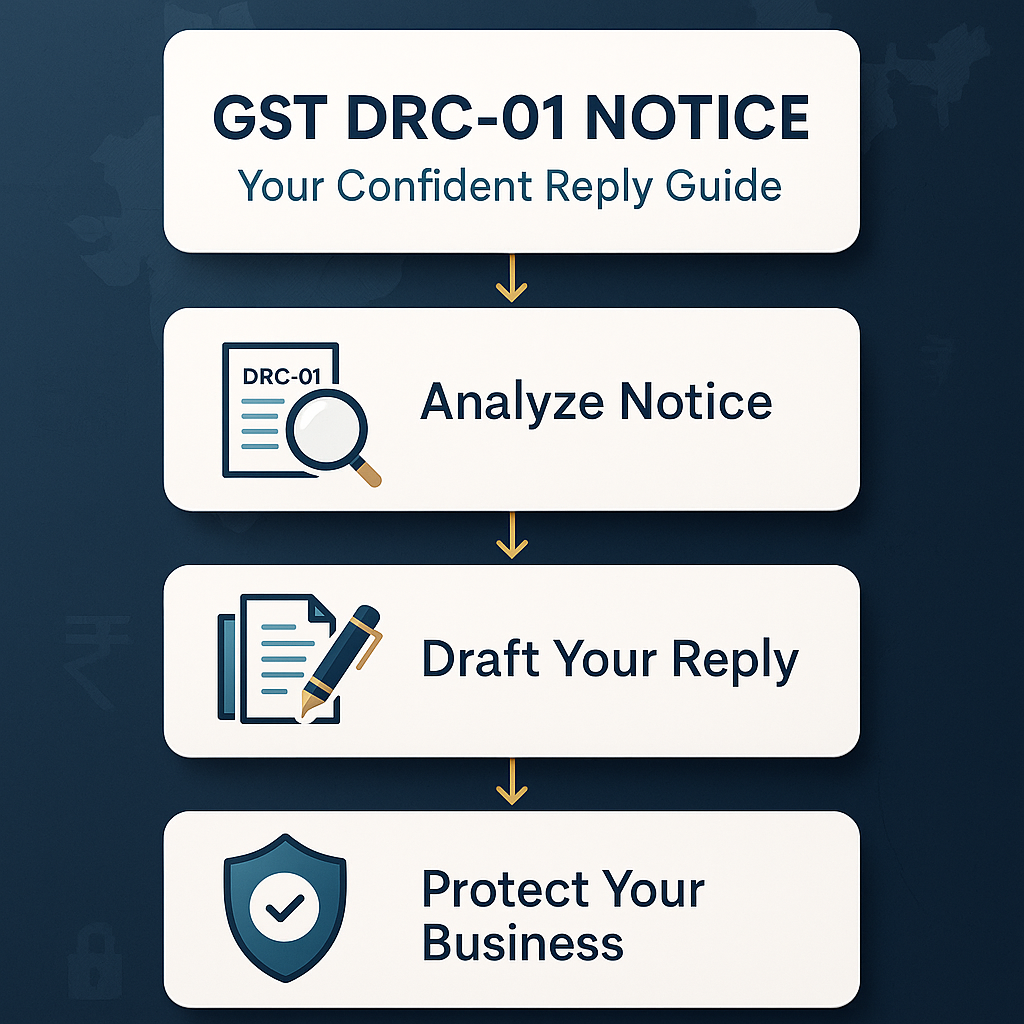
Responding to a DRC-01 notice requires a methodical approach. Rushing the process or submitting an incomplete reply can work against you. Follow these steps to build a strong, evidence-backed response that addresses all the concerns raised by the tax officer.
Step 1: Preliminary Actions – Acknowledge and Analyze
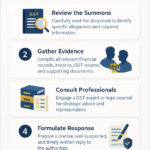
The moment you receive the notice, the clock starts ticking. Your first actions are crucial and set the tone for the entire process. Do not ignore the notice or set it aside for later. Acknowledge its receipt in your internal records and, most importantly, carefully note the deadline for submission mentioned in the notice. Next, begin a thorough analysis of the grounds on which the notice has been issued. Go through each allegation point by point and compare it with your financial records and GST returns. Start gathering all the supporting documents you might need, such as tax invoices, copies of GSTR returns, bank statements confirming payments, reconciliation statements (e.g., GSTR-1 vs. GSTR-3B, GSTR-2B vs. ITC register), and any relevant communication with suppliers or customers.
Step 2: Choose Your Response Strategy
After your initial analysis, you will be in a position to decide on your course of action. Broadly, you have two options, and your choice will depend on whether you agree or disagree with the department’s findings.
- Option A: Agree with the Demand: If, upon review, you find that the officer’s claim is valid and there was a genuine error or omission on your part, the best course of action is to accept the demand. You can pay the demanded tax and interest amount using Form GST DRC-03. The benefit of doing this is that if you pay within 30 days of the notice issuance (under Section 73), the penalty may be waived. If the notice is under Section 74 (fraud cases), paying within 30 days can significantly reduce the penalty amount.
- Option B: Disagree with the Demand (Partially or Fully): If you believe the demand is incorrect, either in whole or in part, you must prepare a detailed written submission to contest the notice. This is where a well-structured and factually correct draft reply to GST DRC-01 notice becomes absolutely critical. Your goal is to provide a clear and logical explanation, supported by irrefutable evidence, to convince the officer that the demand should be dropped.
Step 3: Structuring Your Written Reply
A professional and well-organized reply is more likely to be understood and considered favorably by the tax officer. Avoid writing a long, unstructured story. Instead, use a clear format that addresses each point systematically. Here is a template for GST DRC-01 reply that you can follow.
- Header: Start with your business details at the top: Business Name, GSTIN, and Registered Address.
- Recipient: Clearly address the reply to the designation and address of the issuing officer, as mentioned in the notice.
- Subject Line: This should be concise and informative. For example: “Submission in response to Form GST DRC-01 (Ref: [Your NRN Here]) dated [Date of Notice] for the tax period [Mention the Period]”.
- Introduction: Begin by acknowledging the receipt of the notice. State that this letter is your official reply to the allegations made therein.
- Facts of the Case: In a brief paragraph, state your understanding of the case and the core issue raised in the notice from your perspective.
- Point-by-Point Rebuttal: This is the most critical section of your reply. Address each allegation from the notice in a separate, numbered paragraph. For each point:
- Clearly state the allegation made by the department.
- Present your counter-argument with factual data and clarity.
- Refer to specific supporting documents (e.g., “as per the attached invoice, Annexure-A”).
- Cite relevant legal provisions, GST circulars, or established case laws that support your position, if applicable.
- Prayer: Conclude your reply with a formal request. Summarize your position and respectfully ask the officer to consider your submissions and evidence, and to drop the proceedings initiated by the notice.
- Verification & Signature: End with a verification clause stating that the information provided is true and correct. Sign the reply with your name, designation (e.g., Proprietor, Director), and the date.
Practical Example of a GST DRC-01 Notice Reply
Theoretical knowledge is good, but a practical example brings clarity. Let’s walk through a common scenario to see how the reply structure works in a real-world situation. This will serve as a clear GST DRC-01 notice reply example.
The Scenario: ABC Enterprises Receives a Notice
- Case: ABC Enterprises, a small electronics trader, receives a GST DRC-01 notice for the tax period of July 2023. The notice proposes a tax demand of ₹25,000 along with applicable interest and penalty.
- Reason: The grounds mentioned in the notice allege a mismatch in Input Tax Credit (ITC). The officer’s report, attached to the notice, claims that ABC Enterprises claimed ITC of ₹1,25,000 in its GSTR-3B for July 2023, while its auto-populated GSTR-2B for the same month only reflected an eligible ITC of ₹1,00,000.
- Actual Situation: Upon investigation, the owner of ABC Enterprises discovers that the difference of ₹25,000 pertains to a single tax invoice from a major supplier. The supplier had issued the invoice in July but filed their GSTR-1 return late, reporting the sale in their August 2023 return instead of the July return.
Sample Draft Reply for the Rebuttal Section
Based on the template provided earlier, here is how the point-by-point rebuttal section for this practical example of GST DRC-01 would look. This is the core of the submission that directly addresses the officer’s query.
“Submission on Merits: Point-wise Reply
Para 1: Regarding the alleged excess claim of Input Tax Credit (ITC) amounting to ₹25,000 for the tax period of July 2023.
1.1. We humbly submit that the observation of an excess ITC claim is based on a timing difference in the reporting of the transaction by our supplier and is not a case of an incorrect claim on our part.
1.2. The ITC of ₹25,000 in question pertains to Invoice No. INV-XYZ-001 dated 15th July 2023, issued by our supplier, M/s. Reliable Electronics, whose GSTIN is [Supplier’s GSTIN].
1.3. As per the provisions of Section 16 of the CGST Act, 2017, we are eligible to claim this ITC as we have fulfilled all the necessary conditions:
a) We are in possession of the said tax invoice.
b) We have received the goods covered by the invoice at our business premises.
c) The tax charged on the invoice has been paid by us to the supplier.
d) We have filed our GSTR-3B return for July 2023, claiming the said credit.
1.4. While we rightfully and legally claimed this ITC in our GSTR-3B for July 2023, our supplier, M/s. Reliable Electronics, inadvertently reported this transaction in their GSTR-1 for the month of August 2023 instead of July 2023. Consequently, this credit is now correctly reflected in our GSTR-2B for the month of August 2023.
1.5. For your kind perusal and verification, we are attaching the following documents:
* A self-attested copy of the tax invoice (Annexure-A).
* A screenshot from the GST portal showing the reflection of this invoice in our GSTR-2B for August 2023 (Annexure-B).
In light of the facts and evidence presented above, we reiterate that our claim of ITC for ₹25,000 is valid and in accordance with the GST law. We respectfully request you to kindly consider these facts and drop this point from the proceedings.”
What Happens After You File Your Reply?
Submitting your reply in Form GST DRC-06 is a major step, but it’s not the end of the process. The officer will review your submission and the evidence you’ve provided, leading to one of the following outcomes.
- Officer is Satisfied: If your explanation is clear and your documents are in order, the officer may be satisfied with your reply. In this best-case scenario, the proceedings will be dropped, and an order in Form GST DRC-05 will be issued, formally concluding the matter.
- Officer is Not Satisfied: If the officer finds your reply inadequate or requires further clarification, they will proceed with the adjudication. A formal Show Cause Notice (SCN) will be issued (if not already issued with DRC-01), and you may be called for a personal hearing. This hearing is your opportunity to present your case in person and explain your position to the adjudicating authority.
- The GST Notice Appeal Process: If, after the hearing, an adverse order is passed against you confirming the tax demand, you do not need to lose hope. You have the right to challenge this order by filing an appeal with the first Appellate Authority (the Joint/Additional Commissioner – Appeals) within three months from the date of the order.
Conclusion
A GST DRC-01 notice, while initially intimidating, is a procedural step that can be managed effectively with a calm and structured approach. The key lies in a timely and well-documented response. By understanding the contents of the notice, diligently gathering your evidence, and drafting a factual and polite reply, you can resolve potential discrepancies and demonstrate your commitment to compliance. A professional GST DRC-01 notice reply is not just about avoiding penalties; it is a crucial tool that showcases your diligence and can protect your business from unnecessary litigation and financial strain. It reinforces the integrity of your business operations and helps maintain a clean record with the tax authorities.
Navigating the complexities of GST notices and legal language can be challenging for any business owner. If you feel overwhelmed or need expert assistance to ensure your reply is flawless, TaxRobo offers professional GSTR filing assistance India and dedicated notice response services to guide you through every step of the process. Contact Us Today for a Consultation!
Frequently Asked Questions (FAQ)
1. What is the time limit to reply to a GST DRC-01 notice?
The time limit to submit a reply is generally specified in the notice itself. Typically, you are given 30 days from the date of issuance of the notice to either make the payment or file your written submission. However, it is absolutely crucial to check the specific deadline mentioned in your notice and adhere to it strictly to avoid adverse action.
2. What is the difference between Form DRC-01 and DRC-01A?
Form DRC-01A was a form used for pre-show cause notice consultation, where the officer would intimate a discrepancy and give the taxpayer an opportunity to explain before issuing a formal notice. This form has now been largely made optional or is used for intimating discrepancies found during scrutiny under Rule 99. In contrast, Form GST DRC-01 is a more formal summary of the show cause notice itself, issued after the officer has determined a tax liability and is initiating adjudication proceedings.
3. Is it mandatory to file the reply online on the GST Portal?
Yes, it is mandatory to file your reply electronically on the official GST Portal. The reply to a DRC-01 notice is filed using Form GST DRC-06. This form allows you to provide your response and attach your detailed written submission (as a PDF file) along with all the supporting documents and annexures. You can access the portal here: https://www.gst.gov.in/.
4. What are the consequences of ignoring a GST DRC-01 notice?
Ignoring a GST DRC-01 notice can have severe consequences for your business. If you fail to respond within the stipulated time, the tax officer will assume that you have nothing to say in your defense. They will then proceed to pass an ex-parte (one-sided) order based on the information available to them, confirming the entire demand of tax, interest, and the maximum applicable penalty. This will be followed by recovery proceedings to collect the dues from your business.