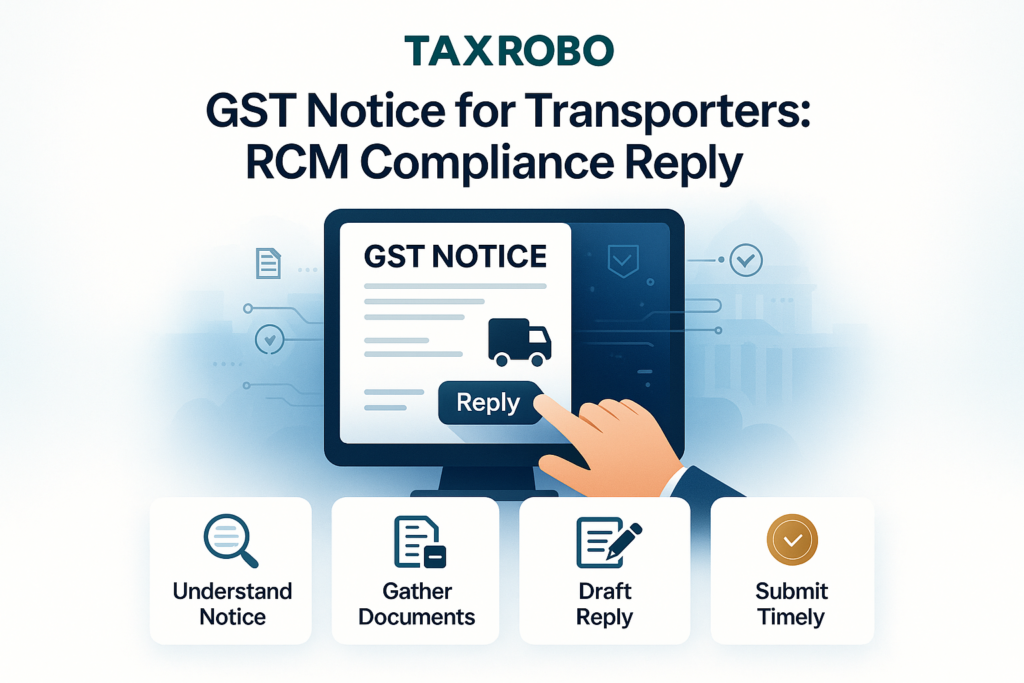

GST Notice for Transporters – A Complete Guide to RCM Compliance Reply Format
Received a GST notice regarding the Reverse Charge Mechanism (RCM)? Don’t panic. You’re not alone. Many transporters and businesses that use transport services often receive such notices and are unsure how to respond correctly. This guide is here to help, providing a clear, step-by-step process and a professional RCM compliance reply format to help you address the notice effectively. A timely and accurate response is crucial for avoiding unnecessary penalties and ensuring smooth GST compliance for transporters in India, and this article will walk you through every detail.
What is RCM for Transporters and Why Did You Get a Notice?
Before drafting a reply, it’s essential to understand the basics of the Reverse Charge Mechanism as it applies to the transport industry. This knowledge will not only help you formulate a better response but also prevent future compliance issues. The GST department typically issues notices when there are discrepancies in filed returns or a suspected short payment of tax. Understanding the ‘why’ behind the notice is the first step towards resolving it.
Understanding RCM in Transportation
In simple terms, the Reverse Charge Mechanism (RCM) flips the tax payment responsibility. Instead of the service provider (the transporter) collecting and paying GST, the liability shifts to the recipient of the service. This mechanism applies specifically to services provided by a Goods Transport Agency (GTA).
Under GST law, a GTA is defined as any person who provides services in relation to the transport of goods by road and issues a consignment note. This last part is key; if no consignment note is issued, the service provider is not considered a GTA, and RCM provisions do not apply.
GTAs have two options for GST payment:
- Forward Charge (12% GST): The GTA can choose to pay GST at 12% (6% CGST + 6% SGST) on their services. The major advantage of this option is that they can claim an Input Tax Credit (ITC) on goods and services used for their business, like trucks, fuel, and maintenance.
- Reverse Charge (5% GST): Alternatively, the GTA can opt for the recipient of the service to pay GST at 5% (2.5% CGST + 2.5% SGST) under RCM. In this case, the GTA cannot claim any ITC. This is the most common model used in the industry.
The notice you received likely stems from a mismatch or confusion related to which party was liable to pay the tax.
Common Reasons for Receiving a GST Notice
The GSTN system is designed to cross-verify data between suppliers and recipients. A notice is usually an automated or manual flag raised due to inconsistencies. Here are the most common triggers:
- Mismatch in Returns: The details you declared in your GSTR-1 (outward supplies) do not match the recipient’s GSTR-2A/2B (auto-populated inward supplies) or their final GSTR-3B return.
- Recipient’s Failure to Pay: The primary reason for a notice is when the service recipient, who was liable to pay GST under RCM, has failed to do so. The tax authorities may then contact you, the service provider, for clarification.
- Incorrect Declaration: You may have made an error in your own GST filings, such as incorrectly classifying a service or failing to declare supplies that fall under RCM.
- Ambiguity in Invoices: Your invoices or consignment notes might not have clearly stated that the tax is payable on an RCM basis, leading to confusion and non-payment by the recipient.
- Audit or Scrutiny: Your case may have been selected for a routine scrutiny or audit, and the officer is seeking documents to verify your RCM transactions.
Understanding these points is central to the RCM compliance guidelines for transporters.
How to Draft a Professional RCM Compliance Reply Format
A well-drafted, professional response can often resolve the issue without further escalation. Your reply should be clear, factual, and supported by documentary evidence. Rushing this process or providing an incomplete reply can lead to more questions and potential penalties.
Initial Steps: Before You Draft the Reply
Before you start writing, follow these critical preparatory steps. These GST notice handling tips for transporters will ensure your reply is comprehensive and accurate.
- Do Not Ignore It: The most crucial rule is to never ignore a GST notice. Note the deadline for submission mentioned in the notice and ensure you reply within that timeframe.
- Read the Notice Carefully: Understand the exact reason for the notice. Is it a query, a show-cause notice, or a demand? Identify the specific transactions, tax periods, and discrepancies mentioned by the officer.
- Gather All Documents: Collect all relevant paperwork related to the transactions in question. This includes:
- Copies of Consignment Notes / Lorry Receipts (LRs).
- Tax Invoices issued by you.
- Ledger statement of the party in question.
- Your GSTR-1 and GSTR-3B returns for the mentioned period.
- Relevant E-way bills.
- Any written agreements or contracts with the service recipient.
Structure of the GST Notice Response Format for Transporters
Your reply should be formal and structured logically. It should always be printed on your official company letterhead and addressed directly to the issuing tax officer. Here’s a breakdown of the ideal RCM notice reply format for transporters:
1. Part 1: Header:
- Your company’s name, registered address, and GSTIN at the top.
- Date of the reply.
- Details of the addressee: The Designation, Address, and Office of the GST officer who issued the notice.
2. Part 2: Reference & Subject Line:
- Reference: Clearly mention the Notice Reference Number (often called ARN or Case ID) and the date of the notice. This helps the department link your reply to the correct file.
- Subject: Write a concise and clear subject line. For example: “Reply in response to Notice/Intimation bearing Reference No. [XXXXXXXX] dated [DD/MM/YYYY] regarding RCM compliance.”
3. Part 3: Introduction & Acknowledgement:
- Begin by respectfully acknowledging the receipt of their notice.
- State your intent to comply and provide the necessary information to the best of your ability.
4. Part 4: Factual Submission (The Body):
- This is the core of your reply. Address each point or query raised in the notice separately. Use a point-by-point format for clarity.
- State the Facts: Clearly explain your position with reference to GST law. For instance, if the notice questions why you didn’t pay GST, you must state that as a GTA providing services to a specified registered person, the liability to pay tax falls on the recipient under RCM as per Notification No. 13/2017-Central Tax (Rate).
- Provide Evidence: Back up every claim with evidence. Refer to the documents you are attaching. For example: “We are attaching copies of all consignment notes issued to XYZ Pvt. Ltd. during the period, which explicitly state that ‘GST is payable by the recipient on RCM basis’ (refer Annexure-A).”
5. Part 5: List of Annexures:
- After your submission, create a numbered or bulleted list of all the documents you are enclosing. Example:
- Annexure A: Copies of Invoices/Consignment Notes.
- Annexure B: Ledger Account of the Client for FY 20XX-XX.
- Annexure C: Copy of GSTR-1 for the relevant period.
6. Part 6: Prayer/Conclusion:
- Conclude with a formal request (often called a ‘prayer’). Request the officer to review your submissions and the attached documents and to consider the matter closed or “drop the proceedings.”
7. Part 7: Signature:
- The reply must be signed by the proprietor, partner, or authorized signatory of the business.
- Include their full name and designation below the signature.
Sample Template: RCM Compliance Reply Format
Here is a fill-in-the-blanks style template. You can adapt this transporters compliance reply format India for your specific situation.
[Your Company Letterhead]

Date: [DD/MM/YYYY]

To,
The [Designation of the Officer],
[Address of the GST Office],
[City, State, PIN Code].

Reference No.: [Notice Reference Number/ARN from the notice]
Date of Notice: [Date mentioned on the notice]

Subject: Reply to Notice/Intimation dated [Date of Notice] regarding RCM compliance for GSTIN [Your GSTIN]

Respected Sir/Madam,

1.  This letter is in response to the notice/intimation cited above, which we received on [Date of Receipt]. We thank you for the opportunity to present our case and submit the necessary clarifications.

2.  We are a Goods Transport Agency (GTA) registered under GST, providing transportation services. The subject notice has raised concerns regarding [Briefly state the issue, e.g., non-payment of GST on services provided to M/s. ABC Corp for the period Q2 20XX-XX].

3.  In this regard, we would like to submit the following facts for your kind consideration:
    *   (Point 1) We confirm that we provided transportation services to M/s. ABC Corp (GSTIN: [Client's GSTIN]), which is a registered corporate body.
    *   (Point 2) As per Notification No. 13/2017-Central Tax (Rate), when a GTA provides services to specified recipients (including any body corporate), the liability to pay GST at 5% falls upon the recipient of the service under the Reverse Charge Mechanism (RCM).
    *   (Point 3) In compliance with this provision, we have not charged GST on our invoices. Instead, our invoices and consignment notes clearly mention the declaration: "GST payable by the recipient on RCM basis."
    *   (Point 4) We have correctly reported these supplies in our GSTR-1 returns as B2B supplies liable to reverse charge.

4.  To support our submission, we are enclosing the following documents as annexures:
    *   Annexure A: Copies of all consignment notes and invoices issued to M/s. ABC Corp for the period in question.
    *   Annexure B: A copy of the ledger statement for M/s. ABC Corp for the relevant period.
    *   Annexure C: A copy of our GSTR-1 return for the said period, highlighting the RCM supplies.

Prayer:
In light of the facts presented and the legal provisions of the GST Act, it is evident that we have complied with our obligations. The liability to pay the tax rests with the service recipient. We humbly request your good office to review our submission and the attached documents and drop the proceedings initiated by the said notice.

We are ready to provide any further information or clarification as may be required.

Thank you for your understanding.

Sincerely,

For [Your Company Name]

(Signature)

[Your Name]
[Your Designation]
Best Practices for Ongoing GST Compliance
Responding to a notice is reactive. The best strategy is to be proactive and maintain impeccable compliance to avoid such situations in the first place. Good compliance hygiene saves you time, money, and stress.
Proactive Measures to Avoid Future Notices
- Clear Invoicing: This is non-negotiable. Always ensure your consignment notes and invoices clearly and prominently state: “GST to be paid on RCM basis by the recipient.” This leaves no room for ambiguity.
- Accurate Filings: Double-check your GSTR-1 and GSTR-3B returns before filing. Ensure that services falling under RCM are correctly reported in the appropriate tables.
- Maintain Proper Records: Keep organized digital and physical records of all transactions. This includes invoices, LRs, e-way bills, and payment proofs. In case of a notice, you’ll have everything ready.
- Client Communication: Have a clear discussion with your clients (especially new ones) about their RCM obligations. A simple email confirming their understanding can prevent future disputes and non-compliance on their end.
When to Seek Professional Help
While you can handle simple clarification notices yourself using the format provided, it is advisable to seek professional help in the following scenarios:
- The notice involves a substantial amount of tax.
- The notice alleges fraud, misrepresentation, or willful misstatement.
- The legal interpretation required is complex.
- You are unsure about any aspect of the notice or the reply.
A minor error in your reply can lead to serious consequences. TaxRobo’s team of GST experts can help you draft the perfect reply and manage your compliance. These transport company GST compliance tips can safeguard your business’s financial health.
Conclusion
Receiving a GST notice can be daunting, but it doesn’t have to be a crisis. By understanding the underlying issue, gathering the right documents, and using a structured RCM compliance reply format, you can address the department’s queries confidently and effectively. Remember, a prompt, professional, and fact-based response is the key to resolving the matter quickly and avoiding potential penalties. This maintains your compliance rating and lets you focus on what you do best—running your transport business.
Feeling overwhelmed? Don’t let GST notices disrupt your business. Contact TaxRobo today for expert assistance with GST notice replies, filings, and end-to-end compliance management.
Frequently Asked Questions (FAQs)
1. What is a Goods Transport Agency (GTA) under GST?
A Goods Transport Agency (GTA) is defined under GST as any person who provides service in relation to the transport of goods by road and issues a consignment note, by whatever name called. The issuance of a consignment note is the mandatory condition to be classified as a GTA.
2. Can I reply to a GST notice myself, or do I need a professional?
For simple notices seeking clarification or basic documents, you can reply yourself using a proper format like the one provided above. However, for complex cases involving large tax amounts, legal interpretations, or allegations of misstatement, it is highly recommended to consult a tax professional like a Chartered Accountant to avoid adverse outcomes.
3. What are the penalties for not replying to a GST notice or for non-compliance with RCM?
Failure to reply to a notice can lead to an ex-parte order, where the officer decides the case based on the information available, which is usually not in your favor. Non-compliance with RCM provisions can attract a penalty equal to the tax amount due, along with interest. A general penalty under Section 125 of the CGST Act, which can extend up to ₹25,000, may also be levied.
4. Is RCM applicable if I provide transport services to an unregistered person?
No. RCM on GTA services is applicable only when the service is provided to certain specified categories of registered persons. These include a factory, society, co-operative society, a registered person, a body corporate, a partnership firm, or a casual taxable person. If you provide services to an unregistered individual, RCM does not apply.
5. Where can I find the official RCM compliance guidelines for transporters?
The official guidelines, notifications, and circulars are published by the Central Board of Indirect Taxes and Customs (CBIC). You can find detailed information on their official website. For specific notifications on RCM rates, you can refer to the notifications section. Visit the Official CBIC Website.