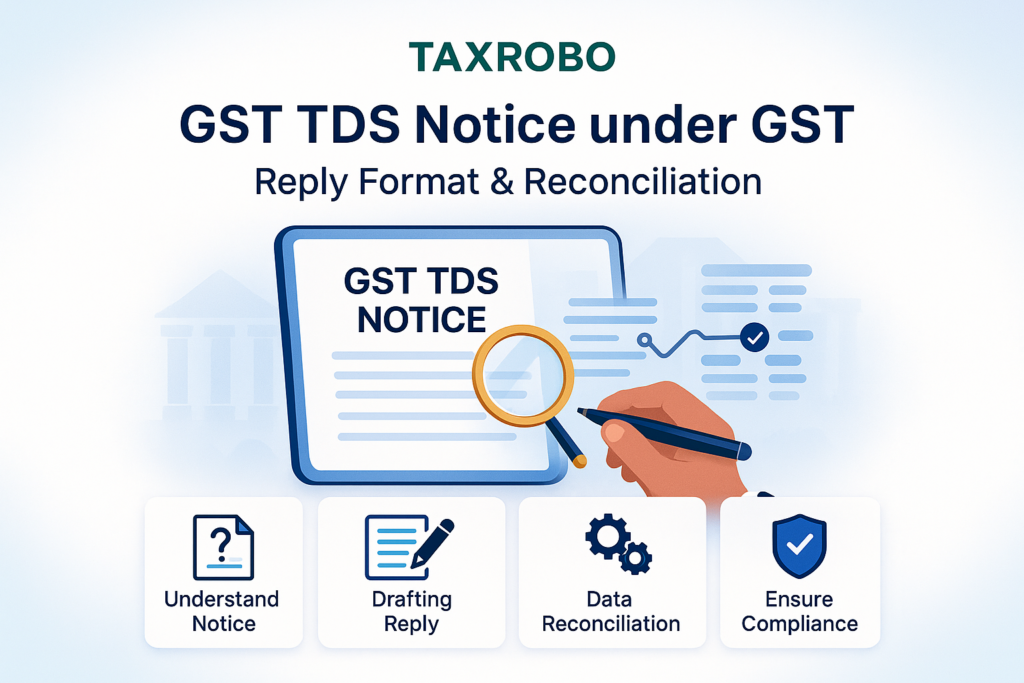

GST TDS Notice under GST – Reply Format & Reconciliation
Introduction
Receiving an official notice from the tax department can be stressful. But when it’s a GST TDS notice, it’s often just a request for clarification due to a data mismatch between your records and the government’s. Panicking is not the answer; a structured, well-documented response is. This guide provides a clear roadmap for responding to GST TDS notice in India, including the correct TDS notice reply format and essential reconciliation steps.
A GST TDS notice is an inquiry from the GST authorities regarding a discrepancy between the Tax Deducted at Source (TDS) credit you claimed and the amount deposited by the government entity (the deductor) that paid you. A timely and accurate response is crucial for maintaining your GST compliance score, ensuring smooth cash flow, and avoiding potential penalties or interest. This comprehensive guide will walk you through everything you need to know.
Understanding GST TDS and Common Reasons for a Notice
What is TDS under GST?
Tax Deducted at Source (TDS) under GST is a mechanism designed to track transactions and collect revenue at the source itself, enhancing tax compliance and preventing evasion. Under this system, certain notified entities are required to deduct a small percentage of tax before making a payment to a supplier for goods or services.
- Who Deducts?: This provision primarily applies when you supply goods or services to government departments, public sector undertakings (PSUs), government agencies, and other entities notified by the government.
- Reference Law: The mandate for GST TDS is outlined in Section 51 of the Central Goods and Services Tax (CGST) Act, 2017.
- Applicable Rates: The current rate for GST TDS is 2% on the payment made for the taxable supply. This is split as 1% CGST + 1% SGST for intra-state transactions or a flat 2% IGST for inter-state transactions.
- How it Works: The government entity (deductor) deducts this 2% tax, deposits it with the government, and files a return called GSTR-7 detailing these deductions. The amount deducted is then reflected in your (the deductee’s) Form GSTR-2B and is automatically credited to your Electronic Cash Ledger. You can then use this credit to offset your final GST liability, effectively treating it as tax already paid.
Why Did You Receive a GST TDS Notice?
Understanding the root cause of the notice is the first step toward resolving it. Most often, the issue stems from a simple data mismatch. Here are the most common reasons:
- Mismatch in Claimed Credit: This is the primary reason. The TDS amount you claimed as credit in your GST returns does not match the amount declared by the deductor in their GSTR-7 return for your GSTIN. For example, you may have claimed ₹20,000 as TDS credit, but the deductor only reported ₹18,000 against your GSTIN.
- Deductor’s Filing Error: The government department or PSU that deducted the tax might have made a clerical error while filing their GSTR-7. Common mistakes include entering your GSTIN incorrectly, quoting the wrong invoice number, reporting the wrong tax amount, or mentioning the incorrect tax period.
- Late or Non-Filing by the Deductor: This is a frequent issue when handling GST TDS inquiries. If the deductor fails to file their GSTR-7 on time or doesn’t file it at all, the TDS credit will not appear in your GSTR-2B. When you proceed to claim the credit based on your invoice, it creates an immediate mismatch in the GST system, triggering a notice.
- System/Portal Glitches: Although rare, technical issues or delays on the GST Portal can sometimes cause temporary discrepancies in data reflection. These issues are usually resolved over time but can lead to a notice if the mismatch persists when the tax officer reviews the data.
The Step-by-Step GST TDS Notice Procedure in India
Once you receive a notice, follow this systematic procedure to ensure a smooth and effective resolution.
Step 1: Acknowledge and Analyze the Notice
- Check the Source: First, verify the authenticity of the notice. It should be received on your GST-registered email address or be available on the GST Portal. To check online, log in and navigate to Services > User Services > View Notices and Orders.
- Read Carefully: Meticulously read the entire notice. Pay close attention to the Notice Reference Number, the date of issue, the specific tax period under scrutiny, and the exact discrepancy amount highlighted by the tax officer. Understanding what the department is asking for is paramount.
- Do Not Ignore the Deadline: The notice will clearly state a deadline for your reply, which is typically 15 to 30 days. Mark this date in your calendar immediately. Ignoring deadlines can lead to the officer making a “best judgment assessment,” which could result in penalties.
Step 2: Perform Internal Reconciliation
This is the most critical part of the process and must align with GST TDS reconciliation guidelines. Your goal is to find the source of the mismatch.
- Compare Records:
- Log in to the GST Portal and download your GSTR-2B for the tax period mentioned in the notice. This form shows the TDS credit that has been officially reported by the deductor.
- Carefully cross-reference the TDS credit amount auto-populated in your GSTR-2B with the entries in your own books of accounts and the tax invoices you issued.
- Check if you have received the TDS Certificate (Form GSTR-7A) from the deductor. This certificate is proof of the tax deducted and should match the amount in GSTR-2B.
- Identify the Source of Mismatch: After comparing these documents, you can pinpoint the source of the error. Is it a mistake in your own accounting where you claimed an incorrect amount? Or is the error on the deductor’s end, where they filed their GSTR-7 incorrectly or not at all?
Step 3: Communicate with the Deductor
Before you draft a formal reply to the tax department, it is highly advisable to contact the deductor.
- Action: If your internal reconciliation reveals that the error lies with the deductor, get in touch with the concerned official. Clearly explain the issue and provide them with supporting documents, such as a copy of your invoice and bank statement. Politely request them to revise their GSTR-7 return to correct the error.
- Document Everything: Maintain a clear record of all communication with the deductor. Save emails, send formal letters, and note down the names and contact details of the people you speak with. This documentation is not just for your records; it serves as crucial evidence to be attached with your reply to the notice.
Crafting Your Response: The Official TDS Notice Reply Format
A professional, clear, and well-supported response is key to resolving the notice quickly. Using a standard TDS notice reply format ensures that you cover all necessary points and present your case effectively.
Key Components of a GST TDS Response
Your reply should be structured formally, whether submitted online or in hard copy. Here are the essential components:
- Header:
- Your Business Name, GSTIN, and Registered Address (preferably on your company letterhead).
- The designation and address of the issuing tax officer (as mentioned in the notice).
- The Notice Reference Number and Date for clear identification.
- Subject: The subject line should be direct and informative. For example: “Reply to Show Cause Notice regarding mismatch in GST TDS Credit for the period [Tax Period] – Ref: [Notice Number]”.
- Body of the Letter:
- Paragraph 1 (Acknowledgement): Always begin by formally acknowledging the receipt of the notice. State the reference number and the date you received it. Example: “This is with reference to the notice dated [Date] with Reference No. [Number] received by us on [Date of Receipt].”
- Paragraph 2 (Statement of Facts): This is the core of your reply. Clearly state your case based on your reconciliation.
- Scenario A (Deductor’s Mistake): “Upon verification of our records, we found that the said mismatch has occurred due to an error in the GSTR-7 filed by the deductor, M/s [Deductor’s Name], GSTIN [Deductor’s GSTIN]. We have already contacted them to revise their return and have attached a copy of our communication for your reference.”
- Scenario B (Your Mistake): “We acknowledge that an inadvertent error was made in our records while claiming the TDS credit. We have rectified the same, and the excess credit claimed will be reversed through Form DRC-03 along with applicable interest.”
- Paragraph 3 (Supporting Evidence): List all the documents you are attaching to support your claim. Example: “In support of our submission and for your ready reference, we are enclosing the following documents: (1) A copy of the relevant tax invoice, (2) Our bank statement highlighting the receipt of payment (net of TDS), and (3) A copy of our email communication with the deductor.”
- Prayer/Conclusion: Conclude your letter with a polite request to the officer. Example: “In light of the facts and documentary evidence presented above, we humbly request your good office to consider our submission and drop the proceedings initiated by the said notice.”
- Closing: End with a formal closing like “Thanking You. Yours Faithfully,” followed by the signature, name, and designation of the authorized signatory.
Sample TDS Notice Reply Format India
[Your Company Letterhead]

Date: [Date of Reply]

To,
The [Designation of the Officer],
[Address of the GST Department],
[City, State, PIN]

Reference No.: [Notice Reference Number]
Dated: [Date of Notice]

Subject: Reply to Notice regarding mismatch in TDS credit under GST for [Tax Period]

Dear Sir/Madam,

1.  This is with reference to the notice cited above, received by us on [Date of Receipt], wherein a discrepancy in the TDS credit amounting to ₹[Amount] has been pointed out for the tax period [Tax Period].

2.  Upon receipt of the notice, we have thoroughly reconciled our financial records with the details available on the GST portal. Our findings indicate that the mismatch has occurred because the deductor, M/s [Deductor's Name] (GSTIN: [Deductor's GSTIN]), has [state the precise reason, e.g., 'not yet filed their GSTR-7 return for the said period' or 'incorrectly reported the transaction value in their GSTR-7 return'].

3.  We have already proactively contacted the deductor regarding this compliance issue and have formally requested them to take the necessary corrective action at the earliest. A copy of our email communication is attached herewith for your records as Annexure-A.

4.  We are also enclosing the following documents for your kind perusal and verification, which substantiate our claim:
    *   Annexure-B: Copy of Tax Invoice No. [Invoice No.] dated [Date].
    *   Annexure-C: Bank statement highlighting the net payment received from the deductor.

In light of the above facts, it is evident that we have correctly accounted for the transaction and are rightfully entitled to the credit. The discrepancy has arisen due to a compliance issue at the deductor's end, which we are actively following up on.

We, therefore, request your good office to kindly take our submission on record, accept the evidence provided, and drop the proceedings. We assure you of our full cooperation in this matter.

Thank you.

Yours Faithfully,

(Signature)
[Your Name/Authorized Signatory]
[Designation]
[Company Name]
[GSTIN: Your GSTIN]
Proactive GST TDS Compliance Steps in India
The best way to handle a notice is to prevent it from being issued in the first place. Adopting these proactive GST TDS compliance steps in India can save you significant time and effort.
- Monthly Reconciliation: Do not wait for a notice. Make it a mandatory monthly practice to reconcile the TDS credits reflected in your GSTR-2B with your own books of accounts. If you spot a discrepancy, you can address it with the deductor immediately.
- Maintain Communication: Build a good working relationship with the finance or accounts department of your government clients (deductors). Having an open line of communication makes it much easier to resolve any filing errors quickly.
- Keep Impeccable Records: Ensure that all invoices, payment proofs (bank statements), TDS certificates (GSTR-7A), and communications related to TDS transactions are filed systematically. Easy access to these documents is vital when a notice arrives.
- Seek Professional Help: If the TDS amounts are significant, the case involves multiple periods, or you are unsure how to proceed, it is always wise to consult a tax professional. Their expertise in handling GST TDS inquiries can ensure the matter is resolved correctly and efficiently.
- Refer to the Source: Always use the official GST Portal as the single source of truth for all your compliance data and filings.
Conclusion: Taking Control of GST TDS Notices
A GST TDS notice is a manageable compliance requirement, not a cause for alarm. The key to successfully navigating it is to act promptly, conduct a thorough reconciliation, communicate clearly with the deductor, and submit a well-documented response using the correct TDS notice reply format. By implementing proactive compliance checks and maintaining diligent records, you can significantly reduce the chances of receiving such notices in the future and ensure your business remains on the right side of the law.
Struggling with GST notices or compliance? TaxRobo’s team of experts simplifies the entire process, from reconciliation to drafting the perfect reply. Contact us today to ensure your business stays compliant and stress-free!
Frequently Asked Questions (FAQs)
Q1: What is the time limit for replying to a GST TDS notice?
The time limit for a reply is always mentioned in the notice itself, typically ranging from 15 to 30 days from the date the notice is issued. It is absolutely crucial to adhere to this deadline to avoid any adverse action from the tax department.
Q2: What happens if I ignore a GST TDS notice?
Ignoring a notice is a serious compliance lapse. It can lead to the tax officer passing an ex-parte order based on the information they have (best judgment assessment). This may result in the confirmation of the tax demand, along with the imposition of interest and penalties.
Q3: The deductor made a mistake in their GSTR-7. Can they correct it?
Yes, the GST framework allows the deductor to correct mistakes made in a previous GSTR-7 filing. They can make amendments or add details of a missed transaction in their GSTR-7 return for a subsequent tax period. You should actively and persistently follow up with them to ensure they make the necessary corrections.
Q4: Can I submit my reply online through the GST Portal?
Yes, the most efficient way to reply is online. You can furnish your reply via the GST Portal by navigating to Services > User Services > View Notices and Orders. Locate the relevant notice, click on the ‘Reply’ option, and you can type your response and upload your supporting documents as PDF attachments.
Q5: Where can I find the TDS certificate (Form GSTR-7A)?
Form GSTR-7A is the TDS certificate, which is auto-generated and made available to you (the deductee) on the GST portal. You can view and download it from your portal dashboard once the deductor correctly files their GSTR-7 return. This certificate serves as official proof of the tax deducted on your behalf.