
A Complete Guide to the ASMT-10 Notice Reply Format in India (2024)
Received a Form GST ASMT-10 notice? Don’t panic. This is a common part of the GST scrutiny process, but responding correctly and on time is crucial. This notice can cause anxiety for any business owner, but it’s important to understand what it truly is: an opportunity to communicate with the tax department, not a confirmed demand for tax. Understanding the proper ASMT-10 notice reply format is the first and most critical step towards resolving the issue efficiently. This comprehensive blog post will provide a clear, step-by-step guide and a detailed reply structure to help you respond effectively, ensure tax compliance, and avoid further complications. We will break down the entire process, making the ASMT-10 notice reply format India simple to understand and implement for Indian taxpayers.
What is an ASMT-10 Notice and Why Did You Receive One?
Before drafting a reply, it’s essential to understand the nature of the notice and the potential reasons it was issued. This is not a show-cause notice or a demand order; it is a preliminary communication from the GST officer seeking clarification on discrepancies observed during the scrutiny of your GST returns. Think of it as the department’s way of asking, “We noticed something that doesn’t add up, can you please explain?” A timely and accurate response can often close the matter without any further proceedings.
Decoding Form GST ASMT-10
Form GST ASMT-10 is officially titled ‘Notice for intimating discrepancies in the return after scrutiny’. It is issued by a Proper Officer under Section 61 of the Central Goods and Services Tax (CGST) Act, 2017, read with Rule 99 of the CGST Rules. The core purpose of this notice is to give you, the taxpayer, a fair chance to explain any inconsistencies the officer has found by comparing the details in your returns with other available data. This is a key part of the ASMT-10 notice clarification process. You are expected to either provide a satisfactory explanation for the noted discrepancy or pay the tax amount short-paid along with any applicable interest and penalty.
Common Reasons for Receiving an ASMT-10 Notice
A GST officer scrutinizes returns to ensure the tax liability has been correctly declared and paid. An ASMT-10 notice is triggered when they find potential errors or mismatches. Here are some of the most common reasons you might receive one:
- Mismatch in GSTR-1 vs. GSTR-3B: This is a frequent trigger. It happens when the total outward supplies (sales) you declared in your GSTR-1 do not match the summary figures you reported and paid tax on in your GSTR-3B for the same period.
- Mismatch in GSTR-3B vs. GSTR-2A/2B: This indicates a discrepancy in your Input Tax Credit (ITC) claim. You may have claimed more ITC in your GSTR-3B than what is reflected in your GSTR-2A or auto-populated in your GSTR-2B, which is based on your suppliers’ filings. Understanding how to resolve ITC mismatch issues – GSTR-2A/2B vs 3B guide is essential to prevent such notices.
- Delay or non-filing of GST returns: Consistent delays in filing returns or a complete failure to file can lead to scrutiny and a notice, as it raises red flags about your compliance history.
- Incorrectly claiming ITC: You might receive a notice if you have claimed ITC on goods or services that are ineligible under Section 17(5) of the CGST Act, often referred to as “blocked credits.” This includes items like food and beverages, motor vehicles for personal use, and club memberships.
- Discrepancies with E-way bill data: The value of goods declared in your E-way bills may not match the sales reported in your GSTR-1 or GSTR-3B, prompting the officer to seek clarification on the difference. Following the Guide to GST E-Way Bill Generation can help prevent these issues.
A Step-by-Step Guide to Replying to an ASMT-10 Notice in India
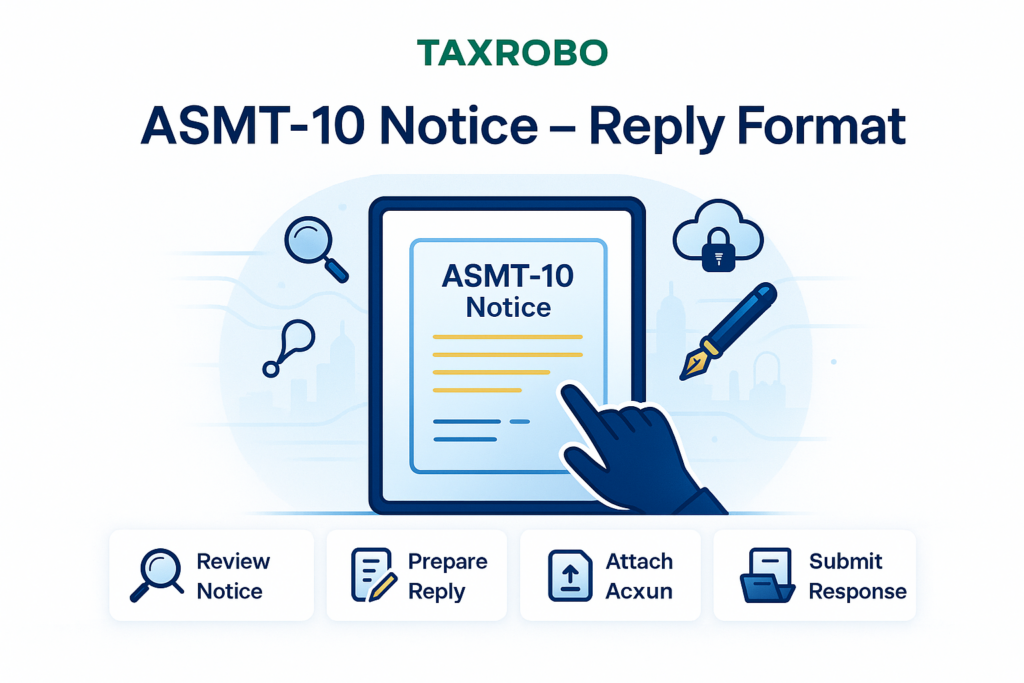
A structured approach is key to drafting a response that is both comprehensive and convincing. Panicking and sending a hasty reply can do more harm than good. Follow these systematic steps to manage the process effectively and prepare your response using the correct ASMT-10 notice format for Indian taxpayers.
Step 1: Do Not Ignore the Notice – Analyze It Carefully
The single biggest mistake you can make is ignoring the notice. The first action you must take is to read the ASMT-10 document thoroughly from start to finish. Pay close attention to every detail, including the specific financial year and tax periods mentioned. The notice will clearly list the discrepancies or observations made by the tax officer, often with specific amounts. Understand exactly what the officer is questioning. Is it a specific invoice? A mismatch in ITC? An issue with your declared turnover? Breaking down the notice into individual points will help you formulate a targeted and relevant reply for each query.
Step 2: Reconcile Your Data and Gather Supporting Documents
Once you understand the discrepancies, your next task is to dive into your records and gather all the necessary evidence to support your case. This is the most crucial part of the preparation, as a reply without supporting documents holds little weight. Your goal is to create a clear trail of evidence that validates your filings.
Here is a checklist of essential documents you should gather:
- Copies of your GSTR-1, GSTR-3B, GSTR-9 (if applicable), and GSTR-2A/2B for the specific period under scrutiny.
- Detailed Sales and Purchase registers from your accounting software.
- Copies of the specific tax invoices, debit notes, or credit notes that are being questioned.
- Bank statements to prove that transactions were legitimate and payments were made.
- Copies of E-way bill records if the discrepancy is related to the movement of goods.
- A detailed reconciliation statement, preferably in an Excel sheet, that clearly explains the reasons for any differences. For example, a reconciliation between GSTR-3B ITC and GSTR-2B ITC, with reasons for any variance.
Step 3: Decide on Your Course of Action
After your internal reconciliation, you will be in a position to decide on the best course of action. Your path will diverge based on whether you agree or disagree with the tax officer’s observations.
- Scenario A: You agree with the discrepancy. If your internal review confirms the officer’s findings and you realize a mistake was made, the best approach is to accept it. You should proceed to pay the shortfall in tax, along with any applicable interest and penalty, using Form GST DRC-03. After making the payment, you must inform the officer of this action in your formal reply. This shows proactiveness and compliance, which is often viewed favorably.
- Scenario B: You do not agree with the discrepancy. If you believe your returns are correct and the officer’s observation is based on a misunderstanding, you need to prepare a detailed, point-by-point rebuttal. Your reply must clearly state your position for each discrepancy and provide logical justifications. Each justification must be backed by the supporting documents you gathered in Step 2.
Step 4: Prepare the Reply in Form GST ASMT-11
The official and mandatory method for replying to an ASMT-10 notice is by filing Form GST ASMT-11 on the GST portal. This is the prescribed form for furnishing explanations or clarifications. You cannot reply via email or physical letter; the response must be submitted electronically through the portal to be considered valid. This form serves as the official container for your detailed explanations and the annexures containing your supporting documents.
Structuring Your Response: The Perfect ASMT-10 Notice Reply Format
Your response in Form ASMT-11 needs to be clear, professional, and easy for the tax officer to understand. A well-structured reply that directly addresses each point from the ASMT-10 will significantly increase your chances of a favorable outcome. Using the right ASMT-10 notice reply format is non-negotiable for success.
Key Components of Your ASMT-11 Reply
Form ASMT-11 is relatively straightforward. It has sections for basic details and for your detailed reply.
- Part 1: Basic Details: The GST portal will auto-populate most of this information. You simply need to ensure that the Application Reference Number (ARN) of your reply, the date of filing, and the reference number of the original ASMT-10 notice are correctly captured.
- Part 2: The Clarification: This is the heart of your response. Instead of writing a long, unstructured paragraph, it is highly recommended to use a table format to address each discrepancy individually. This makes your reply organized and easy for the officer to cross-reference with their original notice.
Your table should ideally have the following columns:
| Sr. No. | Discrepancy as per ASMT-10 | Taxpayer’s Reply / Justification | Reference to Supporting Document Annexed |
|---|---|---|---|
| 1. | [Quote the officer’s point] | [Your detailed explanation] | [e.g., Annexure-A: Invoices] |
| 2. | [Quote the officer’s point] | [Your detailed explanation] | [e.g., Annexure-B: Reconciliation] |
Sample Wording for Your Justification
The tone of your reply should be respectful and factual. Clearly state your point without being confrontational. Here are a couple of examples to guide you in crafting your response. This ASMT-10 answer format for tax compliance helps maintain professionalism.
- Example for ITC Mismatch (GSTR-3B vs. GSTR-2B):
“The discrepancy of Rs. [Amount] noted in the Input Tax Credit for the month of [Month, Year] is duly acknowledged. This difference arose because a key supplier, [Supplier Name, GSTIN], filed their GSTR-1 for the said month after the due date. As per Section 16(2) of the CGST Act, the credit was correctly and validly claimed by us in the subsequent tax period of [Next Month, Year] once it appeared in our GSTR-2B. A ledger confirmation from the supplier and a copy of their GSTR-1 screenshot are attached as Annexure-A for your kind perusal.”
- Example for Turnover Mismatch (GSTR-1 vs. GSTR-3B):
“The observed difference in turnover between GSTR-1 and GSTR-3B for the tax period [Month, Year] is due to a clerical error where an incorrect value was entered in GSTR-3B. We have accepted this discrepancy and have paid the differential tax of Rs. [Amount] along with applicable interest via Form DRC-03. The challan and payment details are attached as Annexure-B. We regret the error and have taken steps to prevent its recurrence.”
Attaching Supporting Documents on the GST Portal
All the documents you gathered must be submitted along with your ASMT-11. The GST portal usually requires you to upload them as attachments. It is best practice to scan all your documents, compile them into a single, well-organized PDF file with clear annexure markings, and then upload it. Ensure the file size is within the limits prescribed on the portal. For easy navigation, you can add a cover page to your PDF listing all the documents included in the annexure. You can access the portal directly at the GST Portal.
What Happens After You Reply? Timelines and Consequences
Submitting your reply is a major step, but it’s not the end of the process. Understanding the subsequent steps, timelines, and potential outcomes is crucial for managing your expectations and staying prepared.
Deadline for Replying to an ASMT-10 Notice
The standard timeline for filing a reply in Form ASMT-11 is 30 days from the date of service of the ASMT-10 notice. However, the notice itself will specify the exact time limit, so always refer to that. If you need more time to gather documents and prepare a robust reply, you can request an extension from the proper officer, but this is at their discretion and should not be taken for granted. Adhering to the original deadline is always the best practice.
Consequences of Not Replying or an Unsatisfactory Reply
Ignoring an ASMT-10 notice or providing a vague, unsupported reply can lead to serious consequences. The officer will assume you have no valid explanation and that the discrepancy is an actual tax evasion. Following the established ASMT-10 notice response guidelines is not optional. If no reply is received or the reply is found to be unsatisfactory, the officer may initiate further proceedings under:
- Section 73: For non-fraudulent cases of tax not paid, short-paid, or ITC wrongly availed.
- Section 74: For fraudulent cases involving willful misstatement or suppression of facts.
This will lead to a formal Show-Cause Notice (SCN) and eventually a demand order, which will include the tax amount, interest, and significant penalties. Knowing how to respond to a GST Show Cause Notice: a step-by-step guide is the next critical step if the situation escalates.
Possible Outcomes After a Successful Reply
If you have submitted a well-documented and satisfactory reply in Form ASMT-11, there are two primary outcomes:
- Officer is Satisfied: If your explanation and supporting documents successfully clarify the discrepancies, the officer will be satisfied. They will then issue an order in Form GST ASMT-12, informing you that the proceedings are dropped and the matter is closed. This is the ideal outcome.
- Officer is Not Satisfied: If the officer is not convinced by your reply, they may proceed with issuing a Show-Cause Notice under Section 73 or 74, as mentioned above. However, a good reply significantly reduces the chances of this happening.
Final Takeaways on Your ASMT-10 Notice Reply Format
Navigating a GST notice can be stressful, but with a clear understanding and a structured approach, you can handle it effectively. Remember that an ASMT-10 is your chance to clarify your tax position before any harsh action is taken.
Here are the key points to remember:
- It’s a preliminary notice, not a demand. Treat ASMT-10 as an inquiry that requires a professional and factual response.
- Analyze and gather documents first. A strong reply is built on the foundation of solid evidence from your own records.
- Always use the official format. Your reply must be filed in Form GST ASMT-11 on the GST portal. This is the correct ASMT-10 notice reply format.
- Provide clear, point-by-point justifications. Address each query from the notice separately and back it up with evidence.
- Never miss the deadline. Timeliness is as important as the content of your reply.
Receiving a GST notice can be overwhelming. If you need help preparing a professional and accurate response, TaxRobo’s expert team is here to assist. We ensure your reply is compliant, comprehensive, and submitted on time. Contact us today for a consultation on your GST matters.
Frequently Asked Questions about Form ASMT-10
1. Can I request an extension to file my reply to an ASMT-10 notice?
Yes, you can file an application for an extension of time to file your reply on the GST portal. However, the granting of this extension is at the discretion of the proper officer. It is always advisable to try and submit your reply within the original time limit mentioned in the notice.
2. What is the difference between ASMT-10, ASMT-11, and ASMT-12?
These three forms represent the key stages of the scrutiny process under Section 61.
- Form GST ASMT-10: This is the notice issued by the tax officer to the taxpayer, pointing out discrepancies found in their GST returns.
- Form GST ASMT-11: This is the form in which the taxpayer submits their reply or clarification to the ASMT-10 notice.
- Form GST ASMT-12: This is the final order issued by the officer if they are satisfied with the taxpayer’s reply in ASMT-11, formally dropping the proceedings.
3. Do I need a Chartered Accountant (CA) or a tax consultant to reply to ASMT-10?
While it is not legally mandatory to hire a professional, it is highly recommended. A qualified CA or tax consultant has the expertise to correctly interpret the notice, identify the core issue, draft a legally sound and persuasive reply, and ensure all supporting documents are in perfect order. Their involvement can significantly minimize the risk of an unsatisfactory reply and subsequent legal action.
4. Where do I file my reply in Form ASMT-11?
The reply must be filed electronically on the official GST Portal. After logging in, you can typically find the notice by navigating to Services > User Services > View Additional Notices/Orders. Here, you will find the ASMT-10 notice and an option to “Reply” which will take you to Form ASMT-11.