
GST Summons Notice – How to Respond Legally Without Mistakes
Receiving an official notice from a tax authority can be a stressful experience for any business owner. A sealed envelope from the Goods and Services Tax (GST) department, in particular, can cause significant anxiety. One such communication is a GST summons. Before panic sets in, it’s crucial to understand what it is and how to formulate a proper GST summons notice response. A GST summons is essentially an official call issued by GST authorities under Section 70 of the CGST Act, 2017, requiring a person to provide evidence, submit documents, or give a statement for an ongoing inquiry. Handling this notice correctly from the very beginning is not just important; it’s critical. An incorrect or delayed response can lead to heavy penalties, further legal complications, and unnecessary disruption to your business operations. This comprehensive guide will provide a clear, step-by-step process for responding to a GST summons legally and without mistakes.
What is a GST Summons and Why Did You Receive One?
Understanding the nature of the summons is the first step toward addressing it. It’s a formal legal document, and its purpose is to aid the tax authorities in an investigation. It is not necessarily an accusation of wrongdoing but a request for information and cooperation. For a deeper understanding of the process, see our guide on GST Investigation by DGGI – What It Means & Why You Are Selected. The reasons for receiving one can vary widely, from a simple data mismatch to being part of a larger, more complex investigation involving your business partners.
Decoding the GST Summons Notice
A GST summons is a legal instrument issued by a “proper officer” under the authority of Section 70 of the Central Goods and Services Tax (CGST) Act, 2017. This section empowers the officer to summon any person whose attendance they consider necessary to give evidence or produce a document or any other thing in any inquiry which such officer is making for the purposes of this Act. It’s important to recognize that the purpose is not always accusatory. The department uses it as a powerful inquiry tool to:
- Gather evidence to confirm or deny suspicions of tax evasion.
- Request specific documents such as invoices, purchase ledgers, bank statements, or e-way bills related to a particular period or set of transactions.
- Record a formal statement from a director, partner, proprietor, or key employee to understand the nature of certain business transactions.
The proceedings under a summons are considered “judicial proceedings” within the meaning of the Indian Penal Code, which means that providing false information can have serious legal repercussions.
Common Reasons for Receiving a GST Summons in India
While the reasons can be numerous, most summonses are triggered by specific red flags in the department’s data analytics systems. Understanding these common triggers can help you identify the potential focus of the inquiry and prepare your response accordingly. Here is a look at how to respond to GST summons India based on the likely cause:
- Input Tax Credit (ITC) Mismatch: This is one of the most frequent reasons. A summons may be issued if there are significant discrepancies between the ITC you have claimed in your GSTR-3B return and the details of inward supplies visible to the department in GSTR-2A/2B. For a detailed explanation, it is helpful to understand How to Resolve ITC Mismatch Issues – GSTR-2A/2B vs 3B Guide.
- GSTR-1 vs. GSTR-3B Discrepancy: If the turnover declared in your outward supplies return (GSTR-1) is substantially different from the turnover on which tax has been paid in your summary return (GSTR-3B), it signals a potential underpayment of tax.
- Suspicious Transactions: You might receive a summons if your business has transacted with a supplier who is currently under investigation for issuing fake invoices, tax evasion, or fraudulent activities. The department may need you to act as a witness or verify the legitimacy of your transactions with that party.
- Scrutiny of Refund Claims: If you have filed a large or unusual refund claim (for example, on account of exports or an inverted duty structure), the department may issue a summons to verify the authenticity of the documents and transactions supporting your claim.
- Third-Party Inquiry: Sometimes, the investigation is not about you at all. The department may require information about one of your customers or vendors, and you are being summoned to provide documents or a statement related to your business dealings with that third party.
Your First 4 Steps After Receiving a GST Summons
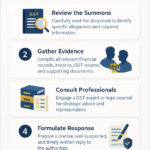
Upon receiving the summons, your immediate actions can significantly impact the outcome. A methodical, calm, and professional approach is key. Avoid hasty decisions or ignoring the notice. Follow these four initial steps to set the right course.
Step 1: Verify the Authenticity of the Notice
Before you do anything else, you must confirm that the summons is genuine. In today’s digital age, the risk of fraudulent notices cannot be ignored. The Central Board of Indirect Taxes and Customs (CBIC) has mandated that every communication from the GST department must have a computer-generated Document Identification Number (DIN).
- Check for DIN: Carefully examine the notice for a DIN. According to official circulars, any communication from the GST department without a valid DIN is to be treated as invalid and shall be deemed to have never been issued.
- How to Verify: You can easily verify the legitimacy of the DIN on the official government portal. Visit the CBIC-GST portal and find the option to “Verify CBIC-DIN.” Enter the DIN from your notice to confirm its authenticity.
Step 2: Read the Summons Carefully and Understand the Requirements
Once you’ve verified the notice, read every word of the summons with meticulous attention to detail. This document contains all the information you need to formulate your response. Treat it as a direct instruction manual from the department. Make a checklist to ensure you have understood everything:
- Specific Documents Requested: Note down the exact list of documents required. Are they asking for invoices for a specific month? Bank statements for a particular quarter? Your purchase register for the entire financial year? Be precise.
- Date, Time, and Location: Clearly identify the date, time, and office address where you are required to appear in person.
- Issuing Officer: Note the name and designation of the officer who has issued the summons.
- Subject of Inquiry: The summons will usually mention the subject or reason for the inquiry. This gives you a crucial clue about the focus of the investigation.
Step 3: Collate All Required Documents and Information
Start gathering all the documents and information requested in the summons immediately. Procrastination can lead to a rushed and incomplete submission. Create a dedicated master file, either physical or digital, to keep everything organized. A typical document request might include:
- GST Registration Certificate
- Copies of GSTR-1 and GSTR-3B returns for the relevant tax period
- Complete Sales and Purchase Registers
- Copies of Tax Invoices, Debit Notes, Credit Notes, and E-way Bills
- Relevant Bank Account Statements showing the business transactions
- Reconciliation statements for ITC or turnover, if applicable
Pro Tip: Always make a complete set of photocopies or scanned digital copies for your records. Never submit original documents unless specifically required by the officer, and if you do, insist on a formal written acknowledgement detailing every original document you have submitted.
Step 4: Seek Professional GST Summons Legal Advice Immediately
This is arguably the most crucial step in the entire process. While it may seem like a straightforward request for documents, a GST summons is a formal legal proceeding. Attempting to handle it on your own can be risky. The language you use in your written replies and the statements you make can have significant legal implications.
A qualified tax consultant or lawyer brings invaluable expertise. They understand the legal nuances of GST law, know the procedures followed by the department, can anticipate the officer’s questions, and can help you frame your answers accurately. Seeking GST summons legal advice India is not an expense; it’s an investment in protecting your business and ensuring your rights are upheld. Consulting an expert is the most critical step in responding to GST summons effectively. TaxRobo’s team of tax professionals can guide you through the entire process, from document preparation to representing you before the authorities.
How to Draft an Effective GST Summons Notice Response
Your response, whether written or in person, should be professional, factual, and precise. It should directly address the department’s queries without offering unsolicited information. A well-prepared response demonstrates your compliance and cooperation, which can positively influence the proceedings.
Crafting a Written Reply (If Applicable)
In some cases, you may need to submit a written reply along with the documents before your personal appearance. This letter sets the first impression. A well-drafted letter is the foundation of a legal response to GST summons. Follow this structure:
- Use Formal Letterhead: Always use your official company letterhead for all correspondence.
- Reference the Summons: Clearly mention the summons number and date at the beginning of your letter for easy reference.
- Provide a Point-by-Point Response: Structure your reply to address each query or document request from the summons in a separate, numbered paragraph. This makes it easy for the officer to see that you have complied with all requests.
- Be Factual and Concise: Stick to the facts. Avoid using emotional language, making excuses, or providing vague answers. Attach the requested documents as annexures and clearly reference them in your reply (e.g., “A copy of the bank statement for the period April-June 2023 is attached as Annexure-A.”).
Preparing for a Personal Appearance
Appearing before a tax officer can be intimidating, but with proper preparation, you can handle it confidently.
Do’s:
- Attend on Time: Be punctual. If you are genuinely unable to attend on the specified date, you must seek an adjournment in writing well in advance, stating a valid reason.
- Be Accompanied: You have the right to be accompanied by an authorized representative, such as your Chartered Accountant or lawyer. Their presence provides legal support and ensures the proceedings are conducted fairly.
- Answer Truthfully: Provide honest and accurate answers. Remember that you are under oath, and giving false evidence is a criminal offense.
- Read Your Statement: After your statement is recorded, the officer will ask you to sign it. Insist on reading it carefully first. Ensure it accurately reflects what you said and request corrections if there are any discrepancies.
Don’ts:
- Don’t Speculate: If you do not know the answer to a question, it is better to say “I do not recall” or “I will have to check my records” rather than guessing.
- Don’t Submit Originals Without Acknowledgment: As mentioned earlier, avoid submitting original documents. If you must, get a detailed, signed, and stamped acknowledgement.
- Don’t Be Argumentative: Maintain a calm and respectful demeanor throughout the proceeding. Cooperate with the officer, but do not volunteer information that has not been asked for.
Common Mistakes to Avoid (And Their Consequences)
The path to resolving a GST summons is fraught with potential pitfalls. Avoiding these common mistakes is as important as taking the right steps.
- Mistake 1: Ignoring the Summons
Consequence: This is the worst thing you can do. Non-compliance with a summons is a serious offense. The GST officer can impose a penalty of up to ₹25,000 under Section 122 of the CGST Act. Furthermore, it is a punishable offense under Section 174 of the Indian Penal Code (IPC), which could lead to prosecution and even imprisonment. - Mistake 2: Providing False Information
Consequence: Knowingly providing false documents or making a false statement during a summons proceeding is treated as giving false evidence in a judicial proceeding. This can lead to prosecution under the Indian Penal Code, a serious criminal offense with severe penalties. Such actions can trigger stringent measures, as detailed in our analysis of Section 74 of the CGST Act: Dealing with GST Demand Notices Involving Fraud. - Mistake 3: Responding Without Professional Guidance
Consequence: Without an expert by your side, you might unintentionally admit to a tax liability that doesn’t exist, misinterpret a question, or provide information that could be used against you later. A professional ensures your rights are protected and that your response is legally sound and strategically correct.
Conclusion
A GST summons is a serious matter that requires your immediate and careful attention. However, it is not a reason to panic. By following a structured approach, you can navigate the process effectively and ensure compliance. Remember the key takeaways: verify the summons authenticity, understand the requirements thoroughly, gather all documents meticulously, seek expert help immediately, and respond formally and on time. A timely and well-prepared GST summons notice response is crucial for protecting your business from potential penalties and prolonged legal disputes. It demonstrates your commitment to compliance and can lead to a swifter, more favorable resolution.
Don’t let a GST summons disrupt your business. For expert assistance and professional GST summons legal advice India, connect with the TaxRobo team today. We ensure your response is legally sound and protects your interests.
Frequently Asked Questions (FAQs)
1. What happens if I ignore a GST summons?
Ignoring a summons is a serious offense. The GST officer can impose a penalty of up to ₹25,000 under Section 122 of the CGST Act and can also initiate prosecution proceedings under Section 174 of the Indian Penal Code for non-attendance in obedience to an order from a public servant.
2. Can I ask for more time to respond or appear?
Yes, you can request an adjournment by submitting a written application to the issuing officer. You must provide a genuine and compelling reason (e.g., a medical emergency, pre-scheduled travel, unavailability of key personnel) and request a new date. This request should be made well before the scheduled appearance to show your intent to cooperate.
3. Do I have to appear in person, or can my consultant go on my behalf?
The summons will explicitly state who needs to appear. If it is issued in your name as the proprietor, director, or partner, your personal attendance is generally mandatory. The purpose is to record your statement. Your consultant cannot give a statement on your behalf, but you are strongly advised to have them accompany you to the proceeding for legal support.
4. What are my rights during the summons proceeding?
You have the right to be treated with dignity and respect. You have the right to be accompanied by your legal counsel or tax consultant. Before signing any statement recorded by the officer, you have the right to read it thoroughly and request corrections for any factual inaccuracies or misrepresentations of your testimony. You are not obligated to answer any questions that could incriminate you.
5. Can a GST summons be issued to an employee of the company?
Yes. Section 70 of the CGST Act allows a proper officer to summon “any person” whose attendance is considered necessary for the inquiry. This is not limited to owners or directors. A summons can be issued to a manager, accountant, storekeeper, or any other employee who may possess relevant information, documents, or knowledge about the transactions under investigation.