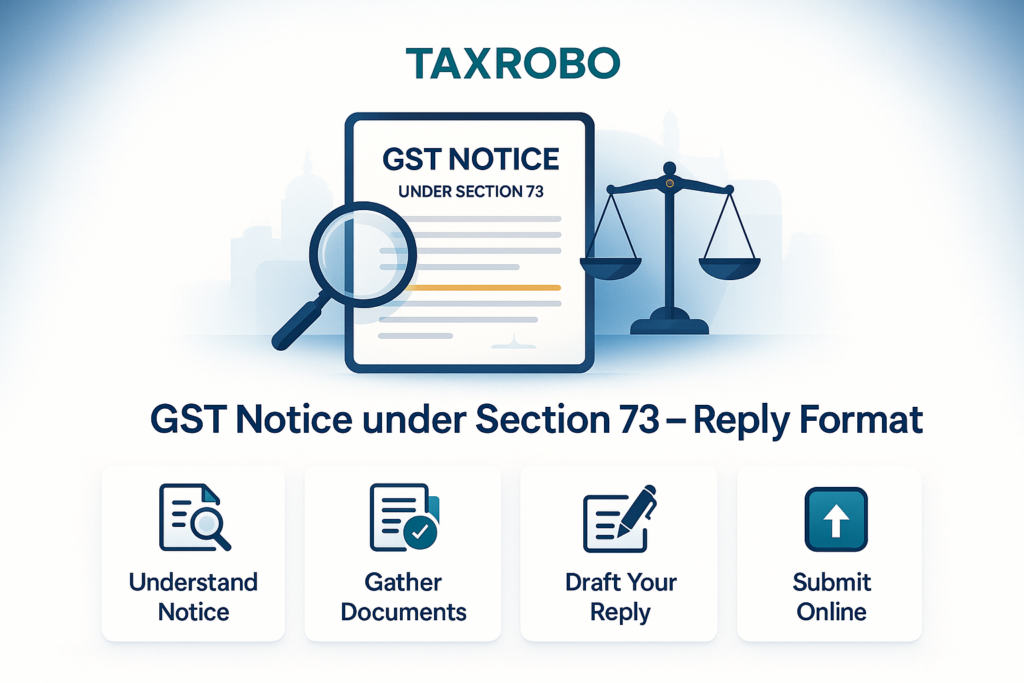

A Step-by-Step Guide to the GST Notice Reply Format under Section 73
Receiving a notice from the GST department can be a stressful experience for any business owner. The official language and the potential for penalties can seem daunting. However, not all notices are a cause for panic. This comprehensive guide will focus on a common notice issued under Section 73 of the CGST Act, 2017, and provide a clear and detailed GST notice reply format to help you respond correctly and confidently. Understanding the structure of a proper response is crucial for businesses across the country, as a well-drafted GST notice reply format India can be the key to resolving the issue efficiently.
What is a GST Notice under Section 73? A Simple Breakdown
Before diving into the format of the reply, it’s essential to understand why you have received this specific notice. A notice under Section 73 is fundamentally different from one issued under other sections, like Section 74. It is issued for discrepancies in tax payment that are not a result of fraud, willful misstatement, or suppression of facts. In simple terms, the tax officer believes there has been a genuine error or omission on your part. Think of it as a formal query to address an honest mistake rather than an accusation of wrongdoing. This distinction is crucial because the penalties associated with Section 73 are significantly lower than those for fraudulent cases, and in some instances, can be waived entirely if you comply promptly.
Key Reasons for Receiving a Section 73 Notice
The Proper Officer (the designated GST official) issues a Show Cause Notice (SCN) under this section for any of the following reasons, where there is no element of fraud involved; our general guide on How to Respond to a GST Show Cause Notice: A Step-by-Step Guide covers the broader process.
- Tax not paid or short-paid: This is the most common reason. It could be due to a calculation error in your GSTR-3B, misclassification of a product’s HSN code leading to a lower tax rate being applied, or simply overlooking a particular transaction.
- Wrongful availment or utilization of Input Tax Credit (ITC): You might have claimed ITC on an ineligible item (like a motor vehicle for personal use), or there might be a mismatch between the ITC claimed in your GSTR-3B and the details appearing in your GSTR-2A/2B. Resolving these discrepancies is a common challenge, and you can learn more in our detailed article on How to Resolve ITC Mismatch Issues – GSTR-2A/2B vs 3B Guide.
- Erroneous refund granted: The department may have processed a refund that you were not entitled to, perhaps due to a clerical error in your application or their assessment.
The key takeaway is the absence of malicious intent. Section 73 deals with bona fide mistakes. This is in sharp contrast to Section 74, which is invoked for cases involving deliberate tax evasion, fraud, or suppression of facts, and carries much harsher penalties, including up to 100% of the tax demanded. To better understand the distinctions, it’s helpful to read about the Key Differences Between Sections 73 and 74 of the CGST Act in GST Demand Notices.
Who Issues the Notice and What is the Time Limit?
The notice, officially known as FORM GST DRC-01, is issued by the “Proper Officer” from the GST department. This is a formal intimation demanding that you show cause as to why the specified amount of tax, along with interest and a penalty, should not be recovered from you. The law provides a specific timeline for this process. The officer must issue this notice at least three months before the time limit for issuing the final order. The time limit for issuing the order itself is three years from the due date for filing the annual return for the financial year to which the discrepancy pertains.
The Ultimate GST Notice Reply Format: Key Components
A well-structured and professionally written reply is your first and most important line of defense. It demonstrates your diligence and makes it easier for the tax officer to understand your position. A haphazard or incomplete reply can lead to misunderstandings and an unfavorable order. Your reply should be clear, factual, and supported by documentary evidence. It is a formal document and should be treated as such, from the header down to the final submission.
Essential Information for Your Header
Every formal communication with a government department must begin with clear identification details. This ensures your reply is correctly filed against your case and presents a professional image. Your header should always include:
- Your GSTIN: Your Goods and Services Tax Identification Number.
- Your Legal Name & Trade Name: As registered on the GST portal.
- Your Registered Address: The principal place of business address.
- Notice Reference Number (or SCN Number): This is a unique number found on the notice you received.
- Date of the Notice: The date the notice was issued.
- Date of Reply: The date you are submitting your response.
Structuring Your Response: From Subject to Submission
A logical flow is critical for a compelling reply. Breaking your response into distinct sections helps the officer follow your arguments. For business owners in Bangalore wondering how to reply GST notice Section 73 Bangalore, this point-by-point method is the most effective approach to ensure every allegation is addressed meticulously.
- Subject Line: Keep it clear and direct. For example: “Reply to Show Cause Notice Ref No. [Insert Notice Reference Number] dated [Insert Notice Date] under Section 73 of the CGST Act, 2017.”
- Preamble: Begin with a formal acknowledgment. State that you are in receipt of the notice and are submitting your reply in response to it. For example: “This is with reference to the Show Cause Notice (SCN) cited above, issued by your good office. We have carefully reviewed the contents of the notice and are hereby submitting our detailed reply for your kind consideration.”
- Facts of the Case (as per the department): In this section, you should briefly and neutrally summarize the allegations made in the notice. Do not admit fault here. Simply state what the department has claimed. For example: “The SCN alleges a short payment of tax amounting to ₹XX,XXX for the period [Month, Year] due to an alleged mismatch in turnover reported in GSTR-1 and GSTR-3B.”
- Point-by-Point Rebuttal/Submission: This is the heart of your reply. Address each allegation from the notice one by one. Use a numbered list or a table for clarity. For each point:
- State the Allegation: Clearly mention the specific issue raised by the officer.
- Present Your Facts: Provide your explanation with supporting facts and figures.
- Provide Calculations: If there’s a numerical discrepancy, show your own calculation to prove your point.
- Cite Legal Provisions: Refer to relevant sections of the GST Act, Rules, or any circulars/notifications that support your case.
- Refer to Evidence: Mention the specific supporting documents you are attaching for that point (e.g., “as evidenced by the attached tax invoice copy, marked as Annexure-A”).
- Prayer/Conclusion: Conclude your reply with a formal “prayer.” This is where you request the officer to consider your submissions and drop the proceedings. For example: “In light of the facts, legal provisions, and documentary evidence submitted above, we humbly pray that your good office accepts our contentions and drops the proceedings initiated via the aforementioned SCN. We are willing to provide any further clarification or appear for a personal hearing if required.”
List of Supporting Documents to Attach
Your words are only as strong as the evidence that backs them up. Attaching a comprehensive set of documents is non-negotiable. Create an annexure for each document and refer to it clearly in your reply.
- Copies of relevant tax invoices (both sales and purchases).
- A detailed reconciliation statement for GSTR-1 vs. GSTR-3B.
- A reconciliation of ITC claimed in GSTR-3B with the details available in GSTR-2A/2B.
- Copies of your ITC register.
- Bank statements highlighting payments for transactions in question.
- Copies of relevant ledger accounts from your books of accounts.
- Any communication with suppliers or customers that is relevant to the case.
- Certificates from a Chartered Accountant, if applicable.
A Practical Section 73 GST Notice Reply Example (Mumbai Scenario)
To make this practical, let’s consider a common scenario. A clear example can help you visualize how to apply the format to your own situation.
Sample Scenario: ITC Mismatch
Imagine “Creative Prints,” a small printing press in Mumbai, receives a notice under Section 73. The notice alleges a wrongful ITC claim of ₹50,000 for October 2023. The officer points out that this ITC, claimed on a purchase of special printing paper, is not reflecting in Creative Prints’ GSTR-2B. Upon investigation, the owner discovers that their supplier, “Paper Co.,” made a mistake and reported the invoice in their GSTR-1 under the wrong GSTIN. Creative Prints has the valid tax invoice and has already paid Paper Co. for the goods, including GST.
Here’s a walkthrough of how they would draft their reply. This Section 73 GST notice reply example Mumbai provides a clear framework for responding to such a discrepancy.
GST Notice Reply Template India [Copy & Paste]
Here is a standard GST notice reply template India that you can adapt for your specific needs. You can copy and paste the text from the block below and fill in your details.
[Your Company Letterhead]

Date: [Date of Reply]

To,
The Proper Officer,
[Designation of the Officer],
[Address of the GST Office].

GSTIN: [Your GSTIN]
Legal Name: [Your Legal Name]
Trade Name: [Your Trade Name]
Address: [Your Registered Address]

Subject: Reply to Show Cause Notice Ref No. [Insert SCN Number] dated [Insert SCN Date] under Section 73 of the CGST Act, 2017

Respected Sir/Madam,

This is with reference to the Show Cause Notice (SCN) bearing the number mentioned above, issued by your good office for the tax period [Mention Tax Period, e.g., April 2023 to March 2024]. We acknowledge the receipt of the said notice and have carefully reviewed its contents. We are hereby submitting our detailed point-wise reply for your kind perusal and consideration.

1. Brief Facts of the Case (as per the SCN):
The learned SCN has proposed a demand of tax, interest, and penalty on the following grounds:
*   [Briefly summarize the allegation from the notice, e.g., "Alleged excess claim of Input Tax Credit (ITC) amounting to ₹50,000 for the month of October 2023."]

2. Our Submissions/Point-wise Reply:

With respect to the allegation mentioned above, we wish to submit the following facts and legal contentions:

(a) Allegation: Excess claim of ITC of ₹50,000 on account of mismatch between GSTR-3B and GSTR-2B.

(b) Our Submission:
*   We humbly submit that the ITC claim of ₹50,000 is genuine and we are rightfully entitled to it under Section 16 of the CGST Act, 2017.
*   This ITC pertains to the purchase of printing paper from our supplier, M/s Paper Co. (GSTIN: [Supplier's GSTIN]), vide Tax Invoice No. [Invoice Number] dated [Invoice Date].
*   We are in possession of the said tax invoice, and the goods have been duly received at our business premises. A copy of the tax invoice is attached as Annexure-A.
*   We have made the full payment for this invoice, including the GST amount, to the supplier. A copy of our bank statement reflecting this payment is attached as Annexure-B.
*   The mismatch in GSTR-2B has occurred because the supplier, M/s Paper Co., erroneously reported this invoice under an incorrect GSTIN in their GSTR-1 filing for October 2023.
*   We have already contacted the supplier, who has acknowledged their error and has rectified it by reporting the transaction in their GSTR-1 for the subsequent month. A copy of the communication with the supplier is attached as Annexure-C.
*   As we have fulfilled all the conditions stipulated under Section 16(2) of the CGST Act, 2017, the ITC claim is valid and should not be denied merely on the grounds of a clerical error made by our supplier.

3. Prayer:
In light of the facts, submissions, and documentary evidence provided above, we humbly request your good office to review our case and drop the proceedings initiated vide the SCN Ref No. [Insert SCN Number]. We have acted in good faith and have complied with all provisions of the law.

We would be glad to provide any further information or clarification as needed and request an opportunity for a personal hearing before any adverse order is passed.

Thanking you.

Yours sincerely,

For [Your Company Name],

(Authorized Signatory)
[Name of Signatory]
[Designation]
How to File Your Reply and What to Expect Next
Drafting the reply is only half the battle. Submitting it correctly and understanding the subsequent process is equally important to bring the matter to a close.
Step-by-Step Guide to Submitting on the GST Portal
The entire process is online, making it convenient and transparent. Follow these steps to file your response:
- Login to the GST Portal: Go to the official government website: GST Portal.
- Navigate to the Correct Section: Once logged in, go to Services > User Services > View Additional Notices/Orders.
- Locate Your Notice: On this page, you will see a list of all notices and orders issued to you. Find the relevant notice by its reference number and click on “View.”
- Initiate the Reply: Inside the notice details, you will find a “Replies” tab. Click on it and then click on “Add Reply” or a similar button.
- Upload Your Documents: You will be prompted to type a response and upload your attachments. It is best practice to type a brief summary in the text box (e.g., “Detailed reply attached”) and upload your main reply as a single, compiled PDF file. Also, upload all supporting documents (Annexures) as separate PDF files.
- File with DSC or EVC: Finally, submit your reply using either a Digital Signature Certificate (DSC) or an Electronic Verification Code (EVC) sent to your registered mobile number and email.
Possible Outcomes After Responding to GST Notice Section 73
After you submit your reply, the Proper Officer will review your submissions. The procedure for responding to GST notice Section 73 Kolkata is the same as in Chennai; the key is the strength of your submitted documents. Your GST notice under Section 73 response format Chennai must be robust to aim for the best outcome. Here are the potential outcomes:
- Case Dropped: If the officer is satisfied with your explanation and supporting documents, they will conclude the proceedings. You will receive an order in FORM GST DRC-05, formally dropping the show-cause notice. This is the most favorable outcome.
- Demand Confirmed: If the officer is not convinced by your reply, they will issue an order in FORM GST DRC-07. This order will confirm the demand for tax, interest, and penalty as proposed in the original notice (or a modified amount). You will then be liable to pay this amount. You have the option to appeal this order before the appellate authority.
- Personal Hearing: Before passing an adverse order, the officer is generally required to grant you an opportunity for a personal hearing. This is your chance to explain your case in person (or virtually) and clarify any doubts the officer might have.
Conclusion
A notice under Section 73 is manageable if you approach it systematically and professionally. Remember, it relates to non-fraudulent errors, and the department’s primary goal is to ensure correct tax payment. A structured GST notice reply format, backed by solid evidence, is your most powerful tool. By clearly presenting your facts and addressing each allegation head-on, you can significantly increase the chances of a favorable resolution. Always act promptly and never ignore a notice, as this can lead to more severe consequences.
Don’t let a GST notice disrupt your business. A professionally drafted response can make all the difference. If you need an expert to handle your GST notice format response Delhi or anywhere in India, contact TaxRobo today. Our team ensures your reply is compliant, comprehensive, and compelling.
Frequently Asked Questions (FAQs)
- What is the main difference between a notice under Section 73 and Section 74?
Answer: The primary difference is intent. Section 73 is issued for non-fraudulent cases where tax has not been paid or has been short-paid due to genuine mistakes or oversight. Section 74 is invoked for cases involving fraud, willful misstatement, or suppression of facts to evade tax. Consequently, the penalties under Section 74 are much more severe. - Can I pay the tax and interest before getting a show-cause notice?
Answer: Yes. If you proactively identify an error on your own, you can pay the due tax and applicable interest voluntarily using FORM GST DRC-03. If you do this before a show-cause notice is issued to you under Section 73, no penalty will be levied, and the department will not initiate proceedings for that specific issue. - What happens if I don’t reply to a GST notice under Section 73?
Answer: Ignoring a notice is a significant mistake. If you fail to respond, the Proper Officer will proceed to pass an order based on the information available to them. This is known as an ex-parte order. This order will confirm the tax, interest, and penalty demand against you, and you will be legally liable to pay the amount. It becomes much more difficult to contest the demand at this stage. - Do I need a professional to draft the GST notice reply?
Answer: While it is not legally mandatory to hire a professional, it is highly recommended. Tax professionals like Chartered Accountants or tax lawyers understand the legal nuances of GST law. They can draft a legally sound and structured reply, help you gather the correct supporting evidence, and represent you during personal hearings. Their expertise significantly increases your chances of a favorable outcome and saves you valuable time and stress.