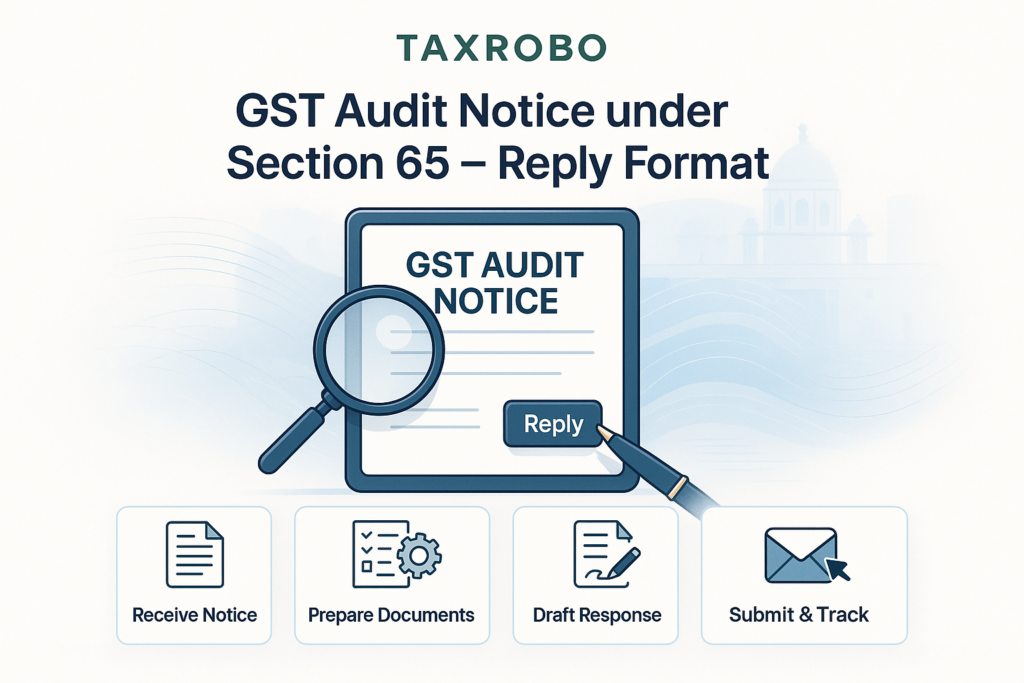

GST Audit Notice under Section 65 – Reply Format
Receiving an official-looking envelope from the GST department can be a stressful experience for any business owner. Your mind might race with questions and concerns. However, it’s important to understand that a notice for a departmental audit is a standard procedure and not an immediate accusation of wrongdoing. The key to navigating this process successfully lies in preparing a timely, accurate, and professional GST audit notice reply. This notice, issued under Section 65 of the CGST Act, is the department’s way of verifying that your business is compliant with tax laws. A well-structured response can resolve queries efficiently, prevent unnecessary penalties, and demonstrate your commitment to compliance. This guide will walk you through everything you need to know about how to respond to a GST audit notice, providing a detailed reply format to make the process smoother.
Understanding the GST Audit Notice Under Section 65
Before you begin drafting a response, it is crucial to understand the nature of the notice you have received and what the authorities are looking for. A GST audit under Section 65 is a formal examination of your business’s financial records conducted by the tax authorities themselves. It involves a detailed review to ensure that the turnover you’ve declared, the taxes you’ve paid, the refunds you’ve claimed, and the Input Tax Credit (ITC) you’ve availed are all accurate and in line with GST regulations. This process helps the government ensure tax compliance across the board and maintain the integrity of the tax system. Panicking is a common first reaction, but a clear understanding of the process can transform this challenge into an opportunity to validate your good financial practices.
What is a GST Audit?
A GST audit is a comprehensive examination of the records, returns, and other documents maintained by a registered taxpayer. The primary objective is to verify the correctness of the information you have filed with the government. Tax officers will scrutinize your financial data to confirm that your business operations align with your tax filings. They focus on key areas such as the accuracy of declared turnover, the correctness of taxes paid, the validity of refunds claimed, and the proper utilization of Input Tax Credit (ITC). Essentially, it’s a health check-up for your company’s tax compliance, ensuring that every financial detail is correctly reported and accounted for under the GST framework. To get a broader perspective, you can read our guide on What is a Tax Audit and How Can You Prepare for It?.
Why is a Notice Under Section 65 Issued?
A notice under Section 65 is formally issued in Form GST ADT-01. This document serves as the official intimation that the GST department intends to conduct an audit of your business for a specific period. This type of audit, known as a departmental audit, is typically conducted at your principal place of business or, in some cases, at the office of the tax authorities. The notice is not a random occurrence; it is usually based on risk parameters or specific intelligence that flags a taxpayer for review. It outlines the scope of the audit, the financial years to be covered, and the documents the department requires, setting the stage for the entire audit proceeding.
Key Details to Check in Your Notice (Form GST ADT-01)
Upon receiving Form GST ADT-01, your first action should be to carefully review its contents. Do not overlook any detail, as it contains critical information for your response. Pay close attention to the following:
- Audit Reference Number (ARN) and Date: This unique number identifies your case.
- The financial year(s) to be audited: Confirm the exact period under review.
- Date of the audit: The notice must provide at least 15 working days before the audit commences.
- List of records/documents required: This is a checklist of the information you must prepare.
Actionable Tip: It is always a good practice to verify the authenticity of any notice you receive. You can do this by logging into your account on the official GST Portal and checking the “Notices and Orders” section to confirm that the notice has been officially issued to your GSTIN.
First Steps: How to Respond to a GST Audit Notice
Once you have verified the notice and understood its requirements, you need a clear action plan. A systematic approach will help you stay organized, meet deadlines, and prepare a robust response that addresses all the department’s concerns. Acting promptly and methodically is far more effective than delaying or responding in a haphazard manner. The following steps provide a structured framework to guide your initial actions, ensuring you are well-prepared for the subsequent stages of the audit process.
Step 1: Acknowledge the Notice and Stay Calm
The single most important rule is: do not ignore the notice. Ignoring it will only lead to more severe consequences, including penalties and a “Best Judgment Assessment” where the officer determines your tax liability for you. Acknowledge the receipt of the notice internally and immediately note the deadline for submitting your GST audit notice reply and documents. Staying calm and approaching the situation methodically will allow you to think clearly and prepare an effective response.
Step 2: Assemble Your Documents
The notice will specify the documents required for the audit. Begin gathering and organizing these records immediately. A typical checklist includes:
- GST Returns: GSTR-1, GSTR-3B, and annual returns (GSTR-9/9C) for the entire audit period.
- Sales and Purchase Registers: Detailed ledgers that correspond with your GST returns.
- Invoices: Copies of tax invoices, bills of supply, debit notes, and credit notes issued and received.
- Input Tax Credit (ITC) Records: Your ITC register, along with the corresponding purchase invoices and proof of payment to suppliers.
- Financial Statements: Audited financial statements, bank statements, and bank reconciliation statements.
- Operational Documents: E-way bills, stock registers, and delivery challans.
Step 3: Review Your Records and Identify Discrepancies
Before submitting your documents, conduct a thorough self-review. This proactive step allows you to identify and prepare explanations for any potential discrepancies that the audit officer is likely to find. Compare your GSTR-1 with GSTR-3B, your GSTR-3B with your books of accounts, and your claimed ITC with your GSTR-2A/2B. If you find mismatches, document the reasons for them clearly. A detailed How to Resolve ITC Mismatch Issues – GSTR-2A/2B vs 3B Guide can help you navigate this specific challenge. This shows the officer that you are diligent and transparent, which can significantly smoothen the audit process.
Step 4: Seek Professional Assistance
While you can respond to the notice yourself, the complexities of GST law make professional assistance invaluable. Consulting a tax expert or a Chartered Accountant is highly recommended. An expert can help you understand the nuances of the notice, prepare a legally sound and professional response, and represent your case effectively before the tax authorities. A professional can provide a robust GST notice response template India tailored to your specific case, ensuring all legal points are meticulously covered. Engaging an expert from a firm like TaxRobo can save you time, prevent costly errors, and give you peace of mind.
Crafting a Comprehensive GST Audit Notice Reply
The quality of your written reply is paramount. It is your first formal opportunity to present your case, clarify discrepancies, and provide documentary evidence to support your claims. A well-drafted reply sets a cooperative tone and can resolve many queries even before the physical audit begins. Your response should be clear, concise, and structured in a way that directly addresses each point raised by the tax officer, leaving no room for ambiguity.
The Essential Components of a Strong Reply
A strong and effective reply is built on a foundation of clarity, factual accuracy, and a professional approach. It should be structured to make it as easy as possible for the audit officer to understand your position and verify your claims. Keep the following principles in mind:
- Clarity and Precision: Respond to each query or requested document point-by-point. Vague or general statements will only invite more questions.
- Factual Basis: Every explanation you provide must be backed by documentary evidence. If you state a reason for a mismatch, attach the relevant ledger, invoice, or reconciliation statement as an annexure.
- Professional Tone: Maintain a cooperative and respectful tone throughout the letter. The goal is to assist the officer in their duties, not to be confrontational.
- Structure: Number your responses to correspond directly with the queries in the notice. This organized approach demonstrates professionalism and makes the review process much simpler for the officer.
The Section 65 Reply Format for GST (A Template)
Using a standardized format ensures that your reply is professional and covers all necessary information. Below is a versatile Section 65 reply format for GST that you can adapt to your specific situation.
[Date]
To,
The [Designation of the Officer],
[Address of the GST Office]
Subject: Reply to GST Audit Notice under Section 65 for [Your GSTIN] for the period [Financial Year]
Reference: Notice No. [GST ADT-01 Notice Number] dated [Date of Notice]
Respected Sir/Madam,
This is with reference to the audit notice issued to M/s [Your Company Name], holding GSTIN [Your GSTIN], for the financial period [Financial Year]. We acknowledge the receipt of the notice and wish to submit our point-wise reply and the requested documents as follows:
Query 1: [State the query from the notice, e.g., “Discrepancy in ITC claimed in GSTR-3B vs. GSTR-2A.”].
Our Reply to Query 1: We submit that [Provide a detailed and factual explanation. E.g., “the difference of Rs. X is due to ITC on invoices from Supplier Y (GSTIN:…) which was not uploaded by them in the said period. The conditions under Section 16(2) of the CGST Act have been fulfilled by us. We are enclosing a copy of the tax invoice and proof of payment as Annexure-A to substantiate our claim.”]
Query 2: [State the second query from the notice, e.g., “Mismatch in turnover reported in GSTR-1 and GSTR-3B.”].
Our Reply to Query 2: [Provide a detailed explanation and reference supporting documents. E.g., “The reported mismatch is on account of an advance received in March for which the invoice was raised in April. As per GST law, the tax on the advance was paid in March itself. A complete reconciliation statement is attached as Annexure-B for your perusal.”]
We assure you of our fullest cooperation during the audit proceedings. All requested documents have been attached as annexures for your ready reference. We are prepared to provide any further clarification or documentation as may be required.
Thank you.
Sincerely,
[Your Name/Authorized Signatory]
[Your Designation]
For M/s [Your Company Name]
List of Enclosures:
1. Annexure-A: [Description of document, e.g., Copy of Tax Invoice and Bank Statement]
2. Annexure-B: [Description of document, e.g., GSTR-1 vs. GSTR-3B Reconciliation]
Common Mistakes to Avoid
In the process of responding, certain missteps can complicate the audit and potentially lead to adverse findings. Be mindful to avoid these common errors:
- Vague Answers: Providing incomplete or evasive replies will raise suspicion.
- Missing Deadlines: Failing to respond or submit documents on time can result in penalties.
- Incomplete Documentation: Ensure you attach all supporting documents mentioned in your reply.
- Factual Errors: Double-check all figures and facts in your response to ensure accuracy.
What Happens After You Submit the Reply?
Submitting your reply is a significant step, but it is not the end of the audit process. Understanding the subsequent stages will help you manage expectations and prepare for what comes next. The tax officer will use your submission as the basis for their verification, and the outcome will depend on how well your response addresses their initial concerns.
The Audit Conclusion
After you submit the GST audit notice reply and all the required documents, the proper officer will begin their review. They will scrutinize your explanations and cross-verify the information with the documents provided. If your explanations are clear and supported by sufficient evidence, the officer may be satisfied and conclude the audit. However, they may also schedule a personal hearing or request further information if any ambiguities remain. Your full cooperation during this phase is crucial for a favorable outcome.
The Final Audit Report (Form GST ADT-02)
Within 30 days of the conclusion of the audit, the officer is required to issue a Final Audit Report in Form GST ADT-02. This is a critical document that summarizes the findings of the audit. It will detail any discrepancies, non-compliances, or shortfalls in tax payment that were identified during the process, along with the reasons for these findings. It is essential to review this report carefully as it forms the basis for any subsequent action.
Next Steps Based on the Report
The content of Form GST ADT-02 will determine the final outcome:
- No Discrepancies: If the report finds no discrepancies or if you have already paid any minor dues identified, the matter is considered closed.
- Discrepancies Found: If the audit uncovers unpaid taxes, incorrect refunds, or wrongly availed ITC, the officer may initiate proceedings under Section 73 (for non-fraud cases) or Section 74 (for cases involving fraud, willful misstatement, or suppression of facts) to demand the tax and impose penalties. It is important to understand the Key Differences Between Sections 73 and 74 of the CGST Act in GST Demand Notices as they determine the severity of the proceedings.
Conclusion
Receiving a GST audit notice under Section 65 can feel intimidating, but with a structured and proactive approach, it is a manageable process. The key is to understand the notice, meticulously gather your documents, perform a self-review, and draft a detailed point-by-point GST audit notice reply. A clear, well-documented response not only demonstrates your compliance but also helps in resolving the audit smoothly and efficiently. Remember, a proactive and transparent approach is always the best strategy when dealing with tax authorities.
Receiving a GST notice can be daunting. Don’t navigate it alone. TaxRobo’s team of experts is here to help you draft a precise and effective GST compliance notice response India. Our professionals can analyze your case, prepare all necessary documentation, and ensure your business stays compliant. Contact us today for an online CA consultation and handle your tax matters with confidence.
Frequently Asked Questions (FAQs)
1. What is the time limit to reply to a GST audit notice under Section 65?
Answer: The notice in Form GST ADT-01 will specify a date for the audit, which must not be less than 15 working days from the date you receive the notice. While there isn’t a strict deadline for the written reply itself, it is best practice to prepare your reply and have all documents ready well before the scheduled audit date to ensure a smooth process.
2. Can I ask for an extension to submit my reply and documents?
Answer: Yes, if you have valid reasons for not being able to compile the documents or reply within the given timeframe, you can submit a written request for an extension to the proper officer. You must clearly state the reasons for the delay. The officer has the discretion to grant the extension based on the merits of your request.
3. What are the consequences if I don’t respond to the GST audit notice?
Answer: Failure to comply with a GST audit notice is a serious offense. It can lead to penalties under the GST Act. More significantly, the officer may proceed with a “Best Judgment Assessment” under Section 62. This means they will determine your tax liability based on the limited information available to them, which is often not in the taxpayer’s favor and can result in a higher tax demand.
4. Is it necessary to hire a professional for drafting a GST audit notice reply format Delhi?
Answer: While it is not legally mandatory to hire a professional, it is highly recommended, whether you are in Delhi or any other part of India. Tax laws are complex, and a professional can identify the core issues in the notice, draft a legally sound reply, and represent you effectively. An expert can help you avoid common pitfalls that could lead to higher tax liabilities and penalties, making it a worthwhile investment.