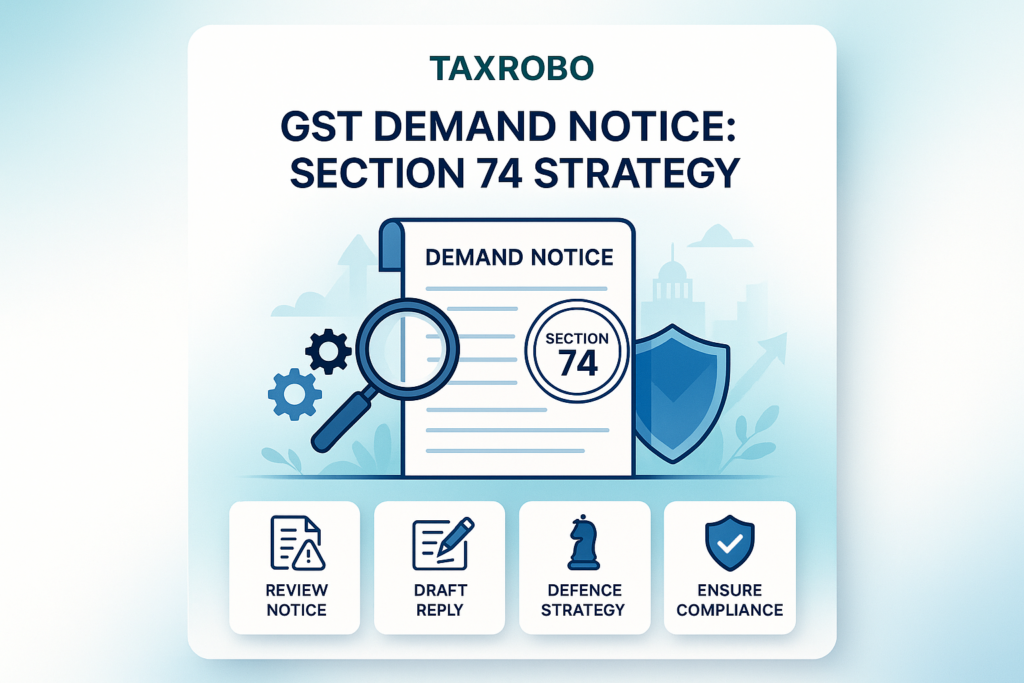

GST Demand Notice under Section 74 – Reply Format & Defence Strategy
Opening a formal notice from the GST department can be stressful for any business owner, especially when it mentions Section 74. This specific section implies serious allegations, making it crucial to handle the situation with care, precision, and urgency. Unlike routine inquiries, a notice under Section 74 suggests the tax authorities believe there has been a deliberate attempt to evade tax, which carries significant financial penalties. This comprehensive guide is designed to help you understand the intricacies of this notice and formulate an effective GST demand notice reply, ensuring you protect your business from undue liabilities. We will walk you through the correct format, a robust defence strategy, and the step-by-step process to navigate this challenge successfully.
Understanding a GST Demand Notice Under Section 74
A GST demand notice under Section 74 is a formal communication, often a Show Cause Notice (SCN), from the GST authorities. It is issued when an officer has reason to believe that a taxpayer has not paid the correct amount of tax, has wrongly availed of Input Tax Credit (ITC), or has erroneously obtained a refund due to deliberate and malafide intentions. The core of this notice is the element of intent. It is not about a simple calculation error; it’s about an alleged conscious effort to defraud the exchequer. Understanding the gravity of these allegations is the first step in preparing a strong defence and a well-structured response.
Decoding Section 74: When is this Notice Issued?
Section 74 of the CGST Act, 2017, is invoked when a tax discrepancy is linked to reasons of fraud, wilful misstatement, or the suppression of facts. It is essential for business owners to understand what these terms legally imply, as the entire defence strategy will revolve around proving their absence.
- Fraud: This involves an intentional act of deception to gain an unlawful advantage. In the context of GST, it could mean using fake invoices to claim ITC or deliberately misclassifying goods to pay a lower tax rate.
- Wilful Misstatement: This refers to knowingly providing incorrect information or making false declarations in GST returns or other submitted documents. An example would be intentionally declaring a lower sales turnover than what was actually achieved.
- Suppression of Facts: This means intentionally hiding or failing to disclose material information that is required to be shared with the tax authorities. For instance, not registering for GST despite crossing the mandatory turnover threshold is a clear case of suppression.
Key Differences: Section 74 vs. Section 73 Notices
It is vital to distinguish a notice under Section 74 from one issued under Section 73. The difference lies in the reason for the tax shortfall, which directly impacts the penalty amount and the legal proceedings.
| Feature | Section 73 Notice | Section 74 Notice |
|---|---|---|
| Reason for Issuance | Tax not paid/short-paid for reasons other than fraud, wilful misstatement, or suppression (e.g., genuine oversight, clerical error). | Tax not paid/short-paid specifically due to fraud, wilful misstatement, or suppression of facts. |
| Element of Intent | Malafide intent is absent. The error is considered unintentional. | Malafide intent (mens rea) is the key ingredient. The action is considered deliberate. |
| Penalty Amount | 10% of the tax due or ₹10,000, whichever is higher. | Up to 100% of the tax due. |
| Opportunity to Reduce Penalty | Penalty can be waived if tax and interest are paid before the notice is issued. | Penalty can be reduced to 15%, 25%, or 50% depending on the stage at which the tax, interest, and penalty are paid. |
Understanding this distinction is crucial because your primary defence against a Section 74 notice is to prove that any discrepancy was not intentional and should, at most, fall under the purview of Section 73.
Common Reasons for Receiving a Section 74 Notice
Knowing the common triggers can help you understand why you might have received this notice and is the first step in learning how to respond to GST demand notice. The GST department uses advanced data analytics to flag inconsistencies, and a Section 74 notice is typically issued for significant and seemingly deliberate discrepancies.
- Significant Mismatch in GSTR-1 and GSTR-3B: A large, unexplained gap between the sales declared in GSTR-1 and the tax paid via GSTR-3B is a major red flag for tax evasion.
- Claiming Input Tax Credit (ITC) on Fake Invoices: The authorities are cracking down on fake ITC rackets. If you have claimed ITC from suppliers who are found to be non-existent, issuing fake invoices, or have not paid their taxes, you could receive a notice.
- Deliberately Undervaluing Goods or Services: Intentionally declaring a lower value for goods or services than the actual transaction value to reduce the GST liability is considered a wilful misstatement.
- Collecting GST from Customers but Not Depositing It: If a business collects GST from its customers but fails to remit it to the government, it is a direct violation and often triggers a Section 74 notice.
- Non-Registration for GST: Knowingly avoiding GST registration even after crossing the prescribed turnover threshold is treated as suppression of facts.
- Wrongful Refund Claims: Obtaining a refund by submitting fraudulent documents or suppressing material facts is a serious offence that attracts a Section 74 notice.
Your Immediate Action Plan: 5 Steps to Take After Receiving the Notice
Receiving a notice that alleges fraud can be daunting, but a calm, methodical approach is your best ally. Panicking or ignoring the notice can worsen the situation. Follow these five immediate steps to take control.
Step 1: Do Not Ignore the Notice
The most critical first step is to acknowledge the notice and act on it. A GST notice under Section 74 typically provides a deadline, usually 30 days, to submit your reply. Ignoring it empowers the officer to pass an ex-parte order (an order passed without hearing your side), confirming the full tax demand along with a 100% penalty. This can lead to severe recovery actions, including freezing of bank accounts.
Step 2: Carefully Verify the Notice Details
Before you dive into the allegations, verify the authenticity and correctness of the notice itself. Log in to the official GST Portal and check for the notice in your dashboard under “View Notices and Orders.” Ensure the GSTIN is correct and verify the Document Identification Number (DIN). A valid notice must have a computer-generated DIN. Any discrepancy here could be a preliminary point of defence.
Step 3: Analyse the Allegations in Detail
Read the Show Cause Notice (SCN) multiple times. Break down the allegations point-by-point. Understand the specific financial years, tax periods, and transactions under scrutiny. The notice will usually include annexures with detailed calculations of the alleged tax shortfall, interest, and proposed penalty. Grasping the core of the department’s argument is essential for drafting a targeted reply.
Step 4: Gather All Supporting Documents
A strong reply is built on strong evidence. Immediately start compiling all documents that can support your case and counter the allegations. Your document checklist should include:
- A copy of the Show Cause Notice (SCN) received.
- All relevant GSTR filings for the period in question (GSTR-1, GSTR-3B, GSTR-9, GSTR-9C).
- Copies of sales invoices, purchase invoices, credit/debit notes, and e-way bills related to the disputed transactions.
- Bank statements to prove the movement of funds for the transactions.
- Reconciliation statements (e.g., GSTR-2A/2B vs. Purchase Register, GSTR-1 vs. GSTR-3B, GSTR-3B vs. Books of Accounts).
- Any communication with suppliers or customers that can clarify the nature of a transaction.
Step 5: Consult a GST Professional
Navigating a Section 74 notice requires deep knowledge of GST law, procedural rules, and case precedents. While you can reply yourself, consulting a tax professional is highly advisable. An expert can help you interpret the notice correctly, identify the strengths and weaknesses of your case, and build a robust Section 74 GST notice defence strategy. Their expertise is invaluable in drafting a legally sound reply and representing you in hearings.
The Complete Guide to Your GST Demand Notice Reply
Crafting a clear, comprehensive, and legally sound reply is the most crucial part of the process. Your response will determine whether the proceedings are dropped or escalated. It is your official opportunity to present your side of the story, backed by facts and legal arguments, to the adjudicating authority. This section serves as a comprehensive GST notice reply guide for businesses in India.
Understanding the Official GST Demand Notice Reply Format
Your reply must be formal and structured. It should be filed electronically on the GST portal using Form GST DRC-06. While the content will be unique to your case, a professional GST demand notice reply format generally includes the following sections:
- Header: Start with your business details, including name, address, and GSTIN. Clearly mention the reference number and date of the Show Cause Notice you are responding to.
- Introduction: Formally acknowledge the receipt of the notice. State that you have reviewed the allegations and are submitting your reply within the stipulated time.
- Facts of the Case: Briefly outline your understanding of the case and the nature of your business operations. Present the facts from your perspective without admitting guilt. This sets the context for your arguments.
- Point-by-Point Rebuttal: This is the heart of your reply. Address each allegation raised in the notice separately and methodically. For each point:
- State the allegation clearly.
- Present your counter-argument.
- Refer to the specific supporting documents you have attached (e.g., “As per the attached invoice no. XYZ and corresponding bank statement…”).
- Provide clear and logical explanations for any discrepancies.
- Legal Submissions: Support your arguments by citing relevant provisions of the CGST Act, 2017, related rules, circulars, notifications, and applicable case laws or judicial precedents. This demonstrates that your position is legally valid.
- Prayer/Conclusion: Conclude your reply with a formal “prayer.” This is a request to the adjudicating authority to consider your submissions and evidence, find them satisfactory, and drop the proceedings initiated by the Show Cause Notice.
Crafting a Strong Section 74 GST Notice Defence Strategy
Your defence must focus on negating the core element of Section 74: the intent to defraud. Here are some effective tips for defending GST demand notice in India and building a compelling case.
- Strategy 1: Prove Absence of Intent (Mens Rea): This is the most crucial defence. Argue that the error, if any, was not a result of fraud, wilful misstatement, or suppression. It could have been due to a clerical mistake, a technical glitch on the GST portal, a genuine misinterpretation of a complex legal provision, or an oversight by an employee. Provide evidence to support this claim, such as past compliance records, to establish a history of honest tax behaviour.
- Strategy 2: Submit Detailed Reconciliations: Numbers speak louder than words. If the notice points out a mismatch between GSTR-1 and GSTR-3B, prepare a detailed reconciliation statement explaining every variance. For ITC-related issues, provide a reconciliation of GSTR-2B with your purchase register and books of accounts. A clear, well-documented reconciliation can often resolve the issue entirely.
- Strategy 3: Challenge the Allegations on Merits: Do not hesitate to challenge the officer’s findings if they are factually incorrect. For example, if the department has disallowed ITC based on the assumption that a supplier is non-compliant, you can provide proof of your valid purchase (tax invoice, e-way bill, bank payment, proof of receipt of goods/services) to argue that you fulfilled your obligations as a buyer. If the tax calculation is wrong, provide your own detailed calculation with a clear justification.
What Happens After You File Your Reply?
Submitting your reply is a significant milestone, but it is not the end of the process. Understanding the subsequent steps will help you stay prepared and manage your expectations for the road ahead.
The Adjudication Process
Once you file your reply in Form GST DRC-06, the adjudicating officer will review your submissions, the evidence you have provided, and your legal arguments. Based on this review, the officer will decide on the next course of action. They may find your explanation satisfactory and decide to drop the proceedings, in which case they will issue an order to that effect. Alternatively, if they are not fully convinced or require further clarification, they will schedule a personal hearing.
Preparing for a Personal Hearing
A personal hearing is your opportunity to explain your case in person before the adjudicating authority. It is essential to be thoroughly prepared. You or your authorized representative (such as a Chartered Accountant or a lawyer) should attend the hearing with all original documents and a summary of your key arguments. Be ready to answer questions and provide clarifications on the spot. Presenting your case confidently and clearly can significantly influence the outcome.
Potential Outcomes
After the personal hearing and a final review of all facts, the officer will pass a formal order, known as an Order-in-Original. The potential outcomes are:
- Order Dropped: This is the best-case scenario. The officer accepts your explanation and drops the Show Cause Notice. The proceedings are closed without any demand for tax, interest, or penalty.
- Demand Confirmed: The officer does not accept your arguments and passes an order confirming the demand for tax, interest, and the proposed penalty (up to 100% of the tax amount).
- Demand Modified: The officer may partially accept your arguments, leading to a reduction in the proposed tax demand and a corresponding reduction in the penalty.
If you receive an unfavourable order, you have the right to appeal to the appellate authority within the prescribed time limit.
Conclusion: Safeguard Your Business with a Professional GST Demand Notice Reply
A GST demand notice under Section 74 is a serious matter that demands immediate and professional attention. The key to successfully navigating it lies in a timely, structured, and evidence-backed response. Always remember to act promptly upon receiving the notice, carefully analyse every allegation, gather all necessary supporting documents, and draft a comprehensive reply that systematically refutes the department’s claims. A well-drafted GST demand notice reply is not just a procedural formality; it is your primary tool for defending your business against hefty penalties and prolonged legal disputes. By demonstrating the absence of any fraudulent intent and providing clear factual evidence, you can protect your business’s financial health and reputation.
Feeling overwhelmed by a GST notice? Don’t risk your business. The experts at TaxRobo specialize in handling complex GST matters. Contact us today for professional assistance with your GST demand notice reply and build a robust defence.
Frequently Asked Questions (FAQs)
1. What is the time limit to reply to a GST notice under Section 74?
The taxpayer generally has 30 days from the date of receipt of the notice to file a reply. However, the adjudicating authority can grant an extension if you make a formal request with reasonable grounds for the delay. It is always best to file the reply within the initial deadline.
2. Can I pay the tax amount mentioned in the notice to avoid penalties?
Yes. Section 74 provides an option for reduced penalties. If you pay the full amount of tax and interest along with a reduced penalty of 15% of the tax amount before the Show Cause Notice is issued, and inform the officer, the proceedings may be concluded. If you pay within 30 days of the SCN, the penalty is 25%. This is a strategic decision that should be made after careful evaluation and consultation with a tax expert.
3. What happens if I ignore a GST demand notice?
Ignoring a notice under Section 74 has severe consequences. The proper officer is empowered to pass an ex-parte order based on the available information, confirming the entire tax demand along with a 100% penalty. This order is legally binding, and the department will initiate recovery proceedings, which can include garnishing bank accounts and attaching property.
4. Do I need a lawyer or a CA to reply to a GST notice?
While it is not legally mandatory for you to hire a professional, it is highly recommended, especially for a notice under Section 74. The allegations of fraud and wilful misstatement involve complex legal interpretations. A professional can help you understand the legal nuances, draft a technically and legally sound reply, and effectively represent you during personal hearings, which significantly improves your chances of a favourable outcome. This is a core part of a strong Section 74 GST notice defence strategy.