
GST Summons under Section 70 – Reply Format & Precautions
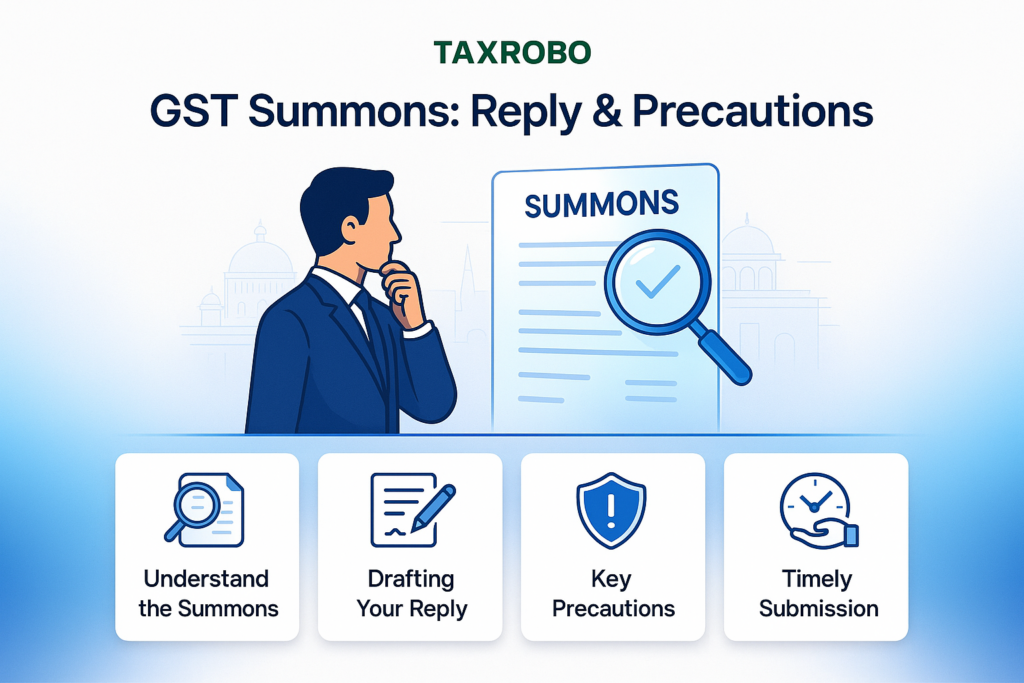
Receiving a formal communication from the GST department can be daunting for any business owner, and a summons, in particular, requires careful and immediate attention. This legal document is an official order that can feel intimidating, but understanding its purpose and the correct response procedure is the first step toward handling it effectively. A summons under Section 70 of the CGST Act, 2017, is a legal instrument requiring a person to appear before a GST officer to provide evidence or produce specific documents as part of an ongoing inquiry. It is crucial to remember that a timely and correct response is not just a legal obligation but also a critical measure to prevent hefty penalties and further legal complications. This comprehensive guide will provide a detailed breakdown of the official GST summons reply format, essential precautions, and clear guidelines on how to respond to GST summons India, empowering you to navigate the process with confidence and clarity.
What is a GST Summons under Section 70?
A GST summons is a powerful tool used by the tax authorities to gather information and evidence. It is fundamentally different from a routine notice as it carries the weight of a judicial proceeding, meaning non-compliance has more severe consequences. Understanding its legal basis, the authority of the issuing officer, and the common triggers for its issuance can significantly demystify the process for taxpayers. This knowledge helps in formulating a response that is not only compliant but also strategic, protecting your business interests while fulfilling your legal duties.
The Legal Framework: Understanding Section 70 of the CGST Act
Section 70 of the Central Goods and Services Tax (CGST) Act, 2017, grants authorized GST officers the power to summon any person whose attendance they consider necessary. This is one of the key Powers of GST Officers During Investigation (Section 67, 70, 74 Explained). This can be for the purpose of giving evidence or producing a document or any other tangible thing in an inquiry that the officer is making. A critical aspect to understand is that any inquiry conducted under this section is legally deemed to be a “judicial proceeding” within the meaning of Section 193 and Section 228 of the Indian Penal Code, 1860. This legal status elevates the seriousness of the summons; it means that providing false information can be treated as perjury, and any act of disrespect or interruption can be considered an insult to a public servant, both of which are punishable offenses. For a deeper dive into the legalities of the GST framework, you can explore our detailed article on understanding the key sections of the CGST Act.
Who Can Issue a GST Summons?
Not every officer in the GST department is empowered to issue a summons. The law specifies that only a “proper officer,” duly authorized, can exercise this power. Typically, an officer of the rank of Superintendent or above is vested with the authority to issue a summons under Section 70. When you receive a summons, one of the first and most important checks is to verify the authority of the issuing officer. The summons must be in writing, properly signed, and bear the official stamp. Furthermore, a crucial element for authenticity is the Document Identification Number (DIN). The CBIC has made it mandatory for all official communications, including summons, to have a computer-generated DIN. You can and should verify the genuineness of the DIN on the official CBIC portal to ensure the summons is legitimate. This verification can be done on the official CBIC website.
Common Reasons for Receiving a GST Summons
A summons is not issued arbitrarily; it is typically triggered by specific red flags or discrepancies identified by the GST department’s data analytics systems or during an ongoing investigation. Understanding these common triggers can help businesses maintain better compliance and proactively address potential issues before they escalate to the level of a summons.
- Mismatch in Input Tax Credit (ITC): One of the most frequent reasons is a significant discrepancy between the ITC you have claimed in your GSTR-3B return and the credit that is visible to the department in your GSTR-2A/2B.
- Suspicion of Fake Invoices: The department may summon you if they suspect your business is involved in creating fake invoices merely to pass on fraudulent ITC without the actual supply of goods or services. Handling such allegations requires a specific approach, which is detailed in our guide on Fake ITC Cases in GST – Latest Rules, Penalties & Defence Strategy.
- Investigation into a Third Party: You might be summoned not because you have done anything wrong, but because one of your suppliers or customers is under investigation. The department may require your testimony or documents related to your transactions with that party.
- Significant Variance in Returns: A large, unexplained difference between the turnover declared in your GSTR-1 (outward supplies) and GSTR-3B (summary return with tax payment) can trigger an inquiry.
- Non-filing or Chronic Delays: Consistent failure to file GST returns or significant delays in filing can lead the department to believe there may be tax evasion, prompting them to issue a summons to investigate the matter.
- Unusual Refund Claims: If you have claimed a substantial GST refund that appears unusual or lacks proper documentation, the department may summon you to verify the legitimacy of the claim before processing it.
How to Respond to GST Summons India: A Step-by-Step Guide
Receiving a summons can be stressful, but a systematic approach can make the process manageable. The key is to act promptly, be thorough, and ensure your response is professional and compliant. Following a structured process not only helps in meeting the legal requirements but also presents your case clearly and concisely to the tax authorities, potentially leading to a quicker resolution of the inquiry. Panicking or delaying your response can complicate matters, so it’s essential to follow these steps carefully.
Step 1: Verify the Authenticity of the Summons
Before you take any other action, the very first step is to confirm that the summons you have received is genuine. Do not panic. Carefully inspect the document for the following key details:
- Document Identification Number (DIN): As mentioned earlier, this is a mandatory, computer-generated number. An absence of a DIN could mean the summons is not valid.
- Summons Number and Date: The document must have a unique reference number and a clear date of issue.
- Issuing Officer’s Details: Check for the name, designation, and signature of the officer who has issued the summons.
- Official Seal/Stamp: A legitimate summons will always bear the official seal or stamp of the concerned GST office.
If any of these elements are missing or seem suspicious, it is advisable to seek clarification from the relevant GST office or consult with a tax professional immediately.
Step 2: Carefully Read and Understand the Requirements
Once you have verified the authenticity of the summons, your next task is to read it multiple times to fully comprehend its contents. A summons is a precise legal document, and every word matters. Pay close attention to:
- The specific reason for the summons: The document should state the purpose of the inquiry or the matter being investigated.
- The list of documents or records: It will contain a detailed list of all the documents, books of accounts, or other records that you are required to produce.
- The date, time, and place of appearance: Note down the exact schedule and location where you are required to be present. Understanding these details is fundamental to preparing an appropriate and complete response.
Step 3: Gather and Organize All Required Documents
After understanding what is required, begin the process of gathering and organizing the necessary paperwork. This is a critical step in the GST summons notice response procedures. Create a detailed checklist based on the list mentioned in the summons to ensure you don’t miss anything. Common documents requested include:
- Sales and Purchase Invoices
- Copies of GSTR filings (GSTR-1, GSTR-3B, GSTR-9, etc.)
- Bank Statements for the relevant period
- Sales and Purchase Ledgers
- E-way Bills
- Stock Registers
- Any other contracts or agreements relevant to the inquiry
It is highly recommended to make a complete set of photocopies of all the documents. Self-attest each copy (sign and write “True Copy”). You should carry the originals with you on the day of the hearing for verification by the officer, but only submit the self-attested copies unless specifically instructed otherwise.
Step 4: Drafting the Response: The Correct GST Summons Reply Format
Drafting a formal reply to accompany your documents is a crucial part of the process. A well-structured letter demonstrates professionalism and makes it easier for the officer to review your submission. Using this professional GST summons reply format ensures clarity and demonstrates your compliance.
Here is a simple and effective template you can follow:
[Your Company Letterhead]
Date: [Date of Reply]
To,
The [Designation of the Issuing Officer],
[Name of the GST Office/Commissionerate],
[Address of the GST Office].
Subject: Submission of Information/Documents in response to Summons dated [Date of Summons] bearing reference No. [Summons Number]
Respected Sir/Madam,
Paragraph 1 (Acknowledgement): This is with reference to the summons received by us on [Date of Receipt], bearing the reference number [Summons Number] dated [Date of Summons]. We hereby acknowledge the receipt of the said summons, which requires us to furnish certain documents and information in connection with an ongoing inquiry.
Paragraph 2 (Point-wise Reply): In compliance with the requirements of the summons, we are providing the requested information and documents in a point-wise manner as follows:
1. (Address the first point from the summons and state the document you are providing for it.)
2. (Address the second point from the summons and state the document you are providing for it.)
3. (Continue this for all the points mentioned in the summons.)
Paragraph 3 (Enclosures): Please find enclosed the self-attested copies of the following documents for your kind perusal and records:
- Encl. 1: Copy of GSTR-3B returns for the financial year 2022-23.
- Encl. 2: Copies of relevant sales invoices from [Date] to [Date].
- Encl. 3: Bank statement for the period [Start Date] to [End Date].
- (List all documents you are submitting)
Paragraph 4 (Cooperation): We assure you of our fullest cooperation in this inquiry. Should you require any further information, clarification, or documents, please do not hesitate to contact the undersigned.
Closing:
Thank you.
Sincerely/Yours faithfully,
(Signature)
[Your Name]
[Your Designation]
[Your Company Name]
[Contact Number]
GST Summons Precautions India: Key Do’s and Don’ts
Navigating a GST summons involves more than just submitting documents; your conduct during the process is equally important. Adhering to certain best practices can help ensure a smooth and favourable outcome, while common mistakes can lead to unnecessary complications. These GST summons guidelines for taxpayers are designed to help you handle the situation professionally.
Do’s: Essential Guidelines for Taxpayers
- Attend the summons: Punctuality is paramount. Always appear before the officer on the specified date and time. If you are genuinely unable to attend due to a valid reason (like a medical emergency), you must submit a written request for an adjournment well in advance. Ignoring the summons is not an option.
- Be truthful and accurate: Remember, this is a judicial proceeding. The statements you make are recorded and hold legal weight. Always provide information that is accurate and factual to the best of your knowledge. Providing false statements can lead to prosecution for perjury under the Indian Penal Code.
- Carry identity proof: When you go to the GST office, always carry a government-issued photo identification card such as your Aadhaar Card, PAN Card, or Passport for verification purposes.
- Seek professional help: This is one of the most important GST summons precautions India taxpayers should take. It is highly advisable to consult with a Chartered Accountant (CA) or a tax lawyer. They can help you understand the legal implications of the summons, prepare a robust and compliant response, and even accompany you during the proceedings. Their expertise is invaluable in navigating complex GST summons notice response procedures.
Don’ts: Mistakes to Avoid
- Don’t ignore the summons: Failing to comply with a summons without a valid reason is a punishable offense. Under Section 122(3)(d) of the CGST Act, a penalty of up to ₹25,000 can be levied for not appearing before the officer when summoned.
- Don’t submit original documents: Unless the officer specifically asks to retain an original document against a proper receipt, you should only provide self-attested photocopies. Keep the originals with you for on-the-spot verification but take them back after the officer has seen them.
- Don’t volunteer extra information: During the hearing, listen to the officer’s questions carefully. Answer only what is asked. Be precise, concise, and to the point. Volunteering unsolicited information can sometimes open up new lines of questioning that may not be in your best interest.
- Don’t lose your temper: The inquiry process can be long and stressful. However, it is essential to remain calm, composed, and cooperative throughout the proceeding. Being argumentative or disrespectful will not help your case and can create a negative impression.
Conclusion
A GST summons is undoubtedly a serious legal document, but it is not a cause for panic. It requires a systematic, professional, and timely response. The key takeaways for any taxpayer are to first verify the authenticity of the summons, carefully understand its requirements, meticulously gather all necessary documents, and follow the correct GST summons reply format while drafting your submission. By adhering to the crucial do’s and don’ts, you can ensure that you handle the inquiry in the most compliant and effective manner. Taking the right precautions and understanding your rights and obligations are critical steps that can protect you from penalties and unnecessary legal trouble, turning a potentially stressful situation into a manageable legal process.
Navigating a GST summons can be complex, and the stakes are high. If you need expert assistance in drafting a professional reply, organizing your documentation, or require representation before the tax authorities, it’s always best to rely on seasoned professionals. Contact TaxRobo’s team of GST experts today. We ensure your response is compliant, professional, and robustly protects your interests.
Frequently Asked Questions (FAQs)
1. What happens if I ignore a GST summons?
Ignoring a GST summons is a serious offense with significant consequences. The GST officer is empowered to impose a penalty of up to ₹25,000 under the CGST Act. Moreover, since the proceedings are treated as judicial proceedings, your non-compliance can lead to prosecution under Section 174 of the Indian Penal Code for non-attendance in obedience to an order from a public servant.
2. Can I send an authorized representative instead of appearing myself?
In many cases, you can authorize a representative, such as your Chartered Accountant, lawyer, or a senior employee, to appear on your behalf. You would need to provide them with a formal letter of authorization. However, you must carefully read the summons document; if it specifically requires your personal appearance, then you must attend in person. Even in such cases, your authorized representative can accompany you to provide assistance.
3. Do I need a lawyer to respond to a GST summons?
While it is not legally mandatory to hire a lawyer to respond to a GST summons, it is highly recommended. A tax expert or lawyer brings invaluable experience to the table. They can help you prepare the correct GST summons reply format India, ensure all your documents are in order, and advise you on the critical GST summons precautions India taxpayers should be aware of. Their guidance can be crucial in protecting your rights and ensuring a favourable outcome.
4. What is the difference between a GST notice and a GST summons?
A GST notice and a GST summons are both official communications from the tax department, but they differ in their legal severity. A notice is generally issued to seek information, ask for clarification, or prompt you to correct a discrepancy found during routine scrutiny of your returns (e.g., a scrutiny notice under Section 61). To understand this better, it’s helpful to know about The Significance of ‘Show Cause Notices’ in GST: Legal Framework and Compliance. A summons under Section 70, on the other hand, is a more stringent legal order. It compels your presence and/or the production of documents as part of a formal inquiry, which has the legal standing of a judicial proceeding.