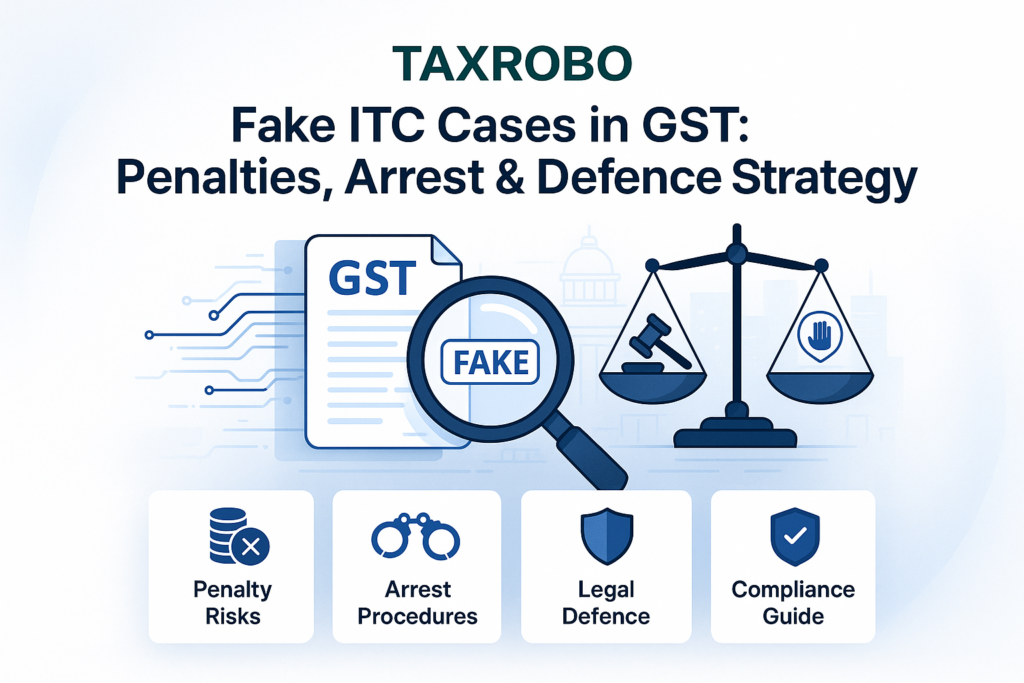

Fake ITC Cases in GST – Penalty, Arrest & Defence Strategy
Imagine opening your email to find a GST notice (Form DRC-01) from the tax department, alleging a fraudulent Input Tax Credit (ITC) claim of several lakhs. For any honest business owner, this is a nightmare scenario. The Goods and Services Tax (GST) system is built on the foundation of ITC, which allows you to reduce your tax liability by claiming credit for the GST you’ve already paid on your business purchases. However, this very mechanism is being exploited, leading to a surge in fake ITC cases that cause massive revenue loss to the government. This issue is not just a problem for tax evaders; genuine businesses can be unintentionally caught in the crossfire. This blog provides a complete guide to understanding fake ITC cases, their severe consequences, and most importantly, a practical strategy to defend your business.
Understanding Fake ITC Cases: How Do They Happen?
At the heart of most fake ITC claims is a simple yet illegal concept: claiming ITC on the strength of an invoice without any actual movement of goods or services. This is a deliberate attempt to defraud the exchequer. However, sometimes genuine businesses get embroiled when they unknowingly deal with a fraudulent supplier.
The Anatomy of a Fake Invoice
A fake invoice is a document that looks like a legitimate tax invoice but has been created solely for the purpose of passing on fraudulent ITC. Here are the common scenarios that lead to fake ITC cases in India:
- Invoice Mills: These are sham entities that exist only on paper. They are created with the sole purpose of issuing a large number of fake invoices to multiple businesses without supplying any goods or services. The recipients of these invoices then use them to illegally claim ITC.
- Circular Trading: This involves a group of companies issuing invoices to one another in a circular manner without any real supply of goods. This is done to artificially inflate turnover, which can help in obtaining higher credit limits from banks, while also fraudulently availing ITC at each stage.
- Invoices without Goods: A common scenario where a business receives an invoice from a supplier for goods or services that were never actually delivered. The recipient pays the GST amount to the supplier (who then absconds without paying it to the government) and claims ITC.
- Using a Defunct/Fake GSTIN: Fraudsters may use the GST Identification Number (GSTIN) of a closed or non-existent business to generate fake invoices, making it difficult to trace the origin of the fraud.
The Legal Red Lines: Key Sections of the CGST Act, 2017
To protect yourself, it’s crucial to understand the basic legal requirements for claiming ITC. The CGST Act, 2017, is very clear on this:
- Section 16: This is the most important section. It lays down the four mandatory conditions for claiming ITC:
- You must be in possession of a valid tax invoice or debit note.
- You must have actually received the goods or services.
- The tax charged on your purchase has been paid to the government by your supplier.
- You have filed your GST return (GSTR-3B).
- Section 122: This section details the penalty for fake ITC cases. It prescribes a hefty penalty for fraudulently availing ITC or issuing invoices without a supply.
- Section 132: This section elevates the issue from a civil to a criminal matter. It defines the fraudulent availment of ITC as a punishable offense, with provisions for imprisonment.
Actionable Tip: Before claiming ITC on any purchase, always run a quick mental check against the conditions of Section 16. Do you have the invoice? Did you receive the goods? Is your supplier compliant? This simple habit can save you from immense trouble.
The Severe Consequences of Fake ITC India: More Than Just a Fine
Getting implicated in a fake ITC matter goes far beyond a simple tax demand. The authorities are taking an extremely strict stance, and the consequences can be crippling for a business.
GST Fake ITC Penalties: The Financial Blow
The financial repercussions are severe and designed to be a strong deterrent. Under Section 122 of the CGST Act, the penalty for fake ITC cases is substantial.
- Monetary Penalty: The department will impose a penalty equivalent to 100% of the tax amount involved in the fraudulent claim, or ₹10,000, whichever is higher. So, if the fake ITC claimed is ₹10 lakhs, the penalty will also be ₹10 lakhs, making the total liability ₹20 lakhs plus interest.
- Interest: In addition to the tax and penalty, you will be liable to pay interest (currently at 18% per annum) on the wrongfully claimed ITC from the date it was availed until the date it is paid back. This can accumulate into a significant amount over time.
These GST fake ITC penalties are designed to recover the loss and punish the offender, often leading to a financial crisis for the business involved.
When Can You Be Arrested? Understanding Arrest in Fake ITC Cases
This is where the situation becomes truly serious. The GST law contains provisions for the arrest of individuals involved in major tax evasion.
- Under Section 69 of the CGST Act, the Commissioner has the power to order the arrest of a person if there is reason to believe they have committed an offense specified under Section 132.
- The monetary threshold for arrest in fake ITC cases is a critical factor. If the amount of fraudulent ITC claimed exceeds ₹5 crores, the offense becomes cognizable and non-bailable. This means the police can arrest the accused without a warrant, and getting bail is extremely difficult.
- Even for amounts between ₹2 crores and ₹5 crores, the offense is punishable with imprisonment up to three years and is a non-cognizable, bailable offense.
The power of arrest transforms a tax dispute into a criminal proceeding, putting the personal liberty of the business owner or key management personnel at risk.
Beyond Penalties: Other Damaging Consequences
The consequences of fake ITC India extend beyond financial penalties and potential arrest. The GST department has several other powers to ensure compliance and protect government revenue.
- Provisional Attachment: Under Section 83, the department can provisionally attach your business assets, including bank accounts and property, to safeguard revenue during the investigation. This can paralyze your business operations by cutting off your access to working capital.
- GST Registration Cancellation: Your GST registration can be suspended or even cancelled if you are found to be involved in issuing invoices without a supply of goods. Without a GSTIN, you cannot legally conduct business.
- Reputational Damage: Being associated with a tax fraud investigation can permanently damage your business’s reputation. It can destroy trust with your customers, suppliers, and financial institutions like banks, making it difficult to secure loans or credit in the future.
Your Shield: A Proactive and Legal Defence Strategy for ITC Cases
The best way to handle a fake ITC allegation is to prevent it from happening in the first place. A combination of proactive due diligence and a well-prepared response plan is your strongest shield.
Prevention is Better Than Cure: Due Diligence on Suppliers
The onus is often on the buyer to prove the legitimacy of a transaction. Therefore, conducting thorough due diligence on your suppliers is non-negotiable.
- Verify GSTIN: Before entering into a transaction with a new supplier, always verify their GSTIN on the official GST Portal. You can do this using the “Search Taxpayer” utility on https://www.gst.gov.in/. This confirms that the business is active and legitimate.
- Check Filing Status: Use the same utility to check the supplier’s return filing status. A supplier who is not filing their GSTR-1 and GSTR-3B returns regularly is a major red flag. If they don’t file, the tax they collect from you will never reach the government, and your ITC claim will be disallowed.
- Maintain Impeccable Records: Documentation is your best friend. For every transaction, ensure you have a complete and organized file containing:
- Valid Tax Invoice
- E-way Bill (for movement of goods)
- Delivery Challan or Lorry Receipt
- Weighment Slips
- Proof of Payment (Bank Statements)
- Reconcile Regularly: Make it a non-negotiable monthly task to reconcile your purchase records with the data appearing in your GSTR-2A and GSTR-2B. This helps you identify discrepancies early, such as an invoice from a supplier not appearing in your GSTR-2B, which could indicate non-payment of tax by them.
Fighting Fake ITC Charges India: A Step-by-Step Response to a Notice
If you do receive a notice from the GST department, how you respond in the initial hours is crucial.
- Step 1: Don’t Ignore the Notice: The worst thing you can do is ignore the notice or miss the deadline for a reply. This will be viewed negatively by the authorities and may lead to an ex-parte order against you without you getting a chance to present your case.
- Step 2: Analyse the Allegations: Read the notice carefully to understand the specific transactions, invoice numbers, and suppliers that are under scrutiny. Identify exactly what the department is alleging.
- Step 3: Collate All Evidence: Immediately gather all the documents related to the questioned transactions. This includes the invoices, e-way bills, proof of delivery, bank statements showing you paid the supplier, and any email or written communication you had with them.
- Step 4: Prepare a Detailed Reply: Draft a formal, point-by-point reply that systematically addresses each allegation made in the notice. Attach clear, legible copies of all your supporting documents as evidence.
- Step 5: Seek Expert Help: This is absolutely critical. Fighting fake ITC charges India is not a do-it-yourself task. The moment you receive a notice, engage a qualified tax consultant or lawyer. They have the expertise to interpret the notice, frame the strongest legal arguments, and represent you effectively before the tax authorities.
Crafting a Strong Legal Defence for Fake ITC Cases in India
When you are presenting your case, your entire legal defence for fake ITC cases in India should be built on proving one central point: you are a bona fide (good faith) purchaser. Your goal is to demonstrate that you took all reasonable steps to ensure the transaction was genuine.
Your defence should highlight the following:
– Proof of Due Diligence: Show the authorities the steps you took to verify the supplier’s credentials.
– Proof of Actual Receipt: Provide evidence like delivery challans, transport receipts, and entry records in your inventory to prove that you physically received the goods or services.
– Proof of Payment: Bank statements showing payment to the supplier through legitimate banking channels are powerful evidence, as they demonstrate a genuine commercial transaction.
A well-documented case proving that you acted in good faith significantly improves your chances of a favourable outcome and is the cornerstone of a successful defence strategy for ITC cases.
Conclusion
The crackdown on fake ITC cases is intensifying, and the consequences for non-compliance, whether intentional or accidental, are severe. The risk of crippling financial penalties, business disruption, and even arrest makes it imperative for every business owner to be vigilant. The best defence is a strong offense—implementing a robust system of supplier verification and meticulous record-keeping is no longer optional. It is fundamental to your business’s survival and growth.
Navigating a GST notice can be overwhelming. Don’t risk your business’s future. If you are facing scrutiny or want to build a foolproof compliance system, contact the experts at TaxRobo today. We specialize in creating a robust defence strategy for ITC cases and ensuring your peace of mind.
Frequently Asked Questions (FAQs)
1. What is the first thing I should do if I receive a GST notice for a fake ITC claim?
Answer: Do not panic. The first step is to carefully read the notice to understand the issue and immediately consult a GST expert or a tax lawyer. Do not ignore the deadline mentioned in the notice. Acting swiftly and professionally is key to a successful resolution.
2. Can I be penalized if my supplier is found to be fraudulent, even if I genuinely purchased the goods?
Answer: Yes, unfortunately. The burden of proof often falls on the recipient to prove the transaction’s legitimacy. The department can deny your ITC claim if your supplier has not paid the tax to the government. This is why maintaining thorough documentation and conducting supplier due diligence is critical for your legal defence in fake ITC cases in India.
3. What is the monetary threshold for arrest in fake ITC cases?
Answer: As per the CGST Act, if the amount of tax evaded or fraudulent ITC availed exceeds ₹5 crores, the offense is cognizable and non-bailable, meaning arrest is highly probable. Arrest can also occur for lower amounts depending on the circumstances and the commissioner’s discretion.
4. How can I verify a supplier’s GSTIN and filing status?
Answer: You can use the “Search Taxpayer” service on the official GST portal (https://www.gst.gov.in/) to verify a GSTIN and check their filing history. This is a simple but crucial step in preventing fraud and protecting your business.