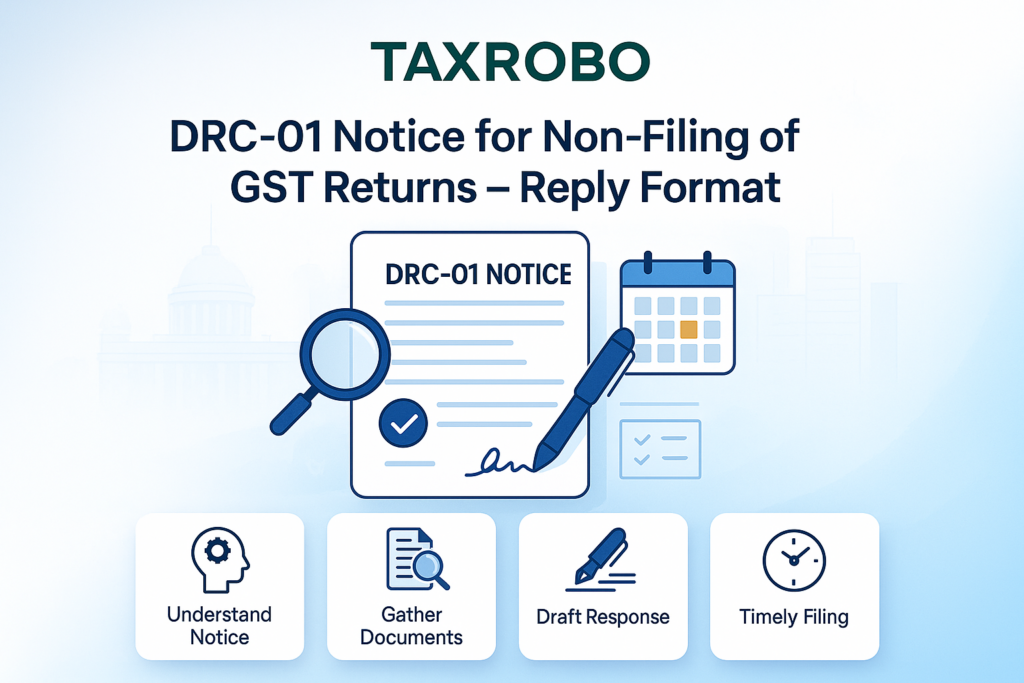

DRC-01 Notice for Non-Filing of GST Returns – A Complete Reply Format Guide
Receiving a notice from the GST department can be daunting for any business owner in India. Among the various communications, the DRC-01 notice is one that demands immediate and careful attention. This notice is a summary of a ‘Show Cause Notice’ (SCN) issued when the GST department believes you have an unpaid tax liability, often due to the non-filing of your GST returns. A timely and correctly structured response is not just a procedural formality; it is your first and most crucial step in resolving the issue without further complications. This article aims to demystify the process by providing a step-by-step guide and a detailed DRC-01 notice response format, empowering small businesses to handle this situation with confidence and clarity.
What is a DRC-01 Notice for Non-Filing of GST Returns?
Understanding the notice you’ve received is the first step toward resolving it. Many taxpayers get confused, thinking DRC-01 is the notice itself. However, it’s more accurate to see it as a summary statement that accompanies a detailed Show Cause Notice. To understand this better, you can read our guide on The Significance of ‘Show Cause Notices’ in GST: Legal Framework and Compliance. Its purpose is to present the grounds for the notice in a clear, tabulated format, making it easier for you to understand the government’s claim against you.
Decoding Form DRC-01
Form DRC-01 is formally issued as a summary of the notice under Section 73 (for non-fraudulent cases) or Section 74 (for cases involving fraud) of the CGST Act, 2017. Understanding the Key Differences Between Sections 73 and 74 of the CGST Act in GST Demand Notices is crucial for a proper response. In the context of non-filing, its primary function is to intimate you about the specific tax, interest, and penalty amounts that a proper officer has calculated based on the returns you failed to file, such as GSTR-1 and GSTR-3B. This notice usually doesn’t appear out of the blue. It is often preceded by other communications, such as a GSTR-3A notice (a reminder to file returns) or an ASMT-10 notice (intimating discrepancies in your returns). The issuance of DRC-01 signifies that the department is moving from a preliminary inquiry to a formal demand process, and your action is required to prevent further legal proceedings.
Key Details to Check in Your DRC-01 Notice
Once you receive the notice, it’s vital to carefully examine its contents. Rushing into a reply without verifying the details can lead to more problems. Take a moment to sit down with the document and cross-check every piece of information against your records. Here are the essential components you must verify:
- Notice Reference Number (NRN): This unique number identifies your specific case and must be quoted in all future correspondence.
- Date of Issue: This is critical as your deadline for response is calculated from this date.
- Tax Period(s) in Question: The notice will specify the exact months or quarters for which the returns are allegedly unfiled. Ensure this matches your understanding.
- Breakdown of Demand: Scrutinize the amounts mentioned. The notice will provide a clear breakdown of the tax (CGST, SGST/UTGST, IGST), the calculated interest on the delayed tax, and the proposed penalty.
- Deadline for Response: The notice will clearly state the date by which you must submit your payment or reply. Missing this deadline has serious consequences.
You can verify and view all official notices by logging into the official GST Portal.
Immediate Steps After Receiving the Notice
The moment a DRC-01 notice lands in your inbox or on your GST dashboard, it’s natural to feel a sense of urgency and perhaps some anxiety. However, a structured and calm approach is your best ally. Acting rashly can be as damaging as inaction. Follow these immediate steps to get a handle on the situation and prepare for a proper response.
Step 1: Don’t Panic, Verify the Notice
First and foremost, do not panic. The GST system is automated, and notices can sometimes be issued due to system lags or clerical errors. Your initial task is to confirm the notice’s authenticity. Log in to your GST Portal dashboard and navigate to Services > User Services > View Additional Notices/Orders. Here, you will find a record of all official communications sent to your GSTIN. If the notice you received via email is also present here, it is genuine. This step is crucial to protect yourself from potential phishing scams and to ensure you are acting on a legitimate demand from the tax authorities.
Step 2: Reconcile Your Records
With the notice verified, the next logical step is to turn to your own financial records. Gather all your books of accounts, sales registers, purchase invoices, e-way bills, and bank statements for the tax period(s) mentioned in the DRC-01. Your primary goal is to conduct an internal audit to ascertain the facts. Were the returns for the specified period truly missed? Was there a partial filing? Or have you filed everything, and the notice is an error? A thorough reconciliation will give you a clear picture of your compliance status and form the basis of your reply, allowing you to understand precisely how to reply DRC-01 notice in India.
Step 3: Decide Your Course of Action
After reconciling your records, you will arrive at a clear conclusion about the validity of the notice. This will lead you to one of two primary courses of action, each with a distinct set of procedures.
- Agree with the notice: If your internal review confirms that you did indeed miss filing the returns and the tax liability calculated is correct, the best path forward is to accept the liability, file the pending returns, and pay the dues promptly.
- Disagree with the notice: If you find that the notice is incorrect—either you have already filed the returns, or the tax amount calculated is wrong—you will need to contest the demand. This requires filing a formal, detailed written reply supported by evidence.
A Comprehensive Guide to the DRC-01 Notice Response Format
Your response strategy will depend entirely on whether you agree or disagree with the tax officer’s assessment. Each path requires a specific set of actions on the GST portal and a different type of communication. Understanding these differences is key to resolving the matter efficiently and correctly.
Scenario 1: You Agree with the Notice and Wish to Pay
This is the most straightforward scenario and often the quickest route to closure if the non-filing was a genuine oversight. The GST framework encourages voluntary compliance by offering benefits like reduced penalties for taxpayers who promptly pay their dues after a notice is issued. If your reconciliation shows the department is correct, follow these action steps immediately.
- File Pending Returns: The very first step is to complete the primary compliance that was missed. Log in to the GST portal and file all pending GSTR-1 and GSTR-3B returns for the period(s) mentioned in the notice. For a detailed walkthrough, you can follow our guide on How to File GST Returns Online: A Step-by-Step Guide of the GST Filing Process & Procedure.
- Calculate and Pay Liability: Once the returns are filed, the portal will auto-calculate the tax due. You must also manually calculate the applicable interest for the period of delay. Pay this entire amount (tax + interest) using Form GST DRC-03 on the portal.
- File Your Reply: After payment, you must formally inform the department. On the GST portal, in response to the DRC-01, you will file a simple intimation in Part A of Form DRC-01B. This part is specifically for acknowledging the notice and confirming that payment has been made. You should attach the payment challan (ARN of DRC-03) and the acknowledgement receipt numbers (ARNs) of the filed returns as proof of compliance.
Scenario 2: You Disagree (Partially or Fully) and Wish to Reply
If your records show that the notice is incorrect, you must prepare a robust and formal reply. Simply ignoring the notice because you believe it’s wrong is not an option and will lead to an ex-parte order against you. Your goal is to present a clear, point-by-point rebuttal to the claims made in the Show Cause Notice, supported by documentary evidence. This is where a professional and well-structured non-filing notice reply format India becomes absolutely essential. Your reply should be polite, factual, and legally sound, demonstrating that you have met your compliance obligations or that there are valid reasons for your position.
Sample GST Return Non-Filing Reply Template
A well-drafted written reply is the cornerstone of your defense when you disagree with a DRC-01 notice. It should be structured logically, state the facts clearly, and make a specific request to the officer. The following template covers the essential components and can be adapted to your specific situation.
Essential Components of Your Written Reply
Your reply should be drafted on your business letterhead and addressed to the officer who issued the notice. It should be concise yet comprehensive. For your convenience, here is a template that you can use.
[Date]

To,
The Proper Officer,
[Jurisdiction/Address as per Notice]

Subject: Reply to Show Cause Notice (SCN) - Ref: [Your Notice Reference Number] dated [Date of Notice]

Reference:
1. GSTIN: [Your GSTIN]
2. Legal Name: [Your Legal Name]
3. Trade Name: [Your Trade Name]

Respected Sir/Madam,

1. This letter is in response to the Show Cause Notice summarized via Form DRC-01, received on [Date of Receipt], concerning the non-filing of GST returns for the tax period(s) [Mention Tax Periods, e.g., April 2023 to June 2023].

2. Factual Position & Submissions:
   (Choose the applicable reason and elaborate. Be precise and provide evidence.)
   *   Case A - Returns Filed After Notice: We admit the delay in filing due to [Mention a brief, genuine reason if any]. However, we have since complied and filed all pending returns. The details are as follows:
       *   Return Type: GSTR-3B | Tax Period: [Month/Year] | ARN: [ARN Number] | Date of Filing: [Date]
       *   (Add more rows as needed for each return filed)
   *   Case B - Technical Glitch/Other Reason: The non-filing was due to [Explain the genuine reason in detail, e.g., a prolonged technical issue on the GST portal for which a grievance was raised, an unforeseen medical emergency affecting the proprietor, etc.]. We have attached [Mention supporting document, e.g., screenshot of portal error with ticket number, medical certificate] as evidence of our situation.
   *   Case C - Incorrect Notice: We respectfully submit that this notice appears to have been issued in error. Our records indicate that all returns for the said period were filed within the due dates. The details of our filings are:
       *   Return Type: GSTR-3B | Tax Period: [Month/Year] | ARN: [ARN Number] | Date of Filing: [Date]
       *   (We have attached copies of the filing acknowledgements for your reference.)

3. Payment of Admitted Liability (if any):
   (Use this section if you have paid the tax and interest after receiving the notice, as in Case A)
   We have paid the admitted tax and interest liability via Form DRC-03. The payment details are as follows:
   *   Challan Identification Number (CIN): [CIN Number]
   *   Date of Payment: [Date]
   *   (A copy of the DRC-03 challan is attached.)

4. Prayer:
   In light of the above submissions and the evidence provided, we humbly request your good office to consider our reply favorably and drop the proceedings initiated by the said Show Cause Notice. If applicable, we also request a lenient view and a waiver of the penalty as the delay was unintentional and all dues have been cleared.

Thank you for your consideration.

Sincerely,
[Your Name]
[Designation]
[Business Name]
How to Upload Your Reply on the GST Portal
Once you have drafted your detailed reply and collected all supporting documents, you need to submit them officially through the GST portal. Follow these steps:
- Log in to the GST Portal.
- Navigate to `Services > User Services > View Additional Notices/Orders`.
- Find the relevant notice using the reference number and click `View`.
- Navigate to the `Replies` tab and click on `ADD REPLY`.
- You will be prompted to respond in Part B of the form. Here, you can type a brief summary of your response.
- Click the `Upload` button to attach your detailed written response (saved as a PDF) and any other supporting documents (like ARNs, challans, or other evidence).
- Once all documents are attached, submit the reply and file it using your Digital Signature Certificate (DSC) or Electronic Verification Code (EVC).
Conclusion
Receiving a DRC-01 notice for the non-filing of returns is a serious matter, but it is manageable with a prompt and systematic approach. The key is to verify the notice, thoroughly analyze the facts by reconciling your records, and respond within the stipulated deadline using the correct DRC-01 notice response format. Whether you agree with the demand and pay up or disagree and contest it, a clear, well-documented reply is critical to resolving the issue efficiently. Remember, ignoring a notice is never an option and will only lead to more severe consequences, including ex-parte orders and recovery proceedings. A proactive approach protects your business and ensures you remain in good standing with the tax authorities.
Feeling overwhelmed by GST notices? Navigating tax compliance can be complex. The experts at TaxRobo are here to help you draft a professional reply, ensure compliance, and manage your GST filings seamlessly. Contact us today for a consultation!
Frequently Asked Questions (FAQs)
1. What happens if I ignore a DRC-01 notice?
Answer: If you don’t respond to the DRC-01 notice within the given timeframe, the tax officer is empowered to pass an order based on the information available to them. This is known as an ex-parte order. They will finalize the demand (tax, interest, and penalty) and can initiate recovery proceedings, which may include garnishee notices to your banks to freeze your accounts or attachment of your property.
2. Is there a time limit to respond to a DRC-01 notice?
Answer: Yes, there is a strict time limit. The deadline for filing your reply or making the payment is mentioned in the notice itself, which is typically 30 days from the date of issue. It is crucial to adhere to this timeline to avoid adverse actions and to be eligible for any potential penalty waivers.
3. Can I file my pending returns after receiving the DRC-01 notice?
Answer: Absolutely. In fact, if you agree that the returns were not filed, it is the very first thing you should do. Filing all pending returns and paying the associated tax and interest before you reply can significantly strengthen your case. For notices under Section 73 (non-fraud cases), doing so can lead to a substantial reduction or even a complete waiver of the penalty.
4. What is the difference between a reply in Part A and Part B of the form on the portal?
Answer: When you go to reply to the notice on the GST portal, you will see options for Part A and Part B. They serve different purposes:
* Part A is for intimation of payment. You use this when you fully accept the liability stated in the notice and have already made the payment using DRC-03.
* Part B is for filing a detailed reply. You use this when you want to contest the notice, either in full or in part. You provide your arguments and upload supporting documents here. Our non-filing notice reply format India guide and template are designed to help you prepare the detailed written document required for a Part B submission.