
DRC-01 Notice for Classification Dispute under GST – Reply Format
Receiving a formal notice from the GST department can be daunting for any business owner. One such critical notice that demands immediate and careful attention is Form DRC-01. While it can be issued for various reasons, this guide focuses on a common yet complex issue: classification disputes. If you’ve received a notice questioning your product’s HSN code or service’s SAC code, understanding how to draft a comprehensive DRC-01 notice reply is your most crucial first step. A classification dispute arises from a simple disagreement: the tax officer believes your goods or services fall under a different category with a higher GST rate than the one you have applied. This guide will demystify the GST classification dispute procedure in India and provide a detailed template to help you draft an effective response, protecting your business from potential tax demands and penalties.
What is a DRC-01 Notice? A Detailed Explanation for Indian Businesses
Before drafting a response, it is essential to understand what the notice signifies and why you received it. A DRC-01 notice is not an arbitrary demand; it is a structured communication from the tax authorities that initiates a formal inquiry into your tax filings. Knowing its components and triggers is fundamental to formulating a successful rebuttal. This section breaks down the notice and explores the common reasons behind its issuance for classification-related discrepancies.
Understanding the DRC-01 Notice Explanation India
Form GST DRC-01 is essentially a summary of a Show Cause Notice (SCN) issued by a proper officer. It is typically issued under Section 73 of the CGST Act for cases where tax has not been paid or has been short-paid due to reasons other than fraud, willful misstatement, or suppression of facts. In more severe cases involving fraud, it is issued under Section 74. Understanding the Key Differences Between Sections 73 and 74 of the CGST Act in GST Demand Notices is vital for taxpayers. It’s crucial to understand that a DRC-01 is not a confirmed tax demand. Instead, it is an opportunity for you, the taxpayer, to present your case, submit evidence, and explain why the tax liability proposed by the officer is incorrect. Upon receiving the notice, you must immediately verify key details like your GSTIN, the unique Document Identification Number (DIN), the specific tax period under scrutiny, the legal provisions cited by the officer, and a clear description of the alleged discrepancy. This initial review helps you grasp the core of the department’s query and begin preparing your defense.
Why Did You Receive a DRC-01 for a Classification Dispute?
A classification dispute is at the heart of many GST notices, as the HSN (Harmonized System of Nomenclature) for goods and SAC (Services Accounting Code) for services directly determine the applicable GST rate. The tax department may issue a DRC-01 notice for a classification dispute due to several common triggers. A thorough DRC-01 notice explanation India often reveals one of the following underlying issues:
- Incorrect HSN/SAC Code Application: The most frequent cause is using an HSN or SAC code that attracts a lower tax rate (e.g., 5% or 12%) when the tax officer believes the product or service correctly falls under a higher tax slab (e.g., 18% or 28%).
- Ambiguity in Product/Service Description: If the description of goods or services on your invoices is vague or lacks sufficient detail, it can lead to misinterpretation by the tax authorities, prompting them to question your chosen classification.
- Misinterpretation of Tax Laws: The GST tariff schedules, notifications, and circulars can be complex. A genuine misinterpretation of these legal documents can lead to an incorrect classification that is later challenged by the department.
- Industry-wide Inconsistencies: If other businesses in your industry are classifying a similar product under a different HSN code with a higher tax rate, it can trigger an investigation into your classification practices.
How to Respond to a DRC-01 Notice: A Step-by-Step Guide
A timely and well-structured response is critical. Ignoring the notice or sending a weak, unsupported reply can lead to an adverse order confirming the tax demand. Following a systematic process ensures that your reply is comprehensive, legally sound, and effectively communicates your position to the tax officer. Here is a step-by-step guide on how to respond to DRC-01 notice effectively.
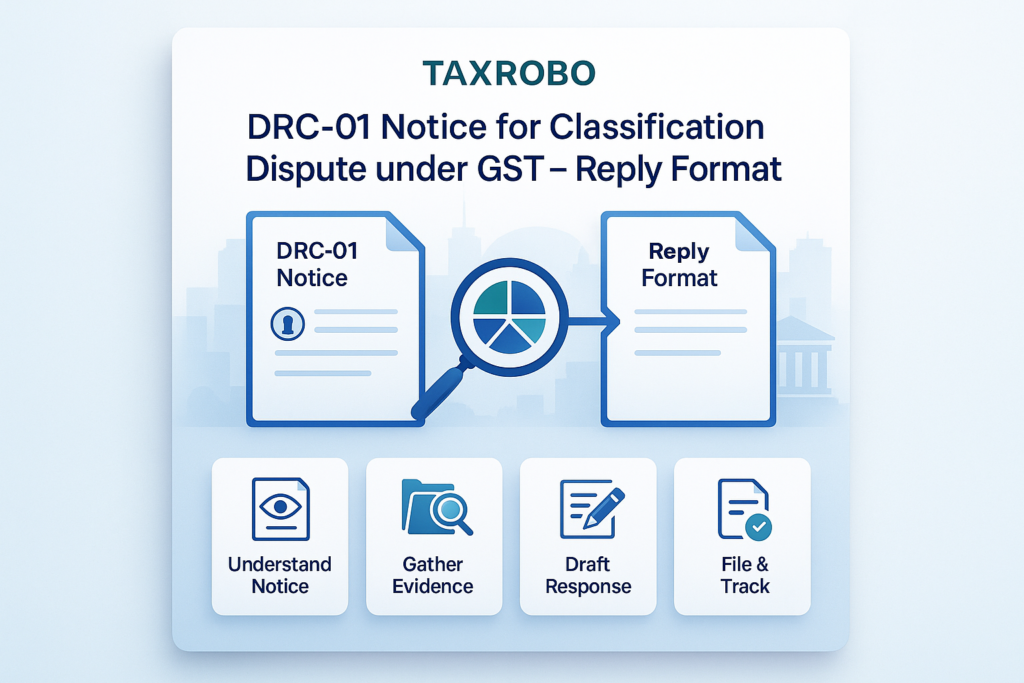
Step 1: Acknowledge and Analyze the Notice
The first and most important rule is to never ignore a GST notice. As soon as you receive the DRC-01, carefully note the deadline for filing your reply, which is usually mentioned in the notice itself. Missing this deadline can result in the officer passing an ex-parte order (an order without hearing your side), confirming the proposed tax demand. Once you’ve noted the deadline, begin the process of gathering all relevant documentation that can substantiate your case. This includes, but is not limited to, copies of tax invoices for the period in question, supply contracts or agreements that describe the nature of the goods or services, product brochures or marketing materials, technical specifications, and any expert opinions you may have previously sought regarding the product’s classification.
Step 2: Research and Build Your Case
With all your documents in hand, the next step is to conduct thorough research to build a strong, evidence-based argument for your chosen classification. Your goal is to prove that the HSN or SAC code you have been using is correct based on legal provisions and factual evidence. A great place to start is the official GST Portal, which has an HSN/SAC code search tool. However, your research should go deeper. You must review the Customs Tariff Act, 1975, which forms the basis for the HSN code structure in India. Additionally, look for relevant CBIC circulars, notifications, and any advance rulings or court judgments (from appellate authorities, High Courts, or the Supreme Court) that have dealt with the classification of similar products or services. These legal precedents can significantly strengthen your reply.
Step 3: Draft a Comprehensive DRC-01 Notice Reply
Your written reply is the cornerstone of your defense. It must be formal, factual, logical, and meticulously address every single allegation or point raised in the Show Cause Notice. A vague or emotional response will be ineffective. Instead, structure your reply to systematically counter the officer’s arguments with your own justifications, supported by the evidence and legal research you have compiled. The reply should be drafted in a clear and professional manner, making it easy for the officer to understand your line of reasoning. The subsequent section of this article provides a detailed DRC-01 response template to guide you in structuring your submission perfectly.
Step 4: File Your Reply in Form GST DRC-06
The official response to a DRC-01 notice must be filed electronically on the GST portal using Form GST DRC-06. Simply sending a physical letter or an email is not sufficient and will not be considered a formal reply. The online filing process is straightforward. After logging into your GST account, you need to navigate through the dashboard: Services > User Services > My Replies. Here, you can select the relevant notice and use the ‘Add Reply’ option to upload your written submission (typically in PDF format) along with all the supporting documents you have gathered. This ensures your reply is officially recorded in the GST system.
The Perfect DRC-01 Notice Reply Format for a Classification Dispute
Structuring your response correctly is just as important as the content itself. A well-organized reply makes your arguments clear and compelling. Using a standard reply format for DRC-01 notice ensures you cover all necessary components and present a professional case to the tax authorities.
Part A: Introduction and Preliminary Submission
This initial section sets the context for your reply. It should be concise and formal, establishing the reference to the notice and outlining the basic facts of the case from your perspective.
- Reference: Begin by clearly stating the Show Cause Notice number (and DIN), its date, and the name and designation of the issuing authority. For example: “Ref: Show Cause Notice No. [SCN Number] dated [Date].”
- Acknowledgement: Formally acknowledge the receipt of the notice. A simple statement like, “This is with reference to the Show Cause Notice cited above, which has been duly received by us,” is sufficient.
- Summary of Facts: Briefly state the nature of your business and the product/service in question. You should present the facts neutrally without admitting to any liability. The purpose is to establish your understanding of the case before you present your arguments.
Part B: Detailed Justification and Legal Arguments (The Core of Your Reply)
This is the most critical part of your submission. Here, you will systematically dismantle the department’s arguments and build your own case with evidence and legal citations. Each argument should be presented as a separate point for clarity.
- Heading: Use a clear heading like: “Submissions on the Correct Classification of [Product/Service Name] under HSN/SAC [Your Code]”
- Argument 1: Nature and Characteristics of the Product/Service: Describe your product or service in exhaustive detail. Explain its composition, manufacturing process, primary function, and end-use. The goal is to connect these inherent characteristics directly to the description of the HSN/SAC code you have used, demonstrating a logical fit.
- Argument 2: Interpretation of the Tariff/HSN Rules: This is a technical but vital argument. Refer to the General Rules for Interpretation (GRI) of the HSN Tariff. For example, you might argue that based on GRI 3(a), which prioritizes specificity, your chosen HSN code is the most appropriate. Explaining how these internationally accepted rules support your classification adds significant weight to your classification notice reply example.
- Argument 3: Citing Supporting Documents: Explicitly mention all the supporting documents you are attaching with your reply. Refer to them within your arguments. For instance, “As detailed in the attached technical literature (Annexure-A), the primary function of the product is…” This links your claims directly to tangible proof.
- Argument 4: Referencing Legal Precedents: If your research uncovered any favorable advance rulings, appellate orders, or court judgments for similar products, cite them clearly. Mention the case name, the authority that passed the order, and the relevant paragraphs that support your classification choice. This shows that your interpretation of the law is not isolated but is backed by judicial or quasi-judicial wisdom.
Part C: Prayer and Conclusion
This final section summarizes your position and formally requests the desired outcome.
- Concisely restate your main arguments, emphasizing that your classification is correct, bona fide, and not intended to evade tax.
- Make a formal request to the officer. This is often called the “prayer.” For example: “In light of the facts, legal provisions, and evidence submitted above, we humbly pray that the proceedings initiated via the aforementioned Show Cause Notice be dropped and the notice be vacated.”
- Conclude by stating your willingness to cooperate further. Mention that you are ready to provide any additional information required or attend a personal hearing to explain the matter in more detail.
What Happens After Filing Your DRC-01 Notice Reply?
Submitting your reply in Form DRC-06 is a major step, but it is not the end of the process. The proper officer will review your submissions and decide on the future course of action. Understanding the potential outcomes helps you stay prepared for what comes next.
Potential Outcomes
Once your DRC-01 notice reply is filed, there are two primary outcomes:
- Case Dropped (Form GST DRC-05): If the officer is convinced by your reply, finds your arguments valid, and agrees with the evidence presented, they will conclude the proceedings. An order will be issued in Form GST DRC-05, formally dropping the Show Cause Notice. This is the most favorable outcome for the taxpayer.
- Order Issued (Form GST DRC-07): If the officer is not satisfied with your written submissions, they are required to grant you an opportunity for a personal hearing. After the hearing, if they are still not convinced, they will proceed to issue a final tax demand order in Form GST DRC-07. This order confirms the tax liability, along with applicable interest and penalty, and is a formal demand for payment.
Your Next Course of Action
If you receive a favorable outcome in Form DRC-05, no further action is required from your side. However, if an adverse order is passed in Form DRC-07, you do not have to accept it as final. The GST law provides a clear appellate mechanism. You have the right to file an appeal against the DRC-07 order before the designated appellate authority within the stipulated time frame. This allows for a fresh review of your case by a higher authority.
Conclusion
A DRC-01 notice for a classification dispute, while intimidating, is a procedural step that you can navigate successfully with a methodical approach. The key lies in not panicking and instead focusing on preparing a timely, structured, and evidence-backed response. A well-prepared DRC-01 notice reply serves as your primary defense, showcasing that your classification is bona fide and legally sound. Ensuring correct GST classification from the outset is fundamental to long-term compliance, and The Importance of Accurate Record-Keeping to Prevent GST Demand Notices cannot be overstated as it helps in avoiding such disputes altogether.
Navigating the complexities of GST notices can be challenging. Don’t risk your business’s financial health. Let TaxRobo’s GST experts draft a professional and effective DRC-01 notice reply India on your behalf. Contact us today for expert assistance!
FAQs: Common Questions on DRC-01 Notice Reply
1. What is the time limit to file a reply to a DRC-01 notice?
The time limit is generally 30 days from the date of the notice. However, you must always check the specific deadline mentioned in the notice you received, as it can sometimes vary.
2. Can I just pay the tax mentioned in DRC-01 without filing a reply?
Yes, you can pay the proposed tax and interest via Form GST DRC-03. In non-fraud cases (Section 73), paying within 30 days of the notice may even lead to the waiver of penalties. However, this is considered an admission of liability. If you believe your classification is correct, it is essential to file a detailed reply to contest the notice.
3. What is the difference between Form DRC-01 and DRC-01A?
DRC-01A is a pre-notice consultation, formally an “Intimation of Tax Ascertained as being payable.” It is sent to the taxpayer *before* a formal Show Cause Notice is issued, giving them an opportunity to pay the tax without formal proceedings. DRC-01 is the official Show Cause Notice that formally initiates the legal proceedings. Understanding The Significance of ‘Show Cause Notices’ in GST: Legal Framework and Compliance is key to handling the entire process.
4. Is it mandatory to hire a professional for a DRC-01 notice reply?
While not mandatory, it is highly recommended. Classification disputes involve a technical interpretation of GST law, HSN tariff headings, explanatory notes, and legal precedents. A professional like a Chartered Accountant or a tax lawyer ensures your DRC-01 notice reply is legally robust and structured correctly, which significantly increases your chances of a favorable outcome.
5. Where can I officially check the HSN code for my product?
The primary legal source for HSN codes is the Customs Tariff Act, 1975, which is aligned with the international HSN system. For user-friendly access and guidance, you can use the HSN search functionality available on the official GST Portal. You can also refer to the detailed tariff documents and circulars published on the CBIC website.