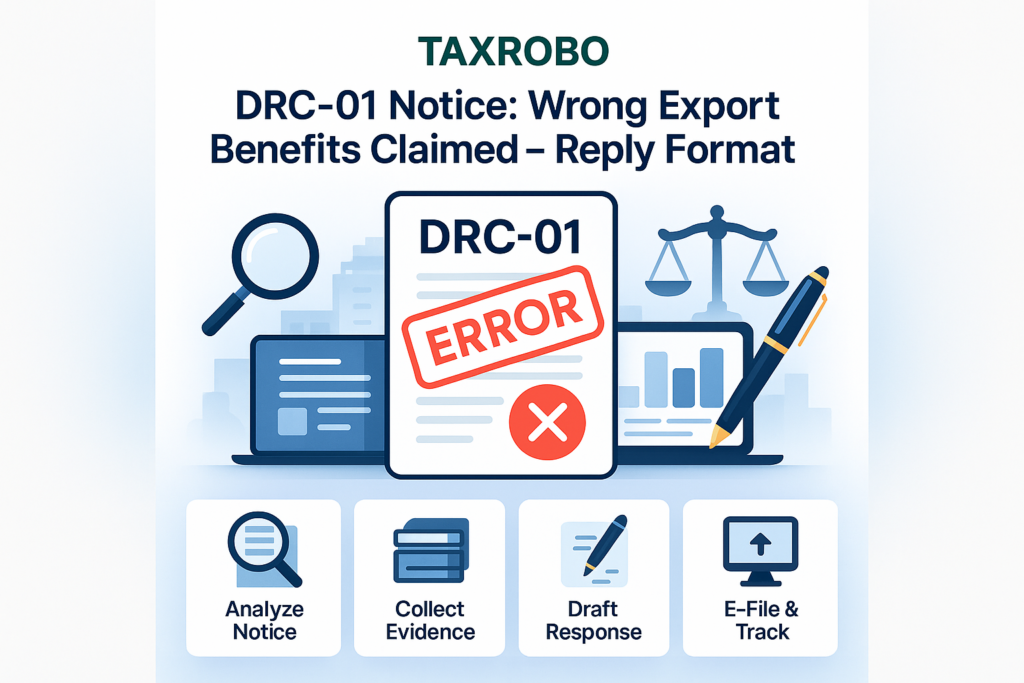

DRC-01 Notice for Wrong Export Benefits Claimed – Reply Format
Receiving a notice from the GST department can be stressful, especially for exporters who rely on timely benefits to manage their cash flow and remain competitive in the global market. A DRC-01 notice concerning wrongly claimed export benefits is a serious matter that requires a precise, timely, and legally sound response. This comprehensive guide provides a detailed DRC-01 notice reply format specifically designed for Indian exporters. We will break down the entire process, from understanding the notice and its implications to drafting and submitting a professional response, ensuring you can handle this challenge confidently and protect your business interests.
What is a DRC-01 Notice? A Simple Explanation for Indian Exporters
Before you can draft a reply, it’s crucial to understand what this notice signifies. Panicking is a common reaction, but knowing the purpose behind the form can help you approach the situation with a clear strategy. A DRC-01 notice is not a final demand for payment; it is an opportunity for you to present your side of the story, supported by facts and evidence. Understanding its components is the first step toward a successful resolution.
Understanding the Purpose of a DRC-01 Notice
In simple terms, FORM GST DRC-01 is a formal Show Cause Notice (SCN) issued by a GST officer when they have reason to believe that tax has been underpaid, not paid, or an incorrect refund has been claimed. It is issued under either Section 73 (for cases without allegations of fraud) or Section 74 (for cases involving fraud) of the Central Goods and Services Tax (CGST) Act, 2017. The primary purpose of this notice is to communicate the officer’s findings and give you, the taxpayer, a formal opportunity to explain why the proposed tax demand, along with applicable interest and penalty, should not be confirmed. This DRC-01 notice explanation India is a fundamental principle of natural justice, ensuring that no adverse order is passed without hearing from the person affected. For a deeper understanding, it’s important to grasp The Significance of ‘Show Cause Notices’ in GST: Legal Framework and Compliance.
Common Reasons for Receiving a DRC-01 for Wrong Export Benefits
For exporters, a DRC-01 notice is often triggered by discrepancies found during the data reconciliation process between the GST and Customs departments. Here are some of the most common scenarios that lead to such a notice:
- Discrepancy in GSTR-1 and Shipping Bills: This is a frequent issue where the details declared in your GSTR-1 return do not match the data in the shipping bills filed with the Customs authorities. Mismatches can occur in invoice values, HSN codes, product quantities, or even the port code.
- Erroneous IGST Refund: An exporter might receive a notice if they have claimed a refund on the Integrated GST (IGST) paid on exports while simultaneously availing the benefit of a higher rate of duty drawback. Under GST rules, you cannot claim both benefits concurrently. This falls under the concept of Understanding the Concept of ‘Erroneous Refund’ in GST and Its Consequences.
- Ineligible Goods/Services: Claiming export benefits or the status of a “zero-rated supply” for goods or services that do not qualify under the GST law can trigger a notice. This could be due to misclassification or a misunderstanding of the export regulations.
- Non-realization of Export Proceeds: A key condition for treating a supply as an export is the receipt of payment in convertible foreign exchange within the time limit prescribed by the Reserve Bank of India (RBI) under the Foreign Exchange Management Act (FEMA). Failure to produce evidence of such realization, like a Bank Realisation Certificate (BRC), can lead to the GST department treating the supply as a domestic one and demanding tax payment. Preparing a detailed export benefits claim response India for this issue is critical.
Decoding Your DRC-01 Notice: Key Components to Look For
Once you receive the notice, don’t just look at the final demand amount. A thorough examination of the entire document is essential to craft an effective reply. Each section contains vital information that will shape your defense strategy. Treat the notice like a roadmap provided by the department, detailing exactly what you need to address in your response.
Section-by-Section Breakdown of the Notice
Carefully read through the notice and identify these key components. Understanding the DRC-01 notice guidelines India will help you structure your reply logically.
- SCN Reference Number & Date: This unique number is your key identifier for this specific case. You must quote it in all future correspondence, including your reply and any online submissions.
- Legal Provisions Cited: Look closely to see if the notice is issued under Section 73 or Section 74 of the CGST Act. This is critically important as it dictates the potential penalty, the burden of proof, and the overall seriousness of the allegation.
- Grounds of the Notice: This is the heart of the SCN. It will contain a detailed explanation of the officer’s reasons for proposing the tax demand. It will list the discrepancies found, the documents relied upon, and the legal reasoning. Your reply must address every single point raised in this section.
- Quantification of Demand: Usually presented in a summary table, this section will clearly state the proposed tax liability, the calculated interest up to a certain date, and the proposed penalty amount. Double-check these calculations against your own records.
Understanding the Difference: Section 73 vs. Section 74
The section under which the notice is issued has significant implications. Knowing the difference is crucial for framing your response and understanding the potential financial impact. Exploring the Key Differences Between Sections 73 and 74 of the CGST Act in GST Demand Notices will provide further clarity.
| Feature | Section 73 (Non-Fraud Cases) | Section 74 (Fraud Cases) |
|---|---|---|
| Reason for Issuance | Tax not paid or short-paid for any reason other than fraud, willful misstatement, or suppression of facts. | Tax not paid or short-paid due to fraud, willful misstatement, or suppression of facts to evade tax. |
| Penalty Amount | Up to 10% of the tax amount or Rs. 10,000, whichever is higher. | Mandatory penalty equal to 100% of the tax amount. |
| Penalty Waiver | If tax and interest are paid within 30 days of the notice, the penalty is waived. | If tax, interest, and a 25% penalty are paid within 30 days, further proceedings are closed. |
| Burden of Proof | The department needs to establish a tax shortfall. | The department has a higher burden to prove the element of fraud or willful suppression. |
| Recommendation | Can often be resolved with a clear factual reply and supporting documents. | Strongly recommended to seek professional legal/tax assistance due to the severe implications. |
The Ultimate Guide to Preparing Your DRC-01 Notice Reply Format
Now we come to the most critical part: drafting your response. A well-structured, fact-based reply is your best defense. The following DRC-01 notice reply format provides a professional and comprehensive template that you can adapt to your specific situation. Remember to maintain a formal and respectful tone throughout the document.
Part 1: The Essential Header Information
Your reply should be drafted on your company’s official letterhead and begin with the following standard information to ensure it is correctly identified and routed.
[Your Company Name]
[Your Company’s Registered Address]
GSTIN: [Your GST Identification Number]Date: [Date of Reply]
To,
The [Designation of the Issuing Officer, e.g., Assistant Commissioner of GST]
[Address of the GST Office as mentioned in the notice]Reference: Show Cause Notice (SCN) No. [Enter the full SCN Number] dated [Enter the Date of the SCN]
Subject: Reply to Show Cause Notice in FORM GST DRC-01 regarding [Briefly state the issue, e.g., Alleged erroneous refund of IGST on exports for the period FY 20XX-XX]
Part 2: Structuring the Body of the Response (Template)
This section forms the core of your argument. Follow this paragraph-by-paragraph structure to build a logical and persuasive case. This response template DRC-01 notice covers all necessary components.
Respected Sir/Madam,
1. Introduction:
This is with reference to the Show Cause Notice (SCN) bearing reference no. [SCN Number] dated [SCN Date], issued to us under Section [73/74] of the CGST Act, 2017. We have received and carefully reviewed the contents of the said SCN and are hereby submitting our detailed point-wise reply as follows for your kind consideration.2. Facts of the Case:
At the outset, we would like to state the facts of the case from our perspective. We, [Your Company Name], are engaged in the business of exporting [mention your goods/services]. During the period in question, we undertook an export transaction vide Invoice No. [Invoice No.] dated [Invoice Date] and Shipping Bill No. [Shipping Bill No.] dated [Shipping Bill Date]. We have complied with all procedural requirements for the export and have correctly claimed the IGST refund as a zero-rated supply.3. Point-wise Rebuttal to Allegations:
The allegations made in the SCN and our submissions against each are presented below in a structured manner:Allegation 1: [Quote or accurately summarize the first allegation from the SCN, e.g., “It has been alleged that there is a mismatch between the invoice value declared in GSTR-1 (Rs. 5,00,000) and the value declared in the Shipping Bill (Rs. 4,50,000).”]
Our Reply/Submission: The allegation is respectfully denied. The difference in value is due to [provide a clear reason, e.g., an early payment discount offered to the foreign buyer after the GSTR-1 was filed but before the goods were shipped]. The final transaction value as realized is Rs. 4,50,000, which is correctly reflected in the Shipping Bill and the Bank Realisation Certificate. We have attached a complete reconciliation statement (Refer Annexure-A), the relevant commercial invoice (Refer Annexure-B), and the Bank Realisation Certificate (Refer Annexure-C) to substantiate our claim.
Allegation 2: [Quote or summarize the second allegation.]
Our Reply/Submission: [Provide a detailed counter-argument with references to your evidence. Repeat this structure for every single allegation made in the notice.]
4. Legal Submissions:
In support of our contentions, we rely on the following legal provisions, circulars, and judicial precedents:
- As per Section 16 of the IGST Act, 2017, the export of goods is considered a ‘zero-rated supply’, and we have fulfilled all conditions prescribed under this section.
- We also draw your attention to CBIC Circular No. [mention any relevant circular number] dated [date], which clarifies the procedure for [mention the relevant issue].
5. Prayer (Conclusion):
In light of the facts, documentary evidence, and legal submissions presented above, it is evident that we have correctly claimed the export benefits and have not violated any provisions of the GST Act. The allegations in the SCN are based on a misinterpretation of facts and are not tenable. We humbly pray your good office to review our submission in detail, accept our contentions, and drop the proceedings initiated by the aforementioned SCN in the interest of justice. We also request an opportunity for a personal hearing to explain our case in person before any adverse order is passed.Thanking you,
For [Your Company Name],
(Signature)
[Name of Authorized Signatory]
[Designation]
This reply format for DRC-01 notice ensures you address everything systematically.
Part 3: Compiling and Attaching Supporting Documents (Annexures)
Your words are only as strong as the evidence that backs them up. Attaching clear, legible copies of all relevant documents is non-negotiable.
- Create a Cover Sheet: Start with a list of all annexures.
- Essential Documents:
- Copy of Shipping Bills / Bill of Export.
- Copy of Export Invoices (both commercial and tax invoices).
- Bank Realisation Certificates (BRCs) or Foreign Inward Remittance Certificates (FIRCs).
- Copies of the relevant GSTR-1 and GSTR-3B returns filed.
- A detailed reconciliation statement explaining any differences between GST returns and customs documents.
- Any relevant correspondence with customs, banks, or other authorities.
- Reference Clearly: Ensure each document is numbered as an Annexure (e.g., Annexure-A, Annexure-B) and is clearly referred to in the body of your reply.
How to Submit Your Reply: The DRC-01 Reply Process for Exporters
Once your reply and all annexures are ready, you must submit them officially through the GST portal. Manual submissions are generally not accepted. Knowing how to respond DRC-01 notice India online is a key part of the process.
Online Filing via the GST Portal (in FORM GST DRC-06)
Follow these steps for a smooth submission:
- Log in to the official GST Portal: GST Portal.
- Navigate to the dashboard and go to: Services > User Services > My Applications.
- In the Application Type dropdown, select “Reply to Show Cause Notice” and then click on “New Application“.
- The system will display any SCNs issued to your GSTIN. Find the relevant SCN by its reference number and click on it.
- This will take you to FORM GST DRC-06, which is the official form for filing your reply.
- You will find fields to add your reply. It’s best practice to write a brief summary in the text box (e.g., “Detailed reply attached”) and upload your comprehensive reply.
- Combine your detailed reply (drafted as per the format above) and all your scanned annexures into a single PDF file.
- Upload this consolidated PDF file in the designated section.
- Finally, submit the form using a Digital Signature Certificate (DSC) or an Electronic Verification Code (EVC).
This DRC-01 reply process for exporters ensures your response is officially recorded in the system.
Timelines and What to Expect After Submission
The standard timeline to file a reply to a DRC-01 notice is 30 days from the date of its issuance. After you submit your reply in FORM DRC-06, the GST officer will review your submissions. The next steps typically involve:
- Review of Reply: The officer examines your facts, legal arguments, and evidence.
- Personal Hearing: You will be called for a personal hearing to present your case. It is crucial to attend this hearing.
- Final Order: After the hearing, the officer will issue a final order in FORM GST DRC-07, either dropping the notice if they are satisfied with your explanation or confirming the demand (partially or fully) if they are not.
Don’t Risk It: When to Seek Professional Help from TaxRobo
While this guide provides a comprehensive template, navigating the nuances of GST law can be incredibly complex. A single misstep can have significant financial consequences for your business.
Why a Professional Reply Matters
An improperly drafted reply, weak legal arguments, or incomplete documentation can lead to the confirmation of the tax demand, imposition of heavy penalties, and potentially years of costly litigation. The GST authorities are meticulous, and your response needs to be equally so. A professional brings expertise in interpreting the law, citing relevant case laws, and presenting your facts in the most effective manner possible.
How TaxRobo’s GST Experts Can Help
Don’t navigate the complexities of a DRC-01 notice alone. The expert team at TaxRobo has extensive experience in handling GST litigation and can provide end-to-end support. We can help you:
- Thoroughly analyze the SCN to identify its legal strengths and weaknesses.
- Draft a legally robust and factually accurate DRC-01 notice reply format tailored to your specific case.
- Compile all necessary documentation and create a compelling evidence file to support your case.
- Represent you during personal hearings with the GST authorities, ensuring your arguments are presented clearly and professionally.
Take the guesswork and stress out of the process. Contact TaxRobo Today for Expert Assistance with Your GST Notice.
Conclusion
Facing a DRC-01 notice for export benefits can be daunting, but a systematic and well-documented response is your strongest defense against an adverse order. By thoroughly understanding the allegations in the notice, gathering strong documentary evidence, and using a structured DRC-01 notice reply format, you can present your case effectively and professionally. The key is to be proactive, factual, and legally sound in your submissions. Remember, timely and professional action is crucial. If you have any doubts about the legal arguments or the process, consulting with an expert like TaxRobo can make all the difference in achieving a favorable outcome and protecting your hard-earned export business.
Frequently Asked Questions (FAQ)
Q1. What happens if I ignore a DRC-01 notice?
If you fail to respond to a DRC-01 notice within the stipulated time, the GST officer has the authority to pass an ex-parte order. This means an order will be passed based solely on the information available to them, without hearing your side of the story. This almost always results in the confirmation of the entire proposed demand, along with interest and the maximum applicable penalty.
Q2. What is the difference between FORM DRC-01 and DRC-01A?
DRC-01A is an intimation of tax liability issued before a formal Show Cause Notice. It is a pre-notice consultation that gives the taxpayer an opportunity to pay the liability voluntarily (in FORM DRC-03) without the issuance of a formal SCN. If the taxpayer does not pay or does not agree with the intimation, the department then issues the formal Show Cause Notice in FORM DRC-01.
Q3. Can I just pay the amount mentioned in the notice to close the matter?
Yes, you can pay the proposed tax and interest using FORM GST DRC-03. If the notice is under Section 73 (non-fraud) and you make the payment within 30 days of the notice, the penalty is typically waived, and proceedings are concluded. However, making a payment is an admission of liability. It is crucial to first assess if the demand is legally and factually correct before deciding to pay.
Q4. Is a personal hearing mandatory after I file my DRC-01 reply?
As per the principles of natural justice embedded in the GST law, the officer must grant an opportunity for a personal hearing if you request it in your written reply or if they are contemplating passing an order that is adverse to you. It is always a best practice to explicitly request a personal hearing in the “Prayer” section of your reply to ensure you have a chance to explain your case in person.