
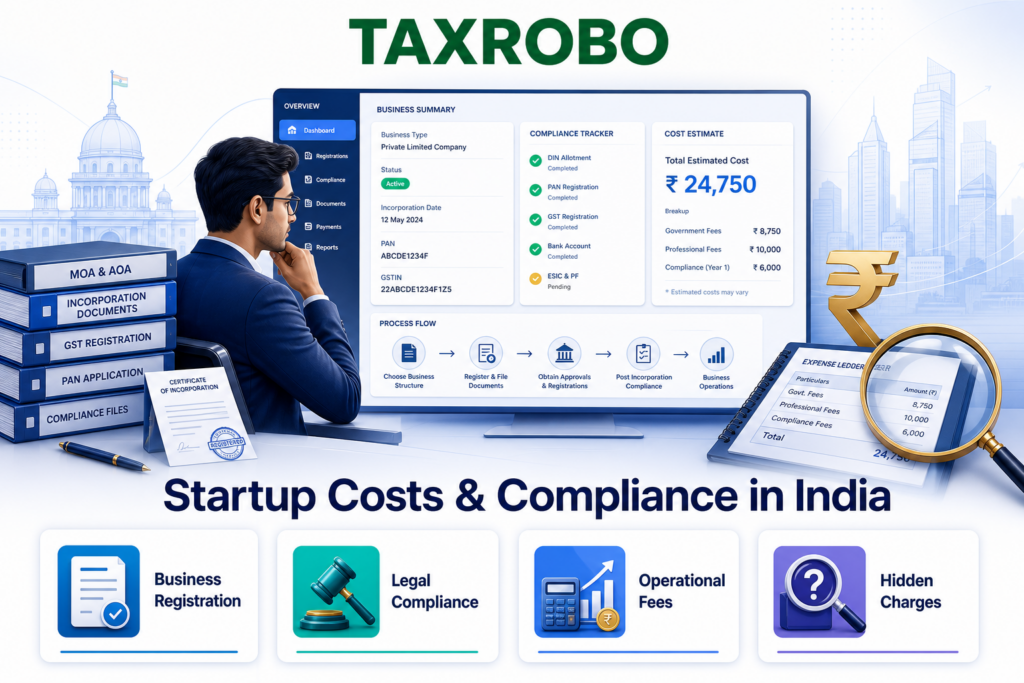

The Real Cost of Starting a Business in India in 2026: Registration, Compliance and Hidden Fees
Turning your entrepreneurial dream into a reality in India is more accessible than ever before. But while the passion is free, the process isn’t. Many aspiring founders focus on their big idea and overlook the practical financial details that bring it to life. Underestimating the cost of starting a business is a common and critical pitfall that can derail a startup before it even gets off the ground. The final figure you need to budget for goes far beyond a simple registration fee, encompassing a wide range of legal, compliance, and operational expenses that are crucial for a smooth launch. This comprehensive guide breaks down the real startup costs in India 2026, giving you a transparent look at what to expect. We’ll cover everything from initial business registration fees India and mandatory licenses to ongoing compliance requirements for startups in India and the unexpected hidden fees for starting a business in India that often catch new entrepreneurs by surprise. By the end of this post, you’ll have a clear, actionable roadmap to budget accurately for your business launch and embark on your journey with financial confidence.
The First Hurdle: Choosing Your Business Structure
The legal structure you choose for your venture is the single most significant factor influencing the initial cost of starting a business. Each entity type—from a simple Sole Proprietorship to a structured Private Limited Company—comes with its own distinct set of registration costs, compliance burdens, and long-term legal implications. Making an informed decision at this stage is vital, as it sets the foundation for your company’s financial and operational future. Let’s compare the most common options available to entrepreneurs in India to help you understand the financial commitments associated with each. This comparison is a key part of Choosing the Right Legal Structure for Your Business.
| Business Structure | Estimated Registration Cost | Liability | Best For |
|---|---|---|---|
| Sole Proprietorship | ₹1,500 – ₹5,000 | Unlimited | Single founders, freelancers, small traders |
| Partnership Firm | ₹3,000 – ₹8,000 | Unlimited | Two or more partners, simple businesses |
| LLP | ₹6,000 – ₹12,000 | Limited | Professionals, service-based businesses |
| Pvt. Ltd. Company | ₹7,000 – ₹15,000 | Limited | Startups seeking funding and scalability |
1. Sole Proprietorship
A Sole Proprietorship is the simplest and most straightforward business structure, where the law sees no distinction between the business and its owner. This model is ideal for single founders, freelancers, and small-scale traders who want to get started quickly with minimal legal formalities. There is no formal registration required with the Ministry of Corporate Affairs (MCA), which significantly brings down the initial setup costs. The primary expenses are typically related to obtaining essential licenses to operate legally, such as a GST Registration if your turnover exceeds the threshold, a Shop and Establishment License as per your state’s regulations, and an MSME/Udyam Registration to avail of government benefits. The estimated cost for these basic registrations usually falls between ₹1,500 and ₹5,000, making it the structure with the lowest registration cost for businesses in India. However, the main drawback is unlimited personal liability, meaning your personal assets can be used to settle business debts.
2. Partnership Firm
A Partnership Firm is a business structure owned and managed by two or more individuals, known as partners, who agree to share profits and losses. The entire relationship is governed by a legal document called a Partnership Deed, which outlines the roles, responsibilities, and capital contributions of each partner. The primary registration cost involves drafting this Partnership Deed and having it notarized on appropriate stamp paper, the value of which varies from state to state. While registering the firm with the Registrar of Firms is optional, it is highly recommended as it provides legal benefits, such as the ability to sue third parties in the firm’s name. The overall estimated cost, including professional fees for drafting the deed and any optional registration, typically ranges from ₹3,000 to ₹8,000. This makes it a relatively low-cost option for starting a business with multiple owners, but just like a proprietorship, all partners bear unlimited personal liability for the business’s debts.
3. Limited Liability Partnership (LLP)
A Limited Liability Partnership, or LLP, is a modern hybrid business structure that combines the operational flexibility of a traditional partnership with the significant advantage of limited liability, a feature typically associated with companies. In an LLP, the partners’ personal assets are protected from business debts and liabilities. The registration process is more formal and is handled by the MCA. Costs include obtaining a Digital Signature Certificate (DSC) and a Designated Partner Identification Number (DPIN) for the partners, reserving the business name through the RUN-LLP service, filing the FiLLiP incorporation form, and drafting the LLP Agreement on state-specific stamp paper. The consolidated business registration fees India for an LLP, including government fees and professional charges, generally range from ₹6,000 to ₹12,000. This structure is an excellent, balanced choice for professionals like consultants, architects, and service-based businesses that want legal protection without the extensive compliance of a private limited company.
4. Private Limited Company (Pvt. Ltd.)
A Private Limited Company is the most popular and robust legal structure for startups in India, especially those aiming for significant growth, scalability, and external funding. It is recognized as a separate legal entity, meaning the company’s assets and liabilities are distinct from those of its owners (shareholders), providing them with limited liability protection. The incorporation process is managed through the integrated SPICe+ form on the MCA portal and involves obtaining DSCs and Director Identification Numbers (DINs) for the directors, getting the company name approved, and filing incorporation documents like the Memorandum of Association (MoA) and Articles of Association (AoA). While government fees for companies with an authorized capital of up to ₹15 Lakh are minimal, costs include stamp duty (which varies by state) and professional fees. The estimated total startup cost in India for registering a Private Limited Company typically falls between ₹7,000 and ₹15,000. While it has the highest initial cost and ongoing compliance requirements, it is essential for any entrepreneur looking to raise investment from venture capitalists or angel investors.
Beyond Incorporation: Mandatory Licenses & Registrations
Once your business entity is formally incorporated, the journey isn’t over. To operate legally and smoothly, you must obtain several other licenses and registrations. These permits are crucial for regulatory compliance and are often specific to your industry, location, and scale of operations. The overall cost of starting a business in India must account for these essential permits, as neglecting them can lead to severe penalties and operational disruptions. Factoring these into your initial budget is non-negotiable for building a sustainable and law-abiding enterprise from day one.
GST Registration
Goods and Services Tax (GST) Registration is a mandatory requirement for businesses whose annual turnover exceeds ₹40 lakhs for the supply of goods or ₹20 lakhs for the supply of services. These thresholds may vary for certain states and special category regions. For startups, mastering this first step to compliance is key, a process detailed in our guide on Launching Your Startup Right – Mastering GST Registration in India. Even if your turnover is below the limit, obtaining GST registration can be beneficial as it allows you to claim input tax credits and is often a prerequisite for dealing with other registered businesses. While registration on the official GST Portal is technically free of charge, the application process can be complex. Many entrepreneurs opt for professional assistance from a CA or tax consultant to ensure all details are filed correctly, which can cost anywhere between ₹1,500 and ₹3,000.
Udyam / MSME Registration
Udyam Registration is a government-backed recognition for businesses to be classified as Micro, Small, or Medium Enterprises (MSMEs). This registration is not mandatory but is highly recommended as it unlocks a wide array of benefits, including eligibility for priority sector lending from banks, access to government schemes and subsidies, and preference in public procurement tenders. The process is straightforward and can be completed online through the official Udyam Registration Portal. The best part is that this registration is completely free, and entrepreneurs should be wary of any third-party agents charging a fee for this service.
Shop and Establishment Act License
The Shop and Establishment Act License is a state-specific registration that is mandatory for almost every commercial establishment, including shops, offices, restaurants, and even home-based businesses in many jurisdictions. This license governs working hours, employee rights, and workplace conditions. The cost and application process vary significantly from one state to another. In some states, the fee is based on the number of employees, while in others, it’s a fixed charge. The cost can range from as low as ₹500 to as high as ₹10,000 or more, depending on your location and the size of your workforce.
Industry-Specific Licenses
Beyond the general licenses, certain industries require special permits to operate legally. The cost of starting a business in these sectors can increase substantially due to these requirements. For example:
- FSSAI License: Any business involved in the manufacturing, processing, storage, or sale of food products must obtain a license from the Food Safety and Standards Authority of India. The cost ranges from a basic registration of ₹100 per year to a central license costing ₹7,500 per year.
- Import Export Code (IEC): This is a mandatory 10-digit code for any business engaging in the import or export of goods from India. The government fee for a new IEC is a one-time payment of ₹500.
- PSARA License: Private security agencies must obtain a license under the Private Security Agencies (Regulation) Act, which can be a complex and costly process, sometimes running into lakhs of rupees.
The Ongoing Expense: Annual Compliance Costs for Indian Startups
Starting a business in India in 2026 is just the initial step; maintaining it in good legal standing is an ongoing commitment. The recurring compliance costs for Indian startups are a critical and often underestimated part of the operational budget. These are not one-time fees but annual or periodic expenses required to keep your business compliant with various laws and regulations. Failing to meet these statutory deadlines or filing incorrect information can attract heavy penalties, legal notices, and even lead to the disqualification of directors. Therefore, it’s essential to plan for these costs from the very beginning to ensure the long-term health and sustainability of your venture.
Annual ROC Filings (For Pvt. Ltd. & LLP)
Both Private Limited Companies and LLPs are required to file annual returns and financial statements with the Registrar of Companies (ROC) to maintain their active status. This is a non-negotiable part of the compliance requirements for startups in India. For a detailed overview, entrepreneurs should understand What are the ROC Compliance for Private Limited Company?.
- For a Private Limited Company: Key filings include Form AOC-4 (to file financial statements like the Balance Sheet and Profit & Loss Account) and Form MGT-7/7A (the Annual Return containing details about shareholders, directors, and corporate governance).
- For an LLP: The mandatory filings are Form 11 (Annual Return) and Form 8 (Statement of Accounts & Solvency).
The process of preparing these documents and filing them requires professional expertise. The estimated annual cost, including auditor and professional fees, typically ranges from ₹8,000 to ₹20,000, depending on the complexity of your business.
Accounting & Bookkeeping
Maintaining proper and accurate books of accounts is not just good business practice—it’s a legal requirement. These records form the basis for all your financial statements and tax filings. The costs associated with this can be broken down into two main components. First, you’ll need accounting software like Zoho Books or Tally, which can cost between ₹5,000 and ₹15,000 per year. Second, unless you are an accounting expert yourself, you will need to hire a part-time accountant or an outsourced professional firm to manage your books. This service can cost anywhere from ₹3,000 to over ₹25,000 per month, depending on the volume of your business transactions and the level of service required.
Tax Filings (GST & Income Tax)
Regular and accurate tax filing is one of the most critical compliance activities for any business. The costs here are primarily for professional assistance to ensure error-free and timely submissions to the tax authorities.
- GST Returns: Businesses registered under GST must file monthly or quarterly returns (like GSTR-1 and GSTR-3B). Professional fees for managing GST compliance can range from ₹1,000 to ₹5,000 per month.
- Income Tax Return (ITR): Your business entity must file an annual income tax return. The fee for preparing and filing the ITR for a company or LLP can range from ₹5,000 to ₹25,000 or more, based on the complexity of the accounts.
- TDS Compliance: If you are required to deduct tax at source (TDS), you must also file quarterly TDS returns.
You can find more information about tax obligations on the official Income Tax Department portal.
Statutory & Tax Audits
An audit is an independent examination of a company’s financial records to ensure they are fair and accurate.
- Statutory Audit: This is mandatory for all Private Limited Companies, irrespective of their turnover or profit. A chartered accountant must audit the company’s financial statements annually.
- Tax Audit: Under the Income Tax Act, a tax audit is mandatory if your business turnover exceeds ₹1 crore in a financial year (this limit is higher under certain conditions if transactions are digital).
The cost for these audits depends heavily on the size and complexity of your business operations. A reasonable estimate for a small to medium-sized business would be between ₹15,000 and ₹50,000+ per year.
Don’t Get Caught Out: The Hidden Fees for Starting a Business in India
Beyond the clear-cut government and professional fees for registration and compliance, there are several other expenses that contribute significantly to the total startup cost in India. These “hidden” costs are often overlooked during the initial planning phase but are essential for getting your business up and running smoothly. Budgeting for these items from the start is crucial to avoid financial strain and ensure you have a solid foundation for your operations. Ignoring them can lead to unexpected cash flow problems right when you need to be focused on growth.
Registered Office Address
Every company and LLP in India is legally required to have a registered office address, which serves as its official correspondence address for all communications from government authorities. If you are not using your own property, you will incur costs here.
- Rented Premise: If you rent a commercial office space, you’ll need to account for a hefty security deposit (often equivalent to 3-6 months’ rent) and the ongoing monthly rent.
- Virtual Office: For many startups, especially service-based ones, a physical office is unnecessary. A virtual office is a highly cost-effective solution. For a monthly fee of ₹1,000 to ₹3,000, these services provide you with a professional commercial address, mail handling services, and sometimes access to meeting rooms, fulfilling the legal requirement without the high cost of a physical lease.
Bank Account Requirements
Opening a dedicated current account in the name of your business is a mandatory step after incorporation. While opening the account itself is usually free, most banks impose a Minimum Average Balance (MAB) requirement to avoid service charges. This MAB can range from ₹10,000 to as high as ₹1,00,000 for premium accounts. This amount is essentially locked-in capital that you cannot use freely. Failure to maintain the required MAB can result in monthly penalty charges, which can eat into your funds. It’s important to shop around and find a bank that offers a current account with an MAB that fits your initial budget.
Intellectual Property (IP) Protection
While not a mandatory legal requirement for starting a business, protecting your intellectual property is one of the most critical investments you can make for your brand’s long-term value. This is especially true if you have a unique brand name, logo, invention, or creative work.
- Trademark Registration: Registering your brand name or logo as a trademark prevents others from using it and builds brand identity. The entire process, including government fees and professional charges, typically costs between ₹9,000 and ₹15,000.
- Copyright/Patent: If your business involves software, creative works, or a unique invention, you should consider copyright or patent protection. The costs for these can vary significantly based on the complexity and scope of the IP, often running much higher than a trademark.
Conclusion: Calculating Your Total Cost of Starting a Business
As we’ve seen, the true cost of starting a business in India is a multifaceted figure that is a sum of multiple critical parts. To budget accurately, you need to consider the complete financial picture, which goes far beyond a single registration fee. Your total initial and ongoing investment will be a combination of:
- One-Time Registration Costs: This is based on your chosen business structure and can range from ₹5,000 to ₹15,000+.
- License Fees: These are dependent on your specific industry and state of operation and can add another ₹2,000 to ₹20,000+ to your initial outlay.
- Annual Compliance Costs: This is the biggest recurring expense for any formal business structure, typically ranging from ₹25,000 to ₹1,00,000+ per year for a small company.
- Hidden & Operational Costs: This includes essentials like your registered office solution, bank minimum balance, and any IP protection you choose to pursue.
Planning your budget is as crucial as planning your business model. Being fully aware of the total startup cost in India ensures that you are financially prepared for the journey ahead, preventing early-stage cash flow issues and setting your venture up for long-term success. A well-planned budget is your first step towards building a sustainable and thriving enterprise.
Feeling overwhelmed by the numbers and legal complexities? You don’t have to navigate this alone. TaxRobo offers transparent, all-inclusive packages for company registration and annual compliance, designed specifically for startups like yours. Contact our experts today for a free consultation and take the first confident step towards starting a business in India in 2026.
Frequently Asked Questions (FAQs)
1. What is the absolute cheapest way to register a business in India?
The absolute cheapest way to start is as a Sole Proprietorship. This structure requires no formal registration with the Ministry of Corporate Affairs (MCA), eliminating significant government and professional fees. Your only mandatory expenses would be for basic licenses like a Shop and Establishment license and GST registration (if your turnover exceeds the threshold). In most cases, you can get these done for under ₹5,000. However, it’s crucial to remember that this low cost comes with the major disadvantage of unlimited personal liability, meaning your personal assets are at risk if the business incurs debt.
2. Can I handle the registration and compliance myself to save money?
While it is technically possible to navigate the government portals and file forms yourself, it is generally not recommended for beginners. The processes for incorporation (like the SPICe+ form) and annual compliance are complex, documentation-heavy, and prone to errors. A small mistake can lead to application rejection, costly delays, and significant penalties down the line. Hiring a professional firm like TaxRobo for the registration cost for businesses in India ensures accuracy, speed, and compliance, giving you peace of mind and allowing you to focus on building your business. The professional fee is a small price to pay to avoid future legal and financial complications.
3. How much should I budget for the first year of running a Private Limited Company?
For the first year of operating a Private Limited Company, a safe and realistic budget for legal and compliance fees is essential. You should account for the initial one-time registration cost, which is approximately ₹7,000 to ₹15,000. In addition to this, you must budget for the first year’s annual compliance, which for a small, newly-started company would include accounting, ROC filings, and an audit, costing approximately ₹30,000 to ₹50,000. Therefore, a total of ₹50,000 to ₹70,000 is a reasonable estimate for your basic legal and compliance expenses in the first year, separate from your other operational costs.
4. Do I need a physical office to start my business?
No, you do not necessarily need a physical office to start your business in India. For the purpose of a registered office address, which is a legal requirement, you have several options. You can use your residential address for registration if you have a No-Objection Certificate (NOC) from the property owner. An even more professional and cost-effective solution is to opt for a virtual office service. For a small monthly fee, this service provides you with a commercial address in a prime location, mail handling, and other related services, allowing you to fulfill the legal requirement without the high overheads of renting a physical space.