
Private Limited, LLP or Proprietorship? Choosing the Right Structure for 10 Trending Businesses
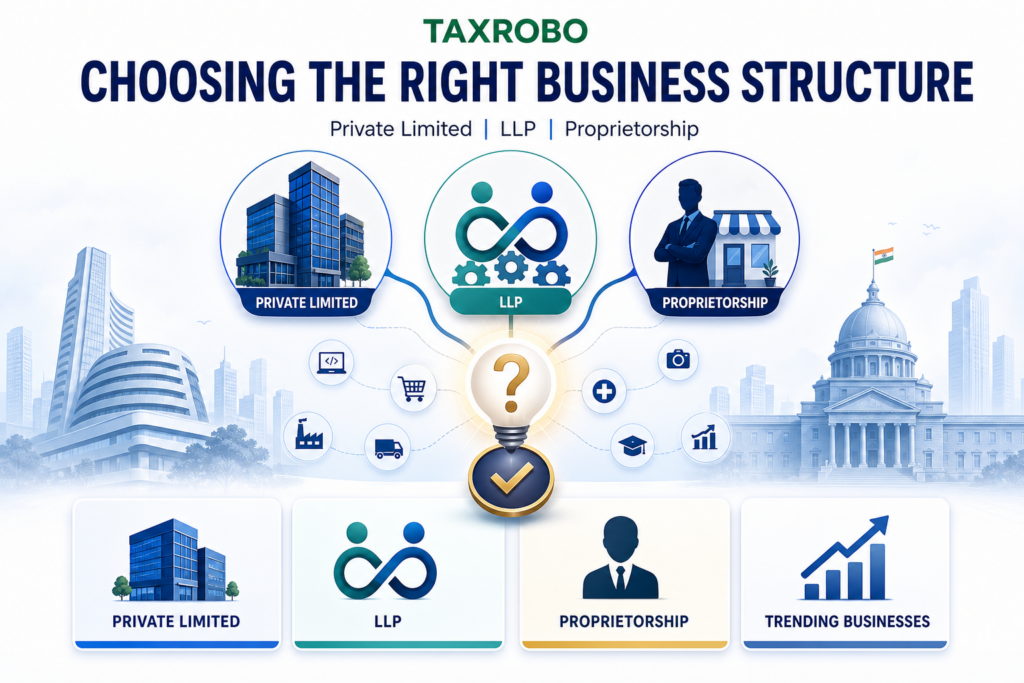
India is now home to over 100 unicorns, a testament to its thriving startup ecosystem. But every successful venture, whether it becomes a billion-dollar company or a beloved local business, starts with one critical decision: its legal structure. This initial choice has long-term implications for your liability, taxation, ability to raise funds, and day-to-day compliance. Therefore, choosing the right business structure is one of the most foundational steps any entrepreneur will take. It’s a decision that can either pave the way for smooth growth or create significant roadblocks down the line. This comprehensive guide to business structures in India will break down the three most popular options—Sole Proprietorship, LLP, and Private Limited Company—and help you decide which is best for 10 of today’s most trending business ideas, giving you a clear path forward from the many business structure options for startups.
Understanding the Core Business Structures in India
Before diving into specific business ideas, it’s crucial to understand the fundamental differences between the most common entity types. Here’s a breakdown for understanding private limited and LLP India and where the classic proprietorship fits into the modern business landscape. Each structure is designed for a different purpose, scale, and vision, and knowing these differences is the first step toward making an informed choice for your new venture. The right foundation will support your business as it grows and evolves, protecting you and enabling your long-term goals.
Sole Proprietorship: The Solopreneur’s Starting Point
A Sole Proprietorship is the simplest and most common business structure in India. In this model, the business is not legally separate from its owner; you and your business are one and the same in the eyes of the law. There is no formal registration process required to establish a proprietorship, although you will need to obtain the necessary tax registrations (like GST) and local licenses relevant to your specific industry, such as a Shop and Establishment Act license. This straightforward approach makes it the go-to choice for freelancers, consultants, and small-scale traders who are just starting out and want to test their business idea with minimal upfront legal complexity or cost.
- Ease of Setup: The setup process involves minimal paperwork and very low initial costs, as there are no government registration fees for the entity itself.
- Full Control: As the sole owner, you have complete and undisputed control over all business decisions, operations, and profits without needing to consult partners or a board.
- Lower Compliance: The legal and compliance formalities are significantly less burdensome compared to LLPs and Private Limited companies, with no mandatory audits (unless turnover exceeds a certain threshold) or annual filings with the Ministry of Corporate Affairs (MCA). The
proprietorship benefits Indiaare most apparent in its simplicity and low administrative overhead.
However, this simplicity comes with significant drawbacks. The most critical is unlimited liability, which means your personal assets, such as your home, car, and savings, are at risk to cover any business debts or losses. Furthermore, proprietorships struggle to raise external funds, as investors and banks perceive them as less stable and credible. This lack of a separate legal identity can also make it difficult to win contracts with larger corporate clients who prefer dealing with registered entities.
Limited Liability Partnership (LLP): The Hybrid Model
A Limited Liability Partnership (LLP) is a modern, hybrid business structure that combines the flexibility of a traditional partnership with the significant advantage of limited liability, a feature previously exclusive to companies. Governed by the Limited Liability Partnership Act, 2008, an LLP is a separate legal entity, meaning it is distinct from its partners. It can own property, sue, and be sued in its own name. To form an LLP, a minimum of two partners is required, and they must execute an LLP Agreement that outlines their roles, responsibilities, and the profit-sharing ratio. This structure is ideal for professionals like chartered accountants, lawyers, and consultants, as well as small to medium-sized businesses run by multiple founders.
- Limited Liability: This is the primary advantage. The personal assets of the partners are protected from the business’s debts and liabilities. A partner is not responsible for the unauthorized or negligent actions of other partners.
- Separate Legal Entity: The LLP has its own legal identity, which enhances its credibility and allows it to enter into contracts and own assets independently of its partners, ensuring business continuity.
- Lower Compliance Burden: While it is a registered entity, an LLP enjoys fewer compliance requirements compared to a Private Limited Company. For instance, a statutory audit is only mandatory if the turnover exceeds ₹40 lakhs or the contribution exceeds ₹25 lakhs.
Despite its benefits, the LLP structure has some limitations. It cannot be formed by a single individual, as it requires a minimum of two partners. Distributing profits is strictly governed by the LLP agreement, offering less flexibility than a proprietorship. Additionally, LLPs are required to file their annual financial statements with the Registrar of Companies (RoC), making their financial information publicly accessible. While it is possible to raise funds, most venture capitalists and angel investors still prefer the more structured and regulated framework of a Private Limited Company for equity investments.
Private Limited Company (Pvt. Ltd.): Built for Growth and Funding
A Private Limited Company is the most sophisticated and preferred business structure for startups that have ambitious growth plans and intend to seek external funding. Registered under the Companies Act, 2013, a Pvt. Ltd. company is a distinct legal entity, completely separate from its owners, who are known as shareholders. This separation is the bedrock of its key advantages, providing a strong corporate governance framework that is trusted by investors, banks, and large corporate clients. It is the gold standard for any business aiming for scalability, from tech startups and D2C brands to large manufacturing enterprises, because it provides the credibility and structure necessary to operate on a large scale.
- Limited Liability: The liability of the shareholders is limited to the amount of their unpaid share capital, offering the highest degree of protection for personal assets.
- Easy to Raise Funds: This is the most credible and investor-friendly structure. Venture Capitalists (VCs), angel investors, and private equity firms almost exclusively invest in Private Limited companies due to easy share allotment, transferability, and a clear governance structure.
- Perpetual Succession: The company’s existence is perpetual and is not affected by the death, retirement, or insolvency of its shareholders or directors. This ensures long-term stability and continuity.
- Enhanced Credibility: Being registered with the Ministry of Corporate Affairs (MCA) and having “Pvt. Ltd.” in its name significantly boosts a business’s credibility with suppliers, customers, employees, and financial institutions.
The primary trade-off for these powerful benefits is a higher compliance burden. A Private Limited Company must adhere to strict regulatory requirements, including holding regular board meetings, maintaining statutory registers, conducting an annual statutory audit, and filing numerous forms with the RoC throughout the year. The setup process is also more complex and expensive compared to a proprietorship or LLP. Decision-making is more formal, governed by the Companies Act and the company’s own articles of association, which can reduce operational flexibility.
Quick Comparison: Proprietorship vs. LLP vs. Pvt. Ltd.
To make things even clearer, here is a simple table that highlights the key differences. This private limited vs LLP comparison India will help you visualize which structure aligns best with your immediate and future business needs.
| Feature | Sole Proprietorship | Limited Liability Partnership (LLP) | Private Limited Company (Pvt. Ltd.) |
|---|---|---|---|
| Liability | Unlimited | Limited | Limited |
| Legal Status | Not a separate legal entity | Separate legal entity | Separate legal entity |
| Minimum Members | 1 | 2 | 2 (up to 200 shareholders) |
| Fund Raising | Difficult | Possible, but difficult | Easy |
| Compliance Cost | Low | Medium | High |
| Taxation | Taxed at individual slab rates | Flat 30% (+ surcharge & cess) | Taxed at corporate tax rates |
Key Factors in Choosing the Right Business Structure
Making the best choice requires more than just understanding the options. It involves a deep reflection on your personal goals and the strategic direction of your business. Consider these factors carefully while choosing the right business structure for your venture, as your decision today will set the stage for your company’s journey tomorrow. Answering these questions honestly will guide you to the entity type that not only fits your current situation but also supports your future ambitions.
1. Your Long-Term Vision and Scalability
Your long-term vision is the single most important factor in this decision. Ask yourself: Are you building a small, manageable lifestyle business to generate personal income, or are you aiming to create the next industry-disrupting unicorn? If your goal is to start small, serve a local community, and maintain full control with minimal complexity, a Sole Proprietorship is an excellent and cost-effective starting point. However, if your vision involves rapid expansion, operating in multiple cities or countries, hiring a large team, and building a significant brand, a Private Limited Company is built for that scale. Its robust legal framework is designed to handle growth, complex operations, and future public offerings (IPOs).
2. Need for External Funding
If raising money from angel investors, venture capitalists (VCs), or private equity is part of your business plan, the choice is clear: you need to form a Private Limited Company. Investors require a structure that allows them to easily acquire equity (shares) in exchange for their capital. The share capital structure of a Pvt. Ltd. company is standardized and regulated, providing investors with clarity on their ownership and rights. Neither a Proprietorship nor an LLP can issue shares, making them unattractive for equity funding. Trying to raise funds with the wrong structure is a non-starter for most professional investors and will force you into a costly and time-consuming conversion process later.
3. Personal Liability and Risk Tolerance
You must carefully consider your personal risk tolerance and the inherent risks of your business. The concept of unlimited liability in a proprietorship means there is no financial distinction between you and your business. If your business takes on significant debt, signs large contracts, or operates in an industry with high potential for lawsuits (like food or construction), this structure could put your family’s financial security at risk. An LLP or a Private Limited Company creates a legal shield, ensuring that business liabilities are confined to the business itself. This limited liability is essential for protecting your personal assets and providing peace of mind as you take calculated business risks.
4. Compliance and Administrative Burden
Every business structure comes with a trade-off between benefits and administrative responsibilities. A Private Limited Company offers the most credibility and funding potential, but it demands the highest level of compliance. This includes mandatory board meetings, maintaining detailed statutory records, appointing an auditor, and filing numerous annual returns with the Registrar of Companies. An LLP offers a middle ground with moderate compliance, while a Proprietorship has the least. You must realistically assess whether you have the time, resources, or willingness to manage this administrative burden. Services like those offered by TaxRobo can significantly ease this load, but it’s a commitment you must be prepared for from the outset.
Best Business Entity Choices India: Top 10 Trending Businesses
Now let’s apply this knowledge to the real world. Here’s our recommendation for choosing the right business structure for 10 of the most popular and trending business ideas today. These suggestions reflect the common growth paths and challenges within each sector, aligning with the trends in business structure types 2023.
1. E-commerce Store / D2C Brand
- Recommendation: Start as a Proprietorship or LLP. Graduate to a Pvt. Ltd. when seeking funding.
- Reasoning: When you’re just starting your Direct-to-Consumer (D2C) brand, the primary goal is to test the market and validate your product with minimal initial investment. A Proprietorship is perfect for this phase as it’s cheap and easy to set up. If you have a co-founder, an LLP is a better choice as it provides limited liability and a formal agreement. Once you achieve product-market fit and plan to scale rapidly through marketing, inventory expansion, and technology, you will likely need external funding. At this point, converting to a Private Limited Company becomes essential to attract investors and build a credible, scalable brand.
2. Freelance Digital Marketer / Content Creator
- Recommendation: Sole Proprietorship.
- Reasoning: This business is almost entirely service-based, with low initial capital requirements and minimal financial risk. The simplicity, full control, and low compliance costs of a proprietorship are perfectly suited for freelancers and individual creators. You can operate under your own PAN, and your main legal requirement will be to obtain GST registration if your annual turnover exceeds the prescribed threshold. As a solopreneur, the complexities of an LLP or Pvt. Ltd. would create unnecessary administrative overhead without providing significant benefits in the early stages. The current GST turnover limit can be checked on the official GST Portal.
3. Cloud Kitchen / Home Bakery
- Recommendation: Sole Proprietorship or LLP.
- Reasoning: For a home baker or a single-person cloud kitchen operation, a Proprietorship is an excellent way to start and keep initial costs low. However, the food industry carries inherent risks related to health, safety, and compliance with FSSAI regulations. If you are starting with a partner or have significant initial investment in equipment, an LLP is a much safer choice. It provides crucial liability protection, shielding your personal assets from potential business liabilities or lawsuits, while still being simpler to manage than a private limited company.
4. IT Services & Software Development (SaaS)
- Recommendation: Private Limited Company from the start.
- Reasoning: The technology sector, especially Software as a Service (SaaS), is fundamentally built for high growth, intellectual property (IP) creation, and venture capital funding. A Private Limited Company is non-negotiable in this space. It is essential for signing contracts with large corporate clients who demand a formal legal entity. More importantly, it provides a structure to properly own and protect valuable IP (your software code) and is the only entity type that VCs will invest in. Starting as a Pvt. Ltd. from day one signals seriousness and prepares your venture for the funding and scaling journey ahead.
5. EdTech Platform
- Recommendation: Private Limited Company.
- Reasoning: Much like a SaaS business, an EdTech platform is a high-growth, technology-driven venture that often requires significant upfront investment in content development, technology infrastructure, and marketing. To attract the necessary capital from angel investors or VCs, a Private Limited Company structure is mandatory. This entity type provides the credibility needed to form partnerships with educational institutions, onboard educators, and handle large volumes of user data and transactions securely. It provides the corporate governance framework necessary to manage a complex and rapidly scaling organization.
6. Boutique Consulting Firm
- Recommendation: LLP.
- Reasoning: A boutique consulting firm, typically run by two or more expert partners, finds its ideal structure in an LLP. It strikes the perfect balance between professionalism and flexibility. The LLP structure provides the limited liability protection that is crucial when giving professional advice, shielding partners’ personal assets from any potential claims of professional negligence. It also projects a more credible and professional image to clients than a traditional partnership firm, while avoiding the rigid compliance and administrative burden of a Private Limited Company, which is often unnecessary if you do not plan to seek equity funding.
7. Social Media Influencer Agency
- Recommendation: LLP or Pvt. Ltd.
- Reasoning: The choice here depends on your ambition and business model. If you are partnering with another co-founder to manage a select portfolio of influencers and brands, an LLP is a great start. It offers liability protection and a formal structure for managing contracts and revenue sharing. However, if your vision is to build a large-scale agency, sign exclusive deals with top-tier talent, work with major multinational brands, and potentially seek investment to build proprietary technology or expand geographically, a Private Limited Company will provide the necessary credibility, structure, and fund-raising capability.
8. Sustainable & Eco-friendly Products
- Recommendation: LLP or Pvt. Ltd.
- Reasoning: This is a rapidly growing D2C segment where the business structure depends heavily on the scale of operations and funding strategy. An LLP is well-suited for a partnership-based business focused on handcrafted or locally sourced products with a moderate scale. However, many successful eco-friendly brands aim for mass-market reach, which requires significant investment in sustainable sourcing, certifications, supply chain, and marketing. For such brands, a Private Limited Company is the wiser choice from the beginning, as it positions them to attract impact investors and VCs who are increasingly interested in the sustainability sector.
9. Health & Wellness Coaching
- Recommendation: Sole Proprietorship or One Person Company (OPC).
- Reasoning: For an individual health or wellness coach providing one-on-one or small group services, a Sole Proprietorship is usually sufficient. It’s simple, low-cost, and allows you to focus on your clients rather than on compliance. However, if you want to build a stronger brand, limit your personal liability, and project a more professional image, a One Person Company (OPC) is an excellent alternative. An OPC gives a single founder the benefits of a private limited company, including a separate legal entity and limited liability, without the need for a second director or shareholder.
10. Local Services Aggregator (e.g., Electricians, Plumbers)
- Recommendation: Private Limited Company.
- Reasoning: An aggregator model is a platform business that connects customers with service providers. This business model inherently involves technology, managing a network of partners, handling financial transactions, and building trust on a large scale. A Private Limited Company is essential for this. It provides the legal framework to sign formal agreements with hundreds of service partners, offers the credibility needed to assure customers of safety and reliability, and is the only structure suitable for raising the significant capital required for app development, marketing, and city-wide or nationwide expansion.
Conclusion: Making Your Final Decision
Ultimately, choosing the right business structure is a strategic decision, not just a legal formality to be checked off a list. It should be a direct reflection of your business’s unique vision, its potential for growth, your need for external capital, and your personal tolerance for risk. The choice between a Sole Proprietorship, LLP, and a Private Limited Company is not about which is “best” in absolute terms, but which is best for you and your venture at this specific moment in time.
To summarize, the path is generally clear: for solopreneurs and freelancers starting small with minimal risk, a Proprietorship is an easy and cost-effective entry point. For businesses run by two or more partners who want to protect their personal assets while maintaining operational flexibility, an LLP offers a balanced and modern solution. And for ambitious startups that are built for scale and aiming for the stars with the help of external funding, a Private Limited Company is the undisputed and necessary choice.
Feeling overwhelmed? The process of choosing right business structure in India can be complex, but you don’t have to do it alone. The right advice at the beginning can save you immense time, money, and stress in the future. Contact the experts at TaxRobo today for a personalized consultation to help you start your business journey on the right foot.
Frequently Asked Questions (FAQs)
1. Can I change my business structure later on?
Yes, it is possible to convert your business structure, for example, from a Proprietorship to a Private Limited Company or an LLP to a Company. However, the process involves significant legal paperwork, costs, and time. It requires filing various forms with the MCA, drafting new incorporation documents, and fulfilling other statutory requirements. Therefore, while conversion is an option, it is often more efficient and cost-effective to choose the right structure from the beginning, especially if you can clearly anticipate future needs like funding or bringing on partners.
2. Is GST registration mandatory for all business structures?
No, GST registration is not tied to your business structure but rather to your business’s annual turnover and the nature of your transactions. Currently, any business whose aggregate turnover exceeds ₹40 lakhs for the supply of goods or ₹20 lakhs for the supply of services (with some state-specific variations) must register for GST. Registration is also mandatory for businesses involved in inter-state supply, e-commerce operators, and a few other specific cases, regardless of turnover. You can find the most up-to-date information on the official GST Council website.
3. What is the minimum capital required to start a Private Limited Company in India?
As per the Companies (Amendment) Act, 2015, the requirement for a minimum paid-up share capital has been removed. This means there is no prescribed minimum amount of capital needed to start a Private Limited Company in India. You can technically start a company with any amount, such as ₹10,000 or even ₹1,000, as your authorized capital. This change was made to significantly improve the ease of doing business in the country and encourage more entrepreneurs to opt for the formal corporate structure.
4. Which structure is best for a solo founder who wants limited liability?
The One Person Company (OPC) is the structure designed specifically for this scenario. An OPC is a type of private limited company that allows a single individual to run a corporate entity with limited liability. It provides the benefits of a separate legal entity, perpetual succession, and enhanced credibility, just like a private limited company, but without the requirement of having a minimum of two shareholders. It is the perfect choice for a solo founder who wants to protect their personal assets and build a scalable business.
5. How does liability really work in an LLP vs a Proprietorship?
The difference is critical for personal financial safety. In a Sole Proprietorship, you have unlimited liability. This means if your business incurs a debt of ₹10 lakhs that it cannot pay, the creditors can legally file a lawsuit to seize and sell your personal assets—such as your car, house, and personal bank savings—to recover their money. In a Limited Liability Partnership (LLP), your liability is limited. If the LLP incurs the same ₹10 lakh debt, creditors can only claim the assets belonging to the LLP itself. Your personal property is completely safe and cannot be touched. This legal “shield” is the single biggest advantage of choosing an LLP or a company over a proprietorship.