
Private Limited, LLP or Proprietorship? Choosing the Right Structure for 10 Trending Businesses
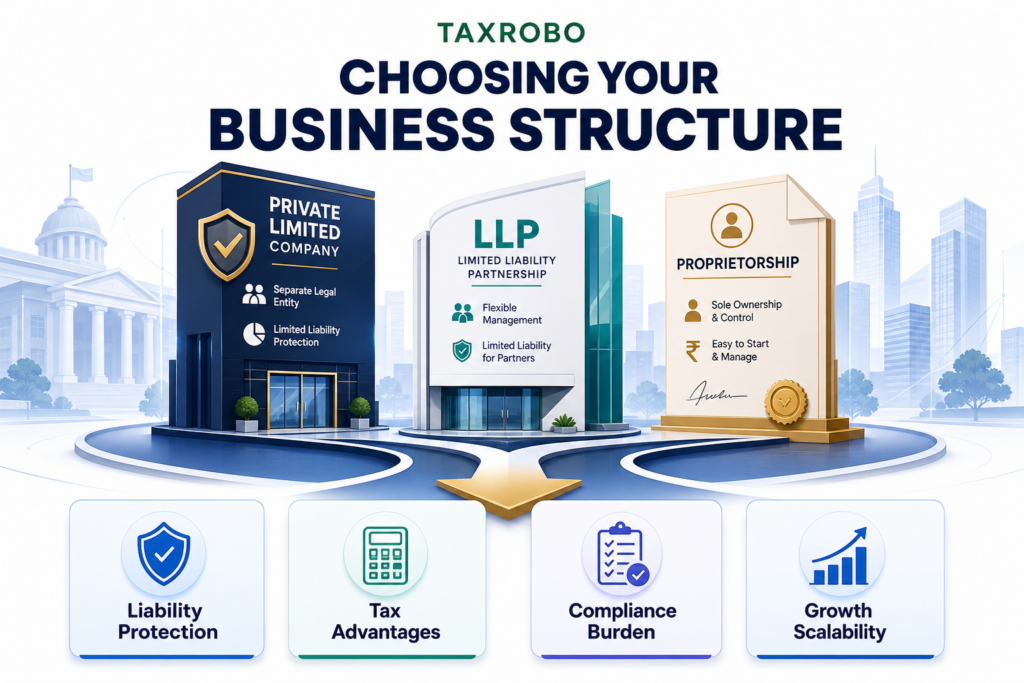
Have a game-changing business idea but are stuck on the first legal hurdle? You’re not alone. Many aspiring entrepreneurs in India find the legal jargon around business structures confusing and intimidating. This guide will simplify the process of choosing right business structure for your venture, ensuring you start on a solid legal foundation. For a broader overview, you can also read our guide on Choosing the Right Legal Structure for Your Business. We will break down the three most popular options—Sole Proprietorship, Limited Liability Partnership (LLP), and Private Limited Company (Pvt. Ltd.)—and explain which one fits your dream business best. This post will first explain the pros and cons of each structure and then provide clear, actionable recommendations for 10 trending business ideas in India, helping you pick the perfect fit for your entrepreneurial journey. Understanding the right business structure for startups India is the first and most critical step towards building a successful enterprise.
A Quick Guide to India’s Most Popular Business Structures
Before we dive into specific business ideas, let’s understand the fundamentals of each structure. The choice you make here will impact your liability, compliance requirements, ability to raise funds, and overall scalability. Making an informed decision now can save you significant time and money in the future.
Sole Proprietorship: The Easiest Start for Solopreneurs
A Sole Proprietorship is the simplest form of business, owned and operated by a single individual. From a legal standpoint, there is no distinction between the owner and the business itself. All profits, losses, debts, and liabilities are the owner’s personal responsibility. This structure is incredibly popular among freelancers, consultants, and small-scale local businesses due to its simplicity and minimal setup costs. While a formal registration with the Ministry of Corporate Affairs (MCA) is not required, you might still need other licenses depending on your business, such as a Shop Act License, MSME registration, or GST registration, which is a key part of any Proprietorship registration guide India. Our Ultimate Guide to GST Registration for Small Businesses can provide more details on this process.
- Pros:
- Easy & Inexpensive Setup: You can start operating almost immediately with minimal paperwork and cost. Your PAN card acts as the business’s identity.
- Minimal Compliance: There are no mandatory annual filings with the MCA, reducing your compliance burden significantly.
- Full Control: You are the sole decision-maker and retain 100% of the profits.
- Simple Taxation: Business income is treated as your personal income and is taxed at your individual slab rate, filed with your personal Income Tax Return (ITR).
- Cons:
- Unlimited Liability: This is the biggest drawback. If the business incurs debt, your personal assets (like your house, car, and savings) can be used to pay it off.
- Difficult to Raise Funds: Banks and investors are hesitant to lend to proprietorships due to their unorganized nature and unlimited liability.
- Lacks Credibility: It may not be perceived as a professional or long-term entity by larger clients or partners.
- Limited Lifespan: The business’s existence is tied directly to the owner.
Ideal For: Freelancers, consultants, home-based businesses, and small local shop owners. The Proprietorship advantages for freelancers India are undeniable for those starting their professional journey alone.
Limited Liability Partnership (LLP): The Hybrid Model for Partners
A Limited Liability Partnership (LLP) is a corporate structure that offers a powerful blend of benefits, combining the operational flexibility of a traditional partnership with the limited liability protection of a private limited company. It is a separate legal entity, meaning it is distinct from its partners. This structure is governed by the LLP Act, 2008, and requires a minimum of two partners to get started. It has become a go-to choice for professional service providers and small teams who want to formalize their business relationship while protecting their personal assets from business liabilities.
- Pros:
- Limited Liability: Partners are only liable to the extent of their contribution to the LLP. Their personal assets are safe from business debts.
- Separate Legal Entity: An LLP can own property, enter into contracts, and sue or be sued in its own name.
- Lower Compliance: Compared to a Private Limited Company, the compliance requirements (like mandatory audits and board meetings) are fewer and less stringent.
- Flexible Management: The rights and duties of partners are defined by a flexible LLP Agreement, allowing for customized governance.
- Cons:
- Cannot Issue Shares or ESOPs: LLPs cannot raise equity funding by issuing shares to investors or offer Employee Stock Ownership Plans (ESOPs) to attract talent.
- Funding Challenges: While better than a proprietorship, many venture capitalists and angel investors still prefer the well-understood shareholding structure of a Private Limited company.
- Complex Ownership Transfer: Transferring ownership rights in an LLP is more complex than simply transferring shares in a company.
Ideal For: Professional services (CAs, lawyers, architects), small creative agencies, and businesses where partners want protection without the heavy compliance of a company. The LLP benefits for Indian entrepreneurs looking for a middle ground are significant, making it a key contender in the Private Limited vs LLP India debate.
Private Limited Company (Pvt. Ltd.): The Scalable Choice for Startups
A Private Limited Company is the most formal and scalable business structure in India. It is a separate legal entity, completely distinct from its owners (shareholders), meaning the company’s liabilities are its own. This structure provides the highest level of credibility and is the preferred choice for startups aiming for rapid growth and external funding. It is governed by the Companies Act, 2013, and requires a minimum of two directors and two shareholders (who can be the same people) and can have up to 200 shareholders. The robust legal framework surrounding it makes it attractive to investors, employees, and large corporate clients.
- Pros:
- Limited Liability: The liability of shareholders is limited to the value of their shares, offering the best protection for personal assets.
- Separate Legal Entity: It has perpetual succession, meaning the company continues to exist even if the owners change or pass away.
- Easiest to Raise Funding: This is the most significant of the
advantages of Private Limited company India. It’s the only structure that can easily issue shares to angel investors, venture capitalists, and other equity investors. - Enhanced Credibility: Being registered as a Pvt. Ltd. enhances the brand’s image and builds trust with customers, suppliers, and lenders.
- Easy Ownership Transfer: Ownership can be transferred simply by selling shares.
- Cons:
- Higher Setup & Compliance Costs: The registration process is more expensive, and there are mandatory annual compliance requirements, including statutory audits and multiple filings with the MCA.
- Complex Regulations: The structure is subject to numerous provisions under the Companies Act, 2013, making governance more complex.
- Less Flexibility: Decision-making must follow formal procedures like passing board resolutions.
Ideal For: Startups aiming for high growth, businesses planning to raise external funds, and any venture where liability protection and a professional image are paramount. It is the gold standard business structure for startups India.
Quick Comparison: Proprietorship vs. LLP vs. Pvt. Ltd.
| Feature | Sole Proprietorship | Limited Liability Partnership (LLP) | Private Limited Company (Pvt. Ltd.) |
|---|---|---|---|
| Liability | Unlimited | Limited | Limited |
| Compliance Burden | Very Low | Moderate | High |
| Fundraising Ability | Very Difficult | Difficult (for Equity) | Easiest (for Equity) |
| Minimum Members | 1 | 2 | 2 |
| Registration Cost | Low | Moderate | High |
Choosing the Right Business Structure for 10 Trending Businesses in India
Now that you understand the basics, let’s apply this knowledge. Here’s our expert recommendation on choosing right business structure for some of India’s most popular and trending business models.
1. E-commerce & D2C Brands
Recommendation: Private Limited Company.
Reasoning: When you’re selling products online, credibility and liability are huge factors. A Private Limited company is essential for building trust with payment gateway providers, suppliers, and customers. It provides a professional image that is crucial for a consumer-facing brand. Most importantly, it offers robust liability protection, shielding your personal assets from any claims related to product defects, delivery issues, or other business risks. As your brand grows, you’ll likely need funding for inventory, marketing, and expansion. A Pvt. Ltd. structure is the only viable option for attracting angel investors and venture capitalists. While an LLP is a possible secondary option for bootstrapping partners, a Pvt. Ltd. is built for scale.
2. Digital Marketing or IT Services Agency
Recommendation: LLP.
Reasoning: An agency model typically involves two or more partners collaborating to provide services. An LLP is perfect for this scenario. It provides a formal, professional structure that clients respect, and it limits each partner’s liability, which is crucial when signing high-value contracts. The compliance burden is lower than a Pvt. Ltd., which means you can focus more resources on client acquisition and service delivery rather than administrative tasks. If you are starting as a solo marketing freelancer, a Sole Proprietorship is more than sufficient in the beginning. However, once you bring on a partner, upgrading to an LLP is the logical next step.
3. Freelance Writer, Designer, or Consultant
Recommendation: Sole Proprietorship.
Reasoning: For an individual service provider, simplicity and low cost are paramount. The Sole Proprietorship is the undisputed champion here. There are no complex MCA registration processes or mandatory annual filings to worry about. You can start your business using your personal PAN, easily manage your income, and file taxes as part of your regular income tax return. This structure gives you complete freedom and control. The Proprietorship advantages for freelancers India are clear: it allows you to test your business idea with minimal financial and legal commitment. As your client base and income grow, you can always convert to an LLP or a Pvt. Ltd. to gain liability protection and a more corporate image.
4. Cloud Kitchen or Restaurant
Recommendation: Private Limited Company or LLP.
Reasoning: The food and beverage industry comes with inherent risks, from food safety and hygiene liabilities to employee-related issues. Therefore, operating as a Sole Proprietorship is highly discouraged due to its unlimited liability. Both an LLP and a Pvt. Ltd. offer a crucial protective shield for your personal assets. If you and a partner are starting a single outlet and plan to fund it yourselves, an LLP is a great, low-compliance choice. However, if your vision is to build a brand, open multiple outlets, or create a franchise model, a Private Limited Company is the superior structure. It will be essential for attracting investors to fund your expansion plans.
5. Professional Services (Architects, Lawyers, CAs)
Recommendation: LLP.
Reasoning: The LLP structure was practically tailor-made for professionals. It allows multiple partners to come together under a formal agreement while ensuring that the malpractice or negligence of one partner does not create a liability for the others. This is a key advantage over a traditional partnership. It provides the firm with a distinct legal identity and limited liability, which protects the partners’ personal wealth from business risks. Given that professional firms rarely seek venture capital funding, the high compliance of a Pvt. Ltd. is often unnecessary. The LLP benefits for Indian entrepreneurs in the professional services sector are perfectly aligned with their business model.
6. Ed-Tech or Health-Tech Platform
Recommendation: Private Limited Company.
Reasoning: Tech platforms in high-growth sectors like education and healthcare are built for scale and almost always require significant external funding to succeed. This makes a Private Limited company a non-negotiable choice. It is the classic business structure for startups India. Investors will only put money into a structure that allows them to take equity (shares) in return for their investment. Furthermore, a Pvt. Ltd. structure is necessary for implementing Employee Stock Ownership Plans (ESOPs), a critical tool for attracting and retaining top tech talent in a competitive market.
7. SaaS (Software-as-a-Service) Business
Recommendation: Private Limited Company.
Reasoning: Much like Ed-Tech, a SaaS business model is predicated on high initial investment in product development, followed by aggressive marketing to achieve scale and recurring revenue. The global standard for tech startups is the Private Limited Company (or its equivalent in other countries). This structure is universally understood by investors, allows for seamless fundraising through multiple rounds (seed, Series A, etc.), and provides the credibility needed to sign on large enterprise clients. Trying to build a scalable SaaS business under any other structure would create significant roadblocks to growth and funding.
8. Local Retail Store or Boutique
Recommendation: Sole Proprietorship.
Reasoning: For a single-owner, small-scale retail business serving a local community, the priority is to keep things simple and costs low. A Sole Proprietorship is the most straightforward and cost-effective option. The compliance burden is minimal, allowing you to dedicate your time and energy to managing inventory, customer service, and sales. You can easily get a GST registration and a Shop Act license under this structure. Unless you have a partner or are planning an aggressive, multi-city expansion that requires investor funding, the complexities of an LLP or Pvt. Ltd. are unnecessary.
9. Dropshipping Business
Recommendation: LLP or Private Limited Company.
Reasoning: In dropshipping, you are dependent on third-party suppliers for product quality and shipping. This introduces risks that are outside your direct control. A customer could sue you for a faulty product even if you never physically handled it. For this reason, a Sole Proprietorship with its unlimited liability is a risky choice. An LLP is a good starting point, offering liability protection with moderate compliance. However, as you scale, especially if dealing with international suppliers and payment gateways, a Private Limited Company adds a layer of credibility and structural robustness that can be very beneficial for securing better terms and building a trusted brand.
10. Coaching or Training Institute
Recommendation: Sole Proprietorship (for individuals) or LLP (for partners).
Reasoning: The right structure here depends on the number of people involved. If you are an individual life coach, tutor, or corporate trainer, a Sole Proprietorship is perfect. It’s easy to set up and manage, keeping your administrative tasks to a minimum. However, if two or more coaches decide to team up to form an institute, an LLP becomes the ideal choice. It allows you to create a formal LLP Agreement defining profit-sharing and responsibilities, while also providing limited liability protection, which is important when dealing with multiple clients, students, and potential contractual disputes.
Making the Final Decision: Your Next Steps with TaxRobo
Reiterating the core message, choosing right business structure is a critical foundation for your business. It’s a strategic decision that directly impacts your personal liability, tax obligations, compliance costs, and your ability to grow and secure funding. The right choice ultimately depends on your long-term vision, the number of owners, your funding needs, and your personal risk appetite. There is no one-size-fits-all answer, but making an informed choice is crucial.
Still unsure? Don’t let legal complexities hold your business back. The experts at TaxRobo are here to help you navigate this crucial first step. We specialize in helping entrepreneurs across India make the right legal and financial decisions from day one.
Schedule a free consultation with our business setup experts today. We’ll help you analyze your goals and choose the best business structure for your small business in India. Get in touch with us through our TaxRobo Company Registration Service page.
Frequently Asked Questions (FAQs)
1. Can I change my business structure later?
Yes, absolutely. It is common for businesses to evolve. You can convert a Sole Proprietorship into an LLP or a Private Limited Company, or an LLP into a Private Limited Company as your business grows and its needs change. The process involves specific legal paperwork and filings with the MCA, which our expert team at TaxRobo can manage seamlessly for you.
2. What is the minimum capital required for a Private Limited company?
As per the latest amendments to the Companies Act, there is no minimum paid-up capital requirement to start a Private Limited company in India. You can learn more by reading our detailed guide on How Much Capital is Required to Start a Private Limited Company?. You can technically start with any amount. However, it is common practice to start with an authorized capital of at least ₹1,00,000, as this is reflected in the company’s official documents.
3. Do I need GST registration for a Sole Proprietorship?
GST registration is mandatory for any business, including a Sole Proprietorship, if your annual turnover exceeds the threshold limit. This limit is generally ₹40 lakh for businesses exclusively supplying goods and ₹20 lakh for those supplying services. However, these limits can be lower for certain special category states. It is also important to note that GST registration is mandatory for anyone selling goods through an e-commerce platform, regardless of their turnover. You should always check the latest thresholds on the official GST Portal.
4. What is the key difference between an LLP and a traditional Partnership Firm?
The primary and most critical difference is liability. In an LLP, the partners’ liability is limited to their capital contribution, which means their personal assets are protected from business debts. In a traditional partnership firm (registered under the Partnership Act, 1932), all partners have unlimited liability, meaning their personal assets can be used to settle the firm’s debts. An LLP also has a separate legal identity, while a partnership firm does not.
5. Which business structure is best for getting a bank loan?
Private Limited Companies and LLPs are generally preferred by banks and financial institutions when it comes to providing business loans. Their status as separate legal entities, mandatory financial filings (like balance sheets and profit & loss statements), and more transparent operations make them appear more credible and less risky to lenders. A proprietorship may find it harder to secure large business loans due to its unorganized nature and the intermingling of personal and business finances.